Fiala Wheel 2DOF
|
Page in progress. |
A Phial wheel with two degrees of freedom and a disc the brake.
blockType: SubSystem
|
Path in the library: |
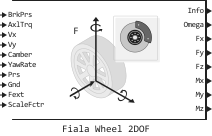
Description
Block Fiala Wheel 2DOF implements a simplified tire model with the possibility of transverse and longitudinal slippage based on the model of E. Fiala [1]. The unit uses a translational friction model to calculate forces and moments when longitudinal and transverse slippage are combined. If you do not have the tire coefficients required for the empirical formula [4], use this block in research where extensive nonlinear joint lateral slippage or lateral motion dynamics are not required.
The unit determines the wheel’s rotation speed, vertical movement, as well as forces and torques in all six degrees of freedom based on transmission torque, brake pressure, road height, wheel camber angle, and tire pressure. The block can be used for the following types of analysis:
-
Simulation of the transmission and vehicle, where calculations of acceleration, braking and rolling resistance of the wheels require low-frequency forces of interaction of the tire with the road and braking forces with a minimum number of tire parameters.
-
The interaction of the wheel with the idealized road surface.
-
Analysis of the controllability and maneuverability of vehicles with moderate joint slippage. For such an analysis, the unit can be connected to transmission and chassis components such as differential, suspension and bodywork.
-
Yaw stability. For such an analysis, the unit can be connected to more detailed models of the braking system.
-
The interaction of tire stiffness and unsprung mass with road surface irregularities, load redistribution, or chassis movement using the vertical degree of freedom of the block.
The block combines models of wheel rotation dynamics, vertical mass, and braking. For forces and moments that depend on tire slippage, the unit implements the Fiala tire model.
You can set your own custom model parameter values or use the built-in bus model.
To calculate the rolling resistance moment, set the parameter Rolling Resistance one of the following values:
-
None— rolling resistance is not taken into account. -
Pressure and velocity— the method defined in [2]. Rolling resistance depends on tire pressure, normal force, and speed. -
ISO 28580— the method defined in [3]. -
Magic Formula— the equations of the empirical formula under the number 4.E70 in [4]. «Magical» The formula is an empirical equation based on approximation coefficients.
To calculate the vertical movement, set the parameter Vertical Motion one of the following values:
-
None— the unit transmits the applied chassis forces directly to the rolling resistance and longitudinal force calculations. -
Mapped stiffness and damping— vertical movement depends on the stiffness and damping of the wheel. Stiffness is a function of tire sidewall displacement and pressure, and damping is a function of tire sidewall velocity and pressure. -
External deflection— The unit uses the specified sidewall deflection directly to calculate the effective radius.
Rotating wheel dynamics
The unit calculates the inertial response of the wheel, taking into account:
-
axis losses;
-
braking and driving torques;
-
rolling resistance of the tire;
-
contact with the road through the tire.
The input torque is the sum of the applied axle torque, the braking torque, and the torque resulting from the total tire torque.:
For the torque resulting from the total torque of the tire, the unit implements the traction forces of the wheel and rolling resistance with first-order dynamics. Rolling resistance has a time constant parameterized in terms of the relaxation length:
To calculate the rolling resistance moment for the parameter Rolling Resistance you can set one of the following values:
-
None— the unit sets the rolling resistance torque equal to zero. -
Pressure and velocity— the block uses the method described in [2]. Rolling resistance is a function of tire pressure, normal force and speed, namely: -
ISO 28580— the block uses the method described in [3]. The method takes into account the normal load, parasitic losses and thermal corrections caused by the test conditions, namely: -
Magic Formula— the unit calculates rolling resistance according to the equation of the empirical formula 4.E70 in [4]. «Magical» The formula is an empirical equation based on approximation coefficients.
If the brakes are on, the unit determines the braking state (locked or unlocked) based on an idealized dry clutch friction model. Depending on the state of the lock, the block uses the following friction and dynamics models.
| Condition | Condition | The friction model | The dynamic model |
|---|---|---|---|
or |
Unblocked |
, where , , |
|
and |
Blocked |
|
|
The following variables are used in the equations:
-
— angular velocity of the wheel;
-
— a force component independent of velocity;
-
— the linear component of the velocity force;
-
— the quadratic component of the velocity force;
-
— length of relaxation of the tire;
-
— moment of inertia;
-
— rolling resistance torque;
-
— applied torque on the axle;
-
— braking torque;
-
— total tire torque;
-
— friction torque;
-
— net input torque;
-
— kinetic friction torque;
-
— net output torque;
-
— static friction torque;
-
— applied coupling force;
-
— the longitudinal force that occurs at the boundary of the tire’s contact with the road surface due to slippage;
-
— effective grip radius;
-
— the outer radius of the annular disk;
-
— the inner radius of the annular disk;
-
— the effective radius of the tire under load and at a given pressure;
-
— the longitudinal speed of the axis;
-
— normal vehicle power;
-
— constant rolling resistance;
-
— ambient temperature;
-
— measured temperature for constant rolling resistance;
-
— the power of parasitic losses;
-
— coefficient of thermal correction;
-
— an indicator of the degree of tire pressure;
-
— an indicator of the degree of normal strength;
-
— tire pressure;
-
— coefficient of static friction;
-
— coefficient of kinetic friction.
Longitudinal force
The block implements the longitudinal force as a function of wheel slip relative to the road surface using the following equations.
-
Critical slippage coefficient:
where
-
— coefficient of friction;
-
— vertically directed force in the engagement field along the axis the coordinate system associated with the bus;
-
— longitudinal stiffness.
-
-
The longitudinal force acting on the axis along the axis the coordinate system associated with the bus:
where — the state of slippage.
-
Coefficient of friction:
where
-
— coefficient of static friction;
-
— coefficient of kinetic friction;
-
— scale coefficient of friction.
-
-
Volumetric coefficient of slippage:
where — the state of the slip angle.
Transverse force
The block implements the lateral force as a function of the state of the wheel slip angle using the following equations.
-
Critical slip angle:
where
-
— coefficient of friction;
-
— vertically directed force in the engagement field along the axis the coordinate system associated with the bus;
-
— lateral stiffness per slip angle.
-
-
The transverse force acting on the axis along the axis the coordinate system associated with the bus:
where
-
— the state of the slip angle;
-
— stiffness of the camber.
-
Vertical dynamics
The block implements vertical dynamics according to the following equations:
where
-
— vertically directed force of the tire along the axis the coordinate system associated with the bus;
-
— vertically directed force in the engagement field along the axis the coordinate system associated with the bus;
-
— vertical deviation of the sidewall along the axis the coordinate system associated with the bus;
-
— vertical stiffness of the sidewall;
-
— vertical damping of the sidewall;
-
— displacement of the road surface along the axis the coordinate system associated with the bus;
-
— deflection of the tire along the axis the coordinate system associated with the bus.
Tipping, leveling, and scaling
Below are brief descriptions of the implementation of flipping, alignment, and scaling.
The throwing moment
The tipping moment is not specified in the Phial model. This block implements the following equation, requiring a minimum number of parameters:
where
-
— the tipping moment acting on the axis relative to the axis the coordinate system associated with the bus;
-
— the transverse force acting on the axis along the axis the coordinate system associated with the bus;
-
— effective radial distance from the engagement field to the wheel hub;
-
— the angle of collapse.
The moment of alignment
The block implements the moment of alignment as a combination of the damping of the yaw velocity and the state of the slip angle.
where
-
— the moment of alignment acting on the axis relative to the axis the coordinate system associated with the bus;
-
— the angular velocity of the tire relative to the axis coordinate system associated with the tire (yaw rate);
-
— linear yaw velocity resistance;
-
— the state of the slip angle;
-
— width of the tire;
-
— coefficient of friction;
-
— vertically directed force in the engagement field along the axis the coordinate system associated with the bus;
-
— lateral stiffness per slip angle.
scale coefficient of friction
To change the coefficient of friction, use the ScaleFctr input port.
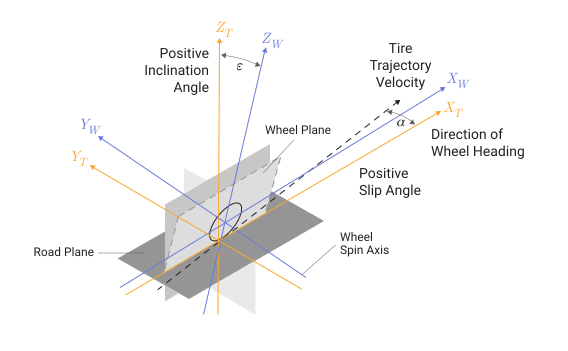
Tire and wheel coordinate systems
To calculate forces and moments, the unit uses the orientation of the coordinate systems associated with the tire and wheel along the upward axis. .
-
Axes of the bus coordinate system ( ) are fixed in the reference frame connected to the bus. The origin is located at the point of contact of the tire with the road.
-
Axes of the wheel coordinate system ( ) are fixed in the frame of reference associated with the wheel. The origin is in the center of the wheel.
Brakes
The unit implements a disc brake. The picture shows the side and front view of the disc brake.
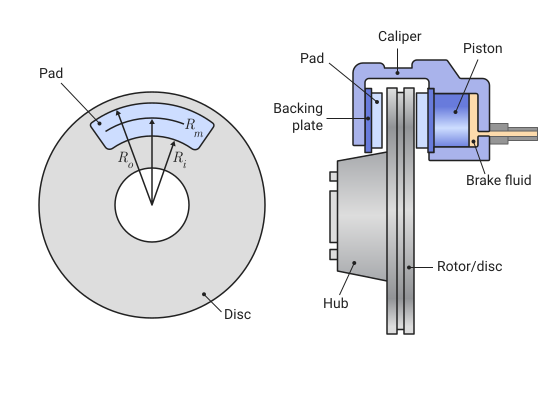
The disc brake converts the pressure in the brake cylinder into force and applies this force to the middle radius of the brake pad.
The unit uses the following equations to calculate the braking torque for the disc brake:
where
-
— braking torque;
-
— applied brake pressure;
-
— the speed of rotation of the wheel;
-
— the number of brake pads in the disc brake assembly;
-
— coefficient of static friction between the disc block and the rotor;
-
— coefficient of kinetic friction between the disc block and the rotor;
-
— diameter of the hole of the brake actuator;
-
— the average radius of application of the brake pad force to the brake rotor;
-
— the outer radius of the brake pad;
-
— the inner radius of the brake pad.
Ports
Entrance
# BrkPrs — brake pressure
+
scalar | vector N by 1
Details
Brake pressure, expressed in Pa.
The vector has the size on , where — the number of wheels. If a scalar is specified, the block assumes that the number of wheels is one.
| Типы данных |
|
| Support for complex numbers |
None |
# AxlTrq — the moment of rotation of the axis
+
scalar | vector N by 1
Details
The moment of rotation of the axis relative to the axis of rotation of the wheel, expressed in nm.
The vector has the size on , where — the number of wheels. If a scalar is specified, the block assumes that the number of wheels is one.
| Типы данных |
|
| Support for complex numbers |
None |
# Vx — longitudinal velocity
+
scalar | vector N by 1
Details
Longitudinal axis speed along the axis in the coordinate system associated with the bus, expressed in m/s.
The vector has the size on , where — the number of wheels. If a scalar is specified, the block assumes that the number of wheels is one.
| Типы данных |
|
| Support for complex numbers |
None |
# Vy — lateral velocity
+
scalar | vector N by 1
Details
Transverse speed of the axis along the axis in the coordinate system associated with the bus, expressed in m/s.
The vector has the size on , where — the number of wheels. If a scalar is specified, the block assumes that the number of wheels is one.
| Типы данных |
|
| Support for complex numbers |
None |
# Camber — camber angle
+
scalar | vector N by 1
Details
Camber angle or the angle of inclination expressed in rad.
The vector has the size on , where — the number of wheels. If a scalar is specified, the block assumes that the number of wheels is one.
| Типы данных |
|
| Support for complex numbers |
None |
# YawRate — angular velocity of the tire
+
scalar | vector N by 1
Details
Angular velocity of the tire relative to the axis The coordinate system of the tire (yaw rate), expressed in rad/s.
The vector has the size on , where — the number of wheels. If a scalar is specified, the block assumes that the number of wheels is one.
| Типы данных |
|
| Support for complex numbers |
None |
# Prs — tire pressure
+
scalar | vector N by 1
Details
Tire pressure expressed in Pa.
The vector has the size on , where — the number of wheels. If a scalar is specified, the block assumes that the number of wheels is one.
| Типы данных |
|
| Support for complex numbers |
None |
# Gnd — surface displacement
+
scalar | vector N by 1
Details
Displacement of the road surface along the axis the coordinate system of the tire, expressed in meters. A positive input value raises the wheel.
The vector has the size on , where — the number of wheels. If a scalar is specified, the block assumes that the number of wheels is one.
| Типы данных |
|
| Support for complex numbers |
None |
# Fext is the force applied to the tire
+
scalar | vector N by 1
Details
Power applied to the tire along the axis the coordinate system associated with the vehicle, expressed in H. A positive input value compresses the tire.
The vector has the size on , where — the number of wheels. If a scalar is specified, the block assumes that the number of wheels is one.
Dependencies
To use this port, set the parameter Vertical Motion meaning None or Mapped stiffness and damping.
| Типы данных |
|
| Support for complex numbers |
None |
# RadialDeflct — radial deflection of the tire
+
scalar | vector N by 1
Details
Radial deflection of the tire. This value is used directly when calculating the effective radius.
The vector is the number of wheels. on . If a scalar is specified, the block assumes that the number of wheels is one.
Dependencies
To use this port, set the parameter Vertical Motion meaning External deflection.
| Типы данных |
|
| Support for complex numbers |
None |
# ScaleFctr — scale factor
+
scalar | vector N by 1
Details
A scale factor that takes into account the change in the coefficient of friction.
The vector has the size on , where — the number of wheels. If a scalar is specified, the block assumes that the number of wheels is one.
| Типы данных |
|
| Support for complex numbers |
None |
# Tamb — ambient temperature
+
scalar
Details
Ambient temperature in kelvin.
Ambient temperature — this is the temperature near the tire under operating conditions, expressed in kelvins. For example, the measured ambient temperature is the ambient temperature near the tire when the vehicle is on the road.
Activate the Tamb input port to enter the measured ambient temperature.
Dependencies
To use this port, set the parameter Rolling Resistance meaning ISO 28580 and in the parameter group Rolling Resistance check the box Input ambient temperature.
| Типы данных |
|
| Support for complex numbers |
None |
Output
# Info — information signal
+
the tire
Details
A bus containing the results of the block calculation.
| The signal | Description | Units of measurement |
|---|---|---|
|
The torque on the axis coordinate systems (SK) of the wheel |
N⋅m |
|
Angular velocity of the wheel relative to the axis SK wheels |
glad/with |
|
The longitudinal force acting on the vehicle along the axis SK tires |
N |
|
The lateral force acting on the vehicle along the axis SK tires |
N |
|
Vertical force acting on the vehicle along the axis SK tires |
N |
|
Tipping moment relative to the axis SK tires |
N⋅m |
|
The moment of rolling resistance relative to the axis SK tires |
N⋅m |
|
The leveling moment relative to the axis SK tires |
N⋅m |
|
The longitudinal speed of the vehicle along the axis SK tires |
m/s |
|
The lateral speed of the vehicle along the axis SK tires |
m/s |
|
Effective load radius |
m |
|
The coefficient of longitudinal slippage |
— |
|
Coefficient of lateral slippage |
glad |
|
Half the length of the engagement field |
m |
|
Half the width of the engagement field |
m |
|
Camber angle |
glad |
|
Angular velocity of the tire relative to the axis Tire slope (yaw rate) |
glad/with |
|
Braking torque relative to the axle SC related to the vehicle |
N⋅m |
|
Brake pressure |
Pa |
|
Vertical deviation of the axis along the axis SK tires |
m |
|
Vertical speed of the axis along the axis SK tires |
m/s |
|
Displacement relative to the surface along the axis SC of the tire (positive input signal causes the wheel to rise) |
m |
|
Vertical force acting on the sidewall of the tire along the axis SK tires |
N |
|
Tire pressure |
Pa |
|
Wheel torque |
N⋅m |
|
Load radius |
m |
|
Radial deflection of the tire |
m |
| Типы данных |
|
| Support for complex numbers |
None |
# Omega — angular velocity of the wheel
+
scalar | vector N by 1
Details
Angular velocity of the wheel relative to the axis the coordinate system of the wheel, expressed in rad/sec.
The vector has the size on , where — the number of wheels. If a scalar is specified, the block assumes that the number of wheels is one.
| Типы данных |
|
| Support for complex numbers |
None |
# Fx is the longitudinal force acting on the axis
+
scalar | vector N by 1
Details
Longitudinal force acting on the axis along the axis the coordinate system of the tire, expressed in H. The positive force acts by moving the vehicle forward.
The vector has the size on , where — the number of wheels. If a scalar is specified, the block assumes that the number of wheels is one.
| Типы данных |
|
| Support for complex numbers |
None |
# Fy is the transverse force acting on the axis
+
scalar | vector N by 1
Details
Transverse force acting on the axis along the axis the coordinate system of the bus, expressed in N.
The vector has the size on , where — the number of wheels. If a scalar is specified, the block assumes that the number of wheels is one.
| Типы данных |
|
| Support for complex numbers |
None |
# Fz is the vertical force acting on the axis
+
scalar | vector N by 1
Details
Vertical force acting on the axis along the axis the coordinate system of the bus, expressed in N.
The vector has the size on , where — the number of wheels. If a scalar is specified, the block assumes that the number of wheels is one.
| Типы данных |
|
| Support for complex numbers |
None |
# Mx — tipping moment
+
scalar | vector N by 1
Details
Longitudinal moment acting on the axis relative to the axis The coordinate system of the bus, expressed in NM.
The vector has the size on , where — the number of wheels. If a scalar is specified, the block assumes that the number of wheels is one.
| Типы данных |
|
| Support for complex numbers |
None |
# My — moment of rolling resistance
+
scalar | vector N by 1
Details
Transverse moment acting on the axis relative to the axis The coordinate system of the bus, expressed in NM.
The vector has the size on , where — the number of wheels. If a scalar is specified, the block assumes that the number of wheels is one.
| Типы данных |
|
| Support for complex numbers |
None |
# Mz — equalizing moment
+
scalar | vector N by 1
Details
Vertical moment acting on the axis relative to the axis The coordinate system of the bus, expressed in NM.
The vector has the size on , where — the number of wheels. If a scalar is specified, the block assumes that the number of wheels is one.
| Типы данных |
|
| Support for complex numbers |
None |
Parameters
TIre Options
#
Rolling Resistance —
moment of rolling resistance
None | Pressure and velocity | ISO 28580 | Magic Formula
Details
To calculate the rolling resistance moment, select one of the following values:
-
None— rolling resistance is not taken into account. -
Pressure and velocity— the method defined in [2]. Rolling resistance depends on tire pressure, normal force, and speed. -
ISO 28580— the method defined in [3]. -
Magic Formula— the equations of the empirical formula under the number 4.E70 in [4]. «Magical» The formula is an empirical equation based on approximation coefficients.
| Values |
|
| Default value |
|
| Program usage name |
|
| Tunable |
No |
| Evaluatable |
Yes |
#
Vertical Motion —
vertical motion calculation method
None | Mapped stiffness and damping | External deflection
Details
To calculate vertical movement, select one of the following values:
-
None— the unit transmits the applied chassis forces directly to the rolling resistance and longitudinal force calculations. -
Mapped stiffness and damping— vertical movement depends on the stiffness and damping of the wheel. Stiffness is a function of tire sidewall displacement and pressure, and damping is a function of tire sidewall velocity and pressure. -
External deflection— The unit uses the specified sidewall deflection directly to calculate the effective radius.
| Values |
|
| Default value |
|
| Program usage name |
|
| Tunable |
No |
| Evaluatable |
Yes |
Longitudinal and Lateral
# Longitudinal stiffness Ckappa, N — longitudinal stiffness
Details
Longitudinal stiffness , defined as a scalar or vector on expressed in H. If a scalar is specified, the block uses this value for all wheels. If a vector is specified, the remaining longitudinal and transverse parameters must also be set as vectors.
— the number of wheels; it must match the dimensions of the input signals.
| Default value |
|
| Program usage name |
|
| Tunable |
No |
| Evaluatable |
Yes |
# Lateral stiffness per slip angle Calpha, N/rad — transverse stiffness
Details
Transverse stiffness per slip angle, set as a scalar or vector on expressed in N/rad. If a scalar is specified, the block uses this value for all wheels. If a vector is specified, the remaining longitudinal and transverse parameters must also be set as vectors.
— the number of wheels; it must match the dimensions of the input signals.
| Default value |
|
| Program usage name |
|
| Tunable |
No |
| Evaluatable |
Yes |
# Camber stiffness Cgamma, N/rad — camber stiffness
Details
Camber stiffness , defined as a scalar or vector on expressed in N/rad. If a scalar is specified, the block uses this value for all wheels. If a vector is specified, the remaining longitudinal and transverse parameters must also be set as vectors.
— the number of wheels; it must match the dimensions of the input signals.
| Default value |
|
| Program usage name |
|
| Tunable |
No |
| Evaluatable |
Yes |
# Kinematic friction muMin — kinetic friction
Details
Coefficient of kinetic friction , defined as a dimensionless scalar or vector on . If a scalar is specified, the block uses this value for all wheels. If a vector is specified, the remaining longitudinal and transverse parameters must also be set as vectors.
— the number of wheels; it must match the dimensions of the input signals.
| Default value |
|
| Program usage name |
|
| Tunable |
No |
| Evaluatable |
Yes |
# Static friction muMax — static friction
Details
Coefficient of static friction , defined as a dimensionless scalar or vector on . If a scalar is specified, the block uses this value for all wheels. If a vector is specified, the remaining longitudinal and transverse parameters must also be set as vectors.
— the number of wheels; it must match the dimensions of the input signals.
| Default value |
|
| Program usage name |
|
| Tunable |
No |
| Evaluatable |
Yes |
# Longitudinal relaxation length Lrelx, m — the longitudinal length of relaxation
Details
The longitudinal length of relaxation , defined as a scalar or vector on expressed in meters. If a scalar is specified, the block uses this value for all wheels. If a vector is specified, the remaining longitudinal and transverse parameters must also be set as vectors.
— the number of wheels; it must match the dimensions of the input signals.
| Default value |
|
| Program usage name |
|
| Tunable |
No |
| Evaluatable |
Yes |
# Lateral relaxation length Lrely, m/rad — transverse length of relaxation
Details
Transverse length of relaxation , specified as a scalar or vector on expressed in m/rad. If a scalar is specified, the block uses this value for all wheels. If a vector is specified, the remaining longitudinal and transverse parameters must also be set as vectors.
— the number of wheels; it must match the dimensions of the input signals.
| Default value |
|
| Program usage name |
|
| Tunable |
No |
| Evaluatable |
Yes |
Rolling Resistance
# Velocity independent force coefficient aMy — coefficient of force independent of velocity
Details
Ratio force independent of velocity, dimensionless.
Dependencies
To use this parameter, set for the parameter Rolling Resistance meaning Pressure and velocity.
| Default value |
|
| Program usage name |
|
| Tunable |
No |
| Evaluatable |
Yes |
# Linear velocity force component bMy, s/m — the linear component of the force of velocity
Details
The linear component of the force of velocity expressed in s/m .
Dependencies
To use this parameter, set for the parameter Rolling Resistance meaning Pressure and velocity.
| Default value |
|
| Program usage name |
|
| Tunable |
No |
| Evaluatable |
Yes |
# Quadratic velocity force component cMy, s^2/m^2 — the quadratic component of the force of velocity
Details
The quadratic component of the force of velocity , in c2/m2.
Dependencies
To use this parameter, set for the parameter Rolling Resistance meaning Pressure and velocity.
| Default value |
|
| Program usage name |
|
| Tunable |
No |
| Evaluatable |
Yes |
# Tire pressure exponent alphaMy — the indicator of the degree of tire pressure
Details
The indicator of the degree of tire pressure , dimensionless.
Dependencies
To use this parameter, set for the parameter Rolling Resistance meaning Pressure and velocity.
| Default value |
|
| Program usage name |
|
| Tunable |
No |
| Evaluatable |
Yes |
# Normal force exponent betaMy — an indicator of the degree of normal strength
Details
An indicator of the degree of normal strength , dimensionless.
Dependencies
To use this parameter, set for the parameter Rolling Resistance meaning Pressure and velocity.
| Default value |
|
| Program usage name |
|
| Tunable |
No |
| Evaluatable |
Yes |
# Parasitic losses force Fpl, N — parasitic power losses
Details
Parasitic power losses expressed in N.
Dependencies
To use this parameter, set for the parameter Rolling Resistance meaning ISO 28580.
| Default value |
|
| Program usage name |
|
| Tunable |
No |
| Evaluatable |
Yes |
# Rolling resistance constant Cr, N/kN — coefficient of rolling resistance
Details
Rolling resistance constant expressed in N/kN. In the ISO 28580 standard, the unit of measurement of rolling resistance is defined as one newton of traction resistance for each kilonewton of normal load.
Dependencies
To use this parameter, set for the parameter Rolling Resistance meaning ISO 28580.
| Default value |
|
| Program usage name |
|
| Tunable |
No |
| Evaluatable |
Yes |
# Thermal correction factor Kt, 1/degC — coefficient of thermal correction
Details
Coefficient of thermal correction expressed in 1/degree (on the Celsius scale).
Dependencies
To use this parameter, set for the parameter Rolling Resistance meaning ISO 28580.
| Default value |
|
| Program usage name |
|
| Tunable |
No |
| Evaluatable |
Yes |
# Measured temperature Tmeas, K — Temperature during testing
Details
The measured ambient temperature near the tire during testing, expressed in kelvins.
Dependencies
To use this parameter, set for the parameter Rolling Resistance meaning ISO 28580.
| Default value |
|
| Program usage name |
|
| Tunable |
No |
| Evaluatable |
Yes |
# Ambient temperature Tamb, K — Operating temperature
Details
The measured ambient temperature near the tire under operating conditions, expressed in kelvins. For example, the measured ambient temperature is the ambient temperature near the tire when the vehicle is on the road.
Dependencies
To use this parameter, set for the parameter Rolling Resistance meaning ISO 28580.
| Default value |
|
| Program usage name |
|
| Tunable |
No |
| Evaluatable |
Yes |
# Input ambient temperature — ambient temperature input option
Details
Select this option to activate the Tamb input port to set the measured ambient temperature.
The measured ambient temperature — this is the temperature near the tire under operating conditions, expressed in kelvins. For example, the measured ambient temperature is the ambient temperature near the tire when the vehicle is on the road.
Dependencies
To use this parameter, set for the parameter Rolling Resistance meaning ISO 28580.
| Default value |
|
| Program usage name |
|
| Tunable |
No |
| Evaluatable |
Yes |
# Nominal inflation pressure NOMPRES, Pa — pressure
Details
Nominal pressure, expressed in Pa.
Dependencies
To use this parameter, set for the parameter Rolling Resistance meaning Magic Formula.
| Default value |
|
| Program usage name |
|
| Tunable |
No |
| Evaluatable |
Yes |
# Rolling resistance torque coefficient QSY1 — torque ratio
Details
Rolling resistance torque coefficient, dimensionless.
Dependencies
To use this parameter, set for the parameter Rolling Resistance meaning Magic Formula.
| Default value |
|
| Program usage name |
|
| Tunable |
No |
| Evaluatable |
Yes |
# Longitudinal force rolling resistance coefficient QSY2 — coefficient of force resistance
Details
Coefficient of rolling resistance of longitudinal force, dimensionless.
Dependencies
To use this parameter, set for the parameter Rolling Resistance meaning Magic Formula.
| Default value |
|
| Program usage name |
|
| Tunable |
No |
| Evaluatable |
Yes |
# Linear rotational speed rolling resistance coefficient QSY3 — linear velocity coefficient
Details
Coefficient of rolling resistance of linear rotation speed, dimensionless.
Dependencies
To use this parameter, set for the parameter Rolling Resistance meaning Magic Formula.
| Default value |
|
| Program usage name |
|
| Tunable |
No |
| Evaluatable |
Yes |
# Quartic rotational speed rolling resistance coefficient QSY4 — the coefficient of the fourth degree of speed
Details
Coefficient of rolling resistance of the fourth degree of rotation speed, dimensionless.
Dependencies
To use this parameter, set for the parameter Rolling Resistance meaning Magic Formula.
| Default value |
|
| Program usage name |
|
| Tunable |
No |
| Evaluatable |
Yes |
# Camber squared rolling resistance torque QSY5, 1/rad^2 — the moment of resistance to collapse
Details
The square of the rolling resistance moment of the camber, expressed in 1/rad ^2 ^.
Dependencies
To use this parameter, set for the parameter Rolling Resistance meaning Magic Formula.
| Default value |
|
| Program usage name |
|
| Tunable |
No |
| Evaluatable |
Yes |
# Load based camber squared rolling resistance torque QSY6, 1/rad^2 — moment of load resistance
Details
The square of the rolling resistance moment of the camber, taking into account the load, expressed in 1/rad ^2 ^.
Dependencies
To use this parameter, set for the parameter Rolling Resistance meaning Magic Formula.
| Default value |
|
| Program usage name |
|
| Tunable |
No |
| Evaluatable |
Yes |
# Normal load rolling resistance coefficient QSY7 — the coefficient of normal resistance
Details
Coefficient of rolling resistance of normal load, dimensionless.
Dependencies
To use this parameter, set for the parameter Rolling Resistance meaning Magic Formula.
| Default value |
|
| Program usage name |
|
| Tunable |
No |
| Evaluatable |
Yes |
# Pressure load rolling resistance coefficient QSY8 — pressure resistance coefficient
Details
Coefficient of pressure rolling resistance, dimensionless.
Dependencies
To use this parameter, set for the parameter Rolling Resistance meaning Magic Formula.
| Default value |
|
| Program usage name |
|
| Tunable |
No |
| Evaluatable |
Yes |
# Nominal normal force FNOMIN, N — power
Details
Nominal design load on the wheel along the axis the coordinate system associated with the wheel, expressed in H.
Dependencies
To use this parameter, set for the parameter Vertical Motion meaning Mapped stiffness and damping and for the parameter Rolling Resistance meaning Magic Formula.
| Default value |
|
| Program usage name |
|
| Tunable |
No |
| Evaluatable |
Yes |
# Rolling resistance scaling factor lam_My — scale factor
Details
Scale coefficient of rolling resistance, dimensionless.
Dependencies
To use this parameter, set for the parameter Rolling Resistance meaning Magic Formula.
| Default value |
|
| Program usage name |
|
| Tunable |
No |
| Evaluatable |
Yes |
Aligning
# Tire nominal section width WIDTH, m — nominal width of the tire profile
Details
The nominal width of the tire profile, expressed in meters.
| Default value |
|
| Program usage name |
|
| Tunable |
No |
| Evaluatable |
Yes |
# Linear yaw rate resistance bMz, N*m*s/rad — linear yaw velocity resistance
Details
Linear yaw velocity resistance expressed in N⋅m⋅s/rad.
| Default value |
|
| Program usage name |
|
| Tunable |
No |
| Evaluatable |
Yes |
Brake
# Static friction coefficient mu_static — static friction
Details
The coefficient of static friction, defined as a dimensionless scalar or vector on . If a scalar is specified, the block uses this value for all wheels. If a vector is specified, the other brake parameters must also be set as vectors.
— the number of wheels; it must match the dimensions of the input signals.
| Default value |
|
| Program usage name |
|
| Tunable |
No |
| Evaluatable |
Yes |
# Kinetic friction coefficient mu_kinetic — kinetic friction
Details
Kinetic friction coefficient, defined as a dimensionless scalar or vector on . If a scalar is specified, the block uses this value for all wheels. If a vector is specified, the other brake parameters must also be set as vectors.
— the number of wheels; it must match the dimensions of the input signals.
| Default value |
|
| Program usage name |
|
| Tunable |
No |
| Evaluatable |
Yes |
# Disc brake actuator bore disk_abore, m — the distance between the holes
Details
Diameter of the disc brake drive hole, specified as a scalar or vector on in meters. If a scalar is specified, the block uses this value for all wheels. If a vector is specified, the other brake parameters must also be set as vectors.
— the number of wheels; it must match the dimensions of the input signals.
| Default value |
|
| Program usage name |
|
| Tunable |
No |
| Evaluatable |
Yes |
# Brake pad mean radius Rm, m — radius
Details
The average radius of the brake pad, set as a scalar or vector on in meters. If a scalar is specified, the block uses this value for all wheels. If a vector is specified, the other brake parameters must also be set as vectors.
— the number of wheels; it must match the dimensions of the input signals.
| Default value |
|
| Program usage name |
|
| Tunable |
No |
| Evaluatable |
Yes |
# Number of brake pads, num_pads — number of pads
Details
The number of brake pads, specified as a dimensionless scalar or vector on . If a scalar is specified, the block uses this value for all wheels. If a vector is specified, the other brake parameters must also be set as vectors.
— the number of wheels; it must match the dimensions of the input signals.
| Default value |
|
| Program usage name |
|
| Tunable |
No |
| Evaluatable |
Yes |
Vertical
# Tire mass MASS, kg — tire weight
Details
The mass of the tire, given as a scalar or vector on in kg. If a scalar is specified, the block uses this value for all wheels. If a vector is specified, the other vertical parameters must also be set as vectors.
— the number of wheels; it must match the dimensions of the input signals.
Dependencies
To use this parameter, set for the parameter Vertical Motion meaning Mapped stiffness and damping.
| Default value |
|
| Program usage name |
|
| Tunable |
No |
| Evaluatable |
Yes |
# Initial tire displacement zo, m — initial tire displacement
Details
The initial bus offset, specified as a scalar or vector on in meters. If a scalar is specified, the block uses this value for all wheels. If a vector is specified, the other vertical parameters must also be set as vectors.
— the number of wheels; it must match the dimensions of the input signals.
Dependencies
To use this parameter, set for the parameter Vertical Motion meaning Mapped stiffness and damping.
| Default value |
|
| Program usage name |
|
| Tunable |
No |
| Evaluatable |
Yes |
# Initial wheel vertical velocity (wheel fixed frame) zdoto, m/s — initial speed of the wheel
Details
The initial vertical speed of the wheel, set as a scalar or vector on in m/s. If a scalar is specified, the block uses this value for all wheels. If a vector is specified, the other vertical parameters must also be set as vectors.
— the number of wheels; it must match the dimensions of the input signals.
Dependencies
To use this parameter, set for the parameter Vertical Motion meaning Mapped stiffness and damping.
| Default value |
|
| Program usage name |
|
| Tunable |
No |
| Evaluatable |
Yes |
# Gravity GRAVITY, m/s^2 — acceleration of free fall
Details
Acceleration of gravity, in m/s 2.
Dependencies
To use this parameter, set for the parameter Vertical Motion meaning Mapped stiffness and damping.
| Default value |
|
| Program usage name |
|
| Tunable |
No |
| Evaluatable |
Yes |
# Vertical deflection breakpoints [zFz], m — inflection points
Details
The vector of the inflection points of the sidewall deflection corresponding to the force table, expressed in meters.
Dependencies
To use this parameter, set for the parameter Vertical Motion meaning Mapped stiffness and damping.
| Default value |
|
| Program usage name |
|
| Tunable |
No |
| Evaluatable |
Yes |
# Pressure breakpoints [pFz], Pa — inflection points
Details
A vector of pressure data points corresponding to the force table, expressed in Pa.
Dependencies
To use this parameter, set for the parameter Vertical Motion meaning Mapped stiffness and damping.
| Default value |
|
| Program usage name |
|
| Tunable |
No |
| Evaluatable |
Yes |
# Force due to deflection [Fzz], N — power
Details
The force resulting from the deflection of the sidewall and the pressure along the axis the coordinate system associated with the wheel, expressed in H.
Dependencies
To use this parameter, set for the parameter Vertical Motion meaning Mapped stiffness and damping.
| Default value |
|
| Program usage name |
|
| Tunable |
No |
| Evaluatable |
Yes |
# Vertical velocity breakpoints [zdotFz], m/s — inflection points
Details
The vector of inflection points of the sidewall velocity corresponding to the force in the velocity table, expressed in m/s.
Dependencies
To use this parameter, set for the parameter Vertical Motion meaning Mapped stiffness and damping.
| Default value |
|
| Program usage name |
|
| Tunable |
No |
| Evaluatable |
Yes |
# Force due to velocity [Fzzdot], N — power
Details
The force due to the velocity and pressure of the sidewall and the pressure along the axis the coordinate system associated with the wheel, expressed in H.
Dependencies
To use this parameter, set for the parameter Vertical Motion meaning Mapped stiffness and damping.
| Default value |
|
| Program usage name |
|
| Tunable |
No |
| Evaluatable |
Yes |
Wheel
# Tire unloaded radius UNLOADED_RADIUS, m — radius without load
Details
The radius of the tire without load, expressed in meters.
| Default value |
|
| Program usage name |
|
| Tunable |
No |
| Evaluatable |
Yes |
# Initial wheel rotational velocity omegao, rad/s — initial angular velocity of the wheel
Details
The initial angular velocity of the wheel, given as a scalar or vector on in rad/s. If a scalar is specified, the block uses this value for all wheels. If a vector is specified, the rest of the rotation parameters must also be set as vectors.
— the number of wheels; it must match the dimensions of the input signals.
| Default value |
|
| Program usage name |
|
| Tunable |
No |
| Evaluatable |
Yes |
# Tire rotational inertia (rolling axis) IYY, kg*m^2 — moment of inertia of the tire
Details
The moment of inertia of the tire (axis of rotation), set as a scalar or vector on in kg⋅m2. If a scalar is specified, the block uses this value for all wheels. If a vector is specified, the rest of the rotation parameters must also be set as vectors.
— the number of wheels; it must match the dimensions of the input signals.
| Default value |
|
| Program usage name |
|
| Tunable |
No |
| Evaluatable |
Yes |
# Rotational damping br, N*m*s/rad — rotation damping
Details
Rotational damping, specified as a scalar or vector on In N⋅m⋅s/glad. If a scalar is specified, the block uses this value for all wheels. If a vector is specified, the rest of the rotation parameters must also be set as vectors.
— the number of wheels; it must match the dimensions of the input signals.
| Default value |
|
| Program usage name |
|
| Tunable |
No |
| Evaluatable |
Yes |
Simulation setup
# Maximum normal force FZMAX, N — maximum normal force
Details
The maximum normal force expressed in N. Is used in all calculations of vertical force.
| Default value |
|
| Program usage name |
|
| Tunable |
No |
| Evaluatable |
Yes |
# Minimum normal force FZMIN, N — minimum normal force
Details
The minimum normal force, expressed in N. Is used in all calculations of vertical force.
| Default value |
|
| Program usage name |
|
| Tunable |
No |
| Evaluatable |
Yes |
# Maximum pressure PRESMAX, Pa — maximum pressure
Details
The maximum pressure expressed in Pa.
| Default value |
|
| Program usage name |
|
| Tunable |
No |
| Evaluatable |
Yes |
# Minimum pressure PRESMIN, Pa — minimum pressure
Details
Minimum pressure, expressed in Pa.
| Default value |
|
| Program usage name |
|
| Tunable |
No |
| Evaluatable |
Yes |
# Max allowable slip ratio (absolute) KPUMAX — maximum allowable coefficient of slippage
Details
The maximum allowable coefficient of slippage in absolute value, dimensionless.
| Default value |
|
| Program usage name |
|
| Tunable |
No |
| Evaluatable |
Yes |
# Minimum allowable slip ratio (absolute) KPUMIN — minimum allowable coefficient of slippage
Details
The minimum allowable coefficient of slippage in absolute value, dimensionless.
| Default value |
|
| Program usage name |
|
| Tunable |
No |
| Evaluatable |
Yes |
# Max allowable slip angle (absolute) ALPMAX, rad — maximum allowable slip angle
Details
The maximum allowable absolute slip angle, expressed in rad.
| Default value |
|
| Program usage name |
|
| Tunable |
No |
| Evaluatable |
Yes |
# Minimum allowable slip angle (absolute) ALPMIN, rad — minimum allowable slip angle
Details
The minimum allowable absolute slip angle, expressed in rad.
| Default value |
|
| Program usage name |
|
| Tunable |
No |
| Evaluatable |
Yes |
# Max allowable camber angle (absolute) CAMMAX, rad — maximum allowable camber angle
Details
The maximum allowable angle of collapse in absolute terms, expressed in rad.
| Default value |
|
| Program usage name |
|
| Tunable |
No |
| Evaluatable |
Yes |
# Minimum allowable camber angle (absolute) CAMMIN, rad — minimum allowable camber angle
Details
The minimum allowable angle of collapse in absolute terms, expressed in rad.
| Default value |
|
| Program usage name |
|
| Tunable |
No |
| Evaluatable |
Yes |
# TMIN — minimum ambient temperature
Details
Minimum ambient temperature expressed in kelvin.
Dependencies
To use this parameter, set for the parameter Rolling Resistance meaning ISO 28580.
| Default value |
|
| Program usage name |
|
| Tunable |
No |
| Evaluatable |
Yes |
# TMAX — maximum ambient temperature
Details
Maximum ambient temperature expressed in kelvin.
Dependencies
To use this parameter, set for the parameter Rolling Resistance meaning ISO 28580.
| Default value |
|
| Program usage name |
|
| Tunable |
No |
| Evaluatable |
Yes |
Literature
-
Fiala, E. «Seitenkrafte am Rollenden Luftreifen.» VDI Zeitschrift, V.D.I. Vol 96, 1954.
-
Highway Tire Committee. Stepwise Coastdown Methodology for Measuring Tire Rolling Resistance. Standard J2452_199906. Warrendale, PA: SAE International, June 1999.
-
ISO 28580:2018. Passenger car, truck and bus tyre rolling resistance measurement method — Single point test and correlation of measurement results. ISO (International Organization for Standardization), 2018.
-
Pacejka, H. B. Tire and Vehicle Dynamics. 3rd ed. Oxford, UK: SAE and Butterworth-Heinemann, 2012.