Convolutional Deinterleaver
Restoring the order of characters rearranged using shift registers.
blockType: ConvolutionalDeinterleaver
|
Path in the library: |

| System object |
Description
Block Convolutional Deinterleaver restores the signal that was interleaved using the block Convolutional Interleaver. A set of shift registers is used inside this block. The parameters in the two blocks must have the same values.
This unit receives real or complex signals at the input, represented as a scalar or column vector. The output signal has the same sampling period as the input signal.
Ports
Input
#
IN_1
—
Input signal
scalar | vector | the matrix
Details
The input signal in which you want to restore the sequence of rearranged characters.
| Data types |
|
| Complex numbers support |
Yes |
Output
#
OUT_1
—
Output signal
scalar | vector | the matrix
Details
The output signal with the restored sequence of characters.
The type and size of the output signal corresponds to the type and size of the input.
| Data types |
|
| Complex numbers support |
Yes |
Parameters
Main
#
Rows of shift registers —
shift register strings
Scalar / array of real numbers
Details
The number of shift registers that the block uses internally.
| Default value |
|
| Program usage name |
|
| Tunable |
No |
| Evaluatable |
Yes |
#
Register length step —
register length step
Scalar / array of real numbers
Details
The number of characters by which the length of each subsequent shift register differs; zero characters are stored in the last register.
| Default value |
|
| Program usage name |
|
| Tunable |
No |
| Evaluatable |
Yes |
#
Initial conditions —
initial conditions
Scalar / array of real and/or complex numbers
Details
Sets the values that fill in each shift register at the beginning of the simulation (with the exception of the last shift register, which has zero delay).
-
If the parameter Initial conditions If it is a scalar, then its value fills all shift registers except the last one.
-
If Initial conditions — column vector, the length of which is equal to the parameter value Rows of shift registers, then each element of this vector fills the corresponding shift register.
The value of the last parameter element Initial conditions it is not used because the last shift register has zero delay.
| Default value |
|
| Program usage name |
|
| Tunable |
No |
| Evaluatable |
Yes |
Additional Info
Delay of convolutional interleaving and de-interleaving (recovery)
Details
The total delay of the convolutional interleaving and de-interleaving methods is
where
-
— the number of registers equal to the parameter value Rows of shift registers;
-
— register length step equal to the parameter value Register length step.
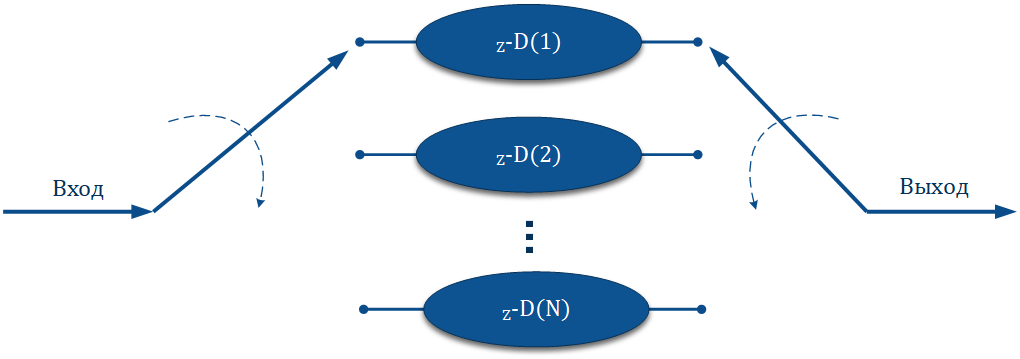
The diagram below shows the structure of a common interleaver consisting of a set of shift registers, each of which has a preset delay, denoted as , and a switch for switching input and output characters through registers. The -th shift register contains characters where and it has a delay value equal to . With each new input character, the switch switches to a new register and enters a new character, while simultaneously deleting the oldest character in that register. When the switchboard reaches On the next new input, the switch returns to the first register.