Free Space Path Loss
Simulates the loss of signal power in free space.
blockType: FreeSpacePathLoss
|
Path in the library: |
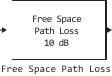
Description
Block Free Space Path Loss adds free space loss to the complex signal. The unit simulates the loss of signal power depending on the distance between the transmitter and receiver. Parameter Mode indicates whether losses are explicitly set in decibels or calculated based on the distance and frequency of the RF signal.
Ports
Input
#
IN_1
—
The input signal
scalar | column vector
Details
A complex input signal specified as a scalar or column vector.
| Data types |
|
| Complex numbers support |
Yes |
Output
#
OUT_1
—
The output signal
scalar | column vector
Details
The output signal returned as a scalar or column vector. The output signal has the same dimension and the same data type as the input signal.
| Data types |
|
| Complex numbers support |
Yes |
Parameters
Main
#
Mode —
loss calculation mode
Decibels | Distance and Frequency
Details
The loss calculation mode, set as one of these parameters:
-
Decibels— losses are determined using the Loss (dB) parameter; -
Distance and Frequency— losses are calculated using the Distance (km) parameters and Carrier frequency (MHz).
| Values |
|
| Default value |
|
| Program usage name |
|
| Tunable |
No |
| Evaluatable |
No |
#
Loss, dB —
power loss
Real number
Details
Power loss in decibels, given as a scalar. The decibels displayed on the block icon are rounded up for demonstration purposes only.
Dependencies
To use this parameter, set for the parameter Mode meaning Decibels.
| Default value |
|
| Program usage name |
|
| Tunable |
No |
| Evaluatable |
Yes |
#
Distance, km —
the distance between the transmitter and receiver
Real number
Details
The distance between the transmitter and receiver in kilometers, given as a scalar.
Dependencies
To use this parameter, set for the parameter Mode meaning Distance and Frequency.
| Default value |
|
| Program usage name |
|
| Tunable |
No |
| Evaluatable |
Yes |
#
Carrier frequency, MHz —
carrier frequency
Real number
Details
The carrier frequency in megahertz, set as a scalar.
Dependencies
To use this parameter, set for the parameter Mode meaning Distance and Frequency.
| Default value |
|
| Program usage name |
|
| Tunable |
No |
| Evaluatable |
Yes |
Algorithms
Losses in free space in decibels, they are:
This formula assumes that the target is in the far zone of the transmitting element or antenna array. In the near zone, the formula for losses in free space does not apply and may lead to less losses. 0 dB, which is equivalent to signal amplification.