Analog Filter Design
Design and implementation of analog filters.
blockType: AnalogFilterDesign
|
Path in the library: |
Description
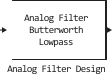
Block Analog Filter Design designs and implements Butterworth filters, Chebyshev filters of the first kind, Chebyshev filters of the second kind, Bessel filters or elliptical filters for different types of frequency response: high-pass filters, low-pass filters, bandpass filters or notch filters.
In the parameters Design method and Filter type It is necessary to specify the filter design and the type of frequency response. For each combination of the filter design and the type of frequency response, the corresponding parameter group is displayed. For more information, see The combination table of the filter design and the type of frequency response.
Block Analog Filter Design uses a representation of the filter in the state space and applies the filter using a block State-Space.
Ports
Input
#
IN_1
—
Input signal
scalar
Details
The input signal for the block, specified as a real scalar in a sample format, is continuous in real time.
| Data types |
|
| Complex numbers support |
I don’t |
Output
#
OUT_1
—
Output signal
scalar
Details
The filtered output signal returned as a scalar.
| Data types |
|
| Complex numbers support |
I don’t |
Parameters
Main
#
Design method —
filter design
Butterworth | Chebyshev I | Chebyshev II | Elliptic | Bessel
Details
The filter design methods are as follows:
-
Butterworth— the amplitude-frequency response of the Butterworth filter has a maximally flat bandwidth and is generally monotonous. -
Chebyshev I— the amplitude-frequency response of the Chebyshev filter of the first kind has uniform pulsations in the passband and is monotonous in the delay band. -
Chebyshev II— the amplitude-frequency response of the Chebyshev filter of the second kind is monotonous in the passband and has uniform pulsations in the delay band. -
Elliptic— the amplitude-frequency response of the elliptical filter has uniform ripples in both the passband and the delay band. -
Bessel— the amplitude-frequency response of the Bessel filter has a maximally flat bandwidth and is generally monotonous. The filter has a maximally flat linear phase-frequency response.
| Values |
|
| Default value |
|
| Program usage name |
|
| Tunable |
No |
| Evaluatable |
No |
#
Filter type —
type of frequency response
Lowpass | Highpass | Bandpass | Bandstop
Details
Frequency response type, options to choose from:
-
Lowpass— low pass filter. -
Highpass— high-pass filter. -
Bandpass— bandpass filter. -
Bandstop— a notch filter.
| Values |
|
| Default value |
|
| Program usage name |
|
| Tunable |
No |
| Evaluatable |
No |
#
Filter order —
filter order
Int64 integer
Details
The order of the filter, if for the parameter Filter type the value is set:
-
Lowpass; -
Highpass.
The order of the generated filter is twice the set value if for the parameter Filter type the value is set:
-
Bandpass; -
Bandstop.
| Default value |
|
| Program usage name |
|
| Tunable |
No |
| Evaluatable |
Yes |
#
Passband edge frequency, rad/s —
the cutoff frequency that determines the bandwidth
Float64 real number
Details
The cutoff frequency that determines the bandwidth. The unit of measurement is rad/sec.
Dependencies
To use this parameter, set for the parameter Design method meaning Butterworth, Chebyshev I, Elliptic or Bessel, and for the parameter Filter type meaning Lowpass or Highpass.
| Default value |
|
| Program usage name |
|
| Tunable |
No |
| Evaluatable |
Yes |
#
Lower passband edge frequency, rad/s —
the frequency of the lower limit of the bandwidth
Float64 real number
Details
The frequency of the lower limit of the bandwidth. The unit of measurement is rad/sec.
Dependencies
To use this parameter, set for the parameter Design method meaning Butterworth, Chebyshev I, Elliptic or Bessel, and for the parameter Filter type meaning Bandpass or Bandstop.
| Default value |
|
| Program usage name |
|
| Tunable |
No |
| Evaluatable |
Yes |
#
Upper passband edge frequency, rad/s —
the frequency of the upper limit of the bandwidth
Float64 real number
Details
The frequency of the upper limit of the bandwidth. The unit of measurement is rad/sec.
Dependencies
To use this parameter, set for the parameter Design method meaning Butterworth, Chebyshev I, Elliptic or Bessel, and for the parameter Filter type meaning Bandpass or Bandstop.
| Default value |
|
| Program usage name |
|
| Tunable |
No |
| Evaluatable |
Yes |
#
Stopband edge frequency, rad/s —
the cutoff frequency that defines the delay band
Float64 real number
Details
The cutoff frequency that defines the delay band. The unit of measurement is rad/sec.
Dependencies
To use this parameter, set for the parameter Design method meaning Chebyshev II, and for the parameter Filter type meaning Lowpass or Highpass.
| Default value |
|
| Program usage name |
|
| Tunable |
No |
| Evaluatable |
Yes |
#
Lower stopband edge frequency, rad/s —
frequency of the lower limit of the delay band
Float64 real number
Details
The frequency of the lower limit of the delay band. The unit of measurement is rad/sec.
Dependencies
To use this parameter, set for the parameter Design method meaning Chebyshev II, and for the parameter Filter type meaning Bandpass or Bandstop.
| Default value |
|
| Program usage name |
|
| Tunable |
No |
| Evaluatable |
Yes |
#
Upper stopband edge frequency, rad/s —
frequency of the upper limit of the delay band
Float64 real number
Details
The frequency of the upper limit of the delay band. The unit of measurement is rad/sec.
Dependencies
To use this parameter, set for the parameter Design method meaning Chebyshev II, and for the parameter Filter type meaning Bandpass or Bandstop.
| Default value |
|
| Program usage name |
|
| Tunable |
No |
| Evaluatable |
Yes |
#
Passband ripple, dB —
ripples in the bandwidth
Float64 real number
Details
Ripples of the amplitude-frequency response in the bandwidth. The unit of measurement is dB.
Dependencies
To use this parameter, set for the parameter Design method meaning Chebyshev I or Elliptic.
| Default value |
|
| Program usage name |
|
| Tunable |
No |
| Evaluatable |
Yes |
#
Stopband attenuation, dB —
attenuation in the delay band
Float64 real number
Details
Attenuation in the delay band. The unit of measurement is dB.
Dependencies
To use this parameter, set for the parameter Design method meaning Chebyshev II or Elliptic.
| Default value |
|
| Program usage name |
|
| Tunable |
No |
| Evaluatable |
Yes |
Additional Info
The combination table of the filter design and the type of frequency response
Details
This table lists the available parameters for each combination of filter design and frequency response type. For configurations with low or high pass filters, these parameters include:
-
The cutoff frequency that determines the bandwidth, ;
-
The cutoff frequency that defines the delay band, ;
-
Ripples in the bandwidth ;
-
Attenuation in the delay band .
For configurations with a bandpass or notch filter, these parameters include:
-
Frequencies of the lower and upper limits of the bandwidth and ;
-
Frequencies of the lower and upper limits of the delay band and ;
-
Ripples in the bandwidth ;
-
Attenuation in the delay band .
The units of frequency measurement are rad/s, and the frequency ripple and attenuation are dB.
| Filter design | Low Pass filter | High-pass filter | Bandpass filter | Notch filter |
|---|---|---|---|---|
|
Order, |
Order, |
Order, , |
Order, , |
|
Order, , |
Order, , |
Order, , , |
Order, , , |
|
Order, , |
Order, , |
Order, , , |
Order, , , |
|
Order, , , |
Order, , , |
Order, , , , |
Order, , , , |
|
Order, |
Order, |
Order, , |
Order, , |
Literature
-
Antoniou, A. Digital Filters: Analysis, Design, and Applications. 2nd ed. New York, NY: McGraw-Hill, 1993