Polynomial Stability Test
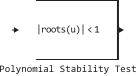
Checking the polynomial for compliance with the Schur–Cohn criterion: all roots of the input polynomial are inside the unit circle.
blockType: PolynomialStabilityTest
|
Path in the library: |
Description
Block Polynomial Stability Test uses the Schur—Cohn algorithm to determine whether all the roots of a polynomial are within the unit circle.
This block is most often used to check the location of the poles of the denominator polynomial transfer function .
The poles are roots of the denominator polynomial, . If the poles are located outside the unit circle, the transfer function unstable. As is customary in DSP, the above transfer function is given in the form of decreasing values , and not .
Ports
Input
#
IN_1
—
input polynomial
vector | matrix M by N
Details
Input polynomial, given as a vector or matrix on .
Each column of the input matrix contains coefficients of an individual polynomial
arranged in descending order of degree: . The polynomial has the order and whole positive degree indicators.
The block always considers the input undirected vector of length as a matrix on .
| Data types |
|
| Complex numbers support |
Yes |
Output
#
OUT_1
—
verification results
scalar | the matrix is 1 by N
Details
The results of the polynomial stability test, returned as a scalar or matrix of size on where each column contains a value 1 or 0.
Value 1 means that the polynomial in the corresponding Input column is stable, that is, the modules of all solutions less 1. Value 0 means that the polynomial in the corresponding Input column may be unstable, that is, the module of at least one solution greater than or equal to 1.
| Data types |
|
| Complex numbers support |
I don’t |