Zero Crossing
Counting the number of signal crossings with zero in one time step.
blockType: Zero Crossing
|
Path in the library: |
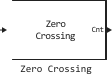
Description
Block Zero Crossing concludes that the signal in this channel has passed through zero if it meets any of the following criteria, where — current signal value, — previous value and so on:
-
and
-
and
-
For a positive integer right , and , where
-
For a positive integer right , and , where
For the first value of the input signal and are equal to zero.
On the Cnt port, the block outputs the number of signal crossings with zero in one time step.
Ports
Input
#
IN_1
—
Input signal
vector | the matrix
Details
An input signal specified as a real vector or matrix.
| Data types |
|
| Complex numbers support |
I don’t |
Output
#
Cnt
—
number of zero crossings
scalar | vector-string
Details
The block displays the number of zero crossings in the input data as one of these values:
-
scalar— if the Input receives data in the form of a column vector, the block outputs a scalar value representing the number of zero crossings at the data Input. -
vector-string— if the input data is a matrix, then the block outputs a row vector, each element of which represents the number of zero crossings in the corresponding input data column.
| Data types |
|
| Complex numbers support |
I don’t |
Parameters
Main
#
Input processing —
input signal processing method
Columns as channels (frame based) | Elements as channels (sample based)
Details
Specify the input signal processing method:
-
Columns as channels (frame based)— when this value is selected, the unit processes each column of the input signal as a separate channel.; -
Elements as channels (sample based)— when this value is selected, the unit processes each element of the input signal as a separate channel.
| Values |
|
| Default value |
|
| Program usage name |
|
| Tunable |
No |
| Evaluatable |
No |