PLL (3ph)
Determines the frequency and phase of the fundamental harmonic of a three-phase signal.
blockType: SubSystem
|
Path in the library: |
Description
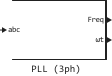
Block PLL (3ph) Simulates a feedback control system based on phase-locked frequency (PLL), which monitors the frequency and phase of a sinusoidal three-phase signal using an internal frequency generator. The control system adjusts the frequency of the internal oscillator to maintain zero phase difference.
The figure shows the internal circuit of the PLL.

The three-phase input signal is converted into a rotating coordinate system (Park conversion) using the usage of the angular velocity of the internal generator. The transverse axis of the signal, proportional to the phase difference between the abc signal and the rotation of the internal generator, is filtered by the Mean (Variable Frequency) block. Proportional-integral-differential (PID) controller with additional automatic gain control (AGC) maintains the phase difference equal to 0 acting on a controlled generator. The output of the PID controller corresponding to the angular velocity is filtered and converted to a frequency in hertz, which is used to calculate the average value.
Ports
Input
#
abc
—
normalized three-phase input signal, O.E.
scalar
Details
Normalized three-phase input signal in relative units.
| Data types |
|
| Complex numbers support |
No |
Output
#
Freq
—
measured frequency, Hz
scalar
Details
The measured frequency in Hz.
| Data types |
|
| Complex numbers support |
No |
#
ωt
—
the angle synchronized with the phase zero intersection , glad
scalar in the range [0, 2π]
Details
The angle in radians, varying from 0 before 2π, synchronized with the zero crossings of the main (direct sequence) phase .
| Data types |
|
| Complex numbers support |
No |
Parameters
Parameters
# Minimum frequency, Hz: — minimum expected input frequency
Details
The minimum expected frequency of the input signal. This parameter determines the size of the block buffer. Mean (Variable Frequency), used inside the block to calculate the average value.
| Default value |
|
| Program usage name |
|
| Evaluatable |
Yes |
# Initial inputs [Phase (deg), Frequency (Hz)]: — initial values of the phase and frequency of the input signal
Details
The initial values of the phase and frequency of the input signal.
| Default value |
|
| Program usage name |
|
| Evaluatable |
Yes |
# Regulator gains [Kp, Ki, Kd]: — proportional, integral and differential coefficients of the internal PID controller
Details
Proportional, integral and differential coefficients of the internal PID controller. Use these coefficients to adjust the PLL response time, outlier, and steady-state error.
| Default value |
|
| Program usage name |
|
| Evaluatable |
Yes |
# Time constant for derivative action, s: — the time constant for the first-order filter
Details
The time constant for the first-order filter.
| Default value |
|
| Program usage name |
|
| Evaluatable |
Yes |
# Maximum rate of change of frequency, Hz/s: — maximum rate of frequency change
Details
The maximum rate of frequency change.
| Default value |
|
| Program usage name |
|
| Evaluatable |
Yes |
# Filter cut-off frequency for frequency measurement, Hz: — the cutoff frequency of the second-order low-pass filter
Details
The cutoff frequency of the second-order low-pass filter.
| Default value |
|
| Program usage name |
|
| Evaluatable |
Yes |
# Sample time: — sampling period
Details
Specify the sampling period of the block in seconds. Set the value 0 to implement a continuous block.
| Default value |
|
| Program usage name |
|
| Evaluatable |
Yes |
# Enable automatic gain control — enabling automatic gain control
Details
When this check box is selected, the block PLL (3ph) optimizes its operation by scaling the signal of the PID controller according to the magnitude of the input signal. Check this box if the input signal is not normalized.
| Default value |
|
| Program usage name |
|
| Evaluatable |
Yes |