Thermal Liquid Predefined Properties (TL)
Sets the properties of a predefined liquid for a network of thermally conductive liquid.
blockType: EngeeFluids.ThermalLiquid.Utilities.PredefinedProperties
|
Path in the library: |
Description
Block Thermal Liquid Predefined Properties (TL) sets the properties of a liquid for a network of thermally conductive liquid in accordance with the properties of a predefined liquid. Available liquids include clean water, water mixtures, diesel fuel, Jet A aviation fuel, and SAE 5W-30 oil. You can use this block as an alternative to the block Thermal Liquid Properties (TL). If you do not specify a liquid, the default values will be used in the system.
The specified properties of a liquid are defined in tabular form as functions of temperature and pressure. During simulation, network properties are set by linear interpolation between data points. Tabular data for aqueous mixtures are provided for a given mass or volume concentration.
All the properties of the liquid that are usually set in the block Thermal Liquid Properties (TL), are defined in this block. These properties include density, volumetric modulus of elasticity and coefficient of thermal expansion, specific internal energy and specific heat capacity, as well as kinematic viscosity and thermal conductivity. These properties are valid in a limited range of temperatures and pressures characteristic of the selected liquid and depending, in the case of mixtures, on the specified concentration. Modeling is allowed only within this range.
Tolerance ranges
The tolerance ranges are defined in the block as matrices of zeros and ones. Each row corresponds to a tabulated temperature, and each column corresponds to a tabulated pressure. A zero indicates an invalid point, and a one indicates an acceptable one. These tolerance value matrices are internal to the block and cannot be changed.
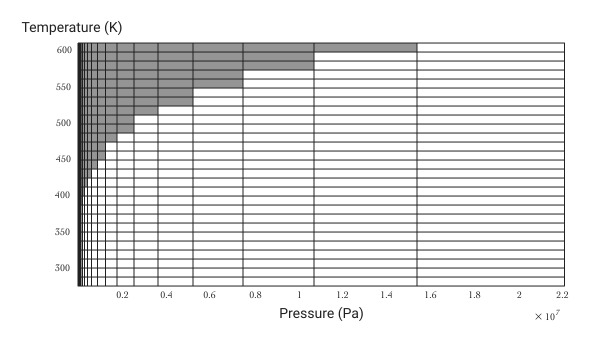
In most cases, the tolerance value matrices are extracted directly from the tabular data. The pressure limits of glycol and glycerol mixtures are not available and are obtained explicitly from the block parameters. The figure below shows an example of the tolerance range for water. The shaded squares indicate areas of temperature and pressure outside the tolerance range.
Water
The properties of water are acceptable in the range between the triple point, when the temperature and pressure of the liquid reach 273.160 To and 611.657 Pa, and the critical point when the temperature and pressure of the liquid reach 647.096 To and 22.064 MPa. Pressures below the saturation point for a given temperature row in the confidence matrix have the value 0.
Seawater (MIT model)
The properties of seawater are acceptable at temperatures from 0°C to 120°C (from 273.15 K before 393.15 K) and at pressures above the saturation point to the maximum value 12 MPa. Pressures below the saturation point for given temperature values (and at a given concentration level) in the confidence matrix have the value 0. The concentration of the mixture may vary from 0 before 0.12 by weight.
Ethylene glycol and water mixture
The properties of the mixture of ethylene glycol and water are acceptable in the temperature range determined by the concentration of the mixture and at pressures within the minimum and maximum values specified in the block parameters (expanded horizontally to cover the width of the temperature lines).
The lower temperature limit is always the smallest of two values: the minimum temperature obtained from the available data and the freezing point of the mixture (the mixture must be in a liquid state). The upper limit of the temperature is always the maximum temperature obtained based on the available data. The concentration of the mixture may vary from 0 before 0.6, if a mass fraction is used, or from 0 before 1, if a volume fraction is used.
Propylene glycol and water mixture
The properties of a mixture of propylene glycol and water are acceptable in the temperature and pressure ranges described for a mixture of ethylene glycol and water. The concentration of the mixture may vary from 0 before 0.6, if a mass fraction is used, or from 0.1 before 0.6, if a volume fraction is used.
Glycerol and water mixture
The properties of a mixture of glycerol and water are acceptable in the temperature and pressure ranges described for a mixture of ethylene glycol and water. The concentration of the mixture may vary from 0 before 0.6 in terms of mass fraction. All properties are expanded to 100°C as follows:
-
density is a quadratic approximation;
-
thermal density derivative, — linear approximation;
-
specific heat capacity — linear approximation;
-
specific internal energy is a linear approximation;
-
Kinematic viscosity is an exponential approximation based on the upper half of the initial temperature range.;
-
Dynamic viscosity is an exponential approximation based on the upper half of the initial temperature range.;
-
The Prandtl number is an exponential approximation based on the upper half of the initial temperature range.
Aviation fuel Jet-A
Jet-A fuel properties are acceptable at temperatures from −50,93°C to 372.46°C (from 222.22 K before 645.61 K) and at pressures above the saturation point and up to the maximum value 2.41 MPa. Pressures below the saturation point for a given temperature row in the confidence matrix have the value 0.
Diesel fuel
The properties of diesel fuel are acceptable at temperatures from −34.95°C to 417.82°C (from 238.20 K before 690.97 K) and at pressures above the saturation point and up to the maximum value 2.29 MPa. Pressures below the saturation point for a given temperature row in the confidence matrix have the value 0.
SAE 5W-30
The properties of SAE 5W-30 fuel are derived from data covering temperature and pressure ranges for each parameter. The unit uses the measured parameter values in the temperature range from 29.85°C to 74.85°C (from 303 K before 348 K) and pressures from 7 MPa up to 82 MPa. The block extrapolates data beyond this range to −38°C and 200°C (from 235.15 K before 473.15 K) and before 0.01 MPa and 100 MPa. The way the data is smoothed and extrapolated depends on the type of data:
-
The density block uses a quadratic approximation. The block approximates the extrapolated regions using the basic ratios of the volume module and -parameter;
-
Volumetric modulus of elasticity — the block uses a basic ratio to density based on a quadratic approximation of density. The block uses linear extrapolation in the field of extrapolation;
-
thermal density derivative, — the block uses a fundamental relationship with density based on a quadratic approximation of density. In the field of extrapolation, linear extrapolation is used.;
-
Specific heat capacity — The unit uses linear extrapolation in the field of extrapolation. There is no dependence on pressure;
-
Thermal conductivity — The unit uses linear extrapolation in the field of extrapolation. There is no dependence on pressure;
-
kinematic viscosity — the block uses a fundamental relationship with the approximation of dynamic viscosity and density;
-
dynamic viscosity — the unit uses exponential temperature approximation and linear pressure approximation;
-
Prandtl number — the block uses a fundamental ratio with approximations of specific heat, dynamic viscosity, and thermal conductivity.
Calculated properties
The density and coefficients of thermal expansion of aqueous mixtures of glycol and glycerin are determined from the block parameters. The density of a liquid, depending on pressure and temperature, is calculated as follows:
where
-
— network temperature;
-
— network pressure;
-
— density of the liquid;
-
— reference pressure corresponding to the tables of liquid properties;
-
— isothermal volumetric modulus of elasticity.
The change in liquid density is estimated as follows:
The coefficient of thermal expansion is calculated as follows:
Ports
Conserving
#
A
—
connection port
thermal liquid
Details
The thermal liquid port connecting the unit to the network for which it is necessary to set the necessary properties of the liquid. The liquid selected in this block is applied to the entire network. Other blocks cannot be connected to the same network Thermal Liquid Properties (TL) or Thermal Liquid Predefined Properties (TL).
| Program usage name |
|
Parameters
Main
# Propylene glycol mass fraction — the mass of propylene glycol divided by the mass of the aqueous mixture
Details
The mass of propylene glycol present in an aqueous mixture divided by the total mass of this mixture. It is set as a dimensionless value in the range (0, 0.6].
Dependencies
To use this parameter, set for the parameter Thermal liquid fluid list meaning Propylene glycol and water mixture, and for the parameter Concentration type meaning Mass fraction.
| Default value |
|
| Program usage name |
|
| Evaluatable |
Yes |
#
Pressure and temperature outside valid range —
notification when pressure or temperature values exceed the permissible range
None | Error
Details
Choose what happens if the pressure or temperature of the liquid exceeds the acceptable range during the simulation.:
-
None— the block does not return an error if the properties fall outside the acceptable range.; -
Error— the block returns an error and stops the simulation.
| Values |
|
| Default value |
|
| Program usage name |
|
| Evaluatable |
No |
# Dissolved salt mass fraction (salinity) — the mass of salt divided by the total mass of the saline solution
Details
The ratio of the mass of salt contained in a saline solution to the total mass of this solution. It is set as a dimensionless value in the range (0, 0.12].
Dependencies
To use this parameter, set for the parameter Thermal liquid fluid list meaning Seawater (MIT model).
| Default value |
|
| Program usage name |
|
| Evaluatable |
Yes |
#
Maximum valid pressure —
the maximum allowable pressure in the heat-conducting fluid network
Pa | uPa | hPa | kPa | MPa | GPa | kgf/m^2 | kgf/cm^2 | kgf/mm^2 | mbar | bar | kbar | atm | ksi | psi | mmHg | inHg
Details
The maximum pressure in the heat-conducting liquid network.
Dependencies
To use this parameter, set for the parameter Thermal liquid fluid list meaning Ethylene glycol and water mixture, Propylene glycol and water mixture or Glycerol and water mixture.
| Units |
|
| Default value |
|
| Program usage names |
|
| Evaluatable |
Yes |
#
Minimum valid pressure —
minimum allowable pressure in the heat-conducting fluid network
Pa | uPa | hPa | kPa | MPa | GPa | kgf/m^2 | kgf/cm^2 | kgf/mm^2 | mbar | bar | kbar | atm | ksi | psi | mmHg | inHg
Details
Minimum pressure in the heat-conducting fluid network.
Dependencies
To use this parameter, set for the parameter Thermal liquid fluid list meaning Ethylene glycol and water mixture, Propylene glycol and water mixture or Glycerol and water mixture.
| Units |
|
| Default value |
|
| Program usage names |
|
| Evaluatable |
Yes |
# Ethylene glycol volume fraction — the volume of ethylene glycol divided by the volume of the aqueous mixture
Details
The volume of ethylene glycol present in an aqueous mixture divided by the total volume of this mixture. It is set as a dimensionless value in the range (0, 1.0].
Dependencies
To use this parameter, set for the parameter Thermal liquid fluid list meaning Ethylene glycol and water mixture, and for the parameter Concentration type meaning Volume fraction.
| Default value |
|
| Program usage name |
|
| Evaluatable |
Yes |
# Glycerol mass fraction — the mass of glycerin divided by the mass of the aqueous mixture
Details
The mass of glycerol present in an aqueous mixture divided by the total mass of this mixture. It is set as a dimensionless value in the range (0, 0.6].
Dependencies
To use this parameter, set for the parameter Thermal liquid fluid list meaning Glycerol and water mixture, and for the parameter Concentration type meaning Mass fraction.
| Default value |
|
| Program usage name |
|
| Evaluatable |
Yes |
#
Atmospheric pressure —
atmospheric pressure in a heat-conducting fluid network
Pa | uPa | hPa | kPa | MPa | GPa | kgf/m^2 | kgf/cm^2 | kgf/mm^2 | mbar | bar | kbar | atm | ksi | psi | mmHg | inHg
Details
The absolute pressure of the external environment of the connected network of a heat-conducting liquid. The default value corresponds to normal atmospheric pressure.
| Units |
|
| Default value |
|
| Program usage name |
|
| Evaluatable |
Yes |
#
Concentration type —
concentration by mass or volume
Volume fraction | Mass fraction
Details
It is indicated how the concentration of ethylene glycol or propylene glycol dissolved in water is measured: by weight or by volume.
Dependencies
To use this parameter, set for the parameter Thermal liquid fluid list meaning Ethylene glycol and water mixture or Propylene glycol and water mixture.
| Values |
|
| Default value |
|
| Program usage names |
|
| Evaluatable |
No |
# Propylene glycol volume fraction — the volume of propylene glycol divided by the volume of the aqueous mixture
Details
The volume of propylene glycol present in an aqueous mixture divided by the total volume of this mixture. It is set as a dimensionless value in the range [0.1, 0.6].
Dependencies
To use this parameter, set for the parameter Thermal liquid fluid list meaning Propylene glycol and water mixture, and for the parameter Concentration type meaning Volume fraction.
| Default value |
|
| Program usage name |
|
| Evaluatable |
Yes |
#
Thermal liquid fluid list —
selection of the working fluid
Water | Seawater (MIT model) | Ethylene glycol and water mixture | Propylene glycol and water mixture | Glycerol and water mixture | Aviation fuel Jet-A | Diesel fuel | SAE 5W-30
Details
Sets the properties of the liquid in your network. Available liquids include clean water, water mixtures, engine oils, and fuels.
| Values |
|
| Default value |
|
| Program usage name |
|
| Evaluatable |
No |
#
Isothermal bulk modulus —
the compressibility index of a liquid, set at a constant temperature
Pa | uPa | hPa | kPa | MPa | GPa | kgf/m^2 | kgf/cm^2 | kgf/mm^2 | mbar | bar | kbar | atm | ksi | psi | mmHg | inHg
Details
The volumetric modulus of elasticity of an aqueous mixture at a constant temperature. The volumetric modulus of elasticity measures the pressure change required to cause a relative volume change in a liquid.
Dependencies
To use this parameter, set for the parameter Thermal liquid fluid list meaning Ethylene glycol and water mixture, Propylene glycol and water mixture or Glycerol and water mixture.
| Units |
|
| Default value |
|
| Program usage names |
|
| Evaluatable |
Yes |
# Ethylene glycol mass fraction — the mass of ethylene glycol divided by the mass of the aqueous mixture
Details
The mass of ethylene glycol present in an aqueous mixture divided by the total mass of this mixture. It is set as a dimensionless value in the range (0, 0.6].
Dependencies
To use this parameter, set for the parameter Thermal liquid fluid list meaning Ethylene glycol and water mixture, and for the parameter Concentration type meaning Mass fraction.
| Default value |
|
| Program usage name |
|
| Evaluatable |
Yes |
Literature
-
Massachusetts Institute of Technology (MIT), Thermophysical properties of seawater database. http://web.mit.edu/seawater.
-
K.G. Nayar, M.H. Sharqawy, L.D. Banchik, J.H. Lienhard V, Thermophysical properties of seawater: A review and new correlations that include pressure dependence, Desalination, Vol. 390, pp. 1–24, 2016.
-
M.H. Sharqawy, J.H. Lienhard V, S.M. Zubair, Thermophysical properties of seawater: A review of existing correlations and data, Desalination and Water Treatment, Vol. 16, pp. 354–380.