Poppet Valve (G)
A poppet valve in the gas network.
blockType: EngeeFluids.Gas.Valves.FlowControl.Poppet
|
Path in the library: |

Description
Block Poppet Valve (G) It is an opening with a movable ball that regulates the flow through the valve. In the fully closed position, the ball rests against the perforated seat and completely blocks the passage of gas between ports A and B. The area between the ball and the seat is the valve opening area.
The flow can be laminar or turbulent and can reach sonic velocities. The maximum velocity occurs in the valve seat, where the flow is narrowest and fastest. The flow reaches a critical mode and maximum speed when a pressure drop downstream can no longer increase the speed. The flow is blocked when the pressure drop reaches a critical value characteristic of the valve. The unit does not calculate supersonic flow.
Ball Mechanics
The block simulates the movement of the ball, but not the dynamics of opening or closing the valve. The signal at port L represents the normalized ball displacement . Please note that — this is the normalized value of the offset between 0 and 1, which mean a fully closed and fully open valve, respectively. If the calculation returns a number outside of this range, then this number is set equal to the nearest boundary.
calculated smoothing
When the Smoothing factor parameter has a non-zero value, the block applies numerical smoothing to the normalized ball position. . Enabling anti-aliasing helps maintain the numerical stability of the simulation.
Opening Square
The valve opening area depends on the Valve seat geometry parameter, which may be relevant Sharp-edged or Conical. The Leakage flow fraction parameter is the ratio of the valve flow rate in the closed state to the flow rate in the open state. The Leakage flow fraction parameter allows for small contact gaps between the ball and the seat in the fully closed position. This parameter also ensures continuity of flow for the solver operation.
The figure shows poppet valves with different seat types.
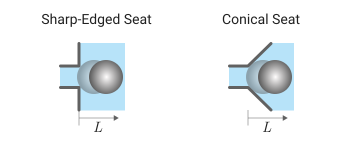
Seat with a sharp edge_
The valve opening area is calculated as follows
where
-
— the distance between the outer edge of the ball and the saddle;
-
— the radius of the saddle opening, which the unit calculates from the value of the Orifice diameter parameter;
-
— the radius of the ball, which the block calculates from the value of the parameter Ball diameter;
-
is a geometric parameter that is calculated as .
Maximum offset restricts the opening area:
For any ball displacement exceeding , value is the value of the maximum hole area:
When the signal on port L is less 0, the valve closes, and the Leakage flow fraction parameter determines the mass flow rate.
conical saddle
The valve opening area is calculated as follows
where
-
— the distance between the outer edge of the ball and the saddle;
-
— value of the Cone angle parameter;
-
is a geometric parameter that is calculated as , where — the radius of the ball.
Maximum offset restricts the opening area:
For any ball displacement exceeding , value is the value of the maximum hole area:
When the signal on port L is less 0, the valve closes, and the Leakage flow fraction parameter determines the mass flow rate.
Parameterization of the valve
The block behavior depends on the parameter Valve parameterization:
-
Cv flow coefficient— expense ratio determines the dependence of throughput on pressure drop; -
Kv flow coefficient— expense ratio determines the dependence of throughput on pressure drop, ; -
Sonic conductance— steady-state acoustic conductivity determines the throughput at critical flow, a condition in which the flow velocity is equal to the local speed of sound. The flow becomes critical when the ratio of outlet pressure to inlet pressure reaches a value called the critical pressure ratio.; -
Orifice area based on geometry— the size of the flow limit determines the throughput.
The unit scales the set flow rate according to the degree of valve opening. When increasing the degree of valve opening from 0 before 1 The throughput indicator increases from a set minimum to a set maximum.
Calculation of mass flow
Parameter Valve parameterization determines which equations will be used to calculate the flow rate. If for the parameter Valve parameterization the value is set Cv flow coefficient, then the mass consumption will be defined as
where
-
— expense ratio;
-
— valve opening area;
-
— the maximum area of the valve when it is fully open;
-
— a constant equal to
27.3for mass flow rate in kg/hour, pressure in bar and density in kg/m33; -
— expansion coefficient;
-
— inlet pressure;
-
— outlet pressure;
-
— density at the entrance.
The expansion coefficient is defined as
where
-
— the ratio of the adiabatic index to
1.4; -
— parameter value xT pressure differential ratio factor at choked flow.
When is the pressure ratio exceeds the value of the parameter Laminar flow pressure ratio, , there is a smooth transition to using the linearized equation:
where
When is the pressure ratio falls lower , the flow becomes critical, and the equation is used
If for the parameter Valve parameterization the value is set Kv flow coefficient, then the block uses the same equations, but replaces on using a relationship . More detailed information about the mass flow equations when for the parameter Valve parameterization the value is set Kv flow coefficient or Cv flow coefficient, is given in [2] and [3].
If for the parameter Valve parameterization the value is set Sonic conductance, then the mass flow rate defined as
where
-
— acoustic conductivity;
-
— critical pressure ratio;
-
— parameter value Subsonic index;
-
— parameter value ISO reference temperature;
-
— parameter value ISO reference density;
-
— temperature at the entrance.
When is the pressure ratio exceeds the value of the parameter Laminar flow pressure ratio, , there is a smooth transition to using the linearized equation:
When is the pressure ratio falls below the critical pressure ratio , the flow becomes critical, and the equation is used
More detailed information about the mass flow equations when for the parameter Valve parameterization the value is set Sonic conductance, is given in [1].
If for the parameter Valve parameterization the value is set Orifice area based on geometry, then the mass consumption defined as
where
-
— valve opening area;
-
— parameter value Cross-sectional area at ports A and B;
-
— parameter value Discharge coefficient;
-
— the adiabatic index.
When is the pressure ratio exceeds the value of the parameter Laminar flow pressure ratio, , there is a smooth transition to using the linearized equation:
When is the pressure ratio falls lower , the flow becomes critical, and the equation is used
More detailed information about the mass flow equations when for the parameter Valve parameterization the value is set Orifice area based on geometry, is given in [4].
Conservation of mass
It is assumed that the volume and mass of gas inside the valve are very small, and these values are not taken into account, so gas cannot accumulate in the valve. According to the principle of conservation of mass, the mass flow rate of gas entering through one port is equal to the flow rate of gas exiting through another port.:
where and — the mass flow rate at ports A and B respectively.
Energy conservation
The valve is an adiabatic component. There is no heat exchange between the gas and the valve wall. When the gas passes through the valve, no work is performed on it. Under these assumptions, energy can enter and exit the valve only through convection through ports A and B. According to the principle of energy conservation, the sum of energy flows through ports is always zero:
where and — the flow of energy entering the valve through ports A and B, respectively.
Assumptions and limitations
-
Meaning
Sonic conductancethe parameter Valve parameterization designed for pneumatic systems. If this parameter is used for gases other than air, it may be necessary to adjust the acoustic conductivity value by the square root of the relative density. -
The equation for parameterization
Orifice area based on geometryit has lower accuracy for gases that are far from ideal. -
This block does not simulate supersonic flow.
Ports
Input
#
L
—
normalized ball displacement
scalar in the range [0,1]
Details
The normalized displacement of the ball. The position of the ball is normalized by the maximum displacement. Meaning 0 corresponds to a fully closed valve, and the value of 1 — completely open.
| Data types |
|
| Complex numbers support |
No |
Parameters
Main
#
Valve parameterization —
the method of defining the characteristics of the flow through the hole
Orifice area based on geometry | Cv flow coefficient | Kv flow coefficient | Sonic conductance
Details
The method of calculating the mass flow rate is based on:
-
Cv flow coefficient— the expense ratio ; -
Kv flow coefficient— the expense ratio , which is defined as ; -
Sonic conductance— acoustic conductivity in steady state; -
Orifice area based on geometry— the size of the flow restriction.
| Values |
|
| Default value |
|
| Program usage name |
|
| Evaluatable |
No |
#
Valve seat geometry —
geometry of the valve seat
Sharp-edged | Conical
Details
Geometry of the valve seat. The valve opening area is calculated depending on the value of this parameter.
| Values |
|
| Default value |
|
| Program usage name |
|
| Evaluatable |
No |
# xT pressure differential ratio factor at choked flow — critical pressure drop ratio
Details
The ratio between inlet pressure and the outlet pressure , defined as at which point the flow becomes critical. If this value is not known, it can be found in table 2 in ISA-75.01.01 [3].
Default value 0.7 suitable for many valves.
Dependencies
To use this parameter, set for the parameter Valve parameterization meaning Kv flow coefficient.
| Default value |
|
| Program usage names |
|
| Evaluatable |
Yes |
# Critical pressure ratio — critical pressure ratio
Details
The pressure ratio at which the flow becomes critical and the flow velocity reaches a maximum determined by the local speed of sound. The ratio between the outlet pressure and inlet pressure : .
Dependencies
To use this parameter, set for the parameter Valve parameterization meaning Sonic conductance.
| Default value |
|
| Program usage name |
|
| Evaluatable |
Yes |
# Discharge coefficient — expiration rate
Details
The correction factor is the ratio of the actual mass flow to the theoretical mass flow.
Dependencies
To use this parameter, set for the parameter Valve parameterization meaning Orifice area based on geometry.
| Default value |
|
| Program usage name |
|
| Evaluatable |
Yes |
#
Ball diameter —
diameter of the ball
m | um | mm | cm | km | in | ft | yd | mi | nmi
Details
The diameter of the ball, which is the control element.
| Units |
|
| Default value |
|
| Program usage name |
|
| Evaluatable |
Yes |
#
Orifice diameter —
valve opening diameter
m | um | mm | cm | km | in | ft | yd | mi | nmi
Details
The diameter of the permanent valve opening. For the conical geometry of the seat, the value of this parameter is the diameter of the seat base.
| Units |
|
| Default value |
|
| Program usage name |
|
| Evaluatable |
Yes |
#
Maximum sonic conductance —
acoustic conductivity corresponding to the maximum hole area
l/(bar*s) | gal/(min*psi) | m^3/(Pa*s)
Details
The value of acoustic conductivity, when the cross-sectional area of the hole is maximum.
Dependencies
To use this parameter, set for the parameter Valve parameterization meaning Sonic conductance.
| Units |
|
| Default value |
|
| Program usage name |
|
| Evaluatable |
Yes |
# Laminar flow pressure ratio — the pressure ratio at which the flow transitions between laminar and turbulent modes
Details
The ratio of outlet pressure to inlet pressure at which the flow transitions between laminar and turbulent flow modes.
Typical values range from 0.995 before 0.999.
| Default value |
|
| Program usage name |
|
| Evaluatable |
Yes |
#
Cross-sectional area at ports A and B —
the area at the inlet or outlet of the valve
m^2 | um^2 | mm^2 | cm^2 | km^2 | in^2 | ft^2 | yd^2 | mi^2 | ha | ac
Details
This area is used when calculating the mass flow through ports.
The ports have the same size. The value of this parameter must correspond to the area of the inlet of the component to which the unit is connected.
| Units |
|
| Default value |
|
| Program usage name |
|
| Evaluatable |
Yes |
#
Cone angle —
the angle of the conical seat solution
rad | deg | rev | mrad | arcsec | arcmin | gon
Details
The angle formed by the inclination of the conical saddle to its center line.
Dependencies
To use this parameter, set the Valve seat specification parameter to Conical.
| Units |
|
| Default value |
|
| Program usage name |
|
| Evaluatable |
Yes |
# Subsonic index — the value of the degree used to calculate the mass flow rate in subsonic flow mode
Details
An empirical value used for more accurate calculation of mass flow rate in subsonic flow mode.
Dependencies
To use this parameter, set for the parameter Valve parameterization meaning Sonic conductance.
| Default value |
|
| Program usage name |
|
| Evaluatable |
Yes |
# Maximum Cv flow coefficient — the flow rate corresponding to the maximum opening area
Details
The value of the flow coefficient , when the cross-sectional area of the hole is maximal. The flow coefficient determines the dependence of the throughput on the pressure drop.
Dependencies
To use this parameter, set for the parameter Valve parameterization meaning Cv flow coefficient.
| Default value |
|
| Program usage name |
|
| Evaluatable |
Yes |
#
ISO reference temperature —
reference temperature according to ISO 8778
K | degC | degF | degR | deltaK | deltadegC | deltadegF | deltadegR
Details
The temperature in the standard reference atmosphere in the ISO 8778 standard.
The ISO reference parameter values need to be adjusted only if acoustic conductivity values obtained with excellent reference values are used.
Dependencies
To use this parameter, set for the parameter Valve parameterization meaning Sonic conductance.
| Units |
|
| Default value |
|
| Program usage name |
|
| Evaluatable |
Yes |
# Maximum Kv flow coefficient — the flow rate corresponding to the maximum opening area
Details
The value of the flow coefficient, , when the cross-sectional area of the hole is maximal. The flow coefficient determines the dependence of the throughput on the pressure drop.
Dependencies
To use this parameter, set for the parameter Valve parameterization meaning Kv flow coefficient.
| Default value |
|
| Program usage name |
|
| Evaluatable |
Yes |
#
ISO reference density —
reference density according to ISO 8778
kg/m^3 | g/m^3 | g/cm^3 | g/mm^3 | lbm/ft^3 | lbm/gal | lbm/in^3
Details
The density in the standard reference atmosphere in the ISO 8778 standard.
The ISO reference parameter values need to be adjusted only if acoustic conductivity values obtained with excellent reference values are used.
Dependencies
To use this parameter, set for the parameter Valve parameterization meaning Sonic conductance.
| Units |
|
| Default value |
|
| Program usage name |
|
| Evaluatable |
Yes |
# Smoothing factor — numerical smoothing factor
Details
The continuous smoothing coefficient, which ensures smooth opening by correcting the characteristic of the hole in the almost open and almost closed positions.
| Default value |
|
| Program usage name |
|
| Evaluatable |
Yes |
# Leakage flow fraction — cost ratio
Details
The ratio of flow through a closed and through an open hole.
| Default value |
|
| Program usage name |
|
| Evaluatable |
Yes |
Literature
-
ISO 6358-3. «Pneumatic fluid power — Determination of flow-rate characteristics of components using compressible fluids — Part 3: Method for calculating steady-state flow rate characteristics of systems». 2014.
-
IEC 60534-2-3. «Industrial-process control valves — Part 2-3: Flow capacity — Test procedures». 2015.
-
ANSI/ISA-75.01.01. «Industrial-Process Control Valves — Part 2-1: Flow capacity — Sizing equations for fluid flow underinstalled conditions». 2012.
-
P. Beater. «Pneumatic Drives.» Springer-Verlag Berlin Heidelberg. 2007.