2-Way Directional Valve (G)
A two-line distribution valve in the gas network.
blockType: EngeeFluids.Gas.Valves.DirectionalControl.TwoWay
|
Path in the library: |
Description
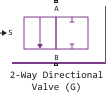
Block 2-Way Directional Valve (G) It is a valve with two ports A and B and one channel A-B. The channel passes through an opening of variable width. The input signal applied to port S controls the position of the spool. The valve closes when the spool covers the opening.
The flow can be laminar or turbulent and can reach sonic velocities. The maximum speed is reached at the mouth of the valve opening, where the flow is narrowest and fastest. The flow becomes critical when the ratio of outlet pressure to inlet pressure reaches a critical value characteristic of the valve. The unit does not calculate supersonic flow.
Valve positions
The valve switches smoothly between the normal and operating position.
When the value of the spool movement in port S is zero, the valve returns to the normal position in which it does not operate. If the piston of the spool is not displaced relative to the valve opening, the valve is completely closed. The operating position is the position to which the valve moves when the spool is maximally moved in a positive direction from the normal position. In this case, the hole is completely open.
The movement of the spool, which moves the valve to the operating position, depends on the movement of the spool piston. The Valve opening fraction offset parameter sets a constant value for determining the movement of the spool on the ports.
The stage of opening the hole
In the intervals between the valve positions, the opening of the hole A-B depends on where the piston of the spool is located relative to the rim. This distance is an open hole, and the unit normalizes this distance so that its value is a fraction of the maximum distance at which the hole is fully open. The normalized variable is the degree of opening of the hole.
The degree of opening of the hole may vary from 0 (normal position), up to 1 (working position). The unit calculates the degree of opening of the hole based on the movement of the spool and the displacement of the degree of opening of the hole. Displacement and displacement are infinitesimal fractions of the maximum piston—hole distance. The degree of opening of the hole is:
where
-
— the degree of opening of the hole is A-B. If the calculation returns a value outside the range
[0, 1], then the block uses the nearest limit; -
— offset of the degree of opening of the hole, the value of the parameter Valve opening fraction offset. To account for unusual valve configurations, the unit does not impose restrictions on their values, although they are usually between
-1and1; -
— this is the normalized displacement of the spool, set as a scalar on the port S. To compensate for extreme shifts in the degree of opening of the hole, the signal value is unlimited. This value is usually in the range of
0before1.
The displacement of the opening degree of the hole
By default, the valve is completely closed when its control displacement is zero. In this state, the valve has zero overlap.
You can displace the piston of the spool to simulate a valve with incomplete or complete closure. The valves with incomplete closure are partially open in the normal position. Fully closed valves are completely closed slightly beyond the normal position. The figure shows how the degree of opening of the hole varies depending on the movement of the spool.:
-
Image I: Valve without overlap. The offset of the opening degree is zero. When the valve is in the normal position, the piston of the spool completely covers the opening.
-
Image II: Valve with incomplete closure. The offset of the opening degree is positive. When the valve is in the normal position, the piston of the spool partially covers the opening.
-
Image III: Closed valve. The offset of the opening degree is negative. The piston of the spool completely closes the hole not only in the normal position, but also in a small area of movement of the spool around it.

consumption of leakage
The leakage rate ensures that no section of the liquid network is isolated. Isolated areas of liquid can reduce the numerical stability of the model, slow down the simulation speed and, in some cases, lead to simulation failure. The Leakage flow fraction parameter represents the leakage area as a small number greater than zero.
composite structure
This block is a composite component consisting of a single block Orifice (G), connected between ports A, B and S. For more information about valve parameterization and calculations, see Orifice (G).
Parameterization of the valve
The block behavior depends on the Valve parametrization parameter:
-
Cv flow coefficient— expense ratio determines the dependence of the throughput on the pressure drop [2], [3]. -
Kv flow coefficient— expense ratio determines the dependence of throughput on pressure drop, [2], [3]. -
Sonic conductance— steady-state acoustic conductivity determines the throughput at a critical flow, a condition in which the flow velocity is equal to the local speed of sound. The flow becomes critical when the ratio of outlet pressure to inlet pressure reaches a value called the critical pressure ratio [1]. -
Orifice area— the area of the hole determines the throughput [4].
Hole Characteristic
The flow characteristic relates the valve opening to the input value, which is often the stroke of the spool. The unit calculates the hole through acoustic conductivity, flow coefficient, or the cross-sectional area of the hole, depending on the setting of the Valve parameterization parameter. The control input is the degree of opening of the hole, which is a function of the movement of the spool set on the port S.
The flow characteristic is usually given in steady-state mode, when the inlet pressure is constant, carefully controlled. The flow characteristic depends only on the valve and can be linear or non-linear. To select a flow characteristic, use the Opening characteristic parameter.:
-
Linear— throughput is a linear function of the degree of opening of the hole. As the degree of opening of the hole increases from0before1, the throughput indicator increases from the specified minimum to the specified maximum.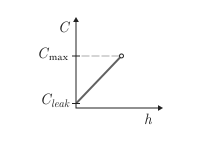
-
Tabulated— throughput is a general function that can be linear or non-linear depending on the degree of opening of the hole. The function is set in tabular form, with the independent variable being set by the Opening fraction vector parameter.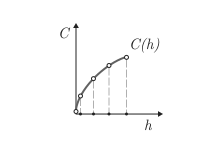
Numerical smoothing
If the Opening characteristic parameter is set to Linear, and the Smoothing factor parameter is set to a non-zero value, then numerical smoothing is applied to the degree of hole opening. Smoothing helps to maintain the numerical stability of the simulation.
Assumptions and limitations
-
Meaning
Sonic conductanceThe Valve parameterization parameter is intended for pneumatic systems. If this parameter is used for gases other than air, it may be necessary to adjust the acoustic conductivity value by the square root of the specific gravity. -
The equation for parameterization
Orifice areait has lower accuracy for gases that are far from ideal. -
This block does not simulate supersonic flow.
Ports
Conserving
#
A
—
gas inlet or outlet
gas
Details
Non-directional port, corresponds to flow in or flow out.
| Program usage name |
|
#
B
—
gas inlet or outlet
gas
Details
Non-directional port, corresponds to flow in or flow out.
| Program usage name |
|
Input
#
S
—
control signal
scalar
Details
The instantaneous movement of the actuating element relative to its normal non-operating position, specified as a scalar. The unit normalises the displacement relative to the maximum position of the actuating element required to fully open the hole. The scalar has no unit of measurement and its instantaneous value is normally in the range from 0 to 1.
| Data types |
|
| Complex numbers support |
No |
Parameters
Parameters
#
Valve parameterization —
the method of defining the characteristics of the flow through the hole
Cv flow coefficient | Kv flow coefficient | Sonic conductance | Orifice area
Details
The method of calculating the mass flow is based on:
-
Cv flow coefficient— the expense ratio . -
Kv flow coefficient— the expense ratio , which is defined as . -
Sonic conductance— acoustic conductivity in steady-state mode. -
Orifice area— the area of the hole.
| Values |
|
| Default value |
|
| Program usage name |
|
| Evaluatable |
No |
#
Opening characteristic —
method for calculating valve opening characteristics
Linear | Tabulated
Details
The method that the unit uses to calculate the valve opening area:
-
Linear— the opening area is a linear function of the degree of opening of the hole. -
Tabulated— a general nonlinear relationship, which is given in tabular form.
| Values |
|
| Default value |
|
| Program usage name |
|
| Evaluatable |
No |
# Maximum Cv flow coefficient — the flow rate corresponding to the maximum opening area
Details
The value of the flow coefficient , when the cross-sectional area of the hole is maximal.
Dependencies
To use this parameter, set the Orifice parameterization parameter to Cv flow coefficient, for the Opening characteristic parameter , the value is Linear.
| Default value |
|
| Program usage name |
|
| Evaluatable |
Yes |
# Opening fraction vector — values of the control signal of the degree of opening
Details
The vector of control signal values at which the bandwidth measure is set is Cv coefficient vector, Kv coefficient vector, Sonic conduction vector or Orifice area vector. The value of the control signal is equal to the degree of opening only in the range from 0 before 1.
The values should be listed in ascending order. The dimension of the vector corresponds to the dimension of the vector Cv coefficient vector, Kv coefficient vector, Sonic conduction vector or Orifice area vector.
Dependencies
To use this parameter, set the Opening characteristic parameter to Tabulated.
| Default value |
|
| Program usage names |
|
| Evaluatable |
Yes |
# Cv flow coefficient vector — vector of flow coefficient values
Details
Vector of flow coefficients . The values should be listed in ascending order. The dimension of the vector corresponds to the dimension of the Opening fraction vector.
Dependencies
To use this parameter, set the Opening characteristic parameter to Tabulated, for the Orifice parameterization parameter , the value Cv flow coefficient.
| Default value |
|
| Program usage name |
|
| Evaluatable |
Yes |
# xT pressure differential ratio factor at choked flow — critical pressure drop ratio
Details
The ratio between inlet pressure and the outlet pressure , defined as at which point the flow becomes critical. If this value is not known, then it can be found in Table 2 in ISA-75.01.01 [3].
Default value 0.7 suitable for many valves.
Dependencies
To use this parameter, set the Orifice parameterization parameter to Cv flow coefficient or Kv flow coefficient.
| Default value |
|
| Program usage names |
|
| Evaluatable |
Yes |
# Maximum Kv flow coefficient — the flow rate corresponding to the maximum opening area
Details
The value of the flow coefficient when the value of the control signal on port L is equal to 1, and the cross-sectional area of the hole is maximal.
Dependencies
To use this parameter, set the Orifice parameterization parameter to Kv flow coefficient, for the Opening characteristic parameter , the value is Linear.
| Default value |
|
| Program usage name |
|
| Evaluatable |
Yes |
# Kv flow coefficient vector — vector of flow coefficient values
Details
Vector of flow coefficients . The values must be specified in ascending order. The dimension of the vector corresponds to the dimension of the Opening fraction vector.
Dependencies
To use this parameter, set the Opening characteristic parameter to Tabulated, for the Orifice parameterization parameter , the value Kv flow coefficient.
| Default value |
|
| Program usage name |
|
| Evaluatable |
Yes |
#
Maximum sonic conductance —
acoustic conductivity corresponding to the maximum hole area
l/(bar*s) | gal/(min*psi) | m^3/(Pa*s)
Details
The value of acoustic conductivity when the value of the control signal on port L is equal to 1, and the cross-sectional area of the hole is maximal.
Dependencies
To use this parameter, set the Orifice parameterization parameter to Sonic conductance, for the Opening characteristic parameter , the value is Linear.
| Units |
|
| Default value |
|
| Program usage name |
|
| Evaluatable |
Yes |
# Critical pressure ratio — critical pressure ratio
Details
The pressure ratio at which the flow becomes critical and the flow velocity reaches a maximum determined by the local speed of sound. The ratio between the outlet pressure and inlet pressure : .
Dependencies
To use this parameter, set the Orifice parameterization parameter to Sonic conductance, for the Opening characteristic parameter , the value is Linear.
| Default value |
|
| Program usage name |
|
| Evaluatable |
Yes |
#
Sonic conductance vector —
vector of acoustic conductivity values
l/(bar*s) | gal/(min*psi) | m^3/(Pa*s)
Details
The vector of acoustic conductivities. The values should be listed in ascending order. The dimension of the vector corresponds to the dimension of the Opening fraction vector.
Dependencies
To use this parameter, set the Orifice parameterization parameter to Sonic conductance, for the Opening characteristic parameter , the value is Tabulated.
| Units |
|
| Default value |
|
| Program usage name |
|
| Evaluatable |
Yes |
# Critical pressure ratio vector — the vector of values of the critical pressure ratio
Details
The vector of critical pressure relations. The critical pressure ratio is the ratio of the outlet pressure to the inlet pressure at which the flow becomes critical and the flow velocity reaches a maximum determined by the local speed of sound. The dimension of the vector corresponds to the dimension of the Opening fraction vector.
Dependencies
To use this parameter, set the Orifice parameterization parameter to Sonic conductance, for the Opening characteristic parameter , the value is Tabulated.
| Default value |
|
| Program usage name |
|
| Evaluatable |
Yes |
# Subsonic index — the value of the degree used to calculate the mass flow rate in subsonic flow mode
Details
An empirical value used for more accurate calculation of mass flow rate in subsonic flow mode.
Dependencies
To use this parameter, set the Orifice parameterization parameter to Sonic conductance.
| Default value |
|
| Program usage name |
|
| Evaluatable |
Yes |
#
ISO reference temperature —
reference temperature according to ISO 8778
K | degC | degF | degR | deltaK | deltadegC | deltadegF | deltadegR
Details
The temperature in the standard reference atmosphere in the ISO 8778 standard.
The ISO reference parameter values need to be adjusted only if acoustic conductivity values obtained with excellent reference values are used.
Dependencies
To use this parameter, set the Orifice parameterization parameter to Sonic conductance.
| Units |
|
| Default value |
|
| Program usage name |
|
| Evaluatable |
Yes |
#
ISO reference density —
reference density according to ISO 8778
kg/m^3 | g/m^3 | g/cm^3 | g/mm^3 | lbm/ft^3 | lbm/gal | lbm/in^3
Details
The density in the standard reference atmosphere in the ISO 8778 standard.
The ISO reference parameter values need to be adjusted only if acoustic conductivity values obtained with excellent reference values are used.
Dependencies
To use this parameter, set the Orifice parameterization parameter to Sonic conductance.
| Units |
|
| Default value |
|
| Program usage name |
|
| Evaluatable |
Yes |
#
Maximum orifice area —
the area of the flow passage section corresponding to the maximum opening area
m^2 | um^2 | mm^2 | cm^2 | km^2 | in^2 | ft^2 | yd^2 | mi^2 | ha | ac
Details
The maximum flow cross-sectional area when the value of the control signal on port L is equal to 1.
Dependencies
To use this parameter, set the Orifice parameterization parameter to Orifice area, for the Opening characteristic parameter , the value is Linear.
| Units |
|
| Default value |
|
| Program usage name |
|
| Evaluatable |
Yes |
#
Orifice area vector —
vector of hole area values
m^2 | um^2 | mm^2 | cm^2 | km^2 | in^2 | ft^2 | yd^2 | mi^2 | ha | ac
Details
The vector of the areas of the passage section of the hole. The dimension of the vector corresponds to the Opening fraction vector vector. The first element of this vector is the area of the leak, and the last element is the maximum area of the hole.
Dependencies
To use this parameter, set the Orifice parameterization parameter to Orifice area, for the Opening characteristic parameter , the value is Tabulated.
| Units |
|
| Default value |
|
| Program usage name |
|
| Evaluatable |
Yes |
# Discharge coefficient — expense ratio
Details
The correction factor is the ratio of the actual mass flow to the theoretical mass flow.
Dependencies
To use this parameter, set the Orifice parameterization parameter to Orifice area.
| Default value |
|
| Program usage name |
|
| Evaluatable |
Yes |
# Leakage flow fraction — cost ratio
Details
The ratio of flow through a closed and through an open hole.
Dependencies
To use this parameter, set the Orifice parameterization parameter to Orifice area.
| Default value |
|
| Program usage name |
|
| Evaluatable |
Yes |
# Smoothing factor — numerical smoothing coefficient
Details
The continuous smoothing coefficient, which ensures smooth opening by correcting the characteristic of the hole in the almost open and almost closed positions.
Dependencies
To use this parameter, set the Opening characteristic parameter to Linear.
| Default value |
|
| Program usage name |
|
| Evaluatable |
Yes |
# Valve opening fraction offset — Degree of valve opening at zero displacement signal
Details
The degree of valve opening when the value of the input signal S is zero. In this case, the valve is in the normal position. The degree of opening measures the distance between the spool edge and the valve opening, normalized to the maximum allowable.
| Default value |
|
| Program usage name |
|
| Evaluatable |
Yes |
# Laminar flow pressure ratio — the pressure ratio at which the flow transitions between laminar and turbulent modes
Details
The ratio of outlet pressure to inlet pressure at which the flow transitions between laminar and turbulent flow modes.
Typical values range from 0.995 before 0.999.
| Default value |
|
| Program usage name |
|
| Evaluatable |
Yes |
#
Cross-sectional area at ports A and B —
the area at the entrance or exit
m^2 | um^2 | mm^2 | cm^2 | km^2 | in^2 | ft^2 | yd^2 | mi^2 | ha | ac
Details
This area is used when calculating the mass flow through ports.
The ports have the same size. The value of this parameter must correspond to the area of the inlet of the component to which the unit is connected.
| Units |
|
| Default value |
|
| Program usage name |
|
| Evaluatable |
Yes |
Literature
[1] ISO 6358-3. "Pneumatic fluid power – Determination of flow-rate characteristics of components using compressible fluids – Part 3: Method for calculating steady-state flow rate characteristics of systems". 2014.
[2] IEC 60534-2-3. "Industrial-process control valves – Part 2-3: Flow capacity – Test procedures". 2015.
[3] ANSI/ISA-75.01.01. "Industrial-Process Control Valves – Part 2-1: Flow capacity – Sizing equations for fluid flow underinstalled conditions". 2012.
[4] P. Beater. Pneumatic Drives. Springer-Verlag Berlin Heidelberg. 2007.