Centrifugal Pump (IL)
A centrifugal pump in an isothermal fluid network.
blockType: EngeeFluids.IsothermalLiquid.Turbomachinery.CentrifugalPump
|
Path in the library: |
Description
Block Centrifugal Pump (IL) simulates a centrifugal pump that transfers energy from a shaft to a liquid in an isothermal fluid network. Differential pressure and mechanical torque are functions of the pump head and effective power, which depend on the pump performance. The pump can be parameterized analytically or by linear interpolation of tabular data. The laws of pump similarity define the basic physical principles of the unit’s operation, which scale pump performance depending on the ratio of the current values of the angular velocity of the pump and the diameter of the impeller to the reference values of the angular velocity and diameter, respectively.
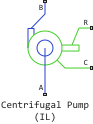
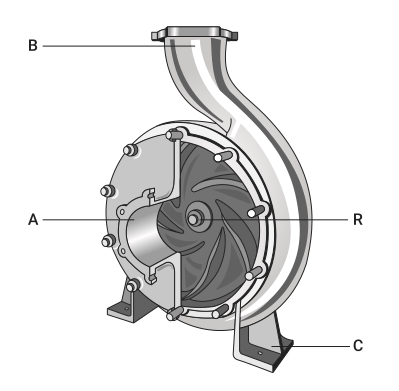
By default, the flow rate and pressure drop generated by the pump are directed so that the flow and pressure gradient are directed from port A to port B. Port C is the pump body, and port R is the pump shaft. The normal direction of rotation of the shaft can be specified in the parameter Mechanical orientation. If the shaft starts rotating in the opposite direction, the pressure difference on the block drops to zero.
configuration of ports
The figure shows the location of the block ports on a typical centrifugal pump.
Analytical parameterization: productivity, pressure and effective power
If set for the parameter Pump parameterization meaning Capacity, head, and brake power at reference shaft speed, the unit calculates the pressure gain at the pump as a function of the laws of similarity of the pump and the difference in set pressures:
where
-
— acceleration of free fall;
-
— the reference pressure value, which the unit calculates by quadratically approximating the pump pressure difference between the parameter values Maximum head at zero capacity, Nominal head and Maximum capacity at zero head;
-
— angular velocity of the shaft, ;
-
— parameter value Reference shaft speed;
-
— parameter value Impeller diameter scale factor; this block does not reflect changes in pump efficiency depending on its size;
-
— the density of the liquid in the network.
The torque on the shaft is
Reference effective power calculated as . The efficiency curve of the pump has a quadratic shape, the peak of which corresponds to the value of the parameter Nominal brake power, and it drops to zero when the productivity (consumption) is zero or maximum.
The unit calculates the reference flow rate as follows:
Parameterization of one-dimensional tabular data: pressure and effective power as functions of productivity
If set for the parameter Pump parameterization meaning 1D tabulated data - head and brake power vs. capacity at reference shaft speed, the pressure increase at the pump is a function of the parameter Reference head vector, , which is a function of the flow reference value :
where — acceleration of free fall.
The unit calculates the shaft torque based on the parameter Reference brake power vector, , which is a function of the reference flow rate:
where — parameter value Reference density. The reference flow rate is
it is used by the block to interpolate parameter values. Reference capacity vector, Reference head vector and Reference brake power vector in relation to .
When the simulation results exceed the range specified in the tables, the unit extrapolates the pressure based on the average slope of the pump curves and effective power to the nearest point.
Parameterization of two-dimensional tabular data: head and effective power as functions of productivity and angular velocity of the shaft
If set for the parameter Pump parameterization meaning 2D tabulated data - head and brake power vs. capacity and shaft speed, the pressure increase at the pump is a function of the parameter Head table, H(q,w), , which is a function of the reference flow rate and the angular velocity of the shaft :
The torque on the shaft is a function of the parameter Brake power table, Wb(q,w), , which, in turn, is a function of the reference flow rate and the angular velocity of the shaft :
The reference flow rate is
When the simulation results exceed the range specified in the tables, the unit extrapolates the pressure based on the average slope of the pump curves and effective power to the nearest point.
The missing data
If your table has unknown values, use NaN instead of these values. The block fills in the elements NaN by extrapolating based on the average slope of the pump curves. Do not use artificial numerical values, as they distort the pump’s behavior when operating in this range. When using unknown data:
-
Elements
NaNthe table should be arranged sequentially; -
Positions of the elements
NaNin the table in the parameters Head table, H(q,w) and Brake power table, Wb(q,w) must match; -
Elements
NaNThey should be located in the lower-left corner of the table, which corresponds to the highest productivity and the lowest angular velocity of the shaft.
Assumptions and limitations
-
If the shaft rotates in the opposite direction to the set mechanical position, the pressure difference on the block drops to zero, and the results may be inaccurate.
-
The unit does not take into account the dynamic pressure in the pump. The unit only takes into account the pump head due to static pressure.
Ports
Conserving
#
C
—
pump housing
rotational mechanics
Details
A non-directional port connected to the case.
| Program usage name |
|
#
R
—
shaft of the impeller
rotational mechanics
Details
A non-directional port connected to the shaft.
| Program usage name |
|
#
B
—
Isothermal liquid port
Isothermal liquid
Details
A non-directional port connected to the pump outlet section.
| Program usage name |
|
#
A
—
Isothermal liquid port
Isothermal liquid
Details
A non-directional port connected to the pump inlet section.
| Program usage name |
|
Parameters
Main
#
Maximum capacity at zero head —
maximum flow rate at zero pressure
m^3/s | mm^3/s | cm^3/s | m^3/hr | m^3/min | l/hr | l/min | l/s | gal/hr | gal/min | gal/s | ft^3/hr | ft^3/min | ft^3/s
Details
The maximum volumetric flow rate generated by the pump at zero pressure at a given angular velocity. This parameter defines the reference pressure drop at the pump, which the unit uses to approximate the quadratic equation for pressure in addition to the parameters Nominal capacity, Nominal head and Maximum head at zero capacity.
Dependencies
To use this parameter, set for the parameter Pump parameterization meaning Capacity, head, and brake power at reference shaft speed.
| Units |
|
| Default value |
|
| Program usage name |
|
| Evaluatable |
Yes |
#
Nominal brake power —
pump power
W | uW | mW | kW | MW | GW | V*A | HP_DIN
Details
Rated mechanical power on the shaft at a given angular velocity.
Dependencies
To use this parameter, set for the parameter Pump parameterization meaning Capacity, head, and brake power at reference shaft speed.
| Units |
|
| Default value |
|
| Program usage name |
|
| Evaluatable |
Yes |
#
Reference capacity vector —
volume consumption
m^3/s | mm^3/s | cm^3/s | m^3/hr | m^3/min | l/hr | l/min | l/s | gal/hr | gal/min | gal/s | ft^3/hr | ft^3/min | ft^3/s
Details
A vector of volumetric flow rates for tabular parameterization of pump head or effective power. The elements of this vector correspond one to one to the elements of the parameters Reference head vector and Reference brake power vector. Under normal operating conditions, the elements of this parameter are non-negative, but the block allows negative values. Negative performance is an abnormal working condition that can occur in certain situations.
Dependencies
To use this parameter, set for the parameter Pump parameterization meaning 1D tabulated data - head and brake power vs. capacity at reference shaft speed.
| Units |
|
| Default value |
|
| Program usage name |
|
| Evaluatable |
Yes |
#
Shaft speed vector, w —
angular velocity vector
rad/s | deg/s | rad/min | deg/min | rpm | rps
Details
The vector of values of the angular velocities of rotation of the shaft for tabular parameterization of the pump head. This vector forms an independent axis with the parameter Capacity vector, q for two-dimensional parameters Head table, H(q,w) and Brake power table, Wb(q,w). The elements of the vector must be listed in ascending order and must be larger 0.
Dependencies
To use this parameter, set for the parameter Pump parameterization meaning 2D tabulated data - head and brake power vs. capacity and shaft speed.
| Units |
|
| Default value |
|
| Program usage name |
|
| Evaluatable |
Yes |
#
Reference brake power vector —
effective pump power vector
W | uW | mW | kW | MW | GW | V*A | HP_DIN
Details
A vector of effective pump power values for a one-dimensional tabular parameterization of pump head and effective power. This parameter corresponds to one-to-one parameter elements Reference capacity vector. Under normal operating conditions, the elements of this parameter are non-negative, but the block allows negative values. In abnormal operating conditions, negative effective power is possible at the end of the vector.
Dependencies
To use this parameter, set for the parameter Pump parameterization meaning 1D tabulated data - head and brake power vs. capacity at reference shaft speed.
| Units |
|
| Default value |
|
| Program usage name |
|
| Evaluatable |
Yes |
#
Nominal capacity —
volumetric flow rate of the pump
m^3/s | mm^3/s | cm^3/s | m^3/hr | m^3/min | l/hr | l/min | l/s | gal/hr | gal/min | gal/s | ft^3/hr | ft^3/min | ft^3/s
Details
The nominal volumetric flow rate of the pump at a given angular velocity of the shaft.
Dependencies
To use this parameter, set for the parameter Pump parameterization meaning Capacity, head, and brake power at reference shaft speed.
| Units |
|
| Default value |
|
| Program usage name |
|
| Evaluatable |
Yes |
#
Reference density —
the density of the liquid for the specified pump performance data
kg/m^3 | g/m^3 | g/cm^3 | g/mm^3 | lbm/ft^3 | lbm/gal | lbm/in^3
Details
The reference density of the liquid. This value is usually indicated in the reference document or technical description. This parameter scales the pump performance for different liquids.
Dependencies
To use this parameter, set for the parameter Pump parameterization meaning 1D tabulated data - head and brake power vs. capacity at reference shaft speed or`2D tabulated data - head and brake power vs. capacity and shaft speed`.
| Units |
|
| Default value |
|
| Program usage names |
|
| Evaluatable |
Yes |
#
Mechanical orientation —
direction of rotation of the shaft
Positive angular velocity of port R relative to port C corresponds to normal pump operation | Negative angular velocity of port R relative to port C corresponds to normal pump operation
Details
The direction of rotation of the shaft to create flow from port A to port B.
| Values |
|
| Default value |
|
| Program usage name |
|
| Evaluatable |
No |
# Impeller diameter scale factor — the ratio of the model diameter to the reference diameter
Details
The ratio of the model diameter to the reference diameter for calculations based on the law of similarity. Change this value if there is a difference between the reference and system diameters of the impeller, for example, when checking the pump scaling. For system pumps with a smaller diameter than the reference pump, use a value less than one. For system pumps with a larger diameter than the reference pump, use a value greater than one. The unit does not reflect changes in pump efficiency depending on its size.
| Default value |
|
| Program usage name |
|
| Evaluatable |
Yes |
#
Maximum head at zero capacity —
maximum pump pressure in the absence of flow
m | um | mm | cm | km | in | ft | yd | mi | nmi
Details
Maximum pump pressure in the absence of flow at a given angular velocity. This parameter defines the reference pressure drop at the pump, which the unit uses to approximate the quadratic equation for pressure in addition to the parameters Nominal capacity, Nominal head and Maximum capacity at zero head.
Dependencies
To use this parameter, set for the parameter Pump parameterization meaning Capacity, head, and brake power at reference shaft speed.
| Units |
|
| Default value |
|
| Program usage name |
|
| Evaluatable |
Yes |
#
Reference shaft speed —
reference angular rotation speed of the shaft
rad/s | deg/s | rad/min | deg/min | rpm | rps
Details
The reference angular velocity for calculations according to the law of similarity.
Dependencies
To use this parameter, set for the parameter Pump parameterization meaning Capacity, head, and brake power at reference shaft speed or 1D tabulated data - head and brake power vs. capacity at reference shaft speed.
| Units |
|
| Default value |
|
| Program usage names |
|
| Evaluatable |
Yes |
# Minimum shaft speed threshold as fraction of reference — threshold value for the minimum angular velocity of the shaft
Details
The threshold value for the minimum shaft rotation speed as a fraction of the reference angular velocity of the shaft. The unit uses this value to prevent the shaft rotation speed from being reset to zero and a division by zero error from occurring in the expression for .
Dependencies
To use this parameter, set for the parameter Pump parameterization meaning Capacity, head, and brake power at reference shaft speed or 1D tabulated data - head and brake power vs. capacity at reference shaft speed.
| Default value |
|
| Program usage name |
|
| Evaluatable |
Yes |
#
Head table, H(q,w) —
pump pressure matrix
m | um | mm | cm | km | in | ft | yd | mi | nmi
Details
Matrix size the values of the pump head at a given volume flow and angular velocity. Under normal operating conditions, the elements of this parameter are non-negative, but the block allows negative values. In abnormal operating conditions, negative pressure or pressure drop is possible at the bottom of the table. The block uses linear interpolation between table elements. and — the sizes of the corresponding vectors:
-
— the number of elements in the parameter Capacity vector, q;
-
— the number of elements in the parameter Shaft speed vector, w. All lines must be arranged in strictly ascending order.
If your table has unknown values, use NaN instead of these values. The block fills in the elements NaN by extrapolating based on the average slope of the pump curves. Do not use artificial numerical values, as they distort the pump’s behavior when operating in this range. When using unknown data:
-
Elements
NaNthe table should be arranged sequentially; -
Positions of the elements
NaNin the table in the parameters Head table, H(q,w) and Brake power table, Wb(q,w) must match; -
Elements
NaNThey should be located in the lower-left corner of the table, which corresponds to the highest productivity and the lowest angular velocity of the shaft.
Dependencies
To use this parameter, set for the parameter Pump parameterization meaning 2D tabulated data - head and brake power vs. capacity and shaft speed.
| Units |
|
| Default value |
|
| Program usage name |
|
| Evaluatable |
Yes |
#
Reference head vector —
pump pressure vector
m | um | mm | cm | km | in | ft | yd | mi | nmi
Details
A vector of pump head values for a one-dimensional tabular parameterization of pump head and effective power. This parameter corresponds to one-to-one parameter elements Reference capacity vector. Under normal operating conditions, the elements of this parameter are non-negative, but the block allows negative values. In abnormal operating conditions, negative pressure or pressure drop is possible at the end of the vector.
Dependencies
To use this parameter, set for the parameter Pump parameterization meaning 1D tabulated data - head and brake power vs. capacity at reference shaft speed.
| Units |
|
| Default value |
|
| Program usage name |
|
| Evaluatable |
Yes |
#
Check if operating beyond normal pump operation —
the option to notify when the block goes beyond the operating parameters
None | Error
Details
The option to notify when the unit goes beyond the normal operating parameters of the pump. This situation occurs when the flow rate through the pump is negative or exceeds the maximum pump capacity.
Dependencies
To use this parameter, set for the parameter Pump parameterization meaning Capacity, head, and brake power at reference shaft speed.
| Values |
|
| Default value |
|
| Program usage name |
|
| Evaluatable |
No |
#
Brake power table, Wb(q,w) —
effective pump power matrix
W | uW | mW | kW | MW | GW | V*A | HP_DIN
Details
Matrix size values of the effective pump power at a given volume flow rate and angular velocity. Under normal operating conditions, the elements of this parameter are non-negative, but the block allows negative values. The block uses linear interpolation between table elements. and — the sizes of the corresponding vectors:
-
— the number of elements in the parameter Capacity vector, q;
-
— the number of elements in the parameter Shaft speed vector, w. All lines must be arranged in strictly ascending order.
If your table has unknown values, use NaN instead of these values. The block fills in the elements NaN by extrapolating based on the average slope of the pump curves. Do not use artificial numerical values, as they distort the pump’s behavior when operating in this range. When using unknown data:
-
Elements
NaNthe table should be arranged sequentially; -
Positions of the elements
NaNin the table in the parameters Head table, H(q,w) and Brake power table, Wb(q,w) must match; -
Elements
NaNThey should be located in the lower-left corner of the table, which corresponds to the highest productivity and the lowest angular velocity of the shaft.
Dependencies
To use this parameter, set for the parameter Pump parameterization meaning 2D tabulated data - head and brake power vs. capacity and shaft speed.
| Units |
|
| Default value |
|
| Program usage name |
|
| Evaluatable |
Yes |
#
Capacity vector, q —
vector of volume expenses
m^3/s | mm^3/s | cm^3/s | m^3/hr | m^3/min | l/hr | l/min | l/s | gal/hr | gal/min | gal/s | ft^3/hr | ft^3/min | ft^3/s
Details
A vector of volumetric flow rates for tabular parameterization of the pump head. This vector forms an independent axis with the parameter Shaft speed vector, w for two-dimensional parameters Head table, H(q,w) and Brake power table, Wb(q,w). The elements of the vector should be listed in ascending order. Under normal operating conditions, the elements of this parameter are non-negative, but the block allows negative values. Negative performance is an abnormal working condition that can occur in certain situations.
Dependencies
To use this parameter, set for the parameter Pump parameterization meaning 2D tabulated data - head and brake power vs. capacity and shaft speed.
| Units |
|
| Default value |
|
| Program usage name |
|
| Evaluatable |
Yes |
#
Nominal head —
pump pressure
m | um | mm | cm | km | in | ft | yd | mi | nmi
Details
The nominal pressure drop of the pump, normalized relative to gravity and liquid density, at a given angular velocity of the shaft.
Dependencies
To use this parameter, set for the parameter Pump parameterization meaning Capacity, head, and brake power at reference shaft speed.
| Units |
|
| Default value |
|
| Program usage name |
|
| Evaluatable |
Yes |
#
Pump parameterization —
parameterization of pressure and effective power
Capacity, head, and brake power at reference shaft speed | 1D tabulated data - head and brake power vs. capacity at reference shaft speed | 2D tabulated data - head and brake power vs. capacity and shaft speed
Details
Parameterization of the pressure and effective power of the pump, set as follows:
-
Capacity, head, and brake power at reference shaft speed— parameterization of pump pressure gain and shaft torque using analytical methods; -
1D tabulated data - head and brake power vs. capacity at reference shaft speed— parameterization of pressure and effective power based on tabular pressure and effective power data for a given performance; -
2D tabulated data - head and brake power vs. capacity and shaft speed— parameterization of head and effective power based on tabular data of head and effective power at a given output and angular velocity of the shaft.
| Values |
|
| Default value |
|
| Program usage name |
|
| Evaluatable |
No |