IMU Filter
Orientation calculation using an inertial measurement unit filter.
blockType: IMUFilter
|
Path in the library: |
Description
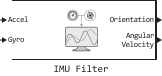
Block IMU Filter Combines accelerometer and gyroscope sensor data to estimate device orientation.
Ports
Input
#
Accel
—
accelerometer readings in the coordinate system of the sensor housing, m/s2
the matrix
Details
Accelerometer readings in the coordinate system of the sensor housing in m/s2, given as a real matrix of the size on , where — the number of samples, and the three columns of the matrix represent measurements respectively.
| Data types |
|
| Complex numbers support |
No |
#
Gyro
—
gyroscope readings in the coordinate system of the sensor housing, rad/s
the matrix
Details
The gyroscope readings in the coordinate system of the sensor housing in rad/s, set as a real matrix of the size on , where — the number of samples, and the three columns of the matrix represent measurements respectively.
| Data types |
|
| Complex numbers support |
No |
Output
#
Orientation
—
orientation of the sensor housing coordinate system relative to the navigation coordinate system
the matrix | array
Details
The orientation of the sensor housing coordinate system relative to the navigation coordinate system, returned as a real matrix on or as an array of rotation matrices on on . Each row of the matrix on It contains four quaternion elements.
Number of input samples and the parameter value Decimation factor determine the size of the output data .
The output format depends on the parameter value Orientation format.
| Data types |
|
| Complex numbers support |
No |
#
Angular Velocity
—
angular velocity in the coordinate system of the sensor housing, rad/s
the matrix
Details
The angular velocity, taking into account the displacement of the gyroscope in the coordinate system of the sensor housing in rad/s, returned as a real matrix of the size on .
Number of input samples and the parameter value Decimation factor determine the size of the output data .
| Data types |
|
| Complex numbers support |
No |
Parameters
Filter Settings
#
Reference frame —
navigation coordinate system
NED | ENU
Details
The navigation coordinate system, set as NED (north-east-down) or ENU (east-north-up).
| Values |
|
| Default value |
|
| Program usage name |
|
| Tunable |
No |
| Evaluatable |
No |
#
Orientation format —
orientation output format
quaternion | Rotation matrix
Details
Output data format Orientation:
-
quaternion— the Orientation output port outputs a real matrix on . Each row of the matrix contains four quaternion elements. -
Rotation matrix— the Orientation output port outputs an array of rotation matrices on on .
Number of input samples and the parameter Decimation factor determine the size of the output data .
| Values |
|
| Default value |
|
| Program usage name |
|
| Tunable |
No |
| Evaluatable |
No |
#
Decimation factor —
decimation coefficient
Real number
Details
The decimation coefficient by which the data transfer rate from the input sensor is reduced, set as a positive integer.
The number of rows in the Accel and Gyro input data matrices must be a multiple of the decimation factor.
| Default value |
|
| Program usage name |
|
| Tunable |
No |
| Evaluatable |
Yes |
#
Initial process noise —
the initial noise of the process
Matrix of real numbers
Details
The initial noise level of the process, set as a real matrix of size on .
| Default value |
|
| Program usage name |
|
| Tunable |
No |
| Evaluatable |
Yes |
Measurement Noise
#
Accelerometer noise ((m/s²)²) —
noise dispersion of the accelerometer signal, (m/s2)2
Real number
Details
The noise dispersion of the accelerometer signal in (m/s2)2, given as a positive real scalar.
| Default value |
|
| Program usage name |
|
| Tunable |
Yes |
| Evaluatable |
Yes |
#
Gyroscope noise ((rad/s)²) —
noise dispersion of the gyroscope signal, (rad/s)2
Real number
Details
The noise dispersion of the gyroscope signal in (rad/s) 2, given as a positive real scalar.
| Default value |
|
| Program usage name |
|
| Tunable |
Yes |
| Evaluatable |
Yes |
#
Gyroscope drift noise ((rad/s)²) —
gyroscope displacement drift variance, (rad/s)2
Real number
Details
The variance of the gyroscope displacement drift in (rad/s)2, given as a positive real scalar.
| Default value |
|
| Program usage name |
|
| Tunable |
Yes |
| Evaluatable |
Yes |
Environmental Noise
#
Linear acceleration noise ((m/s²)²) —
noise dispersion of linear acceleration, (m/s2)2
Real number
Details
The noise variance of linear acceleration in (m/s2)2, given as a positive real scalar. Linear acceleration is modeled as a white noise process filtered out by a low-pass filter.
| Default value |
|
| Program usage name |
|
| Tunable |
Yes |
| Evaluatable |
Yes |
#
Linear acceleration decay factor —
attenuation coefficient for linear acceleration drift
Real number
Details
Attenuation coefficient for linear acceleration drift, given as a scalar in the range [0, 1). If the linear acceleration changes rapidly, set this parameter to a lower value. If the linear acceleration changes slowly, set this parameter to a higher value. Linear acceleration drift is modeled as a white noise process filtered out by a low-pass filter.
| Default value |
|
| Program usage name |
|
| Tunable |
Yes |
| Evaluatable |
Yes |