GPS
Simulation of GPS sensor readings with noise.
blockType: SubSystem
|
Path in the library: |
Description
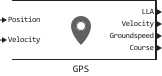
Block GPS outputs noise-distorted GPS measurements based on the input values of position and velocity in the local coordinate system or in the geodetic coordinate system. The block uses the WGS84 Earth model to convert local coordinates to geodetic latitude-longitude-altitude (LLA) coordinates.
Ports
Input
#
Position
—
the position of the GPS receiver in the navigation coordinate system
the matrix
Details
Set the input position of the GPS receiver in the navigation coordinate system as a real matrix on , where — the number of counts in the current frame. The format of the matrix rows depends on the parameter value Position input format:
-
If for the parameter Position input format the value is set
Local, then specify each row of Position as Cartesian coordinates in meters relative to the local navigation reference system set by the parameter Reference frame, with the origin specified by the parameter Reference location ([deg, deg, m]). -
If for the parameter Position input format the value is set
Geodetic, then specify each row of Position as geodetic coordinates of the form[latitude longitude altitude]. Valueslatitudeandlongitudeindicated in degrees.Altitude— height above the WGS84 ellipsoid model in meters.
| Data types |
|
| Complex numbers support |
No |
#
Velocity
—
speed in the local navigation coordinate system, m/s
the matrix
Details
Specify the input speed of the GPS receiver in the navigation coordinate system in meters per second as a real matrix on , where — the number of counts in the current frame. The format of the matrix rows depends on the parameter value Position input format:
-
If for the parameter Position input format the value is set
Local, then specify each line of Velocity relative to the local navigation reference system (NEDorENU), set by the parameter Reference frame, with the origin specified by the parameter Reference location ([deg, deg, m]). -
If for the parameter Position input format the value is set
Geodetic, then specify each row of Velocity relative to the navigation reference frame (NEDorENU), set by the parameter Reference frame, with the origin set in Position.
| Data types |
|
| Complex numbers support |
No |
Output
#
LLA
—
position in the LLA coordinate system
the matrix
Details
The position of the GPS receiver in the geodetic coordinate system latitude-longitude-altitude (LLA), returned as a real matrix on , where — the number of counts in the current frame. Latitude and longitude are indicated in degrees, north and east are positive. The height above sea level is in meters.
| Data types |
|
| Complex numbers support |
No |
#
Velocity
—
speed in the local navigation coordinate system, m/s
the matrix
Details
The speed of the GPS receiver in the local navigation coordinate system in m/s, returned as a real matrix on , where — the number of counts in the current frame. The format of the matrix rows depends on the parameter value Position input format:
-
If for the parameter Position input format the value is set
Local, then specify each line of Velocity relative to the local navigation reference system (NEDorENU), set by the parameter Reference frame, with the origin specified by the parameter Reference location ([deg, deg, m]). -
If for the parameter Position input format the value is set
Geodetic, then specify each row of Velocity relative to the navigation reference frame (NEDorENU), set by the parameter Reference frame, with the origin defined in LLA.
| Data types |
|
| Complex numbers support |
No |
#
Groundspeed
—
the value of the horizontal velocity in the local navigation coordinate system, m/s
vector
Details
The value of the horizontal velocity of the GPS receiver in the local navigation coordinate system in m/s is returned as a real vector-a column of size , where — the number of counts in the current frame.
| Data types |
|
| Complex numbers support |
No |
#
Course
—
the direction of the horizontal velocity in the local navigation coordinate system, degrees.
vector
Details
The direction of the horizontal velocity of the GPS receiver in the local navigation coordinate system, in degrees, is returned as a real vector-a column of size with values from 0 before 360. The North corresponds to 0 degrees, and east — 90 degrees. — the number of counts in the current frame.
| Data types |
|
| Complex numbers support |
No |
Parameters
Parameters
#
Reference frame —
coordinate system
NED | ENU
Details
Specify the coordinate system NED (north-east-down) or ENU(east-north-up).
| Values |
|
| Default value |
|
| Program usage name |
|
| Tunable |
No |
| Evaluatable |
Yes |
#
Position input format —
the format for entering position coordinates
Local | Geodetic
Details
Specify the format for entering the position coordinates:
-
If the value is specified
Local, then the input data for the Position port must be set as Cartesian coordinates relative to the local navigation system specified by the parameter Reference frame, with a fixed origin defined by the parameter Reference location ([deg, deg, m]). The Velocity input data must also be set relative to this local navigation system. -
If the value is specified
Geodetic, then the input data for the port Position must be set as geodetic coordinates in the format[latitude longitude altitude]. The Velocity input data must also be set relative to the navigation system specified by the parameter Reference frame, with the origin corresponding to the port Position.
| Values |
|
| Default value |
|
| Program usage name |
|
| Tunable |
No |
| Evaluatable |
Yes |
# Reference location ([deg, deg, m]) — the origin of the local navigation coordinate system
Details
Specify the origin of the local coordinate system as a three-element row vector in geodetic coordinates. [latitude longitude altitude], where altitude — height above the reference ellipsoid of the WGS84 model. The first two elements (latitude and longitude) are specified in degrees, the third element (altitude) — in meters. The format of degrees is decimal degrees.
Dependencies
To use this parameter, set for the parameter Position input format meaning Local.
| Default value |
|
| Program usage name |
|
| Tunable |
No |
| Evaluatable |
Yes |
# Horizontal position accuracy (m) — accuracy of horizontal position, m
Details
Specify the accuracy of the horizontal position as a non-negative real scalar in meters. The accuracy of the horizontal position determines the standard deviation of the noise when measuring the horizontal position. Increasing this value increases the noise in the measurement, reducing its accuracy.
| Default value |
|
| Program usage name |
|
| Tunable |
No |
| Evaluatable |
Yes |
# Vertical position accuracy (m) — accuracy of vertical position, m
Details
Specify the accuracy of the vertical position as a non-negative real scalar in meters. The accuracy of the vertical position determines the standard deviation of the noise when measuring the vertical position. Increasing this value increases the noise in the measurement, reducing its accuracy.
| Default value |
|
| Program usage name |
|
| Tunable |
No |
| Evaluatable |
Yes |
# Velocity accuracy (m/s) — speed measurement accuracy, m/s
Details
Specify the accuracy of the velocity measurement in the form of a non-negative real scalar in m/s. The accuracy of the speed measurement determines the standard deviation of the noise when measuring the speed. Increasing this value increases the noise in the measurement, reducing its accuracy.
| Default value |
|
| Program usage name |
|
| Tunable |
No |
| Evaluatable |
Yes |
# Decay Factor — attenuation coefficient for global position noise
Details
Specify the attenuation coefficient for global position noise as a numeric scalar in the range [0, 1]. Attenuation coefficient 0 corresponds to white noise simulation. Attenuation coefficient 1 corresponds to the simulation of the random walk process.
| Default value |
|
| Program usage name |
|
| Tunable |
No |
| Evaluatable |
Yes |
Radomization
# Seed — initial value
Details
The initial value for the mt19937ar random number generator algorithm is a non-negative integer.
| Default value |
|
| Program usage name |
|
| Tunable |
No |
| Evaluatable |
Yes |