Dog Clutch
A cam clutch that engages when the cams engage on its plates.
blockType: Engee1DMechanical.Clutches.Dog
|
Path in the library: |

Description
Block Dog Clutch It is a non-slip clutch that uses cam engagement to transfer torque between the cardan shafts. Cam clutches are widely used in systems that require high-speed and frequent gear changes. Cam clutches are widely used in motorcycle manual transmissions and some industrial machines.
The ring and hub are the main components of the cam clutch. The input shaft rotates a ring with grooves. The hub is connected to an output shaft having protruding cams that fit into the grooves of the ring. When shifting gears, the cams and slots engage, connecting both components and transmitting power. Re-shifting the gear turns off the clutch, which causes the cams to exit the slots and allows the transmission to rotate freely. The ring and hub rotate together as a single unit.
To control the actuation, the cam clutch is equipped with a gearshift mechanism that adjusts the position of the ring relative to the hub. You can control the gearshift lever using a physical signal or a non-directional mechanical port S using the parameter Torque transmission model. Select the parameter value according to your specifications, gearshift accuracy, and clutch behavior.:
-
Two-mode— a completely abstract model of torque transmission based on transitions between states. This setup is fast enough for real-time simulation and does not require knowledge of coupling dimensions. The gearshift lever can only be operated using a physical or logical signal. -
Friction clutch approximation - Suitable for HIL and linearization— composite block implementation Fundamental Friction Clutch medium and high precision. This setting supports thermal modeling. The gearshift lever can be controlled either by means of a physical signal or through a non-directional mechanical port S. -
Dynamic with backlash— A high-precision clutch actuation model that takes into account phenomena such as backlash, torsional compliance, and contact forces between the ring and hub cams. -
Dynamic model— implementation of medium and high precision operating modes, which simulates the engagement lock and determines the position of the gearshift lever using a non-directional mechanical port S.
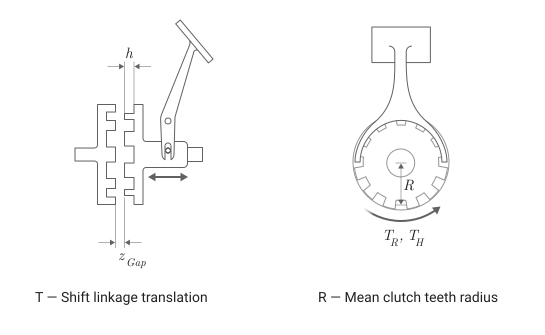
Moving the ring towards the hub so that the cams engage puts the clutch in the engaged state. The cam overlap must exceed the minimum value for activation. Moving the ring in the opposite direction so that the two rows of cams no longer engage puts the clutch back into the off state. The S port determines the position of the gearshift lever. When the clutch is completely off, the gearshift lever position is zero. When the clutch is fully engaged, the position of the gearshift lever is equal to the sum of the cam height and the gap between the ring and the hub when fully off.:
where
-
— gearshift lever position;
-
— cam height;
-
— the gap between the ring and the hub in the off state.
The figure shows the views of the cam clutch from the side and from the front, as well as some of its important parameters.
Torque transmission models
You can choose one of the following models of torque transmission.
The two-mode model
To model an abstract cam coupling, set the parameter Torque transmission model meaning Two-mode. The dual-mode torque transmission model uses state transitions to control whether the clutch is turned on or off. You can control the position of the gearshift lever using logical commands or a physical signal of the lever position. When using logical commands, the value false at the input port, X corresponds to the switched-off coupling, and the value true — the clutch is turned on.
The approximate model of the friction clutch
If for the parameter Torque transmission model the value is set Friction clutch approximation - Suitable for HIL and linearization then the block considers the inclusion of the clutch as a phenomenon of friction between the ring and the hub. This setting is better suited for linearization, fixed-step modeling, and hardware-software modeling. The block uses a composite implementation of the block Fundamental Friction Clutch.
When using this setting, the coupling has three possible configurations: off, on, and locked. In the off state, the contact force between the ring and the hub is zero. This force remains zero until the gearshift lever reaches the minimum position to engage.
When the cams of the ring and hub overlap exceeds the minimum value for switching on, the contact force between the two components begins to increase linearly with a change in the position of the gear lever .
When fully engaged, the contact force reaches its maximum value, and the coupling switches to a locked state. In this state, the ring and hub rotate as a single unit without slipping. To unlock the clutch, the transmitted torque must exceed the value of the parameter Maximum transmitted torque.
dynamic model with backlash
If for the parameter Torque transmission model the value is set Dynamic with backlash The block simulates phenomena such as backlash, torsional compliance, and contact forces between the ring and hub cams. This model provides higher accuracy than the approximate friction clutch model.
When using this setting, the coupling has two possible configurations: off and on. In the off state, the contact force between the ring and the hub is zero. This force remains zero until the gearshift lever reaches the minimum position to engage.
When the cams of the ring and hub overlap exceeds the threshold value for switching on, the clutch transmits the torque. This torque is the sum of the torques of the spring and the damper, including the gap between the cams of the ring and the hub, so that
where
-
— torsional stiffness of the coupling ring hub;
-
— the relative angle between the ring and the hub relative to the common axis of rotation;
-
— the gap between the cams of the ring and the hub;
-
— the relative angular velocity between the ring and the hub. This variable describes the rate of slippage of the two components relative to each other.
Malleable end stops limit the forward movement of the gearshift lever and the ring. The compliance model considers end stops as linear spring-damping systems. The position of the end stops depends on the relative angle and angular velocity between the cams of the ring and the hub:
-
If the cams are aligned and the relative angular velocity is less than the maximum value for turning on the clutch, then the stop position is determined by the sum of the gap between the ring and the hub when fully turned off and the cam height. The clutch can turn on in this stop position.
-
If the cams are not aligned or the relative angular velocity exceeds the maximum value for coupling activation, the stop position is set in such a way as to prevent the ring from engaging with the hub. The clutch does not turn on in this stop position.
Translational friction prevents the gearshift lever and the ring from moving. This friction is the sum of the Coulomb and viscous components, so that
where
-
— the total force of translational friction acting on the gearshift lever and the ring;
-
— coefficient of kinetic friction between the cams of the ring and the hub;
-
— the vertically directed force between the cams of the ring and the hub, where ;
-
— the speed of translational movement of the gearshift lever and the ring;
-
— the threshold value of the translational velocity; below this threshold value, the hyperbolic tangent function smooths the Coulomb friction force to zero when the speed of the gearshift lever and the ring tends to zero;
-
— the coefficient of viscous damping acting on the gearshift lever and the ring.
modal dynamic model
If for the parameter Torque transmission model the value is set Dynamic model, then the unit determines the discrete modal behavior of the clutch by reading the position of the gear lever from the non-directional mechanical port S. This setting takes into account more complex coupling dynamics than parameterization. Two-mode, and it works faster than the settings Friction clutch approximation - Suitable for HIL and linearization and Dynamic with backlash.
You can use the setting Dynamic model to simulate clutch locking when the speed difference is too great for the clutch discs to trigger. The block represents the coupling lock as a spring-damping system in which the coefficients of elasticity and damping can be parameterized. The engagement modes overlap, which prevents them from changing until the position of the gear lever goes beyond the engagement overlap area. The area of overlap of the engagement is determined by the parameter Tooth overlap to engage.
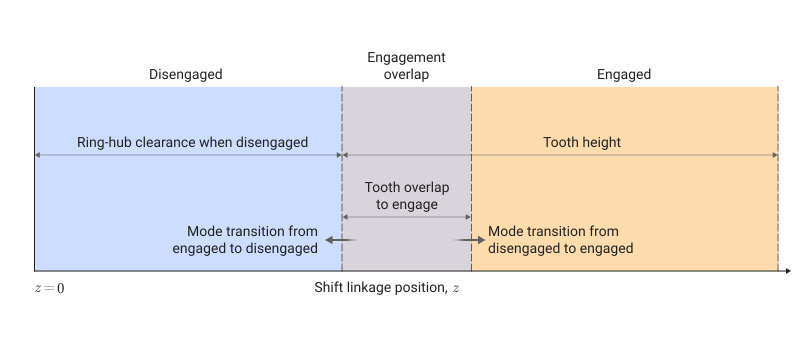
Lever position limitations:
-
— position of the gearshift lever in port S;
-
— parameter Tooth height;
-
— parameter Ring-hub clearance when disengaged;
-
— parameter Tooth overlap to engage;
-
— parameter Engagement speed threshold.
Switching mode positions:
-
— the clutch is completely off;
-
— the clutch is switched off when the position of the gearshift lever is in the area defined by ; the coupling can switch from the off state to the on state if ;
-
— the clutch is turned on when located in the area defined by ; the coupling can switch from the on to the off state if ;
-
— the clutch is fully engaged;
-
— when located in the area of the engagement overlap, the clutch is activated only when the speed difference is less than the parameter value. .
Dissipation of rotational power
Slipping of the clutch under the action of applied torque leads to power dissipation. The power loss is equal to the product of the angular velocity of the slip and the moment of contact between the ring and the hub, so that
where
-
— power dissipation due to slippage;
-
— kinetic moment of contact.
Thermal modeling
If for the parameter Torque transmission model the value is set Friction clutch approximation - Suitable for HIL and linearization, then it is possible to simulate the effect of heat flow and temperature changes using an additional non-directional heat port T.
Ports
Output
#
X
—
coupling position, dimensionless or in meters
scalar
Details
The output port associated with the position of the coupling is in meters or dimensionless. If for the parameter Torque transmission model the value is set Two-mode, then the port outputs a boolean value true for the enabled state, or false for the off state. Otherwise, the port indicates the position of the coupling.
| Data types |
|
| Complex numbers support |
No |
Input
#
S
—
logical gearshift mechanism, dimensionless
scalar
Details
The physical signal input port connected to the gearshift lever is dimensionless. Logical value true allows you to turn on the clutch if the relative rotational speeds of the hub and the ring are within acceptable values. Logical value false it turns off the clutch.
Dependencies
To use this port, set the parameter Torque transmission model meaning Two-mode, and for the parameter Abstract shift linkage control meaning Logic-controlled.
| Data types |
|
| Complex numbers support |
No |
#
S
—
gearshift mechanism, dimensionless
scalar
Details
The physical signal input port connected to the gearshift lever.
Dependencies
To use this port, set the parameter Torque transmission model meaning:
-
Two-mode, and for the parameter Abstract shift linkage control meaningPhysical signal; -
Friction clutch approximation - Suitable for HIL and linearization, and for the parameter Shift linkage control meaningPhysical signal; -
Dynamic with backlash, and for the parameter Shift linkage control meaningPhysical signal.
| Data types |
|
| Complex numbers support |
No |
Conserving
#
T
—
heat flow
warm
Details
A non-directional heat port connected to the heat flow.
Dependencies
To use this port, set the parameter Torque transmission model meaning Friction clutch approximation - Suitable for HIL and linearization, and for the parameter Thermal port check the box.
| Program usage name |
|
#
S
—
gearshift mechanism
translational mechanics
Details
A non-directional mechanical port connected to the gearshift lever.
Dependencies
To use this port, set the parameter Torque transmission model meaning:
-
Friction clutch approximation - Suitable for HIL and linearization, and for the parameter Shift linkage control meaningConserving port; -
Dynamic model; -
Dynamic with backlash, and for the parameter Shift linkage control meaningConserving port.
| Program usage name |
|
#
H
—
coupling hub
rotational mechanics
Details
A non-directional mechanical port connected to the clutch hub.
| Program usage name |
|
#
R
—
coupling ring
rotational mechanics
Details
A non-directional mechanical port connected to the coupling ring.
| Program usage name |
|
Parameters
Thermal Port
#
Initial temperature —
Initial temperature
K | degC | degF | degR | deltaK | deltadegC | deltadegF | deltadegR
Details
The temperature of the component at the beginning of the simulation. The initial temperature changes the efficiency of the component by adjusting the initial engagement or friction losses.
Dependencies
To use this parameter, set for the parameter Torque transmission model meaning Friction clutch approximation - Suitable for HIL and linearization, and for the parameter Thermal port check the box.
| Units |
|
| Default value |
|
| Program usage name |
|
| Evaluatable |
Yes |
#
Thermal mass —
resistance to temperature changes
J/K | kJ/K
Details
The thermal energy required to change the temperature of a component by one degree. The greater the thermal mass, the more resistant the component is to temperature changes.
Dependencies
To use this parameter, set for the parameter Torque transmission model meaning Friction clutch approximation - Suitable for HIL and linearization, and for the parameter Thermal port check the box.
| Units |
|
| Default value |
|
| Program usage name |
|
| Evaluatable |
Yes |
Initial Conditions
#
Initial state —
initial condition of the coupling
Unlocked | Locked
Details
The state of the coupling at the beginning of the simulation:
-
Unlocked— the clutch transmits zero torque between the ring and the hub; -
Locked— the clutch transmits the torque between the ring and the hub.
Dependencies
To use this parameter, set for the parameter Torque transmission model meaning Friction clutch approximation - Suitable for HIL and linearization or Dynamic with backlash.
| Values |
|
| Default value |
|
| Program usage name |
|
| Evaluatable |
No |
#
Initial shift linkage position —
the initial position of the gearshift lever
m | um | mm | cm | km | in | ft | yd | mi | nmi
Details
The position of the gearshift lever at the zero point of the simulation time. The clutch is switched off when this value is in the range from zero to the sum of the gaps between the ring and the hub.
Dependencies
To use this parameter, set for the parameters:
-
Torque transmission model meaning
Dynamic with backlash; -
Shift linkage control meaning
Conserving port.
| Units |
|
| Default value |
|
| Program usage name |
|
| Evaluatable |
Yes |
#
Initial ring-hub offset angle —
the initial angle of displacement of the ring relative to the hub
rad | deg | rev | mrad | arcsec | arcmin | gon
Details
The angle of rotation between the ring and the hub at the zero time of the simulation. This angle determines the possibility of engagement of the ring and hub cams. The initial displacement angle must satisfy these conditions:
-
If the initial state of the coupling is off, the initial offset angle must be in the range
where — the number of cams of the ring or hub. Both components have the same number of cams.
-
If the initial state of the coupling is on, the initial offset angle must be in the range
where — the angle of the gap between the cams of the ring and the hub.
Dependencies
To use this parameter, set for the parameter Torque transmission model meaning Dynamic with backlash.
| Units |
|
| Default value |
|
| Program usage name |
|
| Evaluatable |
Yes |
Clutch
#
Maximum transmitted torque —
maximum transmitted torque
N*m | uN*m | mN*m | kN*m | MN*m | GN*m | kgf*m | lbf*in | lbf*ft
Details
The maximum torque that the clutch can transmit. This value corresponds to a non-slip engagement configuration. If the torque transmitted between the ring and the hub exceeds this value, both components begin to slip relative to each other. This torque determines the limit of static friction in the approximation of a friction clutch.
Dependencies
To use this parameter, set for the parameter Torque transmission model meaning Friction clutch approximation - Suitable for HIL and linearization.
| Units |
|
| Default value |
|
| Program usage name |
|
| Evaluatable |
Yes |
#
Extrapolation method —
the extrapolation method
Linear | Nearest | Error
Details
An extrapolation method for determining the output value when the input value is outside the range specified in the argument list.:
-
Linear— select this value to plot a curve with continuous first-order derivatives in the extrapolation domain and on the boundary with the interpolation domain; -
Nearest— select this value to get an extrapolation that does not go beyond the highest point in the data and does not go beyond the lowest point in the data.; -
Error— select this value to avoid going into extrapolation mode. If the input signal is outside the tabular range, the simulation stops and returns an error.
For more information about extrapolation algorithms, see the block page. 1-D Lookup Table.
Dependencies
To use this parameter, set for the parameter Torque transmission model meaning Friction clutch approximation - Suitable for HIL and linearization, and for the parameter Thermal port check the box.
| Values |
|
| Default value |
|
| Program usage name |
|
| Evaluatable |
No |
#
Torque transmission model —
the model of torque transmission
Two-mode | Friction clutch approximation - Suitable for HIL and linearization | Dynamic with backlash | Dynamic model
Details
A method for modeling the operation of a cam clutch:
-
Two-mode— a completely abstract model of torque transmission based on transitions between states. This setup is fast enough for real-time simulation and does not require knowledge of coupling dimensions. The gearshift lever can only be operated using a physical or logical signal. -
Friction clutch approximation - Suitable for HIL and linearization— composite block implementation Fundamental Friction Clutch medium and high precision. This setting supports thermal modeling. The gearshift lever can be controlled either by means of a physical signal or through a non-directional mechanical port S. -
Dynamic with backlash— A high-precision clutch actuation model that takes into account phenomena such as backlash, torsional compliance, and contact forces between the ring and hub cams. -
Dynamic model— a coupling activation model at the system level that takes into account the impact of engagement lock due to speed differences.
| Values |
|
| Default value |
|
| Program usage name |
|
| Evaluatable |
No |
#
Rotational backlash —
backlash during rotation
rad | deg | rev | mrad | arcsec | arcmin | gon
Details
Permissible angular displacement (backlash) between the ring and hub cams when the clutch is engaged. This value must be greater than zero.
Dependencies
To use this parameter, set for the parameter Torque transmission model meaning Dynamic with backlash.
| Units |
|
| Default value |
|
| Program usage name |
|
| Evaluatable |
Yes |
# Thermal port — turning on the heat port
Details
Whether to turn on the non-directional thermal port T.
Dependencies
To use this parameter, set for the parameter Torque transmission model meaning Friction clutch approximation - Suitable for HIL and linearization.
| Default value |
|
| Program usage name |
|
| Evaluatable |
No |
#
Clutch teeth mean radius —
the average radius of the clutch cams
m | um | mm | cm | km | in | ft | yd | mi | nmi
Details
The distance from the center of the ring or hub to the corresponding center of the cams. The average cam radius determines the normal contact forces between the ring and hub cams, taking into account the torque transmitted between the two components. This value must be greater than zero.
Dependencies
To use this parameter, set for the parameter Torque transmission model meaning Friction clutch approximation - Suitable for HIL and linearization or Dynamic with backlash and for the parameter Shift linkage control meaning Conserving port.
| Units |
|
| Default value |
|
| Program usage name |
|
| Evaluatable |
Yes |
#
Interpolation method —
the interpolation method
Linear | Smooth
Details
An interpolation method for approximating the output value when the input value is between two consecutive grid points:
-
Linear— Select this value to achieve the best performance; -
Smooth— select this value to plot a continuous curve with continuous first-order derivatives.
For more information about interpolation algorithms, see the block page. 1-D Lookup Table.
Dependencies
To use this parameter, set for the parameter Torque transmission model meaning Friction clutch approximation - Suitable for HIL and linearization, and for the parameter Thermal port check the box.
| Values |
|
| Default value |
|
| Program usage name |
|
| Evaluatable |
No |
#
Maximum transmitted torque vector —
maximum transmitted torque
N*m | uN*m | mN*m | kN*m | MN*m | GN*m | kgf*m | lbf*in | lbf*ft
Details
The maximum transmitted torque for a given temperature in the parameter Temperature vector.
Dependencies
To use this parameter, set for the parameter Torque transmission model meaning Friction clutch approximation - Suitable for HIL and linearization, and for the parameter Thermal port check the box.
| Units |
|
| Default value |
|
| Program usage name |
|
| Evaluatable |
Yes |
#
Torsional damping —
torsion damping
N*m*s/rad | mN*m*s/rad | kN*m*s/rad | kgf*m*s/rad | lbf*ft*s/rad
Details
The coefficient of linear damping during torsion in the contact zone between the cams of the ring and the hub. This coefficient characterizes the dissipative component of the contact force between two pairs of cams. Higher damping values correspond to greater energy dissipation upon contact. The value must be greater than zero.
Dependencies
To use this parameter, set for the parameter Torque transmission model meaning Dynamic with backlash.
| Units |
|
| Default value |
|
| Program usage name |
|
| Evaluatable |
Yes |
#
Torsional stiffness —
torsional stiffness
N*m/rad | mN*m/rad | kN*m/rad | kgf*m/rad | lbf*ft/rad | N*m/deg | mN*m/deg | kN*m/deg | kgf*m/deg | lbf*ft/deg | W*s/rad | HP_DIN/rpm | HP_DIN*s/rad
Details
The coefficient of linear torsional stiffness in the contact zone between the cams of the ring and the hub. This coefficient characterizes the restoring component of the contact force between two pairs of cams. High stiffness values correspond to high contact forces. The value must be greater than zero.
Dependencies
To use this parameter, set for the parameter Torque transmission model meaning Dynamic with backlash.
| Units |
|
| Default value |
|
| Program usage name |
|
| Evaluatable |
Yes |
# Number of teeth — number of cams rings or hubs
Details
The total number of cams of the ring or hub. Both components have the same number of cams. This value must be greater than or equal to one.
Dependencies
To use this parameter, set for the parameter Torque transmission model meaning Dynamic with backlash.
| Default value |
|
| Program usage name |
|
| Evaluatable |
Yes |
#
Engagement speed threshold —
switching speed threshold value
rad/s | deg/s | rad/min | deg/min | rpm | rps
Details
The minimum rotation speed at which the clutch provides power.
Dependencies
To use this parameter, set for the parameter Torque transmission model meaning Two-mode or Dynamic model.
| Units |
|
| Default value |
|
| Program usage name |
|
| Evaluatable |
Yes |
#
Temperature vector —
temperature
K | degC | degF | degR | deltaK | deltadegC | deltadegF | deltadegR
Details
Temperature values. The minimum number of values depends on the chosen interpolation method. For linear interpolation, specify at least two values per dimension. For smooth interpolation, specify at least three values per measurement. The values in the vector should increase from left to right.
Dependencies
To use this parameter, set for the parameter Torque transmission model meaning Friction clutch approximation - Suitable for HIL and linearization, and for the parameter Thermal port check the box.
| Units |
|
| Default value |
|
| Program usage name |
|
| Evaluatable |
Yes |
Shift Linkage
#
Abstract shift linkage control —
the ability to control a dual-mode gearshift lever
Logic-controlled | Physical signal
Details
An abstract shift lever control used to transfer torque in two modes.
-
Logic-controlled— input of the value of the gearshift lever in the form of a logical operator through the directional input port S. -
Physical signal— entering the position of the gearshift lever directly through the directional input port S.
Dependencies
To use this parameter, set for the parameter Torque transmission model meaning Two-mode.
| Values |
|
| Default value |
|
| Program usage name |
|
| Evaluatable |
No |
#
Ring stop damping —
ring stop damping
N*s/m | kgf*s/m | lbf*s/ft | lbf*s/in
Details
The coefficient of linear damping of the ring stop. This coefficient characterizes the dissipative component of the contact force, which prevents translational movement behind the stops. Higher damping values correspond to greater energy dissipation upon contact. The value must be greater than or equal to zero.
Dependencies
To use this parameter, set for the parameter Torque transmission model meaning Friction clutch approximation - Suitable for HIL and linearization or Dynamic with backlash, and for the parameter Shift linkage control meaning Conserving port.
| Units |
|
| Default value |
|
| Program usage name |
|
| Evaluatable |
Yes |
# Hard stop at back of shift linkage — possibility of reversing stop
Details
Whether to turn on the stop when the gearshift lever goes beyond the fully off position.
Dependencies
To use this parameter, set for the parameter Torque transmission model meaning:
-
Dynamic model; -
Friction clutch approximation - Suitable for HIL and linearization, and for the parameter Shift linkage control meaningConserving port; -
Dynamic with backlash, and for the parameter Shift linkage control meaningConserving port.
| Default value |
|
| Program usage name |
|
| Evaluatable |
No |
#
Shift linkage control —
gearshift lever control port
Physical signal | Conserving port
Details
Port type for gearshift lever control:
-
Physical signal— The position of the gearshift lever is entered directly through the directional input port S. -
Conserving port— The position of the gearshift lever is entered dynamically through the directional input port S.
Dependencies
To use this parameter, set for the parameter Torque transmission model meaning Friction clutch approximation - Suitable for HIL and linearization or Dynamic with backlash.
| Values |
|
| Default value |
|
| Program usage name |
|
| Evaluatable |
No |
#
Static contact speed threshold —
threshold value of static contact speed
m/s | mm/s | cm/s | km/s | m/hr | km/hr | in/s | ft/s | mi/s | ft/min | mi/hr | kn
Details
The threshold value of the static contact speed.
Dependencies
To use this parameter, set for the parameter Torque transmission model meaning Dynamic model.
| Units |
|
| Default value |
|
| Program usage name |
|
| Evaluatable |
Yes |
#
Shift linkage viscous friction coefficient —
coefficient of viscous friction of the gearshift lever
N*s/m | kgf*s/m | lbf*s/ft | lbf*s/in
Details
Linear damping coefficient acting on the gearshift lever. This coefficient characterizes the dissipative force that prevents the gearshift lever from moving due to viscous damping. Higher coefficient values correspond to greater energy dissipation when the gearshift lever is moving. The value must be greater than zero.
Dependencies
To use this parameter, set for the parameter Torque transmission model meaning Friction clutch approximation - Suitable for HIL and linearization or Dynamic with backlash, and for the parameter Shift linkage control meaning Conserving port.
| Units |
|
| Default value |
|
| Program usage name |
|
| Evaluatable |
Yes |
#
Tooth height —
cam height
m | um | mm | cm | km | in | ft | yd | mi | nmi
Details
The distance between the base and the top of the cam. The cams of the ring and the hub have the same height. The height of the cams and the gap between the ring and the hub in the off state determine the maximum stroke of the gearshift lever. The value of this parameter must be greater than zero.
Dependencies
To use this parameter, set for the parameter Torque transmission model meaning:
-
Friction clutch approximation - Suitable for HIL and linearization; -
Dynamic with backlash; -
Dynamic model; -
Two-mode, and for the parameter Abstract shift linkage control meaningPhysical signal.
| Units |
|
| Default value |
|
| Program usage name |
|
| Evaluatable |
Yes |
#
Ring stop stiffness —
ring stop stiffness
N/m | mN/m | kN/m | MN/m | GN/m | kgf/m | lbf/ft | lbf/in
Details
The coefficient of linear stiffness of the end stop of the ring. This coefficient characterizes the restoring component of the contact force, which prevents translational movement behind the stops. Higher stiffness values correspond to greater contact forces and less malleability of the stop. The value must be greater than zero.
Dependencies
To use this parameter, set for the parameter Torque transmission model meaning Friction clutch approximation - Suitable for HIL and linearization or Dynamic with backlash, and for the parameter Shift linkage control meaning Conserving port.
| Units |
|
| Default value |
|
| Program usage name |
|
| Evaluatable |
Yes |
#
Ring-hub clearance when disengaged —
the gap between the ring and the hub in the off state
m | um | mm | cm | km | in | ft | yd | mi | nmi
Details
The maximum gap between the cams of the ring and the hub along the axis of movement of the gear lever. This gap corresponds to a fully switched-off coupling. The height of the cams and the gap between the ring and the hub in the off state determine the maximum stroke of the gearshift lever. The value of this parameter must be greater than zero.
Dependencies
To use this parameter, set for the parameter Torque transmission model meaning:
-
Friction clutch approximation - Suitable for HIL and linearization; -
Dynamic with backlash; -
Dynamic model; -
Two-mode, and for the parameter Abstract shift linkage control meaningPhysical signal.
| Units |
|
| Default value |
|
| Program usage name |
|
| Evaluatable |
Yes |
#
Static contact release force threshold —
threshold value of the decoupling force
N | nN | uN | mN | kN | MN | GN | dyn | lbf | kgf
Details
The threshold value of the force at which the ring and hub can be released and disengaged.
Dependencies
To use this parameter, set for the parameter Torque transmission model meaning Dynamic model.
| Units |
|
| Default value |
|
| Program usage name |
|
| Evaluatable |
Yes |
#
Shift linkage engaged friction coefficient —
coefficient of friction when switched on
N*s/m | kgf*s/m | lbf*s/ft | lbf*s/in
Details
The coefficient of friction in the gearshift lever when the ring and hub engage. This value represents the friction between the gearshift lever and its support.
Dependencies
To use this parameter, set for the parameter Torque transmission model meaning Dynamic model.
| Units |
|
| Default value |
|
| Program usage name |
|
| Evaluatable |
Yes |
#
Shift linkage disengaged friction coefficient —
coefficient of friction in the off state
N*s/m | kgf*s/m | lbf*s/ft | lbf*s/in
Details
The coefficient of friction in the gearshift lever when the ring and hub are uncoupled. This value represents the friction between the gearshift lever and its support.
Dependencies
To use this parameter, set for the parameter Torque transmission model meaning Dynamic model.
| Units |
|
| Default value |
|
| Program usage name |
|
| Evaluatable |
Yes |
# Tooth-tooth friction coefficient — coefficient of kinetic friction when the cams come into contact with each other
Details
The coefficient of kinetic friction in the contact zone between the cams of the ring and the hub. This coefficient characterizes the dissipative force that prevents the gearshift lever from moving due to the contact of the cams with each other when the clutch is turned on and off.
Higher coefficient values correspond to greater energy dissipation when the gearshift lever is moved. The value must be greater than zero.
Dependencies
To use this parameter, set for the parameters
-
Torque transmission model meaning
Dynamic with backlash; -
Shift linkage control meaning
Conserving port.
| Default value |
|
| Program usage name |
|
| Evaluatable |
Yes |
Engagement Conditions
#
Engagement block damping —
the damping coefficient of the engagement lock
N*s/m | kgf*s/m | lbf*s/ft | lbf*s/in
Details
The damping coefficient when the engagement is blocked.
Dependencies
To use this parameter, set for the parameter Torque transmission model meaning Dynamic model.
| Units |
|
| Default value |
|
| Program usage name |
|
| Evaluatable |
Yes |
#
Maximum engagement speed —
upper threshold of the switching speed
rad/s | deg/s | rad/min | deg/min | rpm | rps
Details
The relative angular velocity between the ring and the hub, beyond which the clutch cannot be engaged. The value depends on the specific transmission or transmission. Minimizing the value helps to avoid a strong dynamic impact when switching on. The value must be greater than zero.
Dependencies
To use this parameter, set for the parameter Torque transmission model meaning Friction clutch approximation - Suitable for HIL and linearization or Dynamic with backlash, and for the parameter Shift linkage control meaning Conserving port.
| Units |
|
| Default value |
|
| Program usage name |
|
| Evaluatable |
Yes |
#
Engagement block stiffness —
the coefficient of rigidity of the engagement lock
N/m | mN/m | kN/m | MN/m | GN/m | kgf/m | lbf/ft | lbf/in
Details
The coefficient of stiffness when locking the engagement.
Dependencies
To use this parameter, set for the parameter Torque transmission model meaning Dynamic model.
| Units |
|
| Default value |
|
| Program usage name |
|
| Evaluatable |
Yes |
#
Tooth overlap to engage —
threshold value of cam overlap for coupling activation
m | um | mm | cm | km | in | ft | yd | mi | nmi
Details
The length of the overlap between the cams of the ring and the hub along the common longitudinal axis. The clutch is activated when the cam overlap exceeds this value. The clutch remains off until the cams of the engaging gears overlap by at least this length. The value must be greater than zero.
Dependencies
To use this parameter, set for the parameter Torque transmission model meaning:
-
Two-mode, and for the parameter Shift linkage control meaningPhysical signal; -
Dynamic model; -
Friction clutch approximation - Suitable for HIL and linearization, and for the parameter Shift linkage control meaningConserving port; -
Dynamic with backlash, and for the parameter Shift linkage control meaningConserving port.
| Units |
|
| Default value |
|
| Program usage name |
|
| Evaluatable |
Yes |
#
Linkage travel direction —
the direction of movement when the coupling is turned on
Positive shift linkage displacement engages clutch | Negative shift linkage displacement engages clutch
Details
The direction in which the gearshift lever should move to activate the clutch.
Dependencies
To use this parameter, set for the parameter Torque transmission model meaning:
-
Two-mode, and for the parameter Shift linkage control meaningPhysical signal; -
Friction clutch approximation - Suitable for HIL and linearization; -
Dynamic with backlash; -
Dynamic model.
| Values |
|
| Default value |
|
| Program usage name |
|
| Evaluatable |
No |