Synchronous Machine (Six-Phase)
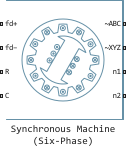
A six-phase synchronous machine.
blockType: AcausalElectricPowerSystems.Electromechanical.Synchronous.SixPhase
|
Path in the library: |
Description
Block Synchronous Machine (Six-Phase) simulates a six-phase synchronous machine.
A six-phase synchronous machine has two groups of stator windings: group ABC and group XYZ. These two groups have a phase shift of 30 degrees.
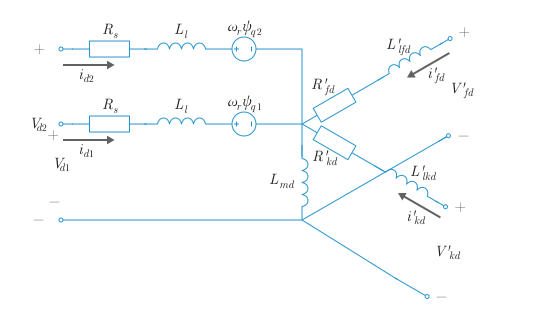
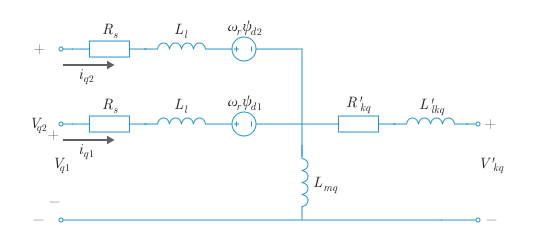
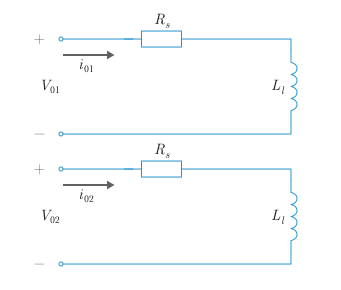
The equivalent circuits of a six-phase synchronous machine for the longitudinal axis, the transverse axis, and the two zero sequences are as shown in the figures below.
The equations
The equations of a synchronous machine are written with respect to a rotating coordinate system, which is defined as follows:
where
-
— electric angle of the rotor;
-
— the number of pairs of poles;
-
— mechanical angle of the rotor;
-
— This is
0if you determine the electric angle of the rotor with respect to -axes, or−pi/2if you determine the electric angle of the rotor with respect to - axes.
Two Park transformations translate the equations of the synchronous machine into a rotating coordinate system relative to the electric angle. The Park transformation for the first group of stator windings, group ABC, is defined as follows:
The Park transformation for the second group of stator windings, the XYZ group, is defined as follows:
The transformation of the Park is written in relative units (OE).
The stator stress equations for group ABC are as follows:
where
-
, and — stator voltages for the ABC group along the axes , and the zero sequence, respectively, determined by the formula
where , and — stator voltages for group ABC, measured from port ~ABC to neutral port n1;
-
— base speed in relative units;
-
, and — flow couplings for the ABC group along the axes , and the zero sequence;
-
— the speed of rotation of the rotor in relative units;
-
— active resistance of the stator;
-
, and — stator winding currents for group ABC along the axes , and the zero sequence, defined as
where , and — stator currents for group ABC from port ~ABC to neutral port n1.
The stator stress equations for the XYZ group are as follows:
where
-
, and — stator voltages for the XYZ group along the axes , and the zero sequence, respectively, determined by the formula
where , and — stator voltages for group XYZ, measured from port ~XYZ to neutral port n1;
-
, and — flow couplings for the XYZ group along the axes , and the zero sequence;
-
, and — stator winding currents for the XYZ group along the axes , and the zero sequence, defined as
where , and — currents on the stator for the XYZ group from port ~XYZ to the neutral port n1.
Rotor voltage equations:
where
-
— voltage of the excitation winding on the stator side;
-
and — voltage on the damper windings along the axes and from the stator side; they are all equal
0; -
, and — magnetic fluxes connecting the excitation circuit, the damping winding along the axis and the damping winding along the axis ;
-
, and — resistance of the excitation circuit of the rotor, the damper winding along the axis and the damping winding along the axis ;
-
, and — currents flowing in the excitation circuit, in the damper winding along the axis and in the damping winding along the axis from the side of the stator.
The stator flow coupling equations are defined as follows:
where
-
— stator scattering inductance;
-
and — mutual inductors of the stator along the axes and .
The rotor flow coupling equations are defined as follows:
where
-
— inductance of the rotor excitation winding;
-
— the inductance of the rotor damper winding along the axis ;
-
— the inductance of the rotor damper winding along the axis ;
Rotor torque:
Modeling of thermal effects
A thermal port can be used to simulate losses during the conversion of energy into heat.
-
If the check box Enable thermal port If not installed, the unit does not contain any thermal ports.
-
If the check box Enable thermal port If installed, the unit contains thermal non-directional ports for each of the windings and for the rotor.
Variables
Use the Initial targets parameter group to set the priority and initial target values for the block parameter variables before modeling. For more information, see Configuring physical blocks using target values.
For this block, the Initial targets parameters are visible only if for the parameter Initialization option the value is set Set targets for rotor angle and Park’s transform variables or if the checkbox is checked Enable thermal port.
Ports
Conserving
#
HX
—
phase thermal port
warm
Details
Thermal port connected to the phase winding .
Dependencies
To use this port, check the box Enable thermal port.
| Program usage name |
|
#
C
—
machine body
rotational mechanics
Details
A mechanical port connected to the machine body.
| Program usage name |
|
#
HB
—
phase thermal port
warm
Details
Thermal port connected to the phase winding .
Dependencies
To use this port, check the box Enable thermal port.
| Program usage name |
|
#
n1
—
neutral winding ABC
electricity
Details
The electrical port connected to the neutral of the ABC winding.
Dependencies
To use this port, set the parameter Zero sequence meaning Include.
| Program usage name |
|
#
~ABC
—
stator windings ABC
electricity
Details
Expandable three-phase port connected to the ABC stator windings.
| Program usage name |
|
#
HC
—
phase thermal port
warm
Details
Thermal port connected to the phase winding .
Dependencies
To use this port, check the box Enable thermal port.
| Program usage name |
|
#
HY
—
phase thermal port
warm
Details
Thermal port connected to the phase winding .
Dependencies
To use this port, check the box Enable thermal port.
| Program usage name |
|
#
HR
—
thermal port of the rotor
warm
Details
The thermal port connected to the rotor.
Dependencies
To use this port, check the box Enable thermal port.
| Program usage name |
|
#
~XYZ
—
XYZ stator windings
electricity
Details
Expandable three-phase port connected to XYZ stator windings.
| Program usage name |
|
#
fd−
—
negative terminal of the field winding
electricity
Details
An electrical port connected to the negative terminal of the field winding.
| Program usage name |
|
#
HZ
—
phase thermal port
warm
Details
Thermal port connected to the phase winding .
Dependencies
To use this port, check the box Enable thermal port.
| Program usage name |
|
#
HA
—
phase thermal port
warm
Details
Thermal port connected to the phase winding .
Dependencies
To use this port, check the box Enable thermal port.
| Program usage name |
|
#
R
—
the rotor of the machine
rotational mechanics
Details
A mechanical port connected to the rotor of the machine.
| Program usage name |
|
#
fd+
—
positive terminal of the field winding
electricity
Details
An electrical port connected to the positive terminal of the excitation winding.
| Program usage name |
|
#
n2
—
winding neutral XYZ
electricity
Details
The electrical port connected to the neutral winding XYZ.
Dependencies
To use this port, set the parameter Zero sequence meaning Include.
| Program usage name |
|
Parameters
Main
#
Nominal voltage (line-to-line,rms) —
Rated RMS voltage
V | uV | mV | kV | MV
Details
The nominal RMS line voltage.
| Units |
|
| Default value |
|
| Program usage name |
|
| Evaluatable |
Yes |
#
Nominal power —
Rated power
W | uW | mW | kW | MW | GW | V*A | HP_DIN
Details
Rated power.
| Units |
|
| Default value |
|
| Program usage name |
|
| Evaluatable |
Yes |
#
Rotor angle definition —
a reference point for measuring the rotation angle of the rotor
Angle between the a-phase magnetic axis and the q-axis | Angle between the a-phase magnetic axis and the d-axis
Details
A reference point for measuring the rotation angle of the rotor.
When selecting a value Angle between the a-phase magnetic axis and the d-axis the axis the rotor and -the phase magnetic axis of the stator is aligned when the rotation angle of the rotor is zero.
When selecting a value Angle between the a-phase magnetic axis and the q-axis the axis the rotor and -the phase magnetic axis of the stator is aligned when the rotation angle of the rotor is zero.
| Values |
|
| Default value |
|
| Program usage name |
|
| Evaluatable |
No |
#
Zero sequence —
the zero sequence model
Exclude | Include
Details
The zero-sequence model:
-
Include— priority is given to the accuracy of the model. When zero sequence conditions are enabled for simulations using Partitioning solving, errors occur.
-
Exclude— Priority is given to simulation speed for desktop simulation or real-time deployment.
| Values |
|
| Default value |
|
| Program usage name |
|
| Evaluatable |
No |
#
Nominal electrical frequency —
Rated electrical frequency
Hz | kHz | MHz | GHz
Details
The rated electrical frequency at which the rated power is indicated.
| Units |
|
| Default value |
|
| Program usage name |
|
| Evaluatable |
Yes |
# Number of pole pairs — number of pairs of poles
Details
The number of pairs of poles of the machine.
| Default value |
|
| Program usage name |
|
| Evaluatable |
Yes |
Thermal
#
Resistance temperature coefficient —
temperature coefficient of resistance
1/K | 1/degR | 1/deltaK | 1/deltadegC | 1/deltadegF | 1/deltadegR
Details
Ratio in the equation relating resistance to temperature.
Default value 3.93e−3 1/K corresponds to copper.
Dependencies
To use this option, check the box Enable thermal port.
| Units |
|
| Default value |
|
| Program usage name |
|
| Evaluatable |
Yes |
#
Rotor thermal mass —
heat capacity of the rotor
J/K | kJ/K
Details
The value of the heat capacity for the rotor. Heat capacity is the energy required to raise the temperature by one degree.
Dependencies
To use this option, check the box Enable thermal port.
| Units |
|
| Default value |
|
| Program usage name |
|
| Evaluatable |
Yes |
# Enable thermal port — switching on thermal ports
Details
Select this option to use the thermal port of the unit and simulate losses when converting energy to heat.
| Default value |
|
| Program usage name |
|
| Evaluatable |
No |
#
Measurement temperature —
Nominal temperature
K | degC | degF | degR | deltaK | deltadegC | deltadegF | deltadegR
Details
The temperature for which the engine parameters are specified.
Dependencies
To use this option, check the box Enable thermal port.
| Units |
|
| Default value |
|
| Program usage name |
|
| Evaluatable |
Yes |
#
Thermal mass for each stator winding —
the heat capacity of the winding
J/K | kJ/K
Details
The value of the heat capacity for each stator winding. Heat capacity is the energy required to raise the temperature by one degree.
Dependencies
To use this option, check the box Enable thermal port.
| Units |
|
| Default value |
|
| Program usage name |
|
| Evaluatable |
Yes |
Initial Conditions
#
Initialization option —
initialization option
Set targets for rotor angle and Park’s transform variables | Set real power, reactive power, terminal voltage, and terminal phase
Details
A model for setting values of certain parameters and variables at the beginning of the simulation:
-
To set an operating point independent of the connected network, select
Set real power, reactive power, terminal voltage, and terminal phase. -
To specify the priority and initial target values of the block variables before modeling, select
Set targets for rotor angle and Park’s transform variables. For more information, see Configuring physical blocks using target values.
| Values |
|
| Default value |
|
| Program usage name |
|
| Evaluatable |
No |
#
Terminal reactive power (ABC group) —
reactive power at terminals corresponding to group ABC
W | uW | mW | kW | MW | GW | V*A | HP_DIN
Details
The reactive power at the terminals generated by the stator windings of the ABC group.
Dependencies
To use this parameter, set for the parameter Initialization option meaning Set real power, reactive power, terminal voltage, and terminal phase.
| Units |
|
| Default value |
|
| Program usage name |
|
| Evaluatable |
Yes |
#
Terminal reactive power (XYZ group) —
reactive power at terminals corresponding to XYZ group
W | uW | mW | kW | MW | GW | V*A | HP_DIN
Details
The reactive power at the terminals generated by the XYZ group stator windings.
Dependencies
To use this parameter, set for the parameter Initialization option meaning Set real power, reactive power, terminal voltage, and terminal phase.
| Units |
|
| Default value |
|
| Program usage name |
|
| Evaluatable |
Yes |
#
Terminal voltage magnitude —
terminal voltage
V | uV | mV | kV | MV
Details
The voltage value at the terminals.
Dependencies
To use this parameter, set for the parameter Initialization option meaning Set real power, reactive power, terminal voltage, and terminal phase.
| Units |
|
| Default value |
|
| Program usage name |
|
| Evaluatable |
Yes |
#
Terminal active power (XYZ group) —
active power at terminals corresponding to XYZ group
W | uW | mW | kW | MW | GW | V*A | HP_DIN
Details
The active terminal power generated by the XYZ group stator windings.
Dependencies
To use this parameter, set for the parameter Initialization option meaning Set real power, reactive power, terminal voltage, and terminal phase.
| Units |
|
| Default value |
|
| Program usage name |
|
| Evaluatable |
Yes |
#
Terminal active power (ABC group) —
active power at terminals corresponding to group ABC
W | uW | mW | kW | MW | GW | V*A | HP_DIN
Details
The active terminal power generated by the stator windings of the ABC group.
Dependencies
To use this parameter, set for the parameter Initialization option meaning Set real power, reactive power, terminal voltage, and terminal phase.
| Units |
|
| Default value |
|
| Program usage name |
|
| Evaluatable |
Yes |
#
Terminal voltage angle corresponding to ABC group —
voltage angle at terminals corresponding to group ABC
rad | deg | rev | mrad | arcsec | arcmin | gon
Details
The voltage angle at the terminals corresponding to the stator of the ABC group.
Dependencies
To use this parameter, set for the parameter Initialization option meaning Set real power, reactive power, terminal voltage, and terminal phase.
| Units |
|
| Default value |
|
| Program usage name |
|
| Evaluatable |
Yes |
Impedances
# Rotor field winding inductance, Llfd' — inductance of the rotor excitation winding
Details
The inductance of the rotor excitation winding. This parameter should be higher. 0.
| Default value |
|
| Program usage name |
|
| Evaluatable |
Yes |
# Stator q-axis mutual inductance, Lmq — mutual axis inductance the stator
Details
Mutual inductance along the axis the stator. This parameter should be higher. 0.
| Default value |
|
| Program usage name |
|
| Evaluatable |
Yes |
# Rotor field winding resistance, Rfd' — resistance of the rotor excitation winding
Details
Resistance of the rotor excitation winding. This parameter should be higher. 0.
| Default value |
|
| Program usage name |
|
| Evaluatable |
Yes |
# Rotor d-axis damper winding inductance, Llkd' — inductance of the rotor damper winding along the axis
Details
Inductance of the rotor damper winding along the axis . This parameter should be higher. 0.
| Default value |
|
| Program usage name |
|
| Evaluatable |
Yes |
# Stator leakage inductance, Ll — stator scattering inductance
Details
The stator scattering inductance. This parameter should be higher. 0.
| Default value |
|
| Program usage name |
|
| Evaluatable |
Yes |
# Rotor q-axis damper winding resistance, Rkq' — resistance of the rotor damper winding along the axis
Details
Resistance of the rotor damper winding along the axis . This parameter should be higher. 0.
| Default value |
|
| Program usage name |
|
| Evaluatable |
Yes |
# Stator d-axis mutual inductance, Lmd — mutual axis inductance the stator
Details
Mutual inductance along the axis the stator. This parameter should be higher. 0.
| Default value |
|
| Program usage name |
|
| Evaluatable |
Yes |
# Stator resistance, Rs — stator resistance
Details
Stator resistance. This parameter should be higher. 0.
| Default value |
|
| Program usage name |
|
| Evaluatable |
Yes |
# Rotor d-axis damper winding resistance, Rkd' — resistance of the rotor damper winding along the axis
Details
Resistance of the rotor damper winding along the axis . This parameter should be higher. 0.
| Default value |
|
| Program usage name |
|
| Evaluatable |
Yes |
# Rotor q-axis damper winding inductance, Llkq' — inductance of the rotor damper winding along the axis
Details
Inductance of the rotor damper winding along the axis . This parameter should be higher. 0.
| Default value |
|
| Program usage name |
|
| Evaluatable |
Yes |
Literature
-
Kieferndorf, F., Burzanowska , H., Kanerva S., Sario P. Modeling of rotor based harmonics in dual-star, wound field, synchronous machines. 2008 18th International Conference on Electrical Machines: Vilamoura, 1–6.
-
Burzanowska , H., Sario P, Stulz C., Joerg P. Redundant Drive with Direct Torque Control (DTC) and dual-star synchronous machine, simulations and verifications. 2007 European Conference on Power Electronics and Applications: Aalborg, 1–10.