Cross-Junction (IL)
Cross-coupling in a system with an isothermal liquid.
blockType: EngeeFluids.IsothermalLiquid.Fittings.CrossJunction
|
Path in the library: |
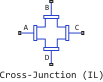
Description
Block Cross-Junction (IL) It is a four-way connection in an isothermal fluid network. The block simulates the interaction of liquids depending on the flow direction in each port, where the path between ports A and C is a straight line, and ports B and D are side branches.
Conservation of mass and momentum
The block keeps the mass in the joint:
where — mass flow rate for a given port .
The unit determines which coefficient and vector element to use, and then calculates the pressure difference to conserve momentum in such a way that
where
-
— the average density of the liquid;
-
— pressure for a given port ;
-
— pressure in node 1;
-
— the flow rate that the unit assigns to this port . Parameter Loss coefficient model defines the method used by the block for calculation ;
-
— fluid inertia for a given port .
The block calculates inertia for each port as
where — parameter value Main line area (A,C), and — parameter value Branch line area (B,D).
Idelchik coefficient
If for the parameter Loss coefficient model the value is set Idel’chik correlation, the unit calculates the resistance coefficients in the pipe according to [1]. The Idelchik model supports merging streams to port C, or splitting from port C. To obtain correct results, it is necessary to orient the block in accordance with the expected flow configuration in the model’s fluid network.
The block considers the connection as symmetrical with respect to the horizontal and vertical planes, so that — parameter value Main line area (A,C), and — parameter value Branch line area (B,D), where — the area of the corresponding port.
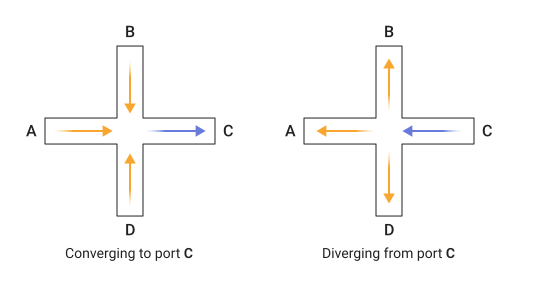
If the flow geometry is invalid, the block behavior can be controlled using the parameter Report when flow configuration is invalid. If for the parameter Report when flow configuration is invalid the value is set None,
The model continues to run in an invalid flow configuration, but the results may be incorrect.
Fluence of streams
When merging streams, the resistance coefficients for ports A and C:
The resistance coefficients for ports B and D are
dividing the stream
With divergent flow from port C, the resistance coefficients for ports A and C are
The resistance coefficients for ports B and D are
where by or , and by or . The block smooths out the transition between and using the hyperbolic tangent function.
According to [1], these resistance coefficients are applicable only when the ratio of the diameter of the lateral branch to the diameter of the forward stroke is less than or equal to 2/3. However, the expected margin of error for the relationship is higher 2/3 It is usually small enough for the block to continue using the specified resistance coefficients.
User Coefficient
If for the parameter Loss coefficient model the value is set Custom The block uses user-defined loss parameters to describe the resistance coefficient in the pipe for each port.
For the user ratio, the block allows four configurations: confluence of flows, flow separation, perpendicular flows and counter flows:
-
merging streams — a stream enters nodes 1, 2, and 4 and exits node 3;
-
flow separation — the flow enters node 1 and exits nodes 2, 3 and 4;
-
perpendicular flows — the flow enters nodes 1 and 2 and exits nodes 3 and 4;
-
oncoming flows — the flow enters nodes 1 and 3 and exits nodes 2 and 4.
The figure shows the configuration data.
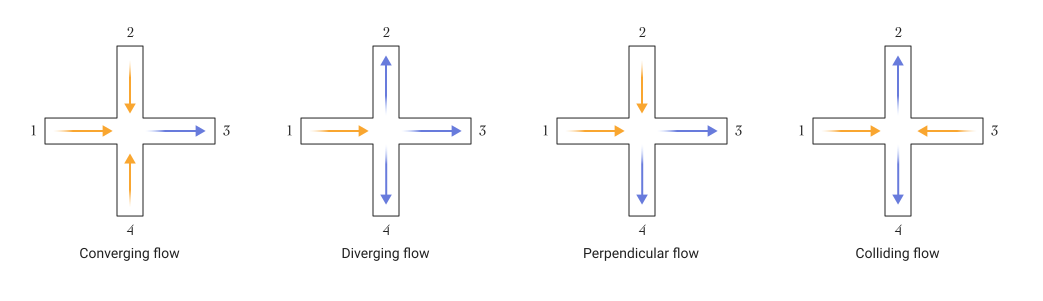
The block considers the connection as symmetrical with respect to the horizontal and vertical planes, so that and , where — the area of the corresponding port in the drawing. Using this symmetry, the block assumes that the coefficients of resistance from 1 to 2 and from 1 to 4 are the same for merging, separation and oncoming flows.
During the simulation, the unit continuously checks the flow direction at each port and compares the result with four possible flow configurations. When the block determines the flow configuration, it adjusts the node corresponding to each port. For example, if the unit detects a separating flow in which liquid enters port A and exits ports B, C, and D, it assigns node 1 to port A, as shown in the first figure. Other figures show the designated nodes for the split stream entering ports other than A.
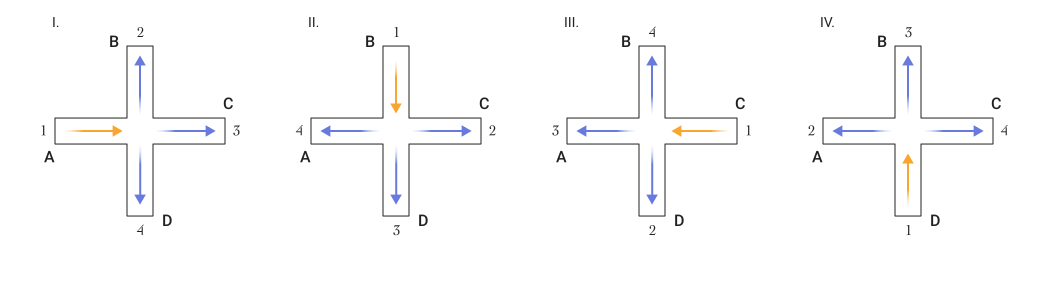
For a user factor, all four flow configurations can be implemented in a single block during simulation. You only need to set the parameters for each condition. When using two-element vectors to set flow coefficients, the block uses the first or second element, depending on whether node 1 coincides with a straight line or with a side branch. The first element corresponds to node 1 in port A or C, and the second element corresponds to node 1 in port B or D.
This table describes the conditions for each operating mode used to determine the resistance coefficients.
| Flow Configuration | ||||||||
|---|---|---|---|---|---|---|---|---|
Separation from port A |
|
|
|
|
|
|
|
|
Separation from port B |
|
|
|
|
|
|
|
|
Separation from port C |
|
|
|
|
|
|
|
|
Separation from port D |
|
|
|
|
|
|
|
|
Merge to port A |
|
|
|
|
|
|
|
|
Merge to port B |
|
|
|
|
|
|
|
|
Merge to port C |
|
|
|
|
|
|
|
|
Merge to port D |
|
|
|
|
|
|
|
|
Perpendicular to the direct entrance A |
|
|
|
|
|
|
|
|
Perpendicular to the direct entrance B |
|
|
|
|
|
|
|
|
Perpendicular to the direct entrance C |
|
|
|
|
|
|
|
|
Perpendicular to the direct entrance D |
|
|
|
|
|
|
|
|
Oncoming traffic from the forward passage to the branch |
|
|
|
|
|
|
|
|
Oncoming traffic from a branch line to a straight line |
|
|
|
|
|
|
|
|
Motionless |
— |
— |
— |
— |
|
|
|
|
The flow is considered stationary if the mass flow conditions do not correspond to any given flow configuration. The block uses the following parameters to calculate the flow coefficients:
-
and — the first and second elements of the parameter Diverging flow straight loss coefficient accordingly;
-
and — the first and second elements of the parameter Diverging flow turning loss coefficient accordingly;
-
and — the first and second elements of the parameter Converging flow straight loss coefficient accordingly;
-
and — the first and second elements of the parameter Converging flow turning loss coefficient accordingly;
-
and — the first and second elements of the parameter Perpendicular flow straight loss coefficient accordingly;
-
and — the first and second elements of the parameter Perpendicular flow straight loss coefficient accordingly;
-
and — the first and second elements of the parameter Perpendicular flow straight loss coefficient accordingly;
-
and — the first and second elements of the parameter Colliding flow straight loss coefficient accordingly;
-
and — the first and second elements of the parameter Colliding flow turning loss coefficient accordingly.
Ports
Conserving
#
B
—
liquid port
isothermal liquid
Details
Non-directional port, liquid inlet or outlet.
| Program usage name |
|
#
D
—
liquid port
isothermal liquid
Details
Non-directional port, liquid inlet or outlet.
| Program usage name |
|
#
A
—
liquid port
isothermal liquid
Details
Non-directional port, liquid inlet or outlet.
| Program usage name |
|
#
C
—
liquid port
isothermal liquid
Details
Non-directional port, liquid inlet or outlet.
| Program usage name |
|
Parameters
Junction Properties
#
Loss coefficient model —
type of resistance coefficient
Idel’chik correlation | Custom
Details
The model of the coefficient of resistance in the connection. Set this parameter to Custom to set separate resistance coefficients for each segment of the diverging and converging flow.
| Values |
|
| Default value |
|
| Program usage name |
|
| Evaluatable |
No |
#
Report when flow configuration is invalid —
warning mode for invalid flow configurations
None | Error
Details
The mode warns the user about thread configurations that exceed the acceptable limits.
If this parameter is set to Error the simulation will be stopped under conditions outside the acceptable flow configurations.
Dependencies
To use this parameter, set for the parameter Loss coefficient model meaning Idel’chik correlation.
| Values |
|
| Default value |
|
| Program usage name |
|
| Evaluatable |
No |
#
Main line area (A,C) —
the cross-sectional area of the forward stroke
m^2 | um^2 | mm^2 | cm^2 | km^2 | in^2 | ft^2 | yd^2 | mi^2 | ha | ac
Details
The cross-sectional area of the forward flow from port A to port C.
| Units |
|
| Default value |
|
| Program usage name |
|
| Evaluatable |
Yes |
# Critical Reynolds number — upper limit of the Reynolds number for laminar flow
Details
The upper limit of the Reynolds number for laminar flow through a joint.
| Default value |
|
| Program usage name |
|
| Evaluatable |
Yes |
# Colliding flow loss coefficients — the ability to specify resistance coefficients for oncoming flows
Details
Whether to specify resistance coefficients for oncoming flows.
Dependencies
To use this parameter, set for the parameter Loss coefficient model meaning Custom.
| Default value |
|
| Program usage name |
|
| Evaluatable |
No |
#
Branch line area (B,D) —
cross-sectional area of the lateral branches
m^2 | um^2 | mm^2 | cm^2 | km^2 | in^2 | ft^2 | yd^2 | mi^2 | ha | ac
Details
The cross-sectional area of the lateral branches of the flow from port B to port D.
| Units |
|
| Default value |
|
| Program usage name |
|
| Evaluatable |
Yes |
# Converging flow loss coefficients — the ability to specify resistance coefficients for merging flows
Details
Whether to specify resistance coefficients for merging flows.
Dependencies
To use this parameter, set for the parameter Loss coefficient model meaning Custom.
| Default value |
|
| Program usage name |
|
| Evaluatable |
No |
# Diverging flow loss coefficients — the ability to specify resistance coefficients for flow separation
Details
Whether to specify resistance coefficients for flow separation.
Dependencies
To use this parameter, set for the parameter Loss coefficient model meaning Custom.
| Default value |
|
| Program usage name |
|
| Evaluatable |
No |
# Perpendicular flow loss coefficients — the ability to specify resistance coefficients for perpendicular flows
Details
Whether to specify resistance coefficients for perpendicular flows.
Dependencies
To use this parameter, set for the parameter Loss coefficient model meaning Custom.
| Default value |
|
| Program usage name |
|
| Evaluatable |
No |
Converging Flow Coefficients
# Converging flow straight loss coefficient — forward running resistance coefficient for flow fusion
Details
The coefficient of resistance of the forward stroke for merging flows. When setting this parameter as a vector, the first element represents the resistance coefficient when ports A or C coincide with node 1. The second element represents the resistance coefficient when ports B or D coincide with node 1. When using a scalar, the block behaves the same for all orientations.
Dependencies
To use this parameter, set for the parameter Loss coefficient model meaning Custom and check the box Converging flow loss coefficients.
| Default value |
|
| Program usage name |
|
| Evaluatable |
Yes |
# Converging flow turning loss coefficient — coefficient of resistance of lateral branches for merging flows
Details
The coefficient of resistance of the lateral branches for merging flows. When setting this parameter as a vector, the first element represents the resistance coefficient when ports A or C coincide with node 1. The second element represents the resistance coefficient when ports B or D coincide with node 1. When using a scalar, the block behaves the same for all orientations.
Dependencies
To use this parameter, set for the parameter Loss coefficient model meaning Custom and check the box Converging flow loss coefficients.
| Default value |
|
| Program usage name |
|
| Evaluatable |
Yes |
Perpendicular Flow Coefficients
# Perpendicular flow turning to outflow loss coefficient — coefficient of resistance of lateral branches with flowing perpendicular flows
Details
The coefficient of resistance for perpendicular rotation of the flow to the outflow. When setting this parameter as a vector, the first element represents the coefficient of resistance when ports A or C are adjacent to node 1. The second element represents the coefficient of resistance when ports B or D coincide with node 1. When using a scalar, the block behaves the same for all orientations.
Dependencies
To use this parameter, set for the parameter Loss coefficient model meaning Custom and check the box Perpendicular flow loss coefficients.
| Default value |
|
| Program usage name |
|
| Evaluatable |
Yes |
# Perpendicular flow turning to inflow loss coefficient — coefficient of resistance of lateral branches with flowing perpendicular flows
Details
The coefficient of resistance when the flow is rotated perpendicular to the inflow. When setting this parameter as a vector, the first element represents the resistance coefficient when ports A or C coincide with node 1. The second element represents the resistance coefficient when ports B or D coincide with node 1. When using a scalar, the block behaves the same for all orientations.
Dependencies
To use this parameter, set for the parameter Loss coefficient model meaning Custom and check the box Perpendicular flow loss coefficients.
| Default value |
|
| Program usage name |
|
| Evaluatable |
Yes |
# Perpendicular flow straight loss coefficient — forward running resistance coefficient for perpendicular flows
Details
The coefficient of resistance of the forward stroke for perpendicular flows. When setting this parameter as a vector, the first element represents the resistance coefficient when ports A or C coincide with node 1. The second element represents the resistance coefficient when ports B or D coincide with node 1. When using a scalar, the block behaves the same for all orientations.
Dependencies
To use this parameter, set for the parameter Loss coefficient model meaning Custom and check the box Perpendicular flow loss coefficients.
| Default value |
|
| Program usage name |
|
| Evaluatable |
Yes |
Diverging Flow Coefficients
# Diverging flow turning loss coefficient — coefficient of resistance of lateral branches for flow separation
Details
The coefficient of resistance of the lateral branches for flow separation. When setting this parameter as a vector, the first element represents the resistance coefficient when ports A or C coincide with node 1. The second element represents the resistance coefficient when ports B or D coincide with node 1. When using a scalar, the block behaves the same for all orientations.
Dependencies
To use this parameter, set for the parameter Loss coefficient model meaning Custom and check the box Diverging flow loss coefficients.
| Default value |
|
| Program usage name |
|
| Evaluatable |
Yes |
# Diverging flow straight loss coefficient — forward running resistance coefficient for flow separation
Details
Forward running resistance coefficient for flow separation. When setting this parameter as a vector, the first element represents the resistance coefficient when ports A or C coincide with node 1. The second element represents the resistance coefficient when ports B or D coincide with node 1. When using a scalar, the block behaves the same for all orientations.
Dependencies
To use this parameter, set for the parameter Loss coefficient model meaning Custom and check the box Diverging flow loss coefficients.
| Default value |
|
| Program usage name |
|
| Evaluatable |
Yes |
Colliding Flow Coefficients
# Colliding flow straight loss coefficient — forward running resistance coefficient for oncoming flows
Details
Forward running resistance coefficient for oncoming flows. When setting this parameter as a vector, the first element represents the resistance coefficient when ports A or C coincide with node 1. The second element represents the resistance coefficient when ports B or D coincide with node 1. When using a scalar, the block behaves the same for all orientations.
Dependencies
To use this parameter, set for the parameter Loss coefficient model meaning Custom and check the box Colliding flow loss coefficients.
| Default value |
|
| Program usage name |
|
| Evaluatable |
Yes |
# Colliding flow turning loss coefficient — coefficient of resistance of side branches for oncoming flows
Details
The coefficient of resistance of lateral branches for oncoming flows. When setting this parameter as a vector, the first element represents the resistance coefficient when ports A or C coincide with node 1. The second element represents the resistance coefficient when ports B or D coincide with node 1. When using a scalar, the block behaves the same for all orientations.
Dependencies
To use this parameter, set for the parameter Loss coefficient model meaning Custom and check the box Colliding flow loss coefficients.
| Default value |
|
| Program usage name |
|
| Evaluatable |
Yes |