T-Junction (IL)
A T-shaped connection in a system with an isothermal liquid.
blockType: EngeeFluids.IsothermalLiquid.Fittings.TJunction
|
Path in the library: |

Description
Block T-Junction (IL) simulates a pipe connection with a side branch in port C, connected at an angle 90° to direct travel between ports A and B. You can specify a custom drag coefficient, or use the Rennels or Crane coefficients. If for the parameter Loss coefficient model the value is set Custom, you can specify the resistance coefficients for each pipe segment for flow fusion and separation.
Flow direction
A tee is considered to be extensive if the flows of the forward course and the lateral branch merge. A tee is considered to be flowing if the flow in the lateral branch is separated from the forward flow. The flow direction between ports A and I, the junction point of the branch with the forward flow, as well as between ports B and I must be consistent for the application of all resistance coefficients. Otherwise, as shown in the last two diagrams in the figure below, the losses at the junction are approximated by the forward resistance coefficient for exhaust or intake tees.
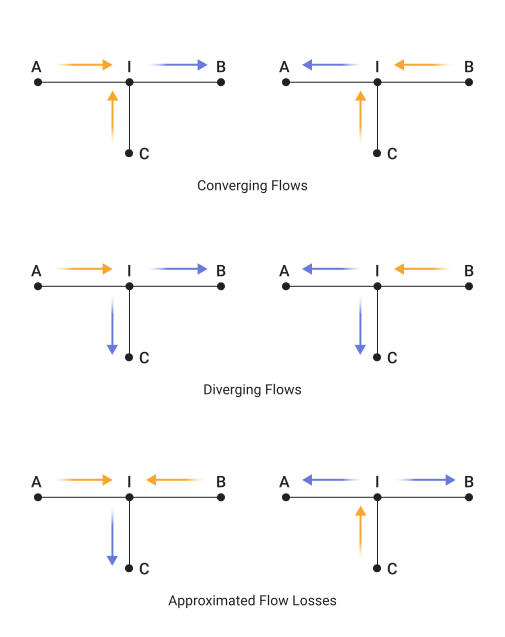
The unit uses a hybrid automaton to determine each resistance coefficient for a given flow configuration. This table describes the conditions and coefficients for each mode, if for the parameter Loss coefficient model the value is set Crane correlation or Custom.
| Flow Configuration | ||||||
|---|---|---|---|---|---|---|
Motionless |
— |
— |
— |
|
|
|
Separation from port A |
|
|
|
|
|
|
Separation from port B |
|
|
|
|
|
|
Merge to port A |
|
|
|
|
|
|
Merge to port B |
|
|
|
|
|
|
Merge to port C (branch) |
|
|
|
|
|
|
Separation from port C (branch) |
|
|
|
|
|
|
If for the parameter Loss coefficient model the value is set Rennels correlation, then the values for merging to port C (branch) and splitting from port C (branch) are calculated directly.
The flow is considered stationary if the mass flow conditions do not correspond to any of the specified configurations. A stationary flow is allowed at the beginning of the simulation, but the block does not return to this state after reaching another mode. The threshold value of the mass flow, that is, the point at which the flow in the pipe begins to change direction, is defined as
where
-
— the critical Reynolds number, when exceeded, the transient flow mode begins;
-
— viscosity of the liquid;
-
— the average density of the liquid;
-
— the smallest cross-sectional area at the pipe junction.
Crane Coefficient
If for the parameter Loss coefficient model the value is set Crane correlation, resistance coefficients in the tee and , as well as the coefficient of friction calculated according to Crane [1]:
The coefficient of resistance in the connection is the same for both exhaust and intake tees. Values , and they are calculated in the same way as for the user coefficient.
| Nominal size, mm | 5 | 10 | 15 | 20 | 25 | 32 | 40 | 50 | 72.5 | 100 | 125 | 150 | 225 | 350 | 609.5 |
|---|---|---|---|---|---|---|---|---|---|---|---|---|---|---|---|
Coefficient of friction |
|
|
|
|
|
|
|
|
|
|
|
|
|
|
|
The Rennels coefficient
If for the parameter Loss coefficient model the value is set Rennels correlation, the block calculates the resistance coefficients in the tee according to [2].
Direct stroke in the intake tee
The coefficient of resistance during forward separation is
where
-
— mass flow rate at the entrance to the straight line;
-
— mass flow rate at the outlet of the forward stroke.
Meaning It reaches saturation when the ratio is equal to the value of the parameter Minimum valid flow ratio for coefficient calculation.
The coefficient of resistance during separation in the lateral branch is equal to
where
-
— mass flow rate at the outlet of the lateral branch;
-
— the diameter of the forward stroke;
-
— diameter of the lateral branch;
-
-
— parameter value Junction radius of curvature.
Meaning It reaches saturation when the ratio is equal to the value of the parameter Minimum valid flow ratio for coefficient calculation.
The direct stroke of the exhaust tee
The coefficient of resistance during forward fusion is
where
Meaning It reaches saturation when the ratio is equal to the value of the parameter Minimum valid flow ratio for coefficient calculation.
The coefficient of resistance at the confluence in the lateral branch is equal to
where
Meaning It reaches saturation when the ratio is equal to the value of the parameter Minimum valid flow ratio for coefficient calculation.
_ Lateral branch of the exhaust or intake tee_
The coefficient of resistance at the confluence in the lateral branch is equal to
where — the diameter of the lateral branch. Meaning It reaches saturation when the ratio is equal to the parameter value Minimum valid flow ratio for coefficient calculation.
The coefficient of resistance during separation in the lateral branch is equal to
Meaning It reaches saturation when the ratio is equal to the parameter value Minimum valid flow ratio for coefficient calculation.
User Coefficient
If for the parameter Loss coefficient model the value is set Custom, the block calculates the resistance coefficient for each port, based on custom resistance parameters for the exhaust and intake tees, as well as the mass flow rate for each port. It is necessary to set , , and as parameter values Main branch converging loss coefficient, Main branch diverging loss coefficient, Side branch converging loss coefficient and Side branch diverging loss coefficient accordingly.
Conservation of mass and momentum
The block retains mass in the joint, so that
The unit calculates the flow through the pipe connection using the momentum conservation equations between ports A, B and C:
where represents the inertia of the fluid, and
where — parameter Main branch area (A-B), and — parameter Side branch area (A-C, B-C).
Ports
Conserving
#
B
—
liquid port
isothermal liquid
Details
A non-directional port connected to the inlet or outlet of liquid from the tee.
| Program usage name |
|
#
A
—
liquid port
isothermal liquid
Details
A non-directional port connected to the inlet or outlet of liquid from the tee.
| Program usage name |
|
#
C
—
liquid port
isothermal liquid
Details
A non-directional port connected to the inlet or outlet of liquid from the tee.
| Program usage name |
|
Parameters
Parameters
# Main branch converging loss coefficient — resistance coefficient for flow fusion between ports A and B
Details
The resistance coefficient for calculating the pressure loss between ports A and B at the confluence of the flow.
Dependencies
To use this parameter, set for the parameter Loss coefficient model meaning Custom.
| Default value |
|
| Program usage name |
|
| Evaluatable |
Yes |
#
Loss coefficient model —
type of resistance coefficient
Crane correlation | Rennels correlation | Custom
Details
The model of the coefficient of resistance in the connection. Set this parameter to Custom to set separate resistance coefficients for each segment of the exhaust and intake tees.
| Values |
|
| Default value |
|
| Program usage name |
|
| Evaluatable |
No |
#
Junction radius of curvature —
radius of curvature of the joint
m | um | mm | cm | km | in | ft | yd | mi | nmi
Details
The radius of curvature of the joint, used to calculate the resistance coefficients, if for the parameter Loss coefficient model the value is set Rennels correlation.
Dependencies
To use this parameter, set for the parameter Loss coefficient model meaning Rennels correlation.
| Units |
|
| Default value |
|
| Program usage name |
|
| Evaluatable |
Yes |
# Critical Reynolds number — upper limit of the Reynolds number for laminar flow
Details
The upper limit of the Reynolds number for laminar flow through a joint.
| Default value |
|
| Program usage name |
|
| Evaluatable |
Yes |
# Main branch diverging loss coefficient — flow separation resistance coefficient between ports A and B
Details
The resistance coefficient for calculating the pressure loss between ports A and B during flow separation.
Dependencies
To use this parameter, set for the parameter Loss coefficient model meaning Custom.
| Default value |
|
| Program usage name |
|
| Evaluatable |
Yes |
#
Side branch area (A-C, B-C) —
cross-sectional area of the lateral branch
m^2 | um^2 | mm^2 | cm^2 | km^2 | in^2 | ft^2 | yd^2 | mi^2 | ha | ac
Details
The cross-sectional area of the lateral branch between ports A and C and between ports B and C.
| Units |
|
| Default value |
|
| Program usage name |
|
| Evaluatable |
Yes |
# Side branch diverging loss coefficient — coefficient of resistance at flow separation between C and direct flow
Details
The resistance coefficient for calculating the pressure loss between port C and the forward flow during flow separation.
Dependencies
To use this parameter, set for the parameter Loss coefficient model meaning Custom.
| Default value |
|
| Program usage name |
|
| Evaluatable |
Yes |
#
Main branch area (A-B) —
the cross-sectional area of the forward stroke
m^2 | um^2 | mm^2 | cm^2 | km^2 | in^2 | ft^2 | yd^2 | mi^2 | ha | ac
Details
The cross-sectional area of the straight pipe passage between ports A and B.
| Units |
|
| Default value |
|
| Program usage name |
|
| Evaluatable |
Yes |
# Minimum valid flow ratio for coefficient calculation — the minimum allowable cost ratio for calculating the Rennels coefficient
Details
The minimum allowable cost ratio when calculating Rennels resistance coefficients. If the expense ratio is below this limit, saturation will occur at this value.
Dependencies
To use this parameter, set for the parameter Loss coefficient model meaning Rennels correlation.
| Default value |
|
| Program usage name |
|
| Evaluatable |
Yes |
# Side branch converging loss coefficient — the coefficient of resistance at the confluence of the flow between C and direct flow
Details
The resistance coefficient for calculating the pressure loss between port C and the forward passage at the confluence of the flow.
Dependencies
To use this parameter, set for the parameter Loss coefficient model meaning Custom.
| Default value |
|
| Program usage name |
|
| Evaluatable |
Yes |