Pressure-Compensated Pump (IL)
A constant pressure pump with a variable working volume in an isothermal fluid network.
blockType: EngeeFluids.IsothermalLiquid.Turbomachinery.PressureCompensatedPump
|
Path in the library: |
Description
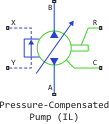
Block Pressure-Compensated Pump (IL) simulates a pump with constant pressure and variable displacement in an isothermal fluid network. The change in working volume is regulated by the pressure drop measured between ports X and Y. When this pressure exceeds Set pressure differential, the change in working volume is adjusted according to Leakage and friction parameterization. The working volume is changed for pressures from the range specified by the parameter Pressure regulation range, between Maximum displacement for and Minimum displacement for .
The liquid flow can be directed from port A to port B (forward mode) or from port B to port A (reverse mode). Operation in the pump mode occurs when the pressure in the flow direction increases. The operation mode of the hydraulic motor is realized when the pressure in the flow direction is reduced.
The rotation of the shaft corresponds to the sign of the working volume of the liquid passing through the pump. A positive working volume corresponds to a positive rotation of the shaft in the forward mode. A negative working volume corresponds to a negative angular velocity of the shaft in the forward mode.
The operating modes are shown in the diagram.
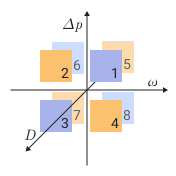
The unit has eight operating modes. The operating mode depends on the pressure drop from port A to port B , angular velocity and the working volume. In the diagram above, these modes are shown as octants of the diagram. :
-
Mode 1, Direct pump mode: the positive angular velocity of the shaft causes pressure to rise from port A to port B and flow from port A to port B.
-
Mode 2, reverse hydraulic motor mode: the flow from port B to port A causes a decrease in pressure from port B to port A and a negative angular velocity of the shaft.
-
Mode 3, Reverse pump mode: the negative angular velocity of the shaft causes pressure to rise from port B to port A and flow from port B to port A.
-
Mode 4, direct hydraulic motor mode: the flow from port A to port B causes a decrease in pressure from port A to port B and a positive angular velocity of the shaft.
-
Mode 5, reverse hydraulic motor mode: the flow from port B to port A causes a decrease in pressure from port B to port A and a positive angular velocity of the shaft.
-
Mode 6, Direct pump mode: the negative angular velocity of the shaft causes pressure to rise from port A to port B and flow from port A to port B.
-
Mode 7, direct hydraulic motor mode: the flow from port A to port B causes a decrease in pressure from port A to port B and a negative angular velocity of the shaft.
-
Mode 8, Reverse pump mode: The positive angular velocity of the shaft causes pressure to rise from port B to port A and flow from port B to port A.
The pump unit has analytical parameterization, tabular parameterization, and input parameterization. When using tabular data or an input signal for parameterization, you can select the pump operation characteristic based on efficiency or volume and mechanical losses.
In the parameterization options for the tabular data and the input signal, the threshold parameters are Pressure gain threshold for pump-motor transition and Angular velocity threshold for pump-motor transition The areas in which a numerically smoothed flow transition between pump operating modes can occur are determined. Select a transition region that provides some margin for the transition term, but which is small enough in terms of pressure and angular velocity not to affect the calculation results. For the working volume threshold, select a threshold value that is less than the typical working volume during normal operation.
Analytical parameterization of leakage and friction moment
If for the parameter Leakage and friction parameterization the value is set Analytical, then the unit calculates leakage and friction moment based on constant values of shaft rotation speed, pressure drop, mechanical and volumetric efficiency. The leakage rate, which depends on the pressure drop at the pump, is calculated as
where
-
;
-
— the average density of the liquid;
-
— the Hagen—Poiseuille coefficient for calculating analytical losses:
where
-
— parameter value Nominal displacement;
-
— parameter value Nominal shaft angular velocity;
-
— parameter value Volumetric efficiency at nominal conditions;
-
— parameter value Nominal pressure gain.
-
The moment of friction, which depends on the pressure drop in the pump, is calculated as
where
-
— parameter value No-load torque;
-
— the coefficient of dependence of the moment of friction on the pressure at the nominal working volume, which is determined based on the value of the parameter Mechanical efficiency at nominal conditions, :
where — the moment of friction under nominal conditions:
-
— the angular velocity of the shaft, or .
Tabular parameterization
When using tabular data for pump efficiency or losses, data can be provided for one or more operating modes. The signs of the tabular data determine the operating mode of the block. If data is provided for less than eight operating modes, the block calculates additional data for another mode(s), expanding the specified data into the remaining octants.
Table data — parameterization of volumetric and mechanical efficiency coefficients_
If for the parameter Leakage and friction parameterization the value is set Tabulated data - volumetric and mechanical efficiencies, then the block performs parameterization based on tabular data for volumetric and mechanical efficiency.
The leakage rate is
where
-
;
-
;
-
— volumetric efficiency, which is interpolated based on tabular data provided by the user;
-
— a transitional member, represents
where
-
;
-
— parameter value Pressure gain threshold for pump-motor transition;
-
;
-
— parameter value Angular velocity threshold for pump-motor transition.
-
The moment of friction is
where
-
;
-
;
-
— mechanical efficiency, which is interpolated based on tabular data provided by the user.
Table data — parameterization of volume and mechanical losses_
If for the parameter Leakage and friction parameterization the value is set Tabulated data - volumetric and mechanical losses, then the block performs parameterization based on tabular data for volume and mechanical losses.
The leakage rate is
where — parameter-based interpolation Volumetric loss table, q_loss(dp,w,D), which is based on data provided by the user about the pressure drop, the angular velocity of the shaft and the working volume of the liquid.
The friction moment of the shaft is
where — parameter-based interpolation Mechanical efficiency table, e_m(dp,w,D), which is based on data provided by the user about the pressure drop, the angular velocity of the shaft and the working volume of the liquid.
Parameterization via the input signal
If for the parameter Leakage and friction parameterization the value is set Input signal - volumetric and mechanical efficiencies, then ports EV and EM are enabled. Internal leakage and shaft friction are calculated in the same way as with parameterization Tabulated data - volumetric and mechanical efficiencies, except that the values of and They are delivered directly to the EV and EM ports, respectively.
If for the parameter Leakage and friction parameterization the value is set Input signal - volumetric and mechanical losses, then ports LV and LM are enabled. These ports receive the values of the leakage current and the moment of friction in the form of positive scalars. The leakage rate is calculated as
where
-
— volumetric leakage rate received at port LV;
-
— parameter value Pressure gain threshold for pump-motor transition.
The moment of friction is calculated as
where
-
— the moment of friction obtained in the port LM;
-
— parameter value Angular velocity threshold for pump-motor transition.
Volumetric and mechanical efficiency vary between user-defined minimum and maximum values. Any values below or above this range will take the minimum and maximum set values, respectively.
Pump operation
The pump consumption is
where .
The torque of the pump is
where .
The mechanical power developed by the pump shaft is
The hydraulic power of the pump is
If you need to find out if the block is working outside of the provided tabular data, you can set the parameter Check if operating beyond the range of supplied tabulated data meaning Error to stop the simulation in this case. When parameterizing by the input signal for volumetric or mechanical losses, you can receive notifications when the simulation goes beyond the operating modes of the motor using the parameter Check if operating beyond pump mode.
You can also control the pump’s functionality. Set for the parameter Check if pressures are less than pump minimum pressure meaning Error to stop the simulation when the outlet pressure is below the minimum setpoint.
Parameterization of the working volume change
The linear parameterization of the change in the working volume of the pump has the form:
where is the normalized pressure represents
where — this is the sum of the parameter values Set pressure differential and Pressure regulation range.
Dynamics of working volume changes
If the dynamics of the working volume change is simulated, then a delay is introduced into the flow response to the simulated control pressure. Pressure It becomes a dynamic control pressure , otherwise — this is steady-state pressure. The instantaneous change in dynamic control pressure is calculated based on a time constant Time constant, :
By default, the checkbox Displacement dynamics removed, and the dynamics of the working volume change is not modeled.
Ports
Conserving
#
C
—
mechanical port
rotational mechanics
Details
Angular velocity and body torque.
| Program usage name |
|
#
A
—
isothermal fluid port
isothermal liquid
Details
The liquid inlet or outlet port in the pump.
| Program usage name |
|
#
B
—
isothermal fluid port
isothermal liquid
Details
The liquid inlet or outlet port in the pump.
| Program usage name |
|
#
Y
—
reference pressure , MPa
isothermal liquid
Details
Control pressure in the MPa. Control pressure compared with Set pressure differential to start or adjust the working volume of the pump.
| Program usage name |
|
#
R
—
mechanical port
rotational mechanics
Details
The angular velocity of rotation and the torque of the shaft.
| Program usage name |
|
#
X
—
reference pressure , MPa
isothermal liquid
Details
Control pressure in the MPa. Control pressure compared with Set pressure differential to start or adjust the working volume of the pump.
| Program usage name |
|
Input
#
LV
—
volumetric leakage rate, m3/s
scalar
Details
Pump losses in m3/s, given as a scalar.
Dependencies
To use this port, set the parameter Leakage and friction parameterization meaning Input signal - volumetric and mechanical losses.
| Data types |
|
| Complex numbers support |
No |
#
EM
—
mechanical efficiency
scalar
Details
The mechanical efficiency of a hydraulic motor, set as a scalar. The value must be in the range of 0 before 1.
Dependencies
To use this port, set the parameter Leakage and friction parameterization meaning Input signal - volumetric and mechanical efficiencies.
| Data types |
|
| Complex numbers support |
No |
#
EV
—
volumetric EFFICIENCY
scalar
Details
Volumetric efficiency, set as a scalar. The value must be in the range of 0 before 1.
Dependencies
To use this port, set the parameter Leakage and friction parameterization meaning Input signal - volumetric and mechanical efficiencies.
| Data types |
|
| Complex numbers support |
No |
#
LM
—
moment of friction, NM
scalar
Details
The mechanical losses of the pump in nm, given as a scalar.
Dependencies
To use this port, set the parameter Leakage and friction parameterization meaning Input signal - volumetric and mechanical losses.
| Data types |
|
| Complex numbers support |
No |
Parameters
Pump
# Maximum mechanical efficiency — maximum value of mechanical efficiency
Details
The maximum value of mechanical efficiency. If the input signal is higher than this value, the mechanical efficiency is set to the maximum value of the mechanical efficiency.
Dependencies
To use this parameter, set for the parameter Leakage and friction parameterization meaning Input signal - volumetric and mechanical efficiencies.
| Default value |
|
| Program usage name |
|
| Evaluatable |
Yes |
#
Displacement vector, D —
vector of working volume values for tabular parameterization
m^3/rad | mm^3/rad | cm^3/rad | km^3/rad | m^3/deg | cm^3/rev | m^3/rev | l/rad | l/rev | in^3/rad | ft^3/rad | gal/rad | igal/rad | in^3/deg | in^3/rev | gal/rev
Details
A vector of working volume values for tabular parameterization of leakage and friction moment. This vector corresponds to the vectors Pressure gain vector, dp and Shaft angular velocity vector, w and tables Volumetric efficiency table, e_v(dp,w,D) or Mechanical efficiency table, e_m(dp,w,D). The elements of the vector must be listed in ascending order.
Dependencies
To use this parameter, set for the parameter Leakage and friction parameterization meaning Tabulated data - volumetric and mechanical efficiencies or Tabulated data - volumetric and mechanical losses.
| Units |
|
| Default value |
|
| Program usage names |
|
| Evaluatable |
Yes |
#
Check if operating beyond pump mode —
a message about the operation of the unit outside the pump mode
None | Error
Details
Select a value Error to stop the simulation when the unit is operating in direct or reverse hydraulic motor modes.
Dependencies
To use this parameter, set for the parameter Leakage and friction parameterization meaning Input signal - volumetric and mechanical losses.
| Values |
|
| Default value |
|
| Program usage name |
|
| Evaluatable |
No |
# Mechanical efficiency table, e_m(dp,w,D) — table of mechanical efficiencies
Details
Array on on mechanical efficiency at a given pressure drop of the liquid, the angular velocity of the shaft and the working volume. The block uses linear interpolation between the table elements.
Values , and — these are the sizes of the corresponding vectors:
-
— the number of vector elements in the parameter Pressure gain vector, dp;
-
— the number of vector elements in the parameter Shaft angular velocity vector, w;
-
— the number of vector elements in the parameter Displacement vector, D.
Dependencies
To use this parameter, set for the parameter Leakage and friction parameterization meaning Tabulated data - volumetric and mechanical efficiencies.
| Default value |
|
| Program usage name |
|
| Evaluatable |
Yes |
#
Shaft angular velocity vector, w —
vector of angular velocity values for tabular parameterization
rad/s | deg/s | rad/min | deg/min | rpm | rps
Details
A vector of angular velocity values for tabular parameterization of leakage and friction moment. This vector corresponds to the vectors Pressure gain vector, dp and Displacement vector, D and tables Volumetric efficiency table, e_v(dp,w,D) or Mechanical efficiency table, e_m(dp,w,D). The elements of the vector should be listed in ascending order.
Dependencies
To use this parameter, set for the parameter Leakage and friction parameterization meaning Tabulated data - volumetric and mechanical efficiencies or Tabulated data - volumetric and mechanical losses.
| Units |
|
| Default value |
|
| Program usage names |
|
| Evaluatable |
Yes |
#
Leakage and friction parameterization —
method for calculating leakage rate and friction moment
Analytical | Tabulated data - volumetric and mechanical efficiencies | Tabulated data - volumetric and mechanical losses | Input signal - volumetric and mechanical efficiencies | Input signal - volumetric and mechanical losses
Details
Parameterization of pump leakage and friction characteristics.
-
Analytical— the leakage rate and the friction moment are calculated using analytical equations. -
Tabulated data - volumetric and mechanical efficiencies— volumetric and mechanical efficiency are calculated according to user-defined parameters Pressure gain vector, dp, Shaft angular velocity vector, w and Displacement vector, D and are interpolated based on the corresponding three-dimensional tables. Volumetric efficiency table, e_v(dp,w,D) and Mechanical efficiency table, e_m(dp,w,D). -
Tabulated data - volumetric and mechanical losses— leakage flow rate and friction moment are calculated according to user-defined parameters Pressure gain vector, dp, Shaft angular velocity vector, w and Displacement vector, D and are interpolated based on the corresponding three-dimensional tables. Volumetric loss table, q_loss(dp,w,D) and Mechanical loss table, torque_loss(dp,w,D). -
Input signal - volumetric and mechanical efficiencies— Volumetric and mechanical efficiency are transmitted as signals to the EV and EM ports, respectively. -
Input signal - volumetric and mechanical losses— the leakage flow rate and the friction moment are sent as signals to the ports LV and LM, respectively.
| Values |
|
| Default value |
|
| Program usage name |
|
| Evaluatable |
No |
#
Nominal shaft angular velocity —
nominal angular velocity of the shaft
rad/s | deg/s | rad/min | deg/min | rpm | rps
Details
Angular velocity of the shaft under nominal operating conditions.
Dependencies
To use this parameter, set for the parameter Leakage and friction parameterization meaning Analytical.
| Units |
|
| Default value |
|
| Program usage name |
|
| Evaluatable |
Yes |
# Minimum mechanical efficiency — minimum value of mechanical efficiency
Details
The minimum value of mechanical efficiency. If the input signal is below this value, the mechanical efficiency is set to the minimum value of the mechanical efficiency.
Dependencies
To use this parameter, set for the parameter Leakage and friction parameterization meaning Input signal - volumetric and mechanical efficiencies.
| Default value |
|
| Program usage name |
|
| Evaluatable |
Yes |
#
Nominal displacement —
nominal working volume
m^3/rad | mm^3/rad | cm^3/rad | km^3/rad | m^3/deg | cm^3/rev | m^3/rev | l/rad | l/rev | in^3/rad | ft^3/rad | gal/rad | igal/rad | in^3/deg | in^3/rev | gal/rev
Details
The amount of liquid displaced by the pump under nominal operating conditions.
Dependencies
To use this parameter, set for the parameter Leakage and friction parameterization meaning Analytical.
| Units |
|
| Default value |
|
| Program usage name |
|
| Evaluatable |
Yes |
# Mechanical efficiency at nominal conditions — mechanical efficiency under nominal conditions
Details
The ratio of the actual torque to the ideal torque generated under rated conditions.
Dependencies
To use this parameter, set for the parameter Leakage and friction parameterization meaning Analytical.
| Default value |
|
| Program usage name |
|
| Evaluatable |
Yes |
# Volumetric efficiency at nominal conditions — volumetric EFFICIENCY
Details
The ratio of the actual flow rate to the ideal flow rate under nominal conditions.
Dependencies
To use this parameter, set for the parameter Leakage and friction parameterization meaning Analytical.
| Default value |
|
| Program usage name |
|
| Evaluatable |
Yes |
#
Pressure gain vector, dp —
vector of pressure increase values for tabular parameterization
Pa | uPa | hPa | kPa | MPa | GPa | kgf/m^2 | kgf/cm^2 | kgf/mm^2 | mbar | bar | kbar | atm | ksi | psi | mmHg | inHg
Details
A vector of pressure increase values for tabular parameterization of leaks and torque friction. This vector corresponds to the vectors Shaft angular velocity vector, w and Displacement vector, D and tables Volumetric efficiency table, e_v(dp,w,D) or Mechanical efficiency table, e_m(dp,w,D). The elements of the vector must be listed in ascending order.
Dependencies
To use this parameter, set for the parameter Leakage and friction parameterization meaning Tabulated data - volumetric and mechanical efficiencies or Tabulated data - volumetric and mechanical losses.
| Units |
|
| Default value |
|
| Program usage names |
|
| Evaluatable |
Yes |
# Minimum volumetric efficiency — minimum value of volumetric efficiency
Details
The minimum value of volumetric efficiency. If the input signal is below this value, the volumetric efficiency is set to the minimum volumetric efficiency value.
Dependencies
To use this parameter, set for the parameter Leakage and friction parameterization meaning Input signal - volumetric and mechanical efficiencies.
| Default value |
|
| Program usage name |
|
| Evaluatable |
Yes |
#
Nominal pressure gain —
nominal pressure increase between liquid inlet and outlet
Pa | uPa | hPa | kPa | MPa | GPa | kgf/m^2 | kgf/cm^2 | kgf/mm^2 | mbar | bar | kbar | atm | ksi | psi | mmHg | inHg
Details
Increasing the pressure between the pump inlet and outlet under nominal operating conditions.
Dependencies
To use this parameter, set for the parameter Leakage and friction parameterization meaning Analytical.
| Units |
|
| Default value |
|
| Program usage name |
|
| Evaluatable |
Yes |
# Volumetric efficiency table, e_v(dp,w,D) — volume efficiency table
Details
Array on on volumetric efficiency at a given pressure drop of the liquid, the angular velocity of the shaft and the working volume. The block uses linear interpolation between table elements.
Values , and — these are the sizes of the corresponding vectors:
-
— the number of vector elements in the parameter Pressure gain vector, dp;
-
— the number of vector elements in the parameter Shaft angular velocity vector, w;
-
— the number of vector elements in the parameter Displacement vector, D.
Dependencies
To use this parameter, set for the parameter Leakage and friction parameterization meaning Tabulated data - volumetric and mechanical efficiencies.
| Default value |
|
| Program usage name |
|
| Evaluatable |
Yes |
#
Pressure gain threshold for pump-motor transition —
threshold pressure for the transition mode
Pa | uPa | hPa | kPa | MPa | GPa | kgf/m^2 | kgf/cm^2 | kgf/mm^2 | mbar | bar | kbar | atm | ksi | psi | mmHg | inHg
Details
The threshold value of the pressure increase for switching between the pump and hydraulic motor operating modes. The transition area is defined in the area of 0 MPa is between the positive and negative values of the threshold pressure drop. Within this area, the calculated leakage rate and friction moment are adjusted according to the transition term to ensure a smooth transition from one mode to another.
Dependencies
To use this parameter, set for Leakage and friction parameterization one of the values is:
-
Tabulated data - volumetric and mechanical efficiencies; -
Input signal - volumetric and mechanical efficiencies; -
Input signal - volumetric and mechanical losses.
| Units |
|
| Default value |
|
| Program usage name |
|
| Evaluatable |
Yes |
#
No-load torque —
moment of friction at rest
N*m | uN*m | mN*m | kN*m | MN*m | GN*m | kgf*m | lbf*in | lbf*ft
Details
The minimum amount of torque to overcome the friction of the seal and causing the shaft to move.
Dependencies
To use this parameter, set for the parameter Leakage and friction parameterization meaning Analytical.
| Units |
|
| Default value |
|
| Program usage name |
|
| Evaluatable |
Yes |
#
Check if operating beyond the range of supplied tabulated data —
a message about going beyond the limits of the provided data
None | Error
Details
Select a value Error to stop the simulation when the block uses values outside the provided data range.
Dependencies
To use this parameter, set for the parameter Leakage and friction parameterization one of the values is:
-
Tabulated data - volumetric and mechanical efficiencies; -
Tabulated data - volumetric and mechanical losses.
| Values |
|
| Default value |
|
| Program usage name |
|
| Evaluatable |
No |
#
Check if pressures are less than pump minimum pressure —
a message about low liquid pressure at the pump outlet
None | Error
Details
Select a value Error to stop the simulation when the outlet pressure drops below the minimum setpoint.
This parameter helps determine the potential conditions for cavitation when the liquid pressure drops below the vapor pressure of the liquid.
| Values |
|
| Default value |
|
| Program usage name |
|
| Evaluatable |
No |
#
Angular velocity threshold for pump-motor transition —
threshold angular velocity for the transition mode
rad/s | deg/s | rad/min | deg/min | rpm | rps
Details
The threshold value of the angular velocity for switching between the operating modes of the pump and the hydraulic motor. The transition area is defined around 0 rpm is between the positive and negative values of the threshold angular velocity. Within this area, the calculated leakage rate and friction moment are adjusted according to the transition term to ensure a smooth transition from one mode to another.
Dependencies
To use this parameter, set for Leakage and friction parameterization one of the values is:
-
Tabulated data - volumetric and mechanical efficiencies; -
Input signal - volumetric and mechanical efficiencies; -
Input signal - volumetric and mechanical losses.
| Units |
|
| Default value |
|
| Program usage name |
|
| Evaluatable |
Yes |
#
Volumetric loss table, q_loss(dp,w,D) —
volume loss table
m^3/s | mm^3/s | cm^3/s | m^3/hr | m^3/min | l/hr | l/min | l/s | gal/hr | gal/min | gal/s | ft^3/hr | ft^3/min | ft^3/s
Details
Array on on volume losses at a given pressure drop of the liquid, the angular velocity of the shaft and the working volume. The block uses linear interpolation between the table elements.
Values , and — these are the sizes of the corresponding vectors:
-
— the number of vector elements in the parameter Pressure gain vector, dp;
-
— the number of vector elements in the parameter Shaft angular velocity vector, w;
-
— the number of vector elements in the parameter Displacement vector, D.
Dependencies
To use this parameter, set for the parameter Leakage and friction parameterization meaning Tabulated data - volumetric and mechanical losses.
| Units |
|
| Default value |
|
| Program usage name |
|
| Evaluatable |
Yes |
#
Mechanical loss table, torque_loss(dp,w,D) —
table of mechanical losses
N*m | uN*m | mN*m | kN*m | MN*m | GN*m | kgf*m | lbf*in | lbf*ft
Details
Array on on mechanical losses at a given pressure drop of the liquid, the angular velocity of the shaft and the working volume. The block uses linear interpolation between the table elements.
Values , and — these are the sizes of the corresponding vectors:
-
— the number of vector elements in the parameter Pressure gain vector, dp;
-
— the number of vector elements in the parameter Shaft angular velocity vector, w;
-
— the number of vector elements in the parameter Displacement vector, D.
Dependencies
To use this parameter, set for the parameter Leakage and friction parameterization meaning Tabulated data - volumetric and mechanical losses.
| Units |
|
| Default value |
|
| Program usage name |
|
| Evaluatable |
Yes |
# Maximum volumetric efficiency — the maximum value of volumetric efficiency
Details
The maximum value of volumetric efficiency. If the input signal exceeds this value, the volumetric efficiency is set to the maximum value of the volumetric efficiency.
Dependencies
To use this parameter, set for the parameter Leakage and friction parameterization meaning Input signal - volumetric and mechanical efficiencies.
| Default value |
|
| Program usage name |
|
| Evaluatable |
Yes |
Pressure Compensation
# Displacement dynamics — should the reaction of the flow to a change in working volume be taken into account?
Details
Is it necessary to take into account the transient effects in the fluid system caused by a change in the working volume? Check the box Displacement dynamics approximates a change in the opening conditions by introducing a first-order delay into the flow response. Parameter Time constant It also affects the simulated opening dynamics.
| Default value |
|
| Program usage name |
|
| Evaluatable |
No |
#
Minimum displacement —
lower limit of the pump’s working volume value
m^3/rad | mm^3/rad | cm^3/rad | km^3/rad | m^3/deg | cm^3/rev | m^3/rev | l/rad | l/rev | in^3/rad | ft^3/rad | gal/rad | igal/rad | in^3/deg | in^3/rev | gal/rev
Details
The lower limit of the pump’s working volume.
| Units |
|
| Default value |
|
| Program usage name |
|
| Evaluatable |
Yes |
#
Time constant —
the time constant
s | ns | us | ms | min | hr | d
Details
A constant that determines the time it takes for a liquid to reach a steady state when the working volume changes. This parameter affects the modeling of the dynamics of the working volume change.
Dependencies
To use this option, check the box Displacement dynamics.
| Units |
|
| Default value |
|
| Program usage name |
|
| Evaluatable |
Yes |
#
Maximum displacement —
the upper limit of the pump’s working volume value
m^3/rad | mm^3/rad | cm^3/rad | km^3/rad | m^3/deg | cm^3/rev | m^3/rev | l/rad | l/rev | in^3/rad | ft^3/rad | gal/rad | igal/rad | in^3/deg | in^3/rev | gal/rev
Details
The upper limit of the pump’s working volume.
| Units |
|
| Default value |
|
| Program usage name |
|
| Evaluatable |
Yes |
#
Set pressure differential —
threshold value for regulating the working volume of the pump
Pa | uPa | hPa | kPa | MPa | GPa | kgf/m^2 | kgf/cm^2 | kgf/mm^2 | mbar | bar | kbar | atm | ksi | psi | mmHg | inHg
Details
The threshold value of the pressure drop, after which the operating volume of the pump is regulated.
| Units |
|
| Default value |
|
| Program usage name |
|
| Evaluatable |
Yes |
# Smoothing factor — numerical smoothing factor
Details
The continuous smoothing coefficient, which ensures a smooth pressure change between the values and .
| Default value |
|
| Program usage name |
|
| Evaluatable |
Yes |
#
Pressure regulation range —
operating pressure range
Pa | uPa | hPa | kPa | MPa | GPa | kgf/m^2 | kgf/cm^2 | kgf/mm^2 | mbar | bar | kbar | atm | ksi | psi | mmHg | inHg
Details
The operating pressure range of the pump volume control. The pump operates in the range between Set pressure differential and the maximum pump pressure, which is .
| Units |
|
| Default value |
|
| Program usage name |
|
| Evaluatable |
Yes |