Sudden Area Change (TL)
A sharp change in the cross-sectional area of a channel in a heat-conducting liquid network.
blockType: EngeeFluids.ThermalLiquid.Fittings.AreaChange
|
Path in the library: |

Description
Block Sudden Area Change (TL) simulates minor pressure losses that occur with a sudden change in the cross-sectional area of the channel. The area change represents a narrowing from port A to port B and an expansion from port B to port A. This component is adiabatic. It does not exchange heat with the environment.
The figure shows a diagram of a sudden change in the cross-sectional area of the channel.
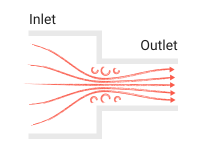
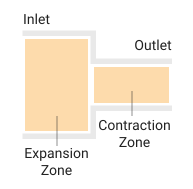
The pressure drop during sudden expansion is mainly due to turbulent mixing in the expansion zone. With a sharp narrowing, it is caused by the separation of the flow at the entrance to the narrowing zone. The figure shows the expansion and contraction zones with a sudden change in area.
Conservation of mass
The equation of conservation of mass with a sudden change in area has the form
where and — bulk charges via ports A and B.
Conservation of momentum
The equation of conservation of momentum with a sudden change in area has the form
where
-
and — pressure at ports A and B;
-
— average mass consumption;
-
— the average density of the liquid;
-
and — channel cross-sectional areas in ports A and B;
-
— loss of mechanical energy due to sudden changes in area.
The loss of mechanical energy is
where — loss ratio.
If for the parameter Local loss parameterization the value is set Semi-empirical correlation, then the loss coefficient for sudden expansion is calculated as
and with a sudden narrowing
where
-
— correction factor in the expansion zone;
-
— correction factor in the narrowing zone.
In the transition zone between a sharp expansion and a sharp contraction, the loss coefficient is smoothed using a cubic polynomial function.:
where
where — the value of the threshold mass flow rate at which the reverse flow occurs:
If the parameter Local loss parameterization it matters Tabulated data - loss coefficient vs. Reynolds number, then the block obtains the loss coefficient from the tabular data presented as a function of the Reynolds number.
Ports
Conserving
#
B
—
inlet or outlet
heat-conducting liquid
Details
The inlet or outlet for the liquid in the area with a sharp change in the area of the channel.
| Program usage name |
|
#
A
—
inlet or outlet
heat-conducting liquid
Details
The inlet or outlet for the liquid in the area with a sharp change in the area of the channel.
| Program usage name |
|
Parameters
Parameters
# Contraction correction factor — correction factor in the narrowing zone
Details
A correction factor for correcting the value of the loss coefficient in the narrowing zone of the channel. The block multiplies the loss coefficient calculated using a semi-empirical expression by this coefficient.
Dependencies
To use this parameter, set for the parameter Local loss parameterization meaning Semi-empirical correlation.
| Default value |
|
| Program usage name |
|
| Evaluatable |
Yes |
# Expansion loss coefficient vector — vector of expansion loss coefficients for tabular parameterization
Details
Vector of expansion loss coefficients. Specify the loss coefficients depending on the value of the Reynolds number Reynolds number vector. The block uses vectors of Reynolds numbers and loss coefficients to build a one-dimensional search table.
Dependencies
To use this parameter, set for the parameter Local loss parameterization meaning Tabulated data - loss coefficient vs. Reynolds number.
| Default value |
|
| Program usage name |
|
| Evaluatable |
Yes |
#
Local loss parameterization —
hydraulic loss model
Semi-empirical correlation | Tabulated data - loss coefficient vs. Reynolds number
Details
A model for calculating hydraulic losses due to sudden changes in area. Choose Semi-empirical correlation to automatically calculate the cross-sectional area loss factor at ports A and B. Choose Tabulated data - loss coefficient vs. Reynolds number to set the values of the loss coefficient in the form of a table depending on the Reynolds number of the flow.
| Values |
|
| Default value |
|
| Program usage name |
|
| Evaluatable |
No |
#
Cross-sectional area at port B —
port cross-sectional area B
m^2 | um^2 | mm^2 | cm^2 | km^2 | in^2 | ft^2 | yd^2 | mi^2 | ha | ac
Details
The cross-sectional area of the channel on port B. This value must be less than the cross-sectional area A.
| Units |
|
| Default value |
|
| Program usage name |
|
| Evaluatable |
Yes |
# Contraction loss coefficient vector — vector of narrowing loss coefficients for tabular parameterization
Details
The vector of loss coefficients during narrowing. Specify the loss coefficients depending on the value of the Reynolds number Reynolds number vector. The block uses vectors of Reynolds numbers and loss coefficients to build a one-dimensional search table.
Dependencies
To use this parameter, set for the parameter Local loss parameterization meaning Tabulated data - loss coefficient vs. Reynolds number.
| Default value |
|
| Program usage name |
|
| Evaluatable |
Yes |
# Critical Reynolds number — upper limit of the Reynolds number for laminar flow
Details
The Reynolds number, at which the flow transitions between laminar and turbulent modes in the narrowing area with a sharp change in area.
Dependencies
To use this parameter, set for the parameter Local loss parameterization meaning Semi-empirical correlation.
| Default value |
|
| Program usage name |
|
| Evaluatable |
Yes |
#
Cross-sectional area at port A —
port cross-sectional area A
m^2 | um^2 | mm^2 | cm^2 | km^2 | in^2 | ft^2 | yd^2 | mi^2 | ha | ac
Details
The cross-sectional area of the channel on port A. This value must be greater than the cross-sectional area B.
| Units |
|
| Default value |
|
| Program usage name |
|
| Evaluatable |
Yes |
# Reynolds number vector — a vector of Reynolds number values for tabular parameterization
Details
A vector of Reynolds numbers for tabular parameterization of loss coefficients. Values of loss coefficients Contraction loss coefficient vector and Expansion loss coefficient vector are set at these Reynolds numbers.
Dependencies
To use this parameter, set for the parameter Local loss parameterization meaning Tabulated data - loss coefficient vs. Reynolds number.
| Default value |
|
| Program usage name |
|
| Evaluatable |
Yes |
# Expansion correction factor — correction factor in the expansion zone
Details
A correction factor for correcting the value of the loss coefficient in the channel expansion zone. The block multiplies the loss coefficient calculated using a semi-empirical expression by this coefficient.
Dependencies
To use this parameter, set for the parameter Local loss parameterization meaning Semi-empirical correlation.
| Default value |
|
| Program usage name |
|
| Evaluatable |
Yes |