Timing Measurement
Measurement of period, frequency, fill factor, rise time and fall time.
blockType: SubSystem
|
Path in the library: |
Description
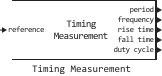
Block Timing Measurement Measures basic time metrics such as period, frequency, fill factor, rise time, and fall time.
Ports
Input
#
reference
—
The input signal
scalar
Details
The input signal, the time metrics of which are measured, is set as a scalar.
| Data types |
|
| Complex numbers support |
No |
Output
#
period
—
the period of the input signal
scalar
Details
The period of the input signal returned as a scalar.
| Data types |
|
| Complex numbers support |
No |
#
frequency
—
Input frequency
scalar
Details
The frequency of the input signal returned as a scalar.
| Data types |
|
| Complex numbers support |
No |
#
rise time
—
input signal rise time
scalar
Details
The rise time of the input signal, returned as a scalar.
| Data types |
|
| Complex numbers support |
No |
#
fall time
—
input signal decay time
scalar
Details
The decay time of the input signal, returned as a scalar.
| Data types |
|
| Complex numbers support |
No |
#
duty cycle
—
input fill factor
scalar
Details
The fill factor of the input signal, returned as a scalar.
| Data types |
|
| Complex numbers support |
No |
Parameters
The same reference threshold
# Use the same reference threshold for all measurments — using the same reference threshold to measure all time metrics
Details
Check the box to use the same reference threshold for measuring all time metrics.
| Default value |
|
| Program usage name |
|
| Tunable |
No |
| Evaluatable |
Yes |
# Reference threshold (V) — the reference threshold used to measure time metrics
Details
The reference threshold voltage used to measure all time metrics, set as a scalar in volts.
Dependencies
To use this option, check the box next to the option Use the same reference threshold for all measurments in the parameter group The same reference threshold on the tab Configuration.
program usage
-
Use
get_param(gcb,"SameRefThreshold")to view the current parameter value Reference threshold (V). -
Use
set_param(gcb,"SameRefThreshold",value)to set for the parameter Reference threshold (V) a certain value.
| Default value |
|
| Program usage name |
|
| Tunable |
No |
| Evaluatable |
Yes |
Period/Frequency
# Reference threshold (V) — the reference threshold voltage used to measure the period and/or frequency
Details
The reference threshold voltage used to measure the period and/or frequency of the signal under study, set as a scalar in volts.
Dependencies
To use this option, uncheck the box next to the option Use the same reference threshold for all measurments in the parameter group The same reference threshold on the tab Configuration.
program usage
-
Use
get_param(gcb,"PeriodRefThreshold")to view the current parameter value Reference threshold (V). -
Use
set_param(gcb,"PeriodRefThreshold",value)to set for the parameter Reference threshold (V) a certain value.
| Default value |
|
| Program usage name |
|
| Tunable |
No |
| Evaluatable |
Yes |
Rise/Fall Time
# Input range (V) — the range of the input signal
Details
The range of the input signal, specified as a two-element vector string, in volts. The first element determines the notch level of the input signal, and the second element determines the peak value. Parameter Input range (V) It is used to calculate the upper and lower thresholds for calculating the rise/fall time.
program usage
-
Use
get_param(gcb,"Range")to view the current parameter value Input range (V). -
Use
set_param(gcb,"Range",value)to set for the parameter Input range (V) a certain value.
| Default value |
|
| Program usage name |
|
| Tunable |
No |
| Evaluatable |
Yes |
#
Type —
input thresholds for measuring rise/fall time
90% / 10% | 80% / 20%
Details
Defines the input thresholds for measuring the rise/fall time, set as 80% / 20% or 90% / 10%.
program usage
-
Use
get_param(gcb,"MeasurementType")to view the current parameter value Type. -
Use
set_param(gcb,"MeasurementType",value)to set for the parameter Type a certain value.
| Values |
|
| Default value |
|
| Program usage name |
|
| Tunable |
No |
| Evaluatable |
Yes |
Duty Cycle
# Reference threshold (V) — the reference threshold voltage used to measure the fill factor
Details
The reference threshold voltage used to measure the fill factor of the studied signal, set as a scalar in volts.
Dependencies
To use this option, uncheck the box next to the option Use the same reference threshold for all measurments in the parameter group The same reference threshold on the tab Configuration.
program usage
-
Use
get_param(gcb,"DcRefThreshold")to view the current parameter value Reference threshold (V). -
Use
set_param(gcb,"DcRefThreshold",value)to set for the parameter Reference threshold (V) a certain value.
| Default value |
|
| Program usage name |
|
| Tunable |
No |
| Evaluatable |
Yes |