INS
|
Page in progress. |
The sensor model is ANN.
blockType: INS
|
Path in the library: |
Description
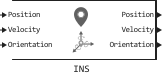
Block INS It simulates an inertial navigation system (INS) sensor, which outputs noise-distorted position, speed, and orientation data based on the corresponding input signals. The unit can also additionally output acceleration and angular velocity data based on the corresponding input signals. To change the noise level present in the output data, the accuracy of roll, pitch, yaw, position, velocity, acceleration, and angular velocity can be varied. The accuracy is defined as the standard deviation of the noise.
Ports
Input
#
Position
—
position of the ANN sensor
the matrix
Details
The position of the ANN sensor relative to the navigation frame, in meters, set as a real matrix of size on , where — the number of counts.
| Data types |
|
| Complex numbers support |
No |
#
Velocity
—
ANN sensor speed
the matrix
Details
The velocity of the ANN sensor relative to the navigation frame, in m/s, set as a real matrix of the size on , where — the number of counts.
| Data types |
|
| Complex numbers support |
No |
#
Orientation
—
orientation of the ANN sensor
array | the matrix
Details
The orientation of the ANN sensor relative to the navigation frame, set in one of the following formats:
-
An array of real numbers of the size on on , where each layer of the array (matrix on ) is a rotation matrix.
-
A matrix of real numbers of the size on , where each row of the matrix represents four quaternion elements.
-
An Euler angle matrix of size on , where each row of the matrix represents three Euler angles corresponding to the rotation pattern .
— the number of counts.
| Data types |
|
| Complex numbers support |
No |
#
Acceleration
—
acceleration of the ANN sensor
the matrix
Details
The acceleration of the ANN sensor relative to the navigation frame, in m/s2, given as a real matrix of size on , where — the number of counts.
Dependencies
To use this input port, check the box Use acceleration and angular velocity.
| Data types |
|
| Complex numbers support |
No |
#
AngularVelocity
—
angular velocity of the ANN sensor
the matrix
Details
The angular velocity of the ANN sensor relative to the navigation frame, in degrees per second, set as a real matrix of the size on , where — the number of counts.
Dependencies
To use this input port, check the box Use acceleration and angular velocity.
| Data types |
|
| Complex numbers support |
No |
#
HasGNSSFix
—
enable GNSS fixation
vector
Details
Enable GNSS fixation, set as a logical vector of size on , where — the number of counts. Set this input port to false to simulate the loss of fixation of the GNSS receiver. When the fixation of the GNSS receiver is lost, the position measurements drift at a speed set by the parameter Position error factor.
Dependencies
To use this input port, check the box Enable HasGNSSFix port.
| Data types |
|
| Complex numbers support |
No |
Output
#
Position
—
position of the ANN sensor
the matrix
Details
The position of the ANN sensor relative to the navigation frame, in meters, returned as a real matrix of the size on , where — the number of samples in the input data.
| Data types |
|
| Complex numbers support |
No |
#
Velocity
—
ANN sensor speed
the matrix
Details
The velocity of the ANN sensor relative to the navigation frame, in m/s, returned as a real matrix of the size on , where — the number of samples in the input data.
| Data types |
|
| Complex numbers support |
No |
#
Orientation
—
orientation of the ANN sensor
array | the matrix
Details
The orientation of the ANN sensor relative to the navigation frame, returned in one of the following formats:
-
An array of real numbers of the size on on , where each layer of the array (matrix on ) is a rotation matrix.
-
A matrix of real numbers of the size on , where each row of the matrix represents four quaternion elements.
-
An Euler angle matrix of size on , where each row of the matrix represents three Euler angles corresponding to the rotation pattern .
— the number of samples in the input data.
| Data types |
|
| Complex numbers support |
No |
#
Acceleration
—
acceleration of the ANN sensor
the matrix
Details
The acceleration of the ANN sensor relative to the navigation frame, in m/s2, returned as a real matrix of the size on , where — the number of counts.
Dependencies
To use this output port, check the box Use acceleration and angular velocity.
| Data types |
|
| Complex numbers support |
No |
#
AngularVelocity
—
angular velocity of the ANN sensor
the matrix
Details
The angular velocity of the ANN sensor relative to the navigation frame, in degrees per second, returned as a real matrix of the size on , where — the number of counts.
Dependencies
To use this output port, check the box Use acceleration and angular velocity.
| Data types |
|
| Complex numbers support |
No |
Parameters
Parameters
#
Mounting location (m) —
sensor location on the platform, m
Array of real numbers
Details
The location of the sensor on the platform, in meters, specified as a three-element real matrix of the form . The vector defines the offset of the sensor’s origin relative to the origin of the platform.
| Default value |
|
| Program usage name |
|
| Tunable |
No |
| Evaluatable |
Yes |
#
Roll (X-axis) accuracy (deg) —
roll measurement accuracy, degrees
Real number
Details
The accuracy of measuring the roll of the sensor body in degrees, set as a non-negative real scalar.
Roll is defined as rotation around an axis sensor housings. The roll noise is modeled as the white noise of the process with a standard deviation equal to the value specified in the parameter Roll (X-axis) accuracy (deg).
| Default value |
|
| Program usage name |
|
| Tunable |
Yes |
| Evaluatable |
Yes |
#
Pitch (Y-axis) accuracy (deg) —
pitch measurement accuracy, degrees
Real number
Details
The accuracy of measuring the pitch of the sensor housing in degrees, set as a non-negative real scalar.
Pitch is defined as rotation around an axis sensor housings. Pitch noise is modeled as white noise of the process with a standard deviation equal to the value specified in the parameter Pitch (Y-axis) accuracy (deg).
| Default value |
|
| Program usage name |
|
| Tunable |
Yes |
| Evaluatable |
Yes |
#
Yaw (Z-axis) accuracy (deg) —
yaw measurement accuracy, degrees
Real number
Details
The accuracy of measuring the yaw of the sensor housing in degrees, set as a non-negative real scalar.
Yaw is defined as rotation around an axis sensor housings. The yaw noise is modeled as the white noise of the process with a standard deviation equal to the value specified in the parameter Yaw (Z-axis) accuracy (deg).
| Default value |
|
| Program usage name |
|
| Tunable |
Yes |
| Evaluatable |
Yes |
#
Position accuracy (m) —
accuracy of position measurement, m
Scalar / array of real numbers
Details
The accuracy of measuring the position of the sensor body in meters, set as a non-negative real scalar or a matrix of non-negative numbers with the size on . If you set a scalar value for the parameter, the block sets the accuracy of all three position components to this value.
Position noise is modeled as white noise of the process with a standard deviation equal to the value specified in the parameter Position accuracy (m).
| Default value |
|
| Program usage name |
|
| Tunable |
Yes |
| Evaluatable |
Yes |
#
Velocity accuracy (m/s) —
speed measurement accuracy, m/s
Real number
Details
The accuracy of measuring the speed of the sensor housing in m/s, set as a non-negative real scalar.
The speed noise is modeled as the white noise of the process with a standard deviation equal to the value specified in the parameter Velocity accuracy (m/s).
| Default value |
|
| Program usage name |
|
| Tunable |
Yes |
| Evaluatable |
Yes |
Additional Kinematics
#
Use acceleration and angular velocity —
Use acceleration and angular velocity
Logical
Details
Select this option to activate the input of acceleration and angular velocity data via the input ports Acceleration and angularVelocity, respectively. In this case, the unit will output acceleration and angular velocity measurements via the output ports Acceleration and angularVelocity, respectively. In addition, checking this box allows you to set parameters. Acceleration accuracy (m/s²) and Angular velocity accuracy (deg/s).
| Default value |
|
| Program usage name |
|
| Tunable |
No |
| Evaluatable |
No |
#
Acceleration accuracy (m/s²) —
acceleration measurement accuracy, m/s2
Real number
Details
The accuracy of measuring the acceleration of the sensor housing in m/s ^ 2^, set as a non-negative real scalar.
Acceleration noise is modeled as white noise of the process with a standard deviation equal to the value specified in the parameter Acceleration accuracy (m/s²).
Dependencies
To use this option, check the box Use acceleration and angular velocity.
| Default value |
|
| Program usage name |
|
| Tunable |
Yes |
| Evaluatable |
Yes |
#
Angular velocity accuracy (deg/s) —
accuracy of angular velocity measurement, deg/s
Real number
Details
The accuracy of measuring the angular velocity of the sensor housing in degrees per second, set as a non-negative real scalar.
Angular velocity noise is modeled as white noise of the process with a standard deviation equal to the value specified in the parameter Angular velocity accuracy (deg/s).
Dependencies
To use this option, check the box Use acceleration and angular velocity.
| Default value |
|
| Program usage name |
|
| Tunable |
Yes |
| Evaluatable |
Yes |
Simulate GNSS Loss
#
Enable HasGNSSFix port —
enable the input port HasGNSSFix
Logical
Details
Check this box to use the HasGNSSFix input port. If the value is specified for the input port HasGNSSFix false, position measurements drift at a speed set by the parameter Position error factor.
| Default value |
|
| Program usage name |
|
| Tunable |
No |
| Evaluatable |
No |
#
Position error factor —
position error coefficient, m
Scalar / array of real numbers
Details
The coefficient of position error without GNSS fixation, specified as a scalar or a matrix of real numbers with the size on . If a scalar value is set for this parameter, the block sets the position error coefficients of all three position components to this value.
If the value is specified for the input port HasGNSSFix false, then the position error increases quadratically due to the constant displacement in the accelerometer. Position error for the position component can be expressed as , where — the position error coefficient for the corresponding component, and — the time elapsed since the loss of GNSS fixation. Calculated values for components , and positions on the output port Position are added to the corresponding components.
Dependencies
To use this option, check the box Enable HasGNSSFix port.
| Default value |
|
| Program usage name |
|
| Tunable |
Yes |
| Evaluatable |
Yes |
Randomization
#
Seed —
the initial value for generating random numbers
Real number
Details
The initial value for the random number generator algorithm, set as a non-negative integer.
| Default value |
|
| Program usage name |
|
| Tunable |
No |
| Evaluatable |
Yes |