Noise (CE)
Noise model with usage of current or voltage noise sources in RF systems.
blockType: SubSystem
|
Path in the library: |
Description
Block Noise (CE) simulates noise as an ideal current or voltage source for blocks. Using this unit, you can select the type of noise distribution: white or piecewise linear. When using the block usage Noise (CE) to simulate noise in an RF model, select the check box Simulate noise block Configuration (CE). Otherwise, the model will be simulated without noise. Block Noise (CE) does not depend on the parameter Temperature, K block Configuration (CE).
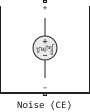
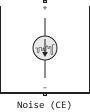
Block icon Noise (CE) It is dynamic and displays the current source type. This table shows how the block icon changes depending on the parameter value. Source type.
Source type: Ideal voltage |
Source type: Ideal current |
|---|---|
|
|
Ports
Conserving
#
+
—
electrical port
electricity
Details
The electrical port corresponding to the positive terminal of the RF circuit.
| Program usage name |
|
#
−
—
electrical port
electricity
Details
The electrical port corresponding to the negative terminal of the RF circuit.
| Program usage name |
|
Parameters
Parameters
#
Source type —
type of noise
Ideal voltage | Ideal current
Details
The type of noise specified as Ideal voltage or Ideal current.
| Values |
|
| Default value |
|
| Program usage name |
|
| Tunable |
No |
| Evaluatable |
Yes |
#
Noise distribution —
type of noise distribution
White | Piece-wise linear
Details
The type of noise distribution, defined as White or Piece-wise linear.
| Values |
|
| Default value |
|
| Program usage name |
|
| Tunable |
No |
| Evaluatable |
Yes |
# Noise power spectral density, V^2/Hz — one-way distribution of noise power spectral density
Details
A one-way distribution of the spectral power density (SPM) of noise, defined as a scalar or vector in V2/Hz. One-way SPM depends on the type of noise distribution. If for the parameter Noise distribution one of the following values is set:
-
White— then specify for the parameter Noise power spectral density, V^2/Hz the value is in the form of a non-negative scalar. The SPM of white noise is constant at all frequencies, and the noise power depends on the carrier bandwidth or time step. This is an uncorrelated noise source. -
Piece-wise linear— then specify for the parameter Noise power spectral density, V^2/Hz the value is in the form of a vector. The vector must have the same length as the vector specified in the parameter. Frequencies, Hz.For each carrier, the noise source behaves like a white noise source. The SPM of the noise source depends on the carrier, and you can calculate it by performing linear interpolation at the carrier frequency on the noise spectral density curve.
The noise spectral density curve represents the change in the SPM of noise as a function of frequency. The block uses the values specified in the parameters Noise power spectral density, V^2/Hz and Frequencies, Hz, to define this curve.
Dependencies
To use this parameter, set for the parameter Source type meaning Ideal voltage.
| Default value |
|
| Program usage names |
|
| Tunable |
No |
| Evaluatable |
Yes |
# Noise power spectral density, A^2/Hz — one-way distribution of noise power spectral density
Details
A one-way distribution of the spectral power density (SPM) of noise, defined as a scalar or vector in A2/Hz. One-way SPM depends on the type of noise distribution. If for the parameter Noise distribution one of the following values is set:
-
White— then specify for the parameter Noise power spectral density, A^2/Hz the value is in the form of a non-negative scalar. The SPM of white noise is constant at all frequencies, and the noise power depends on the carrier bandwidth or time step. This is an uncorrelated noise source. -
Piece-wise linear— then specify for the parameter Noise power spectral density, A^2/Hz the value is in the form of a vector. The vector must have the same length as the vector specified in the parameter. Frequencies, Hz.For each carrier, the noise source behaves like a white noise source. The SPM of the noise source depends on the carrier, and you can calculate it by performing linear interpolation at the carrier frequency on the noise spectral density curve.
The noise spectral density curve represents the change in the SPM of noise as a function of frequency. The block uses the values specified in the parameters Noise power spectral density, A^2/Hz and Frequencies, Hz, to define this curve.
Dependencies
To use this parameter, set for the parameter Source type meaning Ideal current.
| Default value |
|
| Program usage names |
|
| Tunable |
No |
| Evaluatable |
Yes |
# Frequencies, Hz — frequencies for piecewise linear noise distribution
Details
Frequencies for a piecewise linear noise distribution, given as a vector of non-negative frequencies.
Dependencies
To use this parameter, set for the parameter Noise distribution meaning Piece-wise linear.
| Default value |
|
| Program usage names |
|
| Tunable |
No |
| Evaluatable |
Yes |