Rotor
Calculation of the aerodynamic force and torque of the propeller.
blockType: SubSystem
|
Path in the library: |
Description
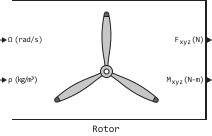
Block Rotor calculates the components of the aerodynamic force and the aerodynamic torque generated by the propeller. The block can also take into account the tilt of the propeller disc due to the swing movement of the blades in horizontal flight.
The components of aerodynamic force:
where
-
— thrust coefficient of the screw;
-
— air density;
-
— the radius of the screw;
-
— the angular velocity of the screw.
Components of the aerodynamic moment:
where — the torque coefficient of the screw.
If the check box is selected Compute CT and CQ The unit calculates the thrust and torque coefficients of the propeller according to the theory of the blade element.
In accordance with the simplified method of accounting for end losses proposed by Prandtl, the thrust coefficient of the elementary section of the blade is found by the formula:
where
-
— a function reflecting the load drop factor in the end section of the blade;
-
— flow rate;
-
— the relative radius of the section.
The exponential function indicator included in the formula , is equal to
where — the number of blades, determined by the parameter Number of blades.
According to the theory of the blade element, the thrust coefficient of the elementary section of the blade is found by the formula:
where
-
— fill factor;
-
— the chord defined by the parameter Chord, [m];
-
— the radius defined by the parameter Radius, [m];
-
— the slope of the lifting force curve, determined by the parameter Lift curve slope (per rad);
-
— the angle of installation at the end of the blade, determined by the parameter Twist distribution.
After equating the right sides of the equations, the resulting equation it is solved numerically with respect to . Knowing the flow coefficient, it is possible to determine the thrust coefficient of the entire blade using the integral formula.
The algorithm for calculating the torque coefficient is similar. The torque coefficient is related to the thrust coefficient of the elementary section of the blade by the following relationship:
Limitations
-
The block does not simulate the swing and cyclic movement of the blades.
-
The block uses the ideal and linear laws of changing the rotation of the blades, set by the parameter Twist distribution. In this case, the chord and the slope of the lifting force curve of the blades are considered constant.
Ports
Entrance
# Ωb(rad/s) is the angular velocity of the screw
+
scalar
Details
The angular velocity of rotation of the propeller around its axis relative to the body (fuselage), rad / s.
| Data types |
|
| Support for complex numbers |
None |
# rb(kg/m3) is the density of air
+
scalar
Details
Air density, kg/m 3. The value must be greater than zero.
| Data types |
|
| Support for complex numbers |
None |
# Vb(m/s) — screw speed
+
a 3-by-1 vector
Details
The components of the screw velocity in the associated coordinate system, m/s.
Dependencies
To use this port, set the parameter Modeling meaning With flap effects.
| Data types |
|
| Support for complex numbers |
None |
# ωb(rad/s) is the angular velocity of the aircraft
+
a 3-by-1 vector
Details
The components of the angular velocity of the aircraft in the associated coordinate system, rad/s.
Dependencies
To use this port, set the parameter Modeling meaning With flap effects.
| Data types |
|
| Support for complex numbers |
None |
Output
# Fxyz(N) — aerodynamic force
+
a 3-by-1 vector
Details
The components of the aerodynamic force in the associated coordinate system, defined as a vector. Vector elements:
-
— longitudinal force;
-
— traction force;
-
— lateral force.
They are measured in units of force.
| Data types |
|
| Support for complex numbers |
None |
# Mxyz(N-m) — aerodynamic moment
+
a 3-by-1 vector
Details
The components of the aerodynamic moment in the associated coordinate system, defined as a vector. Vector elements:
-
— transverse moment;
-
— a normal moment;
-
— the longitudinal moment.
They are measured in units of moment.
| Data types |
|
| Support for complex numbers |
None |
# CT — thrust coefficient
+
scalar
Details
Thrust coefficient.
Dependencies
To use this port, check the box Output computed CT and CQ.
| Data types |
|
| Support for complex numbers |
None |
# CQ is the torque coefficient
+
scalar
Details
The torque coefficient.
Dependencies
To use this port, check the box Output computed CT and CQ.
| Data types |
|
| Support for complex numbers |
None |
Parameters
Main group
#
Modeling —
the method of calculating the thrust force
Without flap effects | With flap effects
Details
The method of calculating the thrust force:
-
Without flap effects— without taking into account the geometry of the blades; -
With flap effects— taking into account the geometry of the blades and the tilt of the propeller disc in horizontal flight.
| Values |
|
| Default value |
|
| Program usage name |
|
| Tunable |
No |
| Evaluatable |
Yes |
Rotor
# Number of blades — number of blades
Details
The number of blades. The value must be greater than zero.
Dependencies
To use this option, check the box Compute CT and CQ or set for the parameter Modeling meaning With flap effects.
| Default value |
|
| Program usage name |
|
| Tunable |
No |
| Evaluatable |
Yes |
# Compute CT and CQ — calculation of thrust and torque coefficients
Details
Check this box so that the thrust and torque coefficients of the screw are calculated inside the unit.
| Default value |
|
| Program usage name |
|
| Tunable |
No |
| Evaluatable |
Yes |
# Output computed CT and CQ — output of calculated thrust and torque coefficients
Details
Check this box to add new output ports to output the calculated thrust and torque coefficients of the propeller.
Dependencies
To use this option, check the box Compute CT and CQ.
| Default value |
|
| Program usage name |
|
| Tunable |
No |
| Evaluatable |
Yes |
# Thrust coefficient (CT) — thrust coefficient
Details
The thrust coefficient of the screw. The value must be greater than zero.
Dependencies
To use this option, uncheck the box. Compute CT and CQ.
| Default value |
|
| Program usage name |
|
| Tunable |
No |
| Evaluatable |
Yes |
# Torque coefficient (CQ) — torque ratio
Details
The torque coefficient of the screw. The value must be greater than zero.
Dependencies
To use this option, uncheck the box. Compute CT and CQ.
| Default value |
|
| Program usage name |
|
| Tunable |
No |
| Evaluatable |
Yes |
Blade
# Radius, [m] — radius
Details
The radius of the screw, m. The value must be greater than zero.
| Default value |
|
| Program usage name |
|
| Tunable |
No |
| Evaluatable |
Yes |
# Chord, [m] — The chord
Details
Horta of the screw, m. The value must be greater than zero.
Dependencies
To use this option, check the box Compute CT and CQ or set for the parameter Modeling meaning With flap effects.
| Default value |
|
| Program usage name |
|
| Tunable |
No |
| Evaluatable |
Yes |
# Hinge offset, [m] — removal of the horizontal hinge
Details
The distance from the axis of rotation of the screw to the axis of the hinge, which ensures the swing movement of the blade. It is measured in meters. The value must be greater than or equal to zero.
As a rule, the value for propellers is zero.
Dependencies
To use this option, check the box Compute CT and CQ or set for the parameter Modeling meaning With flap effects.
| Default value |
|
| Program usage name |
|
| Tunable |
No |
| Evaluatable |
Yes |
# Lift curve slope (per rad) — slope of the lifting force curve
Details
The derivative of the lift coefficient with respect to the angle of attack. The value must be greater than zero.
Changing the value depending on the angle of attack is not taken into account.
Dependencies
To use this option, check the box Compute CT and CQ or set for the parameter Modeling meaning With flap effects.
| Default value |
|
| Program usage name |
|
| Tunable |
No |
| Evaluatable |
Yes |
# Lock number — mass characteristics
Details
Mass characteristic of the propeller blade. The value must be greater than zero.
Dependencies
To use this option, check the box Compute CT and CQ or set for the parameter Modeling meaning With flap effects.
| Default value |
|
| Program usage name |
|
| Tunable |
No |
| Evaluatable |
Yes |
#
Twist distribution —
the law of twist change
Linear | Ideal
Details
The law of twist change:
-
Linear— linear.The model of geometric blade rotation is described by the dependence .
-
Ideal— perfect.The model of geometric blade rotation is described by the dependence .
Dependencies
To use this option, check the box Compute CT and CQ or set for the parameter Modeling meaning With flap effects.
| Values |
|
| Default value |
|
| Program usage name |
|
| Tunable |
No |
| Evaluatable |
Yes |
# Blade root angle, [rad] — installation angle of the section
Details
Angle of installation of the section of the propeller blade I’m glad. The value must be greater than zero.
Dependencies
To use this option, check the box Compute CT and CQ or set for the parameter Modeling meaning With flap effects, and for the Twist distribution parameter, set the value Linear.
| Default value |
|
| Program usage name |
|
| Tunable |
No |
| Evaluatable |
Yes |
# Blade twist angle, [rad] — twist angle
Details
Angle of rotation of the section of the propeller blade I’m glad.
Dependencies
To use this option, check the box Compute CT and CQ or set for the parameter Modeling meaning With flap effects, and for the Twist distribution parameter, set the value Linear.
| Default value |
|
| Program usage name |
|
| Tunable |
No |
| Evaluatable |
Yes |
# Blade tip angle, [rad] — installation angle
Details
Angle of installation of the propeller blade I’m glad. The value must be greater than zero.
Dependencies
To use this option, check the box Compute CT and CQ or set for the parameter Modeling meaning With flap effects, and for the Twist distribution parameter, set the value Ideal.
| Default value |
|
| Program usage name |
|
| Tunable |
No |
| Evaluatable |
Yes |
Literature
-
Pounds, P. E. I. (2007). Design, construction and control of a large quadrotor micro air vehicle (Doctoral dissertation, Australian National University).
-
Riether, F. (2016). Agile quadrotor maneuvering using tensor-decomposition-based globally optimal control and onboard visual-inertial estimation (Doctoral dissertation, Massachusetts Institute of Technology).
-
Alayan O. M. Aerodynamics and dynamics of helicopter flight: Textbook / O. M. Alayan, V. F. Romasevich, V. S. Sovgirenko; Edited by Candidate of Technical Sciences A.M. Zagordan. — M.: Voenizdat, 1973. — 445 p.: ill.
-
Shaidakov V. I., Maslov A.D. Aerodynamic design of propeller blades: Textbook. Moscow: Publishing House of MAI, 1995. 68 p.: ill.
-
B. N. Yuriev. Aerodynamic calculation of helicopters. The State Publishing House of the Defense Industry. Moscow, 1956.