Rolling Resistance
Rolling resistance model.
blockType: Engee1DMechanical.Vehicles.Tires.RollingResistance
|
Path in the library: |
Description
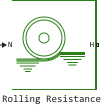
The Rolling Resistance block represents the drag force acting on the wheel hub due to rolling resistance on the road-wheel contact surface. The block may use a constant drag coefficient, pressure and speed dependence in accordance with SAE J2452 or the empirical formula of H. Paceika. The drag force is zero when the normal force acting on the wheel-road contact surface is less than or equal to zero.
Parameterization of the constant drag coefficient
If the Resistance model parameters are set to Constant coefficient, the rolling resistance is directly proportional to the drag coefficient , where:
-
- `Rolling resistance force;
-
- normal force;
-
- rolling resistance coefficient.
The rolling resistance coefficient has a hyperbolic shape, which eliminates the discontinuity at
where
-
- is the asymptotic coefficient of rolling resistance;
-
- hub velocity;
-
- threshold speed.
Pressure and velocity dependent parameterization
If the Resistance model parameters are set to Pressure and velocity dependent (SAE J2542), the block uses the formula:
where
-
- tyre pressure;
-
- hub velocity;
-
- approximating coefficients;
-
- 1 pascal (Pa);
-
- 1 Newton (N).
In this equation, the parameters and remove physical units from each base of the exponential expression.
Parameterization by Hans Paceika’s empirical formula
If the Resistance model parameters are set to Pressure and velocity dependent (Magic Formula), the block uses the empirical formula of H. Patzeki formula for calculating rolling resistance (see [1] for details)
:
where
-
- is the value of the parameter Tire nominal vertical load, FNOMIN;
-
- value of parameters Scale factor of rolling resistance, LMY;
-
- elements of the Q-coefficient parameters [qsy1 qsy2 qsy3 qsy4 qsy5 qsy6 qsy7 qsy8];
-
- value of parameter Hub nominal longitudinal longitudinal speed, LONGVL;
-
- value of parameter Tire pressure;
-
- value of parameter Tire nominal pressure, NOMPRES;
-
- longitudinal speed of the wheel hub;
-
- longitudinal friction force acting on the road side;
-
- vertical load on the tyre.
The tanh expressions in this parameterization smoothly change the sign of the drag force when .
Ports
Input
#
N
—
normal force, N
`scalar
Details
The input port associated with the normal force, in H. The positive direction of the force is downwards.
| Data types |
|
| Complex numbers support |
No |
#
T
—
tread friction force, N
scalar
Details
Input port related to the road friction force on the tyre, in N. The positive direction of the force is forwards.
Dependencies
To use this port, set the Resistance model parameters to Pressure and velocity dependent (Magic Formula).
| Data types |
|
| Complex numbers support |
No |
Conserving
#
H
—
wheel hub, m/s
`rotational mechanics
Details
The non-directional rotational port associated with the wheel hub, in m/s.
| Program usage name |
|
Parameters
Main
#
Resistance model —
rolling resistance method
Constant coefficient | Pressure and velocity dependent (SAE J2452) | Pressure and velocity dependent (Magic Formula)
Details
A method for calculating the rolling resistance of a wheel hub. Set as:
-
Constant coefficient -
Pressure and velocity dependent (SAE J2542) -
Pressure and velocity dependent (Magic Formula)
| Values |
|
| Default value |
|
| Program usage name |
|
| Evaluatable |
No |
# Constant coefficient — coefficient of rolling resistance of the tire
Details
The value of a constant coefficient for calculating rolling resistance.
Dependencies
To use this parameter, set the Resistance model parameter to Constant coefficient.
| Default value |
|
| Program usage name |
|
| Evaluatable |
Yes |
#
Tire pressure —
tire inflating pressure
Pa | uPa | hPa | kPa | MPa | GPa | kgf/m^2 | kgf/cm^2 | kgf/mm^2 | mbar | bar | kbar | atm | ksi | psi | mmHg | inHg
Details
Constant tire inflating pressure.
Dependencies
To use this parameter, set the Resistance model parameter to Pressure and velocity dependent (SAE J2542) or Pressure and velocity dependent (Magic Formula).
| Units |
|
| Default value |
|
| Program usage name |
|
| Evaluatable |
Yes |
# Alpha — coefficient α
Details
Coefficient α SAE J2452 for parameterization of pressure and velocity. You determine this value using empirical data in accordance with SAE J2452.
Dependencies
To use this parameter, set the Resistance model parameter to Pressure and velocity dependent (SAE J2542).
| Default value |
|
| Program usage name |
|
| Evaluatable |
Yes |
# Beta — coefficient β
Details
Coefficient β SAE J2452 for parameterization of pressure and velocity. You determine this value using empirical data in accordance with SAE J2452.
Dependencies
To use this parameter, set the Resistance model parameter to Pressure and velocity dependent (SAE J2542).
| Default value |
|
| Program usage name |
|
| Evaluatable |
Yes |
# Coefficient A — coefficient A
Details
SAE J2452 coefficient A for pressure and velocity parameterization. You determine this value using empirical data in accordance with SAE J2452.
Dependencies
To use this parameter, set the Resistance model parameter to Pressure and velocity dependent (SAE J2542).
| Default value |
|
| Program usage name |
|
| Evaluatable |
Yes |
#
Coefficient B —
coefficient B
s/m | s/ft
Details
SAE J2452 coefficient B for pressure and velocity parameterization. You determine this value using empirical data in accordance with SAE J2452.
Dependencies
To use this parameter, set the Resistance model parameter to Pressure and velocity dependent (SAE J2542).
| Units |
|
| Default value |
|
| Program usage name |
|
| Evaluatable |
Yes |
#
Coefficient C —
coefficient C
s^2/m^2 | s^2/ft^2
Details
Coefficient C SAE J2452 for pressure and velocity parameterization. You determine this value using empirical data in accordance with SAE J2452.
Dependencies
To use this parameter, set the Resistance model parameter to Pressure and velocity dependent (SAE J2542).
| Units |
|
| Default value |
|
| Program usage name |
|
| Evaluatable |
Yes |
#
Tire nominal pressure, NOMPRES —
nominal tire pressure
Pa | uPa | hPa | kPa | MPa | GPa | kgf/m^2 | kgf/cm^2 | kgf/mm^2 | mbar | bar | kbar | atm | ksi | psi | mmHg | inHg
Details
Nominal tire pressure. NOMPRES – ID in the TIR file.
Dependencies
To use this parameter, set the Resistance model parameter to Pressure and velocity dependent (Magic Formula).
| Units |
|
| Default value |
|
| Program usage name |
|
| Evaluatable |
Yes |
#
Tire nominal vertical load, FNOMIN —
normal strength
N | nN | uN | mN | kN | MN | GN | dyn | lbf | kgf
Details
Rated normal power, , on the bus. FNOMIN – ID in the TIR file.
Dependencies
To use this parameter, set the Resistance model parameter to Pressure and velocity dependent (Magic Formula).
| Units |
|
| Default value |
|
| Program usage name |
|
| Evaluatable |
Yes |
#
Hub nominal longitudinal velocity, LONGVL —
nominal longitudinal rotation speed of the hub
m/s | mm/s | cm/s | km/s | m/hr | km/hr | in/s | ft/s | mi/s | ft/min | mi/hr | kn
Details
The nominal longitudinal speed of the hub. LONGVL – id of the TIR file.
Dependencies
To use this parameter, set the Resistance model parameter to Pressure and velocity dependent (Magic Formula).
| Units |
|
| Default value |
|
| Program usage name |
|
| Evaluatable |
Yes |
# Q-coefficient parameters [qsy1, qsy2, qsy3, qsy4, qsy5, qsy6, qsy7, qsy8] — the coefficients of Q in the empirical formula
Details
Coefficients of the empirical formula Q. qsy1,…, qsy8 match the file IDs of the TIR.
Dependencies
To use this parameter, set the Resistance model parameter to Pressure and velocity dependent (Magic Formula).
| Default value |
|
| Program usage name |
|
| Evaluatable |
Yes |
# Scale factor of rolling resistance, LMY — rolling resistance
Details
Scale coefficient of rolling resistance, . LMY – this is the identifier of the TIR file.
Dependencies
To use this parameter, set the Resistance model parameter to Pressure and velocity dependent (Magic Formula).
| Default value |
|
| Program usage name |
|
| Evaluatable |
Yes |
#
Velocity threshold —
the speed when the entire rolling resistance force is transferred to the rolling hub
m/s | mm/s | cm/s | km/s | m/hr | km/hr | in/s | ft/s | mi/s | ft/min | mi/hr | kn
Details
The minimum speed at which maximum rolling resistance is achieved.
| Units |
|
| Default value |
|
| Program usage name |
|
| Evaluatable |
Yes |