Diaphragm (G-G)
|
Page in progress. |
Pneumatic diaphragm with volumetric rigidity.
blockType: EngeeFluids.DesignComponents.Diaphragms.GasGas
|
Diaphragm (G-G) Path in the library: |
|
Diaphragm with Moving Body (G-G) Path in the library: |

Description
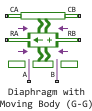
Block Diaphragm (G-G) It is a part of a pneumatic component in which pressure acts on a membrane, a flexible partition separating two gas volumes. If the check box is selected Volumetric stiffness, then the block takes into account the deformation of the membrane and the associated pneumatic stiffness.
If the check box is selected Moving body, then the block is implemented Diaphragm with Moving Body (G-G) and the body movement is simulated. In this case, the movement and speed of the case are related to the ports CA and CB. The speed and displacement of the rod are related to the ports RA and RB. For the diaphragm, the effective diameter is determined as a function of the displacement of the stem if the body is stationary, or the relative displacement between the body and the stem if the body is movable. The force in the port RA is calculated based on the external force in the port RB and the pressure forces on the membrane. If the body is movable, the force in port CA is calculated based on the external force in port CB and the pressure forces on the diaphragm. The speeds and movements in the ports RA and RB, as well as CA and CB in the case of a movable body, are equal in pairs, respectively.
The pressure and temperature are determined in the chambers, and they are equal to the pressure and temperature in ports A and B. The flow rate in ports A and B is calculated based on the relative velocity of the housing and membrane, as well as the current volume of the chamber and the derivative of this volume. It is assumed that the chambers are thermally insulated, so the enthalpy change is due to adiabatic processes in the chamber due to changes in volume and pressure.
Use this block to simulate a pneumatic diaphragm, the effective area of which depends on the movement of the rod relative to the initial position. Note that in more complex membrane models, the effective area is considered as a function of the displacement of the stem and the pressure difference on both sides of the membrane.
This unit can be used in combination with a variable stiffness spring, for example, Variable Translational Spring, for modeling the nonlinear stiffness of a membrane.
The figure shows a diagram of a pneumatic component with a diaphragm.

In this picture:
-
— the diameter of the rod on the port side RA, the value of the parameter Rod diameter at port RA;
-
— the diameter of the rod on the port side RB, the value of the parameter Rod diameter at port RB;
-
— case diameter, parameter value Body diameter;
-
— moving the stem;
-
— the initial position of the diaphragm rod, the value of the parameter Lift corresponding to zero displacement;
-
— effective diameter of the diaphragm depending on the movement of the stem ;
-
and — pressure in chambers A and B;
-
, — forces in ports RA and RB;
-
, — forces in ports CA and CB for the case when the flag Moving body installed.
Effective membrane diameter for different values of rod movement It is determined from the vectors Efficiency diameter vector and Lift vector by linear interpolation.
The equations
effective areas
If the check box is Moving body removed, the body is stationary, the stem is moving , is defined as:
where
-
— the initial position of the rod corresponding to the zero offset, the value of the parameter Lift corresponding to zero displacement;
-
— moving the stem in the RA port.
If the check box Moving body a movable body is installed and modeled, the movement of the rod is defined as:
where — moving the hull in the port CA.
The effective area is the area of the driven cylinder creating an equivalent axial force. The effective area on both sides of the membrane for each chamber is defined as:
Extended forces
The power at port RA is defined as:
where and — pressure in chambers A and B.
If the check box Moving body installed, the hull movement is simulated, and the force in the port CA is defined as:
The rigidity of the membrane
If the check box is selected Volumetric stiffness, then the block takes into account the deformation of the membrane due to excessive pressure on one side of the membrane.
The following test allows you to measure the volumetric stiffness: the stem of the membrane is rigidly fixed, increased pressure is applied to one of the chambers, and the second chamber communicates with the atmosphere.

By measuring the changes in pressure and volume of the chambers, we obtain:
where
-
— the pressure difference acting on the membrane;
-
— volume change;
-
— the coefficient of stiffness of the membrane, the value of the parameter Diaphragm strain pneumatic stiffness;
-
— a measure of gas resistance to volume change in Pa/m 3.
The flow rate due to the deformation of the membrane is calculated as follows:
To calculate the volume derivative (corresponding to the flow rate due to membrane deformation), the following approximation is introduced:
The gas flow rate due to the deformation of the membrane is calculated using an explicit condition , which is initialized as:
where — the pressure difference at the initial time .
Then the derivative can be approximately written as follows:
where — time constant, parameter value Time constant for first order lag.
If the check box Volumetric stiffness if not installed, it is assumed that the membrane does not deform, in this case:
_ Volumes and volume derivatives_
If the check box Moving body removed, and the body movement is not simulated, then the derivatives of the camera volumes A and B are defined as:
where — the speed of movement of the rod.
If the check box Moving body installed, and the body movement is modeled, then the derivatives of the volumes of the chambers A and B are defined as:
where — the speed of movement of the body.
Volumes are calculated as:
where and — camera volumes A and B corresponding to the zero offset, parameter values Chamber volume at port A at zero displacement and Chamber volume at port B at zero displacement.
Ports
Conserving
#
CA
—
housing
translational mechanics
Details
A mechanical translational port connected to the body from the side of the gas port A.
Dependencies
To use this port, check the box Moving body.
| Program usage name |
|
#
RA
—
stock
translational mechanics
Details
A mechanical translational port connected to the rod from the side of the gas port A.
| Program usage name |
|
#
CB
—
housing
translational mechanics
Details
A mechanical translational port connected to the body from the side of the gas port B.
Dependencies
To use this port, check the box Moving body.
| Program usage name |
|
#
A
—
gas inlet or outlet
gas
Details
The port connected to the camera A.
| Program usage name |
|
#
B
—
gas inlet or outlet
gas
Details
The port connected to the camera B.
| Program usage name |
|
#
RB
—
stock
translational mechanics
Details
A mechanical translational port connected to the rod from the side of the gas port B.
| Program usage name |
|
Parameters
Initial Conditions
#
Initial body displacement —
initial displacement of the body
m | um | mm | cm | km | in | ft | yd | mi | nmi
Details
The initial displacement of the body.
Dependencies
To use this option, check the box Moving body.
| Units |
|
| Default value |
|
| Program usage name |
|
| Evaluatable |
Yes |
#
Initial gas temperature in chamber A —
the initial temperature of the gas in the chamber A
K | degC | degF | degR | deltaK | deltadegC | deltadegF | deltadegR
Details
The initial temperature of the gas in the chamber is A.
| Units |
|
| Default value |
|
| Program usage name |
|
| Evaluatable |
Yes |
#
Initial gas temperature in chamber B —
the initial temperature of the gas in the chamber B
K | degC | degF | degR | deltaK | deltadegC | deltadegF | deltadegR
Details
The initial temperature of the gas in the chamber is B.
| Units |
|
| Default value |
|
| Program usage name |
|
| Evaluatable |
Yes |
#
Initial rod displacement —
initial displacement of the rod
m | um | mm | cm | km | in | ft | yd | mi | nmi
Details
The initial displacement of the rod.
| Units |
|
| Default value |
|
| Program usage name |
|
| Evaluatable |
Yes |
#
Initial gas pressure in chamber A —
initial gas pressure in the chamber A
Pa | uPa | hPa | kPa | MPa | GPa | kgf/m^2 | kgf/cm^2 | kgf/mm^2 | mbar | bar | kbar | atm | ksi | psi | mmHg | inHg
Details
The initial gas pressure in the chamber is A.
| Units |
|
| Default value |
|
| Program usage name |
|
| Evaluatable |
Yes |
#
Initial gas pressure in chamber B —
initial gas pressure in the chamber B
Pa | uPa | hPa | kPa | MPa | GPa | kgf/m^2 | kgf/cm^2 | kgf/mm^2 | mbar | bar | kbar | atm | ksi | psi | mmHg | inHg
Details
The initial gas pressure in the chamber is B.
| Units |
|
| Default value |
|
| Program usage name |
|
| Evaluatable |
Yes |
Volumetric stiffness
#
Diaphragm strain pneumatic stiffness —
membrane stiffness coefficient
Pa/m^3 | MPa/m^3
Details
Membrane stiffness coefficient .
Dependencies
To use this option, check the box Volumetric stiffness
| Units |
|
| Default value |
|
| Program usage name |
|
| Evaluatable |
Yes |
#
Time constant for first order lag —
the time constant
s | ns | us | ms | min | hr | d
Details
The time constant .
Dependencies
To use this option, check the box Volumetric stiffness
| Units |
|
| Default value |
|
| Program usage name |
|
| Evaluatable |
Yes |
Main
# Moving body — movable housing
Details
Check this box if you are modeling a movable enclosure.
If the flag is unchecked, it is assumed that the body is stationary.
| Default value |
|
| Program usage name |
|
| Evaluatable |
No |
#
Mechanical orientation —
the direction of movement of the rod
Pressure at port A causes positive relative rod displacement | Pressure at port A causes negative relative rod displacement
Details
Determines the direction of movement of the rod. Options to choose from:
-
Pressure at port A causes positive relative rod displacement— the movement of the rod is positive if the volume of gas in port A increases. This corresponds to the movement of the rod outward from the housing. -
Pressure at port A causes negative relative rod displacement— the movement of the rod is negative if the volume of gas in port A increases. This corresponds to the movement of the rod inside the housing.
| Values |
|
| Default value |
|
| Program usage name |
|
| Evaluatable |
No |
#
Chamber volume at port B at zero displacement —
camera volume on the port side B at zero offset
m^3 | um^3 | mm^3 | cm^3 | km^3 | ml | l | gal | igal | in^3 | ft^3 | yd^3 | mi^3
Details
Camera volume on the side of port B at zero offset.
| Units |
|
| Default value |
|
| Program usage name |
|
| Evaluatable |
Yes |
# Same fluids on both sides — is the same gas simulated in both chambers of the unit
Details
Whether the same gas is simulated on both sides of the block. If the option is checked, the properties of the gas are distributed through the block. If the box is unchecked, then the chambers of the unit are connected to isolated gas networks with different properties.
| Default value |
|
| Program usage name |
|
| Evaluatable |
No |
#
Lift corresponding to zero displacement —
the initial position of the rod
m | um | mm | cm | km | in | ft | yd | mi | nmi
Details
The initial position of the rod corresponding to the zero offset.
| Units |
|
| Default value |
|
| Program usage name |
|
| Evaluatable |
Yes |
#
Chamber volume at port A at zero displacement —
camera volume on the port side A at zero offset
m^3 | um^3 | mm^3 | cm^3 | km^3 | ml | l | gal | igal | in^3 | ft^3 | yd^3 | mi^3
Details
Camera volume from the side of port A at zero offset.
| Units |
|
| Default value |
|
| Program usage name |
|
| Evaluatable |
Yes |
#
Efficiency diameter vector —
vector of effective diameter values
m | um | mm | cm | km | in | ft | yd | mi | nmi
Details
Effective diameter values depending on the values of the rod movements Efficiency diameter vector.
| Units |
|
| Default value |
|
| Program usage name |
|
| Evaluatable |
Yes |
# Volumetric stiffness — volume stiffness
Details
Check this box to take into account the deformation of the membrane due to the pressure difference on both sides.
If the check box is unchecked, the deformation of the membrane due to the pressure difference is not modeled.
| Default value |
|
| Program usage name |
|
| Evaluatable |
No |
#
Rod diameter at port RA —
diameter of the stem on the port side RA
m | um | mm | cm | km | in | ft | yd | mi | nmi
Details
Stem diameter from the RA port side.
| Units |
|
| Default value |
|
| Program usage name |
|
| Evaluatable |
Yes |
#
Body diameter —
Case diameter
m | um | mm | cm | km | in | ft | yd | mi | nmi
Details
Case diameter .
| Units |
|
| Default value |
|
| Program usage name |
|
| Evaluatable |
Yes |
#
Rod diameter at port RB —
diameter of the stem on the port side RB
m | um | mm | cm | km | in | ft | yd | mi | nmi
Details
Stem diameter from the RB port side.
| Units |
|
| Default value |
|
| Program usage name |
|
| Evaluatable |
Yes |
#
Lift vector —
vector of values of rod movements
m | um | mm | cm | km | in | ft | yd | mi | nmi
Details
Rod displacement values , for which values of effective diameters are set Efficiency diameter vector.
| Units |
|
| Default value |
|
| Program usage name |
|
| Evaluatable |
Yes |