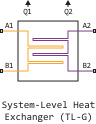
System-Level Heat Exchanger (TL-G)
The heat exchanger is a system level.
blockType: EngeeFluids.HeatExchangers.SystemLevel.ThermalLiquidGas
|
Path in the library: |
Description
Block System-Level Heat Exchanger (TL-G) simulates a heat exchanger based on performance data between heat-conducting liquid and gas networks.
The unit uses performance data from the technical data sheet of the heat exchanger, rather than the detailed geometry of the heat exchanger. You can adjust the size and performance of the heat exchanger during the design process or model heat exchangers with non-standard geometries. This unit can also be used to simulate heat exchangers with a certain level of performance at an early stage of design, when detailed geometry data is not yet available.
The parameterization of the unit is performed in accordance with the nominal operating conditions. The unit determines the parameters of the heat exchanger in accordance with the set capacity under nominal operating conditions in steady state.
This block is similar to the block Heat Exchanger (G-TL), but uses a different parameterization model. The comparison of the two blocks is shown in the table.
| Heat Exchanger (G-TL) | System-Level Heat Exchanger (TL-G) |
|---|---|
The unit parameters depend on the geometry of the heat exchanger |
The parameters of the unit depend on the performance and operating conditions |
The geometry of the heat exchanger may be limited by the available geometry parameters. |
The model does not depend on the specific geometry of the heat exchanger |
You can customize the unit to meet different performance requirements by changing geometric parameters such as rib sizes and tube lengths. |
You can customize the unit to meet different performance requirements by directly specifying the required heat consumption and mass values. |
You can choose a direct-flow, countercurrent, shell-and-tube, or cross-flow coolant flow pattern. |
You can choose a direct-flow, countercurrent, or cross-flow coolant flow pattern under nominal operating conditions, which will help determine the size. |
Predictably accurate results over a wide range of operating conditions, depending on the applicability of the E-NTU equations and correlations of heat transfer coefficients. |
Very accurate results near the specified operating conditions; accuracy may decrease with significant distance from the specified operating conditions |
Heat transfer calculations take into account temperature changes along the flow path using the E-NTU model |
Heat transfer calculations approximate the temperature change along the flow path by dividing it into three segments |
Heat transfer
The block divides the gas flow and the heat-conducting liquid flow in the block into three segments of the same size. The unit calculates the heat transfer between the heat carriers in each segment. For simplicity, the equations in this section are given for a single segment.
If you uncheck the box Wall thermal mass, then the heat balance in the heat exchanger will be
where
-
— heat flow from the wall, which is the heat transfer surface, to the gas in the segment;
-
— heat flow from the wall to the heat-conducting liquid in the segment.
If you check the box Wall thermal mass, then the heat balance in the heat exchanger will be
where
-
— wall mass;
-
— specific heat capacity of the wall;
-
— number of segments;
-
— average wall temperature in the segment;
-
— the time.
The heat flow from the wall to the gas in the segment is
where
-
— heat transfer capacity for gas in the segment;
-
— the average gas temperature in the segment.
The heat flow from the wall to the heat-conducting liquid in the segment is
where
-
— heat transfer capacity for a heat-conducting liquid in the segment;
-
— the average temperature of the heat-conducting liquid in the segment.
Correlation of heat transfer of a heat-conducting liquid
The thermal conductivity on the side of the heat exchanger in contact with the heat-conducting liquid is
where
-
, , — correlation coefficients of the Nusselt number; these coefficients are the parameters of the block in the parameter group Correlation Coefficients;
-
— average Reynolds number for the segment;
-
— the average Prandtl number for the segment;
-
— average thermal conductivity for the segment;
-
— the scale factor of the geometry for the heat-conducting fluid side of the heat exchanger. The unit calculates the scale factor of the geometry so that the total heat transfer across all segments corresponds to the specified performance under nominal operating conditions.
The average Reynolds number is
where
-
— mass flow through the segment;
-
— average dynamic viscosity for the segment;
-
— arbitrary reference diameter;
-
— an arbitrary reference area of the flow section.
| Members and included in this equation is only for calculating units of measurement to make dimensionless. Values and arbitrary, because the calculation overrides these values. |
Correlation of gas heat transfer
The thermal conductivity on the side of the heat exchanger in contact with the gas is
where
-
, , — correlation coefficients of the Nusselt number; these coefficients are the parameters of the block in the parameter group Correlation Coefficients;
-
— average Reynolds number for the segment;
-
— the average Prandtl number for the segment;
-
— average thermal conductivity for the segment;
-
— the scale factor of the geometry for the gas side of the heat exchanger. The unit calculates the scale factor of the geometry so that the total heat transfer across all segments corresponds to the specified performance under nominal operating conditions.
The average Reynolds number is
where
-
— mass flow through the segment;
-
— average dynamic viscosity for the segment;
-
— arbitrary reference diameter;
-
— an arbitrary reference area of the flow section.
| Members and included in this equation is only for calculating units of measurement to make dimensionless. Values and arbitrary, because the calculation overrides these values. |
Pressure loss
The pressure losses on the side of the heat-conducting liquid are determined as follows
where
-
and — pressure in ports A1 and B1, respectively;
-
— the internal pressure of the heat-conducting liquid at which the unit calculates heat transfer;
-
and — mass expenses via ports A1 and B1, respectively;
-
— the average density of the heat-conducting liquid in all segments;
-
— threshold mass flow rate in laminar mode, approximately equal to
1e−4the nominal mass flow rate. The unit calculates the pressure loss coefficient so that the difference it corresponded to the nominal pressure loss at the nominal mass flow rate.
The pressure losses on the gas side are determined as follows
where
-
and — pressure in ports A1 and B1, respectively;
-
— the internal gas pressure at which the unit calculates heat transfer;
-
and — mass expenses via ports A1 and B1, respectively;
-
— average gas density across all segments;
-
— threshold mass flow rate in laminar mode, approximately equal to
1e−4the nominal mass flow rate. The unit calculates the pressure loss coefficient so that the difference it corresponded to the nominal pressure loss at the nominal mass flow rate.
Conservation of mass and energy of a thermally conductive liquid
The mass conservation equation for the entire flow of a thermally conductive liquid has the form
where
-
— partial derivative of density with respect to pressure for a segment;
-
— partial derivative of density with respect to temperature for a segment;
-
— temperature for the segment;
-
— the total volume of the heat-conducting liquid.
Summation is performed for all segments.
| Although the unit divides both coolant streams into For calculating the heat transfer segment, it is assumed that all segments are under the same internal pressure . Therefore, it is not taken into account when summing. |
The energy conservation equation for each segment has the form
where
-
— partial derivative of the specific internal energy in terms of pressure for the segment;
-
— partial derivative of the specific internal energy with respect to temperature for the segment;
-
— the total mass of the heat-conducting liquid;
-
and — mass expenses in and out of the segment;
-
and — energy consumption in and out of the segment.
The block assumes that the mass expenses between the segments are linearly distributed between the values and .
Conservation of gas mass and energy
The mass conservation equation for the entire gas flow has the form
where
-
— partial derivative of density with respect to pressure for a segment;
-
— partial derivative of density with respect to temperature for a segment;
-
— temperature for the segment;
-
— the total volume of gas.
Summation is performed for all segments.
| Although the block divides the gas flow into For calculating the heat transfer segment, it is assumed that all segments are under the same internal pressure . Therefore, it is not taken into account when summing. |
The energy conservation equation for each segment has the form
where
-
— the partial derivative of the specific internal energy in terms of pressure for the segment;
-
— partial derivative of the specific internal energy with respect to temperature for the segment;
-
— total mass of gas;
-
and — mass expenses to and from the segment;
-
and — energy consumption in and out of the segment.
The block assumes that the mass expenses between the segments are linearly distributed between the values and .
Ports
Conserving
#
A1
—
port for heat-conducting liquid
heat-conducting liquid
Details
An input or output non-directional port connected to a heat-conducting fluid network.
| Program usage name |
|
#
B1
—
port for heat-conducting liquid
heat-conducting liquid
Details
An input or output non-directional port connected to a heat-conducting fluid network.
| Program usage name |
|
#
B2
—
gas port
gas
Details
An input or output non-directional port connected to the gas network.
| Program usage name |
|
#
A2
—
gas port
gas
Details
An input or output non-directional port connected to the gas network.
| Program usage name |
|
Output
#
Q2
—
heat transfer rate to gas, W
scalar
Details
The rate of heat transfer to the gas, returned as a scalar signal, in Watts. The scalar signals on ports Q1 and Q2 are usually equal in magnitude and have the opposite sign. However, if you check the box Wall thermal mass These two signals may have different meanings, since the wall can absorb and give off part of the transmitted heat.
| Data types |
|
| Complex numbers support |
No |
#
Q1
—
the rate of heat transfer to a heat-conducting liquid, W
scalar
Details
The rate of heat transfer to a heat-conducting liquid, returned as a scalar signal, in Watts. The scalar signals on ports Q1 and Q2 are usually equal in magnitude and have the opposite sign. However, if you check the box Wall thermal mass These two signals may have different meanings, since the wall can absorb and give off part of the transmitted heat.
| Data types |
|
| Complex numbers support |
No |
Parameters
Gas 2
#
Nominal inlet pressure —
nominal gas inlet pressure
Pa | uPa | hPa | kPa | MPa | GPa | kgf/m^2 | kgf/cm^2 | kgf/mm^2 | mbar | bar | kbar | atm | ksi | psi | mmHg | inHg
Details
The gas pressure at the inlet to the heat exchanger under nominal operating conditions.
| Units |
|
| Default value |
|
| Program usage name |
|
| Evaluatable |
Yes |
# Initialize gas to nominal operating conditions — gas initialization option to nominal conditions
Details
The option to initialize the gas to the nominal operating conditions or set values. If this option is selected, the unit initializes the gas to the rated operating conditions. If you uncheck this box, you can set the initial conditions directly using additional parameters.
| Default value |
|
| Program usage name |
|
| Evaluatable |
No |
#
Initial gas temperature —
the temperature of the gas at the beginning of the simulation
K | degC | degF | degR | deltaK | deltadegC | deltadegF | deltadegR
Details
The temperature of the gas at the beginning of the simulation.
Dependencies
To use this option, uncheck the box. Initialize gas to nominal operating conditions.
| Units |
|
| Default value |
|
| Program usage name |
|
| Evaluatable |
Yes |
#
Nominal inlet temperature —
inlet gas temperature under nominal conditions
K | degC | degF | degR | deltaK | deltadegC | deltadegF | deltadegR
Details
The temperature of the gas at the inlet to the heat exchanger under nominal operating conditions.
| Units |
|
| Default value |
|
| Program usage name |
|
| Evaluatable |
Yes |
#
Gas volume —
gas volume
m^3 | um^3 | mm^3 | cm^3 | km^3 | ml | l | gal | igal | in^3 | ft^3 | yd^3 | mi^3
Details
The total volume of gas inside the heat exchanger.
| Units |
|
| Default value |
|
| Program usage name |
|
| Evaluatable |
Yes |
#
Initial gas pressure —
gas pressure at the beginning of the simulation
Pa | uPa | hPa | kPa | MPa | GPa | kgf/m^2 | kgf/cm^2 | kgf/mm^2 | mbar | bar | kbar | atm | ksi | psi | mmHg | inHg
Details
The gas pressure at the beginning of the simulation.
Dependencies
To use this option, uncheck the box. Initialize gas to nominal operating conditions.
| Units |
|
| Default value |
|
| Program usage name |
|
| Evaluatable |
Yes |
#
Nominal mass flow rate —
mass flow rate between gas ports under nominal operating conditions
kg/s | kg/hr | kg/min | g/hr | g/min | g/s | t/hr | lbm/hr | lbm/min | lbm/s
Details
Mass flow rate from port A2 to port B2 under nominal operating conditions.
| Units |
|
| Default value |
|
| Program usage name |
|
| Evaluatable |
Yes |
#
Nominal pressure drop —
pressure difference between gas ports under nominal operating conditions
Pa | uPa | hPa | kPa | MPa | GPa | kgf/m^2 | kgf/cm^2 | kgf/mm^2 | mbar | bar | kbar | atm | ksi | psi | mmHg | inHg
Details
Pressure difference between port A2 and port B2 under nominal operating conditions.
| Units |
|
| Default value |
|
| Program usage name |
|
| Evaluatable |
Yes |
Thermal Liquid 1
#
Initial thermal liquid temperature —
the temperature of the heat-conducting liquid at the beginning of the simulation
K | degC | degF | degR | deltaK | deltadegC | deltadegF | deltadegR
Details
The temperature of the heat-conducting liquid at the beginning of the simulation.
Dependencies
To use this option, uncheck the box. Initialize thermal liquid to nominal operating conditions.
| Units |
|
| Default value |
|
| Program usage name |
|
| Evaluatable |
Yes |
#
Nominal mass flow rate —
mass flow rate between the ports of the heat-conducting liquid under nominal operating conditions
kg/s | kg/hr | kg/min | g/hr | g/min | g/s | t/hr | lbm/hr | lbm/min | lbm/s
Details
Mass flow rate from port A1 to port B1 under nominal operating conditions.
| Units |
|
| Default value |
|
| Program usage name |
|
| Evaluatable |
Yes |
#
Nominal operating condition —
nominal operating condition
Heat transfer from Thermal Liquid 1 to Gas 2 | Heat transfer from Gas 2 to Thermal Liquid 1
Details
Nominal operating condition used for a heat-conducting fluid network:
-
Heat transfer from Thermal Liquid 1 to Gas 2— the heat-conducting liquid cools, and the gas heats up; -
Heat transfer from Gas 2 to Thermal Liquid 1— the gas cools, and the heat-conducting liquid heats up.
This setting applies only to the parameters of the nominal operating conditions. This does not mean that during the simulation, heat transfer can only occur in the specified direction.
| Values |
|
| Default value |
|
| Program usage name |
|
| Evaluatable |
No |
#
Nominal pressure drop —
pressure difference between the ports of the heat-conducting liquid under nominal operating conditions
Pa | uPa | hPa | kPa | MPa | GPa | kgf/m^2 | kgf/cm^2 | kgf/mm^2 | mbar | bar | kbar | atm | ksi | psi | mmHg | inHg
Details
Pressure difference between port A1 and port B1 under nominal operating conditions.
| Units |
|
| Default value |
|
| Program usage name |
|
| Evaluatable |
Yes |
#
Nominal inlet temperature —
temperature of the heat-conducting liquid at the inlet under nominal conditions
K | degC | degF | degR | deltaK | deltadegC | deltadegF | deltadegR
Details
The temperature of the heat-conducting liquid at the inlet to the heat exchanger under nominal operating conditions.
| Units |
|
| Default value |
|
| Program usage name |
|
| Evaluatable |
Yes |
#
Nominal outlet temperature —
outlet temperature under nominal conditions
K | degC | degF | degR | deltaK | deltadegC | deltadegF | deltadegR
Details
The temperature of the heat-conducting liquid at the outlet of the heat exchanger under nominal operating conditions.
Dependencies
To use this parameter, set for the parameter Heat transfer capacity specification meaning Outlet condition.
| Units |
|
| Default value |
|
| Program usage name |
|
| Evaluatable |
Yes |
#
Heat transfer capacity specification —
the method of setting the heat exchanger performance
Rate of heat transfer | Outlet condition
Details
Determine the performance of a heat exchanger for a heat-conducting liquid under nominal operating conditions directly, by the rate of heat transfer, or indirectly, by the output parameters.
| Values |
|
| Default value |
|
| Program usage name |
|
| Evaluatable |
No |
#
Initial thermal liquid pressure —
the pressure of the heat-conducting liquid at the beginning of the simulation
Pa | uPa | hPa | kPa | MPa | GPa | kgf/m^2 | kgf/cm^2 | kgf/mm^2 | mbar | bar | kbar | atm | ksi | psi | mmHg | inHg
Details
The pressure of the heat-conducting liquid at the beginning of the simulation.
Dependencies
To use this option, uncheck the box. Initialize thermal liquid to nominal operating conditions.
| Units |
|
| Default value |
|
| Program usage name |
|
| Evaluatable |
Yes |
#
Nominal inlet pressure —
nominal pressure of the heat-conducting liquid at the inlet
Pa | uPa | hPa | kPa | MPa | GPa | kgf/m^2 | kgf/cm^2 | kgf/mm^2 | mbar | bar | kbar | atm | ksi | psi | mmHg | inHg
Details
The pressure of the heat-conducting liquid at the inlet to the heat exchanger under nominal operating conditions.
| Units |
|
| Default value |
|
| Program usage name |
|
| Evaluatable |
Yes |
#
Nominal rate of heat transfer —
heat transfer rate under nominal conditions
W | uW | mW | kW | MW | GW | V*A | HP_DIN
Details
The rate of heat transfer. Parameter Nominal operating condition defines the gas network from which and to which heat is transferred:
-
if for the parameter Nominal operating condition the value is set
Heat transfer from Thermal Liquid 1 to Gas 2, this parameter determines the rate of heat transfer from the side of the heat-conducting liquid to the side of the gas under nominal operating conditions; -
if for the parameter Nominal operating condition the value is set
Heat transfer from Gas 2 to Thermal Liquid 1, then this parameter determines the rate of heat transfer from the gas side to the side of the heat-conducting liquid under nominal operating conditions.
Dependencies
To use this parameter, set for the parameter Heat transfer capacity specification meaning Rate of heat transfer.
| Units |
|
| Default value |
|
| Program usage name |
|
| Evaluatable |
Yes |
#
Thermal liquid volume —
volume of heat-conducting liquid
m^3 | um^3 | mm^3 | cm^3 | km^3 | ml | l | gal | igal | in^3 | ft^3 | yd^3 | mi^3
Details
The total volume of heat-conducting liquid inside the heat exchanger.
| Units |
|
| Default value |
|
| Program usage name |
|
| Evaluatable |
Yes |
# Initialize thermal liquid to nominal operating conditions — the option of initializing the heat-conducting liquid to the nominal conditions
Details
The option of initializing the heat-conducting liquid to the nominal operating conditions or set values. If this option is selected, the unit initializes the heat-conducting liquid to the rated operating conditions. If you uncheck this box, you can set the initial conditions directly using additional parameters.
| Default value |
|
| Program usage name |
|
| Evaluatable |
No |
Configuration
#
Cross-sectional area at port B2 —
cross-sectional area of the flow in the port B2
m^2 | um^2 | mm^2 | cm^2 | km^2 | in^2 | ft^2 | yd^2 | mi^2 | ha | ac
Details
The cross-sectional area of the flow in the port B2 for gas.
| Units |
|
| Default value |
|
| Program usage name |
|
| Evaluatable |
Yes |
# Initialize wall temperature to nominal operating conditions — wall temperature initialization option
Details
The option to initialize the wall temperature with nominal operating conditions or preset values. If this option is selected, the unit calculates the initial wall temperature based on the nominal operating conditions set for both sides of the heat carriers. If you uncheck this box, you can set the initial wall temperature directly using the parameter Initial wall temperature.
Dependencies
To use this option, check the box Wall thermal mass.
| Default value |
|
| Program usage name |
|
| Evaluatable |
No |
#
Initial wall temperature —
initial wall temperature
K | degC | degF | degR | deltaK | deltadegC | deltadegF | deltadegR
Details
The initial temperature of the wall. If a scalar is set, then the block assumes that the initial wall temperature is uniform. If a two-element vector is specified, the block assumes that the initial wall temperature varies linearly between ports A1 and A2 and ports B1 and B2. The first element corresponds to the temperature in ports A1 and A2, and the second element corresponds to the temperature in ports B1 and B2.
Dependencies
To use this option, check the box Wall thermal mass and uncheck the box Initialize wall temperature to nominal operating conditions.
| Units |
|
| Default value |
|
| Program usage name |
|
| Evaluatable |
Yes |
# Wall thermal mass — should the influence of thermal inertia on the heat transfer surface be taken into account
Details
Whether to take into account the influence of thermal inertia on the heat transfer surface. When this option is selected, the block adds additional dynamics to the simulation and increases the time to reach the steady state, but this parameter does not affect the results of the steady state simulation.
| Default value |
|
| Program usage name |
|
| Evaluatable |
No |
#
Wall specific heat —
specific heat capacity of the wall
J/(kg*K) | kJ/(kg*K) | cal/(kg*K) | kcal/(kg*K) | cal/(g*K) | kcal/(g*K) | Btu_IT/(lbm*deltadegR)
Details
Specific heat capacity of the wall.
Dependencies
To use this option, check the box Wall thermal mass.
| Units |
|
| Default value |
|
| Program usage name |
|
| Evaluatable |
Yes |
#
Flow arrangement at nominal operating conditions —
flow diagram of heat carriers under nominal operating conditions
Parallel flow - Both fluids flow from A to B | Counter flow - Thermal Liquid 1 flows from A to B, Gas 2 flows from B to A | Cross flow - Both fluids flow from A to B
Details
Flow diagram of heat transfer fluids between the sides of the heat exchanger under nominal operating conditions. Available coolant flow patterns:
-
Counter flow - Thermal Liquid 1 flows from A to B, Gas 2 flows from B to A— the streams move parallel to each other in opposite directions; -
Parallel flow - Both fluids flow from A to B— the streams are moving in the same direction; -
Cross flow - Both fluids flow from A to B— the streams move perpendicular to each other.
The choice between direct current and counterflow affects how the unit determines the size of the heat exchanger. The counterflow setting is the most efficient and requires the smallest size to achieve the desired performance. Conversely, the direct flow is the least efficient and requires the largest size to achieve the desired performance.
The flow direction under nominal conditions (from A to B or from B to A) only affects the initialization of the model when the checkbox is selected. Initialize thermal liquid to nominal operating conditions or Initialize gas to nominal operating conditions. When setting different initial operating conditions, the flow directions may be different.
After the unit determines the size of the heat exchanger, this parameter does not affect how the unit calculates heat transfer during simulation. Instead, the heat transfer depends on the flow direction during the simulation. For example, if you set the parameter to direct flow, and set the model to work in counterflow, the heat transfer rate during the simulation will not match the set performance, even if the other boundary conditions are the same.
If you specify a cross flow, the unit will model the flow paths inside the heat exchanger as perpendicular, so the flow direction does not matter during the simulation.
| Values |
|
| Default value |
|
| Program usage name |
|
| Evaluatable |
No |
#
Wall mass —
wall mass
kg | mg | g | t | lbm | oz | slug
Details
The mass of the wall.
Dependencies
To use this option, check the box Wall thermal mass.
| Units |
|
| Default value |
|
| Program usage name |
|
| Evaluatable |
Yes |
#
Cross-sectional area at port A2 —
cross-sectional area of the flow in the port A2
m^2 | um^2 | mm^2 | cm^2 | km^2 | in^2 | ft^2 | yd^2 | mi^2 | ha | ac
Details
The cross-sectional area of the flow in the port A2 for gas.
| Units |
|
| Default value |
|
| Program usage name |
|
| Evaluatable |
Yes |
#
Cross-sectional area at port B1 —
cross-sectional area of the flow in the port B1
m^2 | um^2 | mm^2 | cm^2 | km^2 | in^2 | ft^2 | yd^2 | mi^2 | ha | ac
Details
The cross-sectional area of the flow in the port B1 for a thermally conductive liquid.
| Units |
|
| Default value |
|
| Program usage name |
|
| Evaluatable |
Yes |
#
Cross-sectional area at port A1 —
cross-sectional area of the flow in the port A1
m^2 | um^2 | mm^2 | cm^2 | km^2 | in^2 | ft^2 | yd^2 | mi^2 | ha | ac
Details
The cross-sectional area of the flow in the port A1 for a thermally conductive liquid.
| Units |
|
| Default value |
|
| Program usage name |
|
| Evaluatable |
Yes |
Correlation Coefficients
# c in Nu = a*Re^b*Pr^c for thermal liquid — the exponent of the Prandtl number in correlation for a thermally conductive liquid
Details
The exponent of the Prandtl number in the correlation of the Nusselt number as a function of the Reynolds number and the Prandtl number for a thermally conductive liquid.
| Default value |
|
| Program usage name |
|
| Evaluatable |
Yes |
# b in Nu = a*Re^b*Pr^c for thermal liquid — the exponent of the Reynolds number in correlation for a thermally conductive liquid
Details
The exponent of the Reynolds number in the correlation of the Nusselt number as a function of the Reynolds number and the Prandtl number for a thermally conductive liquid.
| Default value |
|
| Program usage name |
|
| Evaluatable |
Yes |
# a in Nu = a*Re^b*Pr^c for thermal liquid — correlation coefficient for a thermally conductive liquid
Details
The proportionality constant in the correlation of the Nusselt number as a function of the Reynolds number and the Prandtl number for a thermally conductive liquid. The default value is based on the Colburn equation.
| Default value |
|
| Program usage name |
|
| Evaluatable |
Yes |
# a in Nu = a*Re^b*Pr^c for gas — correlation coefficient for gas
Details
The proportionality constant in the correlation of the Nusselt number as a function of the Reynolds number and the Prandtl number for gas. The default value is based on the Colburn equation.
| Default value |
|
| Program usage name |
|
| Evaluatable |
Yes |
# b in Nu = a*Re^b*Pr^c for gas — the exponent of the Reynolds number in the correlation for gas
Details
The exponent of the Reynolds number in the correlation of the Nusselt number as a function of the Reynolds number and the Prandtl number for gas. The default value is based on the Colburn equation.
| Default value |
|
| Program usage name |
|
| Evaluatable |
Yes |
# c in Nu = a*Re^b*Pr^c for gas — the exponent of the Prandtl number in the correlation for gas
Details
The exponent of the Prandtl number in the correlation of the Nusselt number as a function of the Reynolds number and the Prandtl number for gas. The default value is based on the Colburn equation.
| Default value |
|
| Program usage name |
|
| Evaluatable |
Yes |
Literature
-
Ashrae Handbook: Fundamentals. Atlanta: Ashrae, 2013.
-
Çengel, Yunus A. Heat and Mass Transfer: A Practical Approach. 3rd ed. McGraw-Hill Series in Mechanical Engineering. Boston: McGraw-Hill, 2007.
-
Mitchell, John W., and James E. Braun. Principles of Heating, Ventilation, and Air Conditioning in Buildings. Hoboken, NJ: Wiley, 2013.
-
Shah, R. K., and Dušan P. Sekulić. Fundamentals of Heat Exchanger Design. Hoboken, NJ: John Wiley & Sons, 2003.
-
Cavallini, Alberto, and Roberto Zecchin. «A Dimensionless Correlation for Heat Transfer in Forced Convection Condensation» In Proceeding of International Heat Transfer Conference 5, 309–313. Tokyo, Japan: Begellhouse, 1974. https://doi.org/10.1615/IHTC5.1220.