Solenoid Valve (IL)
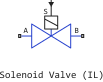
An electromagnetic valve in an isothermal fluid network.
blockType: EngeeFluids.IsothermalLiquid.Valves.DirectionalControl.Solenoid
|
Path in the library: |
Description
Block Solenoid Valve (IL) simulates the flow through an electromagnetic valve in an isothermal fluid network. The valve consists of a two-line control valve with an electromagnetic actuator. The signal on the S port controls the electromagnet. When the signal on port S exceeds the value 0.5 The electromagnet turns on and the valve opens. When the signal on the S port drops below 0.5 The electromagnet turns off and the valve closes.
Solenoid valves consist of a valve body with a spring-loaded plunger, which is controlled by an electromagnet. When the electromagnet is turned on, the magnetic force lifts the spool, allowing the liquid to flow. When the electromagnet is turned off, the spring pushes the plunger back into place, stopping the flow. The block does not explicitly model the mechanics of an electromagnet, but characterizes the opening and closing of a valve using the switching time of opening and closing.
Mass consumption
The mass flow through the valve is calculated as follows:
where
-
— the cross-sectional area of the valve;
-
— parameter value Cross-sectional area at ports A and B;
-
— flow coefficient, the value of the parameter Discharge coefficient;
-
— the average density of the liquid;
-
— pressure difference in the valve;
-
— critical pressure drop:
where — parameter value Critical Reynolds number, and — dynamic viscosity of the liquid.
Dynamics of the opening
The block assumes that the electromagnet behaves like a series resistor-inductor circuit.:
where
-
— voltage across the electromagnetic inductor;
-
— resistance of the electromagnetic inductor;
-
— the inductance of the electromagnet;
-
— current through an electromagnetic inductor.
The electromagnet generates a force proportional to the square of the current , where — the constant of proportionality. The expression for the cross-sectional area of the valve depends on the parameter value Solenoid control.
valve controlled by a scalar signal
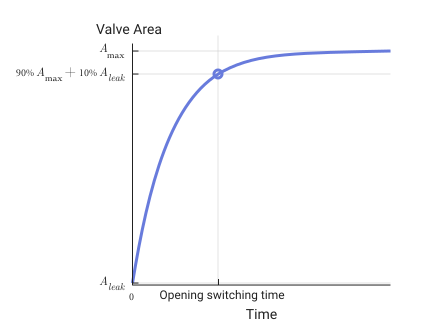
If for the parameter Solenoid control the value is set Signal, then the block calculates the opening area based on the scalar signal received at port S. When the valve opens:
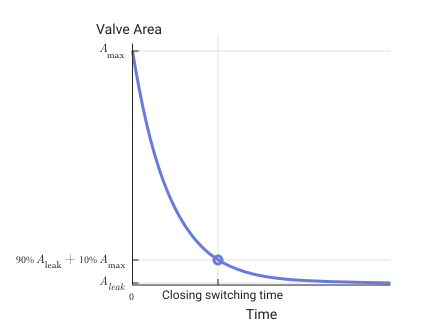
When the valve closes:
where
-
— parameter value Maximum opening area;
-
— parameter value Leakage area;
-
— the time of switching on or off the electromagnet;
-
— the area of the valve at the moment of switching on or off the electromagnet;
-
, where — parameter value Opening switching time.
-
, where — parameter value Closing switching time.
_ Valve controlled by an electrical signal_
If for the parameter Solenoid control the value is set Electrical, then the unit calculates the opening area based on the electrical network connected to the solenoid valve via ports + and −.
The opening area is
where
-
— plunger position;
-
— parameter value Plunger distance of travel.
The block simulates the movement of the plunger in accordance with the force balance equation
where
-
— the mass of the moving parts of the solenoid valve;
-
— the force exerted by the spring to close the valve when the electromagnet is turned off;
-
— the force of the rigid stop, which does not allow the plunger to go beyond the fully open and fully closed positions. The unit calculates the force of the rigid stop using mode diagrams;
-
— the force generated by the electromagnet:
The block uses the solution of the balance of power equation to calculate , and for parameter values Rated voltage, Nominal current, Opening switching time and Closing switching time. The block then uses the values for , and to solve the problem of the plunger position at any given time.
Switching time
The block characterizes the solenoid valve using the opening and closing time set by the parameters Opening switching time and Closing switching time accordingly. Parameter Opening switching time — this is the time from switching on the electromagnet to increasing the flow rate to a level of 90% of the range up to the maximum.
Parameter Closing switching time — this is the time from switching off the electromagnet until the flow rate drops to a level of 10% of the range to the minimum value.
Assumptions and limitations
-
The maximum force of the electromagnet is equal to the force generated by the spring.
-
The damping inside the electromagnet and the flow pressure forces are negligible.
-
The spool is balanced.
-
The stroke length of the electromagnet is small enough for the unit to consider the inductance linear.
Ports
Conserving
#
+
—
positive terminal
electricity
Details
A non-directional port connected to the positive terminal of the valve control.
Dependencies
To use this port, set the parameter Solenoid control value Electrical.
| Program usage name |
|
#
–
—
negative terminal
electricity
Details
A non-directional port connected to the negative terminal of the valve control.
Dependencies
To use this port, set the parameter Solenoid control value Electrical.
| Program usage name |
|
#
B
—
Isothermal liquid port
Isothermal liquid
Details
Liquid inlet or outlet port.
| Program usage name |
|
#
A
—
Isothermal liquid port
Isothermal liquid
Details
Liquid inlet or outlet port.
| Program usage name |
|
Input
#
S
—
valve control signal, dimensionless
scalar
Details
The signal controlling the valve. When the signal on the S port is higher 0.5, the electromagnet turns on and the valve opens. When the signal on the S port drops below 0.5, the electromagnet turns off and the valve closes.
Dependencies
To use this port, set the parameter Solenoid control value Signal.
| Data types |
|
| Complex numbers support |
I don’t |
Parameters
Main
#
Rated voltage —
rated voltage of the electromagnet
V | uV | mV | kV | MV
Details
The rated voltage of the electromagnet. Calculate the parameter values Opening switching time and Closing switching time at this voltage, using a step input signal.
Dependencies
To use this parameter, set for the parameter Solenoid control meaning Electrical.
| Units |
|
| Default value |
|
| Program usage name |
|
| Evaluatable |
Yes |
#
Solenoid control —
valve control method
Signal | Electrical
Details
Select the method that the unit uses to control the valve. If you choose Signal, then the unit uses the scalar signal S to control the valve. If you choose Electrical Then the unit uses the electrical ports + and − and simulates the electrical response.
| Values |
|
| Default value |
|
| Program usage name |
|
| Evaluatable |
No |
# Pressure recovery — should the pressure increase be taken into account when expanding the area
Details
Should the pressure increase be taken into account when liquid flows from an area with a smaller cross-sectional area to an area with a larger cross-sectional area.
| Default value |
|
| Program usage name |
|
| Evaluatable |
No |
#
Opening switching time —
time to increase the flow rate when opening
s | ns | us | ms | min | hr | d
Details
The time from switching on the electromagnet to increasing the flow rate to a level of 90% of the range up to the maximum.
If for the parameter Solenoid control the value is set Electrical, then calculate this parameter by the value of the parameter Rated voltage using a stepped input signal.
| Units |
|
| Default value |
|
| Program usage name |
|
| Evaluatable |
Yes |
# Discharge coefficient — expense ratio
Details
The correction factor is the ratio of the actual mass flow to the theoretical mass flow through the valve.
| Default value |
|
| Program usage name |
|
| Evaluatable |
Yes |
#
Valve initial position —
the initial position of the valve
Open | Closed
Details
Select the initial position of the valve — open or closed.
| Values |
|
| Default value |
|
| Program usage name |
|
| Evaluatable |
No |
#
Nominal current —
steady-state current
A | pA | nA | uA | mA | kA | MA
Details
Steady-state current of the electromagnet at the value of the parameter Rated voltage.
Dependencies
To use this parameter, set for the parameter Solenoid control meaning Electrical.
| Units |
|
| Default value |
|
| Program usage name |
|
| Evaluatable |
Yes |
# Critical Reynolds number — upper limit of the Reynolds number for laminar flow
Details
The upper limit of the Reynolds number for laminar flow through the valve.
| Default value |
|
| Program usage name |
|
| Evaluatable |
Yes |
#
Leakage area —
leakage area through the valve in the fully closed position
m^2 | um^2 | mm^2 | cm^2 | km^2 | in^2 | ft^2 | yd^2 | mi^2 | ha | ac
Details
The sum of all clearances when the valve is in the fully closed position. Any area less than this value is equal to the specified leakage area. This parameter contributes to the stability of the numerical solution by maintaining the continuity of the flow.
| Units |
|
| Default value |
|
| Program usage name |
|
| Evaluatable |
Yes |
#
Closing switching time —
flow drop time at closing
s | ns | us | ms | min | hr | d
Details
The time from switching off the electromagnet until the flow rate drops to a level of 10% of the range to the minimum value.
If for the parameter Solenoid control the value is set Electrical, then calculate this parameter by the value of the parameter Rated voltage using a stepped input signal.
| Units |
|
| Default value |
|
| Program usage name |
|
| Evaluatable |
Yes |
#
Cross-sectional area at ports A and B —
the area at the inlet or outlet of the valve
m^2 | um^2 | mm^2 | cm^2 | km^2 | in^2 | ft^2 | yd^2 | mi^2 | ha | ac
Details
The cross-sectional area at ports A and B. This area is used when calculating the mass flow through the valve.
| Units |
|
| Default value |
|
| Program usage name |
|
| Evaluatable |
Yes |
#
Maximum opening area —
the area of the fully open valve
m^2 | um^2 | mm^2 | cm^2 | km^2 | in^2 | ft^2 | yd^2 | mi^2 | ha | ac
Details
The cross-sectional area of the valve in the fully open position.
| Units |
|
| Default value |
|
| Program usage name |
|
| Evaluatable |
Yes |
#
Plunger distance of travel —
the distance to which the plunger moves
m | um | mm | cm | km | in | ft | yd | mi | nmi
Details
The distance that the plunger passes between the fully closed and fully open valve positions.
Dependencies
To use this parameter, set for the parameter Solenoid control meaning Electrical.
| Units |
|
| Default value |
|
| Program usage name |
|
| Evaluatable |
Yes |
#
Solenoid inductance —
linear inductance of an electromagnet
H | nH | uH | mH
Details
Linear inductance of an electromagnet. The block approximates the inductance as linear.
Dependencies
To use this parameter, set for the parameter Solenoid control meaning Electrical.
| Units |
|
| Default value |
|
| Program usage name |
|
| Evaluatable |
Yes |
#
Initial current —
the initial current of the electromagnet
A | pA | nA | uA | mA | kA | MA
Details
The initial current in the electromagnet.
Dependencies
To use this parameter, set for the parameter Solenoid control meaning Electrical.
| Units |
|
| Default value |
|
| Program usage name |
|
| Evaluatable |
Yes |
Literature
-
Zhang, Xiang, Yonghua Lu, Yang Li, Chi Zhang, and Rui Wang. Numerical Calculation and Experimental Study on Response Characteristics of Pneumatic Solenoid Valves. Measurement and Control 52, no. 9–10 (November 2019): 1382–1393. https://doi.org/10.1177/0020294019866853.
-
Zhang, Jianyu, Peng Liu, Liyun Fan, and Yajie Deng. Analysis on Dynamic Response Characteristics of High-Speed Solenoid Valve for Electronic Control Fuel Injection System. Mathematical Problems in Engineering 2020 (January 22, 2020): 1–9. https://doi.org/10.1155/2020/2803545.