2-Way Directional Valve (TL)
Two-line flow control valve in a thermal liquid network.
blockType: EngeeFluids.ThermalLiquid.Valves.DirectionalControl.TwoWay
|
Path in the library: |
Description
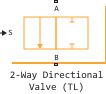
The block 2-Way Directional Valve (TL) represents a two-line valve, such as a shut-off valve. Use this block to model a flow reducing control element that responds to pressure in another part of the system.
The block uses a variable orifice to control flow between ports A and B. The signal at port S determines the movement of the spool to open or close the valve.
It is possible to set the flow characteristic of the distributor channels in the Orifice parameterization as a linear dependence or as a tabular function provided by the user.
Linear parameterization
If Linear - Area vs. spool travel is selected for the Orifice parameterization, the flow area of the channel depends linearly on the spool travel and the value supplied to the port S:
,
where
-
- spool position entering the S port, ;
-
- value of parameters of spool travel between closed and open orifice (value of parameter Spool travel between closed and open orifice);
-
- leakage area (value of parameter Leakage area);
-
- value of the parameter of maximum orifice area (value of the parameter Maximum orifice area).
Note the linear growth from to in the figure:

When the orifice is in the nearly open or nearly closed position in the linear parameterization, you can maintain the numerical stability of the simulation by adjusting the smoothing factor - the value of the Smoothing factor parameter. If the Smoothing factor parameter value is not zero, a smooth change in the cross-sectional area between and is ensured.
Tabular parameterization
If Tabulated data - Area vs. spool travel is selected for Orifice parameterization, the block uses the Spool travel vector and the parameters of the valve area vector to determine the relationship between and by interpolation. and are the first and last elements of the Opening area vector respectively.

If Tabulated data - Volumetric flow rate vs. spool travel and pressure drop is selected for Orifice parameterization, the block uses the volumetric flow rate table Volumetric flow rate table, q(ds,dp), the relative pressure drop vector Pressure drop vector, dp and the spool travel vector Spool travel vector, ds to determine the volumetric flow rate, .

If Tabulated data - Mass flow rate vs. opening and pressure drop is selected for parameterization Orifice parameterization, the block uses the mass flow rate table Mass flow rate table, mdot(ds,dp), the relative pressure drop vector Pressure drop vector, dp and the spool travel vector Spool travel vector, ds to determine the mass flow rate, .

Ports
Conserving
#
A
—
thermal liquid port
thermal liquid
Details
Thermal liquid port, corresponds to valve inlet or outlet.
| Program usage name |
|
#
B
—
thermal liquid port
thermal liquid
Details
Thermal liquid port, corresponds to valve inlet or outlet.
| Program usage name |
|
Input
#
S
—
distributor spool position
scalar
Details
Inlet port of the distributor spool position in m, specifying the valve cross-sectional area. A positive value causes the valve to open.
| Data types |
|
| Complex numbers support |
No |
Parameters
Model Parameterization
#
Orifice parameterization —
the method of calculating the area of the passage section of the valve
Linear - Area vs. spool travel | Tabulated data - Area vs. spool travel | Tabulated data - Volumetric flow rate vs. spool travel and pressure drop | Tabulated data - Mass flow rate vs. spool travel and pressure drop
Details
The method of calculating the area of the valve passage section during modeling.
| Values |
|
| Default value |
|
| Program usage name |
|
| Evaluatable |
No |
#
Spool position at maximum orifice area —
position of the spool at maximum area
m | um | mm | cm | km | in | ft | yd | mi | nmi
Details
The position of the movable spool element when the valve is fully open.
| Units |
|
| Default value |
|
| Program usage name |
|
| Evaluatable |
Yes |
#
Spool travel between closed and open orifice —
maximum stroke of the spool
m | um | mm | cm | km | in | ft | yd | mi | nmi
Details
The stroke of the spool between the closed and open states of the valve.
Dependencies
To use this parameter, set the Orifice parameterization parameter to Linear - area vs. spool travel.
| Units |
|
| Default value |
|
| Program usage name |
|
| Evaluatable |
Yes |
#
Maximum orifice area —
maximum flow-through area of the valve
m^2 | um^2 | mm^2 | cm^2 | km^2 | in^2 | ft^2 | yd^2 | mi^2 | ha | ac
Details
The maximum cross-sectional area of the valve during simulation.
Dependencies
To use this parameter, set the Orifice parameterization parameter to Linear - area vs. spool travel.
| Units |
|
| Default value |
|
| Program usage name |
|
| Evaluatable |
Yes |
#
Leakage area —
leakage area through the valve in the fully closed position
m^2 | um^2 | mm^2 | cm^2 | km^2 | in^2 | ft^2 | yd^2 | mi^2 | ha | ac
Details
The sum of all clearances when the valve is in the fully closed position. Any area less than this value is maintained at the level of the specified leakage area. This parameter contributes to the stability of the numerical solution by maintaining the continuity of the flow.
Dependencies
To use this parameter, set the Orifice parameterization parameter to Linear - area vs. spool travel.
| Units |
|
| Default value |
|
| Program usage name |
|
| Evaluatable |
Yes |
#
Spool travel vector —
the position vector of the spool
m | um | mm | cm | km | in | ft | yd | mi | nmi
Details
The position vector of the spool. The dimension of the vector corresponds to the Orifice area vector vector. A positive value corresponds to the valve opening. The values are listed in ascending order, and the first element should be equal to 0. Linear interpolation is used between the data points in the table.
Dependencies
To use this parameter, set the Orifice parameterization parameter to Tabulated data - Area vs. spool travel.
| Units |
|
| Default value |
|
| Program usage name |
|
| Evaluatable |
Yes |
#
Orifice area vector —
vector of values of the valve passage area
m^2 | um^2 | mm^2 | cm^2 | km^2 | in^2 | ft^2 | yd^2 | mi^2 | ha | ac
Details
The vector of values of the valve passage area for tabular parameterization of the valve area. The dimension of the vector corresponds to the Spool travel vector vector. The values are listed in ascending order. The first element is the leakage area, the last element is the maximum cross—sectional area of the channel. Linear interpolation is used between data points.
Dependencies
To use this parameter, set the Orifice parameterization parameter to Tabulated data - Area vs. spool travel.
| Units |
|
| Default value |
|
| Program usage name |
|
| Evaluatable |
Yes |
# Discharge coefficient — expense ratio
Details
The correction factor is the ratio of the actual mass flow to the theoretical mass flow through the distributor.
Dependencies
To use this parameter, set the Orifice parameterization parameter to Linear - area vs. spool travel or Tabulated data - Area vs. spool travel.
| Default value |
|
| Program usage name |
|
| Evaluatable |
Yes |
# Critical Reynolds number — upper limit of the Reynolds number for laminar flow
Details
The upper limit of the Reynolds number for laminar flow through the hole.
Dependencies
To use this parameter, set the Orifice parameterization parameter to Linear - area vs. spool travel or Tabulated data - Area vs. spool travel.
| Default value |
|
| Program usage name |
|
| Evaluatable |
Yes |
# Smoothing factor — numerical smoothing factor
Details
The continuous smoothing coefficient, which introduces a level of gradual change based on the flow characteristic when the valve is in the nearly open and nearly closed positions. Set a non-zero value less than one to increase the stability of the simulation in these modes.
Dependencies
To use this parameter, set the Orifice parameterization parameter to Linear - area vs. spool travel.
| Default value |
|
| Program usage name |
|
| Evaluatable |
Yes |
# Pressure recovery — should the pressure increase be taken into account when expanding the area
Details
Should the pressure increase be taken into account when liquid flows from an area with a smaller cross-sectional area to an area with a larger cross-sectional area.
If you uncheck Pressure recovery, this increase in pressure is not taken into account.
| Default value |
|
| Program usage name |
|
| Evaluatable |
No |
#
Spool travel vector, ds —
the position vector of the spool
m | um | mm | cm | km | in | ft | yd | mi | nmi
Details
A vector of spool positions for tabular flow parameterization. The dimension of the position vector of the spool corresponds to the pressure drop vector Pressure drop vector, dp and the table of volume flow values Volumetric flow rate table, q(ds,dp) or mass flow rate Mass flow rate table, mdot(ds,dp). The values are listed in ascending order, and the first element should be equal to 0. Linear interpolation is used to calculate the intermediate values.
Dependencies
To use this parameter, set the Orifice parameterization parameter to Tabulated data -Volumetric flow rate vs. spool travel and pressure drop or Tabulated data - Mass flow rate vs. spool travel and pressure drop.
| Units |
|
| Default value |
|
| Program usage name |
|
| Evaluatable |
Yes |
#
Pressure drop vector, dp —
vector of pressure drop values
Pa | uPa | hPa | kPa | MPa | GPa | kgf/m^2 | kgf/cm^2 | kgf/mm^2 | mbar | bar | kbar | atm | ksi | psi | mmHg | inHg
Details
Vector of differential pressure values for tabular flow parameterization. The dimension of the differential pressure vector corresponds to the position vector of the spool Spool travel vector, ds and the table of volume flow values Volumetric flow rate table, q(ds,dp) or mass flow rate Mass flow rate table, mdot(ds,dp). The values are listed in ascending order and must be greater. 0. Linear interpolation is used to calculate the intermediate values.
Dependencies
To use this parameter, set the Orifice parameterization parameter to Tabulated data -Volumetric flow rate vs. spool travel and pressure drop or Tabulated data - Mass flow rate vs. spool travel and pressure drop.
| Units |
|
| Default value |
|
| Program usage name |
|
| Evaluatable |
Yes |
#
Volumetric flow rate table, q(ds,dp) —
table of volume flow values
m^3/s | mm^3/s | cm^3/s | m^3/hr | m^3/min | l/hr | l/min | l/s | gal/hr | gal/min | gal/s | ft^3/hr | ft^3/min | ft^3/s
Details
The matrix on volume flow rates corresponding to the values of the differential pressure and the position of the spool. and — the sizes of the corresponding vectors:
-
— the number of elements in the spool position vector Spool travel vector, ds.
-
— the number of elements in the pressure drop vector Pressure drop vector, dp.
Dependencies
To use this parameter, set the Orifice parameterization parameter to Tabulated data - Volumetric flow rate vs. spool travel and pressure drop.
| Units |
|
| Default value |
|
| Program usage name |
|
| Evaluatable |
Yes |
#
Mass flow rate table, mdot(ds,dp) —
table of mass flow values
kg/s | kg/hr | kg/min | g/hr | g/min | g/s | t/hr | lbm/hr | lbm/min | lbm/s
Details
The matrix on the mass flow rates corresponding to the values of the pressure drop and the position of the spool. and — the sizes of the corresponding vectors:
-
— the number of elements in the spool position vector Spool travel vector, ds.
-
— the number of elements in the pressure drop vector Pressure drop vector, dp.
Dependencies
To use this parameter, set the Orifice parameterization parameter to Tabulated data - Mass flow rate vs. spool travel and pressure drop.
| Units |
|
| Default value |
|
| Program usage name |
|
| Evaluatable |
Yes |
#
Reference inflow temperature —
the temperature for which the mass flow data is set
K | degC | degF | degR | deltaK | deltadegC | deltadegF | deltadegR
Details
The temperature for which tabular mass flow data is set.
Dependencies
To use this parameter, set the Orifice parameterization parameter to Tabulated data - Mass flow rate vs. spool travel and pressure drop.
| Units |
|
| Default value |
|
| Program usage name |
|
| Evaluatable |
Yes |
#
Reference inflow pressure —
the pressure for which tabular mass flow data is set
Pa | uPa | hPa | kPa | MPa | GPa | kgf/m^2 | kgf/cm^2 | kgf/mm^2 | mbar | bar | kbar | atm | ksi | psi | mmHg | inHg
Details
The pressure for which tabular mass flow data is set. The block uses this parameter to calculate the corresponding density.
Dependencies
To use this parameter, set the Orifice parameterization parameter to Tabulated data - Mass flow rate vs. spool travel and pressure drop.
| Units |
|
| Default value |
|
| Program usage name |
|
| Evaluatable |
Yes |
#
Cross-sectional area at ports A and B —
the area at the inlet or outlet of the valve
m^2 | um^2 | mm^2 | cm^2 | km^2 | in^2 | ft^2 | yd^2 | mi^2 | ha | ac
Details
The cross-sectional area at the inlet and outlet of the holes A and B. This area is used when calculating the mass flow through the hole.
Dependencies
To use this parameter, set the Orifice parameterization parameter to Linear - area vs. spool travel or Tabulated data - Area vs. spool travel.
| Units |
|
| Default value |
|
| Program usage name |
|
| Evaluatable |
Yes |