rfckt.rlcgline
Creates a passive component or network.
| Library |
|
Description
Use the function rfckt.rlcgline to create an RLCG transmission line, the characteristics of which include line losses, line length, loop type, and short circuit.
Syntax
Function call
-
h = rfckt.rlcgline()— creates an RLCG transmission line object with default properties.
-
h = rfckt.rlcgline(Name=Value)— sets properties specified by one or more arguments of the type «name-value». Unspecified properties retain their default values.
Arguments
Input arguments «name-value»
Specify optional argument pairs as Name=Value, where Name — the name of the argument, and Value — the appropriate value.
Example: rfckt.rlcgline(LineLength = 0.04) creates an RLCG transmission line object with a physical length 0.04 meters. You can specify multiple pairs «name-value».
# AnalyzedResult — calculated values of S-parameters, noise factor, OIP3 and group delay
+
the rfdata.data object
Details
Calculated values of S-parameters, noise factor, OIP3, and group delay, set as an object rfdata.data. For more information, see Algorithms.
| This argument is read-only. |
# Freq — frequency values
+
1e9 | vector
Details
Frequency values for RLCG values, set as a vector from elements. The values must be positive and correspond to the order of the RLCG values.
| Типы данных |
|
# IntpType — interpolation method
+
"Linear" (by default) | "Spline" | "Cubic"
Details
The interpolation method used in the function rfckt.rlcgline, set as one of the following values:
-
"Linear"— linear interpolation; -
"Spline"— cubic spline interpolation; -
"Cubic"— piecewise cubic Hermite interpolation.
# lineLength — the physical length of the transmission line, m
+
0.01 (by default) | scalar
Details
The physical length of the transmission line, specified as a scalar in meters.
| Типы данных |
|
# Name — the name of the object
+
"RLCG Transmission Line" (by default) | line
Details
The name of the object, set as a string.
| This argument is read-only. |
| Типы данных |
|
# NPort — number of ports
+
2 (default) | a positive integer
Details
The number of ports specified as a positive integer.
| This argument is read-only. |
| Типы данных |
|
# StubMode — loop type
+
"NotAStub" (by default) | "Series" | "Shunt"
Details
The type of loop specified by one of the following values: "NotAStub", "Series", "Shunt".
#
Termination —
shorting of the transmission
loop
"NotApplicable" (by default) | "Open" | "Short"
Details
The short circuit of the transmission loop, set by one of the following values: "NotApplicable", "Open", "Short".
Output arguments
#
h —
The object of the RLCG
+ transmission line
object
Details
The object of the RLCG transmission line.
Methods
analyze: RFCKT object analysis in the frequency domain
groupdelay:: Calculation of the group delay of S-parameters, RF filter or circuit object
Examples
RLCG Transmission Line
Details
Let’s create an RLCG transmission line using the function rfckt.rlcgline.
using EngeeRF

h = rfckt.rlcgline(R = 0.002, C = 8.8542e-12, L = 1.2566e-6, G = 0.002)

println("Freq: ", h.Freq,
        "\nR: ", h.R,
        "\nL: ", h.L,
        "\nC: ", h.C,
        "\nG: ", h.G,
        "\nIntpType: ", h.IntpType,
        "\nLineLength: ", h.LineLength,
        "\nStubMode: ", h.StubMode,
        "\nTermination: ", h.Termination,
        "\nnPort: ", h.nPort,
        "\nAnalyzedResult: ", h.AnalyzedResult,
        "\nName: ", h.Name)
Freq: 1.0e9
R: 0.002
L: 1.2566e-6
C: 8.8542e-12
G: 0.002
IntpType: Linear
LineLength: 0.01
StubMode: NotAStub
Termination: NotApplicable
nPort: 2
AnalyzedResult: nothing
Name: RLCG Transmission LineAlgorithms
Method analyze considers a transmission line, which can be lossy or lossless, as a two-port linear network. It uses the interpolation method specified in the property IntpType to find the values R, L, C and G on the frequencies specified during the call analyze. Then, the characteristic impedance is calculated from these interpolated values. Z0, phase velocity PV and losses. It calculates the property AnalyzedResult for a loop line or a line without a loop, using data stored in the object properties rfckt.rlcgline, as follows:
-
If we model the transmission line as a line without a loop, the method
analyzeFirst, it calculates the ABCD parameters at each frequency contained in the vector of simulated frequencies. Then he uses the functionabcd2sto convert ABCD parameters to S parameters.Method
analyzecalculates the ABCD parameters using the physical length of the transmission line and a comprehensive distribution constant , using the following equations:
where and — vectors, the elements of which correspond to the elements of the frequency vector specified in the input argument
Freqfunctionsanalyze. Both vectors can be expressed in terms of linear resistance values. , inductance , conductivity and capacities as follows:
-
If we model the transmission line as a parallel or serial loop, the method
analyzefirst, it calculates the ABCD parameters at the specified frequencies. Then he uses the functionabcd2sto convert ABCD parameters to S parameters.If for an argument
StubModethe value is set"Shunt", then the two-port network consists of a loopback transmission line that can be closed or opened, as shown in the following figure.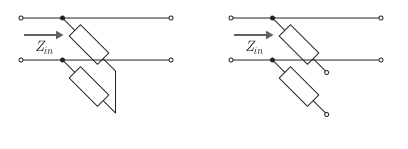
Here — the input impedance of the parallel circuit. The ABCD parameters for the parallel loop are calculated as follows:
If for an argument
StubModethe value is set"Series", then the two-port network is a serial transmission line that can be closed or opened, as shown in the following figure.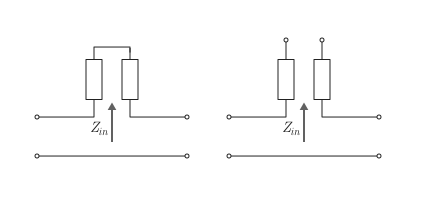
Here — input impedance of the serial circuit. The ABCD parameters for the serial loop are calculated as follows: