Two-Ray Channel
A two-beam distribution channel.
blockType: TwoRayChannel
|
Path in the library: |
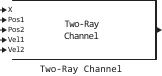
Description
Block Two-Ray Channel It is a narrow-band two-beam propagation channel, simulating both a direct reflected beam and a ray re-reflected from the Earth’s surface. The block generates narrowband signals by decomposing them into sub-bands, simulates their independent propagation, and performs recombination of the propagated sub-bands. The block simulates propagation time, Doppler shift, and propagation loss. The block assumes that the propagation velocity is much higher than the velocity of the object, and in this case the "stop-and-hop" model is valid.
Ports
Entrance
X — narrowband input signal
the complex matrix M by N |the complex matrix M by 2N
A narrow-band unpolarized scalar signal defined as:
-
The complex matrix M by N. M is the number of signal samples, and N is the number of two beam channels. Each channel corresponds to a source– destination pair. Each column contains an identical signal propagating along the line of sight and along the reflected trajectory. -
The complex matrix M by 2N. M is the number of signal samples, N is the number of two–beam channels. Each channel corresponds to a source– destination pair. Each adjacent pair of columns represents a separate channel. In each pair, the first column represents the signal propagating along the line–of-sight trajectory, and the second column represents the reflected trajectory.
Example: [1,1;j,1;0.5,0]
Data types: Float16, Float32, Float64, Int8, Int16, Int32, Int64, UInt8, UInt16, UInt32, UInt64
Support for complex numbers: Yes
Pos1 — position of the pass signal source:q[<br>] a valid 3-by-1 column vector | the real matrix is 3 by N
The position of the signal source or signals specified as a real 3-by-1 column vector or a real 3-by-N. N matrix is the number of two–beam channels. If Pos1 is a column vector, then it takes the form . If Pos1 is a matrix, each column defines a separate signal source and has the form .
At least one of the ports Pos1 and Pos2 must be a 3-by-1 vector column.
Example: [1000;100;500]
Data types: Float16, Float32, Float64, Int8, Int16, Int32, Int64, UInt8, UInt16, UInt32, UInt64
Pos2 — position of the radiation object
a valid 3-by-1 column vector | the real matrix is 3 by N
The position of the irradiated point (target) in space, defined as a real 3-by–1 column vector or a real 3-by-N. N matrix is the number of two-beam channels.
If Pos2 is a column vector, then it takes the form . If Pos2 is a matrix, each column defines a separate signal destination and has the form .
At least one of the ports Pos1 and Pos2 must be a 3-by-1 vector column.
Example: [-100;300;50]
Data types: Float16, Float32, Float64, Int8, Int16, Int32, Int64, UInt8, UInt16, UInt32, UInt64
Vel1 — speed of the pass signal source:q[<br>] a valid 3-by-1 column vector | the real matrix is 3 by N
The speed of the signal source in the form of a real 3-by-1 column vector or a real 3-by-N. N matrix is the number of two–beam channels. The dimensions of Vel1 must match the dimensions of Pos1.
If Vel1 is a column vector, then it takes the form . If Vel1 is a matrix, each column specifies a separate signal start rate and has the form .
Example: [-10;3;5]
Data types: Float16, Float32, Float64, Int8, Int16, Int32, Int64, UInt8, UInt16, UInt32, UInt64
Vel2 — speed of the radiation object
a valid 3-by-1 column vector | the real matrix is 3 by N
The velocity of the irradiated point (target) of space in the form of a real 3-by–1 column vector or a real 3-by-N. N matrix is the number of two-beam channels. The dimensions of Vel2 must match the dimensions of Pos2.
If Vel2 is a column vector, then it takes the form . If Vel2 is a matrix, each column specifies a separate speed of the signal destination and has the form .
Example: [-1000;300;550]
Output
Out — propagated pass signal:q[<br>] the complex matrix M by N |the complex matrix M by 2N
-
The complex matrix M by N. To return this format, set the propertyCombinedRaysOutputin the valuetrue. Each column of the matrix contains a coherently combined direct and reflected ray. -
The complex matrix M by 2N. To return this format, set the propertyCombinedRaysOutputin the valuefalse. The alternating columns of the matrix contain a direct and a re-reflected ray.
The Out output contains the signals reflected to the location of the signal source during the current time interval. If the signal propagation from the source to the target takes longer than the current time interval, the output may not contain all the data from the input in the current time interval. The remaining data will appear the next time the block is executed.
Parameters
Signal propagation speed — signal propagation speed, m/s
3e8 (default) | positive scalar
The propagation velocity of the signal in the form of a real positive scalar. The default value is the speed of light.: 3e8 m/s.
The units of measurement are meters per second.
Data types: Float16, Float32, Float64, Int8, Int16, Int32, Int64, UInt8, UInt16, UInt32, UInt64
Signal carrier frequency (Hz) — carrier frequency of the pass signal:q[<br>] 3e8 (default) | positive scalar
The carrier frequency of the signal in the form of a positive real scalar.
Data types: Float16, Float32, Float64, Int8, Int16, Int32, Int64, UInt8, UInt16, UInt32, UInt64
Specify atmospheric parameters — atmospheric attenuation model
disabled (by default) | enabled
Select this option to add signal attenuation caused by atmospheric gases, rain, fog, or clouds.
When you select this option, the Temperature (degrees Celsius) parameters appear in the dialog box, Dry air pressure (Pa), Water vapour density (g/m^3), Liquid water density (g/m^3), and Rain rate (mm/hr).
Temperature (degrees Celsius) — ambient temperature pass:Q[<br>] 15 (default)
The ambient temperature, set as a real scalar.
Dependencies
To use this parameter, select the Specify atmospheric parameters checkbox.
Dry air pressure (Pa) — atmospheric pressure of dry air
101.325e3 (default)
Atmospheric pressure of dry air, given as a positive real scalar.
The default value of this parameter corresponds to one standard atmosphere.
Dependencies
To use this parameter, select the Specify atmospheric parameters checkbox.
Water vapour density (g/m^3) is the density of water vapour in the atmosphere
7.5 (default)
The density of water vapor in the atmosphere, given as a positive real scalar.
Dependencies
To use this parameter, select the Specify atmospheric parameters checkbox.
Liquid water density (g/m^3) — density of liquid water
0.0 (default)
The density of liquid water in fog or clouds, given as a non-negative real-valued scalar. Typical density values for liquid water are 0,05 for medium fog and 0,5 for thick fog.
Dependencies
To use this parameter, select the Specify atmospheric parameters checkbox.
Rain rate (mm/hr) — precipitation rate
0.0 (default)
The precipitation rate, set as a non-negative real scalar.
Dependencies
To use this parameter, select the Specify atmospheric parameters checkbox.
Inherit sample rate — inherit the sample rate of
enabled (by default) | turned off
Check the box to inherit the sampling rate from higher-level blocks. Otherwise, set the sampling rate using the Sample rate (Hz) parameter.
Sample rate (Hz) — pass sampling rate:q[<br>] 1e6 (default) | positive scalar
The sampling frequency of the signal in the form of a positive scalar. The units of measurement are Hz.
Dependencies
To use this option, uncheck the Inherit sample rate checkbox.
Ground reflection coefficient — the coefficient of reflection from the ground
-1 (default)
The coefficient of reflection from the ground for the field at the point of reflection, given as a complex scalar or a complex vector, lines 1 by N. The coefficients have an absolute value less than or equal to one. N is the number of two–beam channels.
Combine two rays at output — disable combining data at output
enabled (by default) | turned off
Select the checkbox to combine the two beams at the channel output. Combining the two beams coherently adds the propagated line-of-sight signal and the reflected signal to form an output signal. This mode can be used when the antenna or array gain does not need to be taken into account in the simulation.
Maximum one-way propagation distance (m) — maximum one-way propagation distance
10e3 (default)
The maximum distance in meters between the starting point and the destination as a positive scalar value. The amplitudes of any signals that propagate beyond this distance will be set to zero.
Algorithms
Signal delay, Doppler shift, and propagation loss in free space
When the source and target are stationary relative to each other, the output of the block can be written as . Value represents a delay, and — distribution losses. The delay is calculated from , where is the propagation distance, and — the speed of propagation. The losses on the way in free space are determined by the expression:
,
where — the wavelength of the signal.
This formula assumes that the target is in the far zone of the transmitting element or array. In the near-field, the formula for losses along the propagation path in free space is invalid and can lead to losses of less than one, which is equivalent to signal amplification. For this reason, the losses are set to one for the range values. .
When there is relative movement between the source and the target, the processing also introduces a frequency shift. This shift corresponds to the Doppler shift between the starting and ending points. The frequency shift is for unilateral distribution and for two-way distribution. Parameter — this is the relative velocity of the target relative to the source.