Coupler (CE)
Simulates ideal frequency-independent couplers with S-parameters.
blockType: SubSystem
|
Path in the library: |
Description
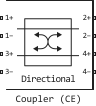
Block Coupler (CE) simulates a four-port directional coupler in an envelope simulation environment using an ideal model with S-parameters. The coupler has the following ports: input ports (1-, 1+), transmission ports (2-, 2+), isolated ports (3-, 3+) and related ports (4-, 4+).
Directional couplers are used to measure direct and reflected waves propagating along a transmission line. Directional couplers are used in many areas of radio frequency engineering, such as linear power sensors and automatic transmitter level controls.
Hybrid couplers are used to separate or combine signals with specific phase ratios.
Ports
Conserving
#
1+
—
input port
electricity
Details
The positive terminal of the input port.
| Program usage name |
|
#
1−
—
input port
electricity
Details
The negative terminal of the input port.
| Program usage name |
|
#
3+
—
isolated port
electricity
Details
The positive terminal of the isolated port.
| Program usage name |
|
#
3−
—
isolated port
electricity
Details
The negative terminal of the isolated port.
| Program usage name |
|
#
2+
—
transfer port
electricity
Details
The positive terminal of the transmission port.
| Program usage name |
|
#
2−
—
transfer port
electricity
Details
The negative terminal of the transmission port.
| Program usage name |
|
#
4+
—
associated port
electricity
Details
The positive terminal of the connected port.
| Program usage name |
|
#
4−
—
associated port
electricity
Details
The negative terminal of the connected port.
| Program usage name |
|
Parameters
Parameters
#
Select component: —
type of coupler
Directional coupler | Coupler symmetrical | Coupler antisymmetrical | Hybrid quadrature (90 deg) | Hybrid rat-race | Magic tee
Details
The type of coupler specified as:
-
Directional couplerThe matrix of S-parameters for
Directional coupler:where
-
;
-
;
-
;
-
.
Use this option to simulate the parameters of the coupler based on the technical characteristics.
-
-
Coupler symmetricalThe matrix of S-parameters for
Coupler symmetrical:where
-
— power transmission coefficient;
-
.
-
-
Coupler antisymmetricalThe matrix of S-parameters for
Coupler antisymmetrical:where
-
— power transmission coefficient;
-
.
-
-
Hybrid quadrature (90 deg)The S-parameter matrix for
Hybrid quadrature (90 deg): -
Hybrid rat-raceThe S-parameter matrix for
Hybrid rat-race: -
Magic teeThe S-parameter matrix for
Magic tee:
| Values |
|
| Default value |
|
| Program usage name |
|
| Tunable |
No |
| Evaluatable |
Yes |
# Coupling, dB — the percentage of the input signal power connected to the output port
Details
The percentage of the input signal power connected to the output port of the type coupler Directional coupler It is defined as a non-negative real scalar.
Dependencies
To use this parameter, set for the parameter Select component: meaning Directional coupler.
| Default value |
|
| Program usage name |
|
| Tunable |
No |
| Evaluatable |
Yes |
# Directivity, dB — the ratio of the power on the connected port to the power on the isolated port
Details
The ratio of the power on the connected port to the power on the isolated port of the type coupler Directional coupler It is defined as a non-negative real scalar.
Dependencies
To use this parameter, set for the parameter Select component: meaning Directional coupler.
| Default value |
|
| Program usage name |
|
| Tunable |
No |
| Evaluatable |
Yes |
# Insertion loss, dB — loss of signal power between input and output ports
Details
Loss of signal power between the input and output ports of the type coupler Directional coupler It is defined as a non-negative real scalar.
Dependencies
To use this parameter, set for the parameter Select component: meaning Directional coupler.
| Default value |
|
| Program usage name |
|
| Tunable |
No |
| Evaluatable |
Yes |
# Return loss, dB — loss of signal power due to impedance mismatch
Details
Loss of signal power due to mismatch of type coupler impedances Directional coupler It is defined as a non-negative real scalar.
Dependencies
To use this parameter, set for the parameter Select component: meaning Directional coupler.
| Default value |
|
| Program usage name |
|
| Tunable |
No |
| Evaluatable |
Yes |
# Power transmission coefficient — the power of the transmitted signal
Details
The power of the transmitted signal of the type coupler Coupler symmetrical or Coupler antisymmetrical It is defined as a real scalar.
Dependencies
To use this parameter, set for the parameter Select component: meaning Coupler symmetrical or Coupler antisymmetrical.
| Default value |
|
| Program usage name |
|
| Tunable |
No |
| Evaluatable |
Yes |
# Reference impedances, Ohm — the calculated total resistance of the coupler
Details
The calculated impedance of the coupler is set as a scalar or a three-component vector.
If the resistances of all ports are not equal, then the model is inside the block. Coupler (CE) normalizes to 50 Om.
|
| Default value |
|
| Program usage name |
|
| Tunable |
No |
| Evaluatable |
Yes |