SPST (CE)
Single-pole single-position switch.
blockType: SubSystem
|
Path in the library: |
Description
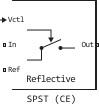
Block SPST (CE) simulates a single-pole single-position switch. This unit supports both reflective and absorption switches. The control signal is a signal Engee connected to the Vctl port of the unit. The control signal determines when the output port Out transmits the input signal to the input port In.
Ports
Input
#
Vctl
—
control signal
scalar
Details
Control signal Engee, set as a scalar.
| Data types |
|
| Complex numbers support |
No |
Conserving
#
In
—
The input signal
electricity
Details
The electrical port connected to the input signal.
| Program usage name |
|
#
Ref
—
electrical port
electricity
Details
The reference electrical port relative to which the input and output resistances are set.
| Program usage name |
|
#
Out
—
The output signal
electricity
Details
The electrical port connected to the output signal.
| Program usage name |
|
Parameters
Parameters
# Threshold voltage, V — Threshold voltage
Details
The switch’s threshold voltage, set as a positive scalar in volts.
| Default value |
|
| Program usage name |
|
| Tunable |
No |
| Evaluatable |
Yes |
#
Characterization —
switch characteristics
Resistance | Insertion loss
Details
The characteristic of the switch, set as Resistance or Insertion loss.
| Values |
|
| Default value |
|
| Program usage name |
|
| Tunable |
No |
| Evaluatable |
Yes |
# On resistance, Ohm — resistance in the open state
Details
The value of the resistance of the switch in the open state, set as a positive scalar in ohms.
Dependencies
To use this parameter, set for the parameter Characterization meaning Resistance.
| Default value |
|
| Program usage name |
|
| Tunable |
No |
| Evaluatable |
Yes |
# Off resistance, Ohm — resistance in the closed state
Details
The value of the switch resistance in the closed state, set as a positive scalar in ohms.
Dependencies
To use this parameter, set for the parameter Characterization meaning Resistance.
| Default value |
|
| Program usage name |
|
| Tunable |
No |
| Evaluatable |
Yes |
# Insertion lossdB, dB — insertion loss
Details
The value of the insertion loss of the switch, set as a positive scalar in dB.
Dependencies
To use this parameter, set for the parameter Characterization meaning Insertion loss.
| Default value |
|
| Program usage name |
|
| Tunable |
No |
| Evaluatable |
Yes |
# Isolation, dB — the value of insulation losses
Details
The value of the insulation loss of the switch, set as a scalar in dB.
Dependencies
To use this parameter, set for the parameter Characterization meaning Insertion loss.
| Default value |
|
| Program usage name |
|
| Tunable |
No |
| Evaluatable |
Yes |
#
Loading type —
type of load
Reflective | Absorptive
Details
The type of switch load, set as Reflective or Absorptive.
| Values |
|
| Default value |
|
| Program usage name |
|
| Tunable |
No |
| Evaluatable |
Yes |
# Port terminations, Ohm — port resistance
Details
Port resistance corresponding to the block impedance SPDT (CE), defined as a scalar in Ohms or a vector of length 2 with the unit of measurement of each element in Ohms. If the value is a scalar, then the input and output port impedances are the same. If the value is a vector, then the first element represents the required matching at the input port of the block, and the second element represents the required matching at the output port.
Dependencies
To use this parameter, set for the parameter Characterization meaning Insertion loss or for the parameter Loading type meaning Absorptive.
| Default value |
|
| Program usage name |
|
| Tunable |
No |
| Evaluatable |
Yes |
Additional Info
Resistance characteristics
Details
-
If the control voltage is less than the threshold voltage, the unit attenuates the signal using the resistance set in the parameter Off resistance, Ohm. The unit places a resistor between the positive input and output ports.
-
If the control voltage is greater than or equal to the threshold voltage, the unit attenuates the signal using the resistance set in the parameter On resistance, Ohm.
-
If the switch load type is absorption and the control voltage is less than the threshold voltage, the unit places internal parallel resistors on the input and output ports. The values of the parallel resistors ensure that the pins on the input and output ports are matched.
Characteristics of insertion loss
Details
-
If the control voltage is less than the threshold voltage, the unit calculates the value of the resistance in the closed state using the value of the parameter Isolation, dB.
-
If the control voltage is greater than or equal to the threshold voltage, the unit calculates the resistance value in the open state using the parameter value Insertion lossdB, dB.
-
If the switch load type is absorption and the control voltage is less than the threshold voltage, the unit places internal parallel resistors on the input and output ports. The values of the parallel resistors ensure that the pins on the input and output ports are matched.