Flexible Shaft
A shaft with torsional flexibility.
blockType: Engee1DMechanical.Elements.Rotational.FlexibleShaft
|
Path in the library: |
Description
Block Flexible Shaft It is a cardan shaft, malleable to torsion. The shaft is made of a flexible material that twists under the action of applied torque.
Twisting slows down the transfer of power between the ends of the shaft, changing the dynamic characteristics of the drive system.
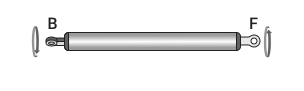
The concentrated mass method is used to represent a torsion-flexible shaft in the block. This model divides the shaft into various elements interconnected by means of parallel systems of spring dampers. The elements ensure the inertia of the shaft, and the spring damper systems ensure its compliance.
The block provides four parameterization methods that allow modeling the compliance of both homogeneous and axially inhomogeneous shafts. An axially inhomogeneous shaft is a shaft in which any of these parameters varies along the length of the shaft.:
-
torsional stiffness;
-
torsion inertia;
-
density;
-
the shear modulus;
-
Outer diameter;
-
the inner diameter.
An additional parameter allows you to simulate power losses in bearings due to viscous friction at the ends of the shaft. For more information, see The torsion model.
| The viscous friction at the ends of the shaft is different from the internal damping of the material, which corresponds to losses occurring in the shaft material itself. |
In the concentrated mass method, the model is divided into a number of elements that determine the inertia of the shaft, and the stiffness matrices determine compliance.
Supports can be modeled as ideal or using stiffness and damping matrices. It can be varied for each support:
-
Location — any point along the length of the shaft.
-
The type is an ideal clamp, an ideal pin, free, with constant bearing stiffness and damping, or with stiffness and damping depending on the rotation speed.
-
The number is two, three or four.
The parameterization of the torsion model can be set using either stiffness and the moment of inertia , or the dimensions and properties of the shaft material.
The torsion model
For the torsion model, the block Flexible Shaft approximates the distributed continuous properties of the shaft using the concentrated mass method. The model contains a finite number ( ) series-connected concentrated spring elements with damping, as well as a finite moment of inertia. The result is a series of inertia blocks connected by rotary springs and rotational dampers.
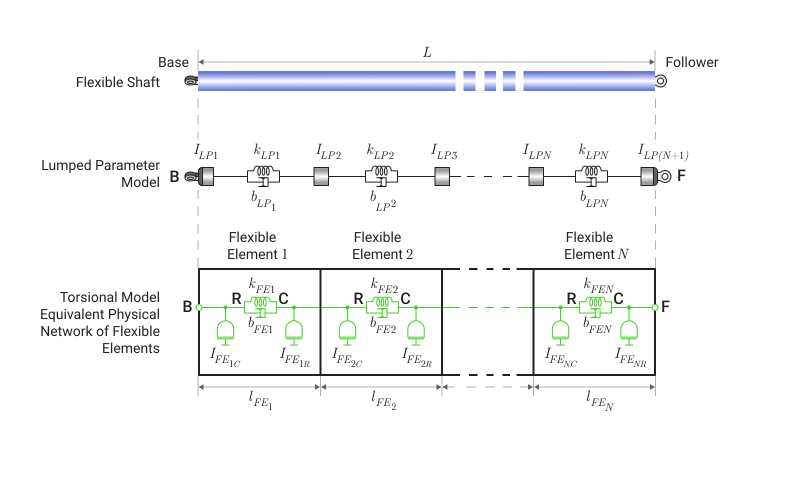
The block considers the shaft as an equivalent physical network of elastic elements. Each elastic element It is a short section of the shaft and contains:
-
One spring to ensure torsional compliance. Total online springs.
-
One damper to provide damping in the material. Total online dampers.
-
Two moments of inertia and to provide resistance to rotation. The moments of inertia of neighboring elastic elements are summed up so that the total in the network moments of inertia.
For an axially homogeneous shaft, the lengths of elastic elements, ductility, damping, and distributed moments of inertia in the physical network are equal, therefore
For an axially inhomogeneous shaft, the degree of compliance, damping, and inertia of the R node and C node may differ for individual elastic elements in the physical network model.
algorithm of node placement
The balance between model accuracy and simulation speed depends on — the number of elastic elements used by the block to represent the shaft. For information about the balance between simulation speed and model accuracy, see Improving the speed or accuracy of the simulation.
The block allows you to set the minimum number of elastic elements. as a parameter value Minimum number of flexible elements. However, the actual number of elastic elements used by the block depends on the complexity of the simulated shaft. If, to solve a model containing axial inhomogeneity, intermediate supports,
the block requires more elastic elements than you specified, then .
For example, suppose that for a complex shaft in the diagram you specify the axial position of the supports and
a section with a larger diameter.
You set for the parameter meaning 10.
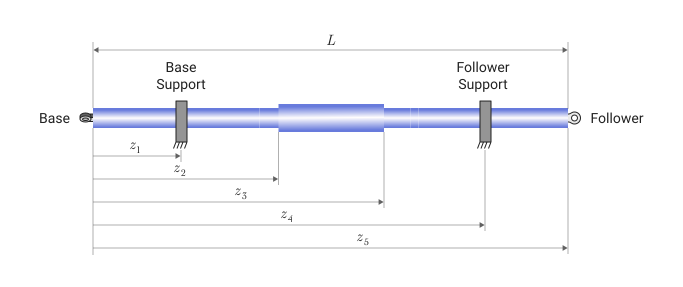
The block algorithm determines the number of elastic elements and the length of individual elements needed to solve the modeling problem.:
-
The unit places one node at each of the driving and driven ends of the shaft. These nodes are considered fixed in the axial position, since they are physical objects along the axis of the shaft. In the diagram, the fixed nodes are shown in red. The block evenly distributes the other eight ( ) internal nodes along the length of the shaft. He then places an elastic element between each successive pair of nodes.
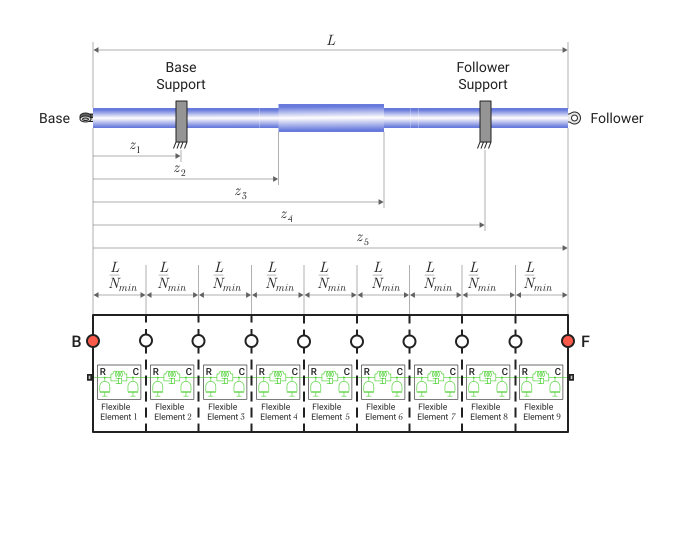
For a shaft with support at the leading end, axially homogeneous,
depending on the other specified parameters and values, the block can solve the simulation problem using only elastic elements of equivalent length:
+
+
However, in most cases, the block can solve the modeling problem only if it adds more elastic elements.
-
To add more elastic elements, the block places fixed internal nodes in the following locations:
-
Each location of the shaft supports. The block allows you to specify the number and location of shaft supports. For the shaft in the diagram, the supports are located at the points and .
-
-
Each boundary of the parameterization segment. Parameterization boundaries are locations along an axially inhomogeneous shaft where two adjacent shaft sections differ in stiffness, inertia, or geometry. This block allows you to determine the location of the boundaries of the parameterization segment. For the shaft in the diagram, the segment boundaries are at points and .
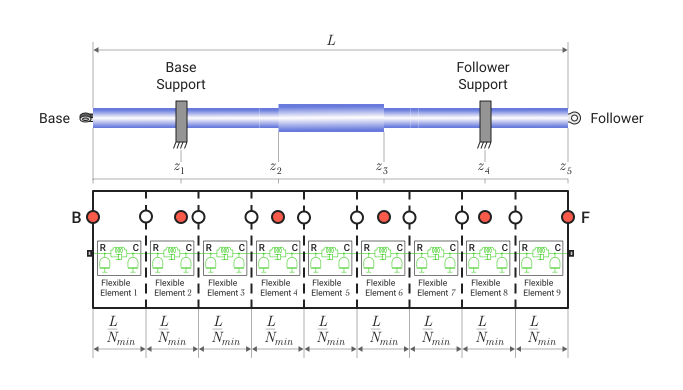
-
The block adjusts the location of the non-fixed nodes between the fixed nodes so that they are evenly distributed.
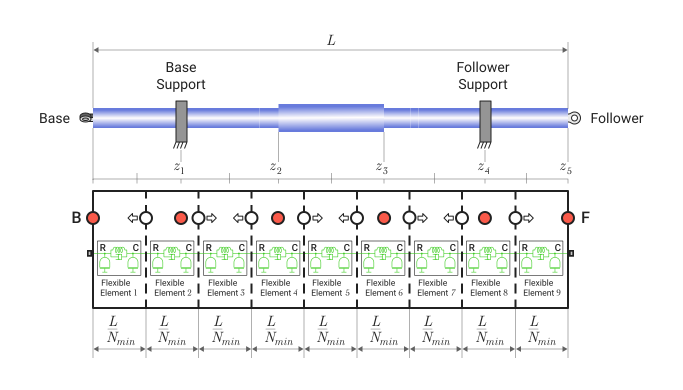
Finally, the block places elastic elements between each node. The length of each elastic element corresponds to the center-to-center distance between adjacent nodes. The block distributes inertia between elastic elements depending on the length of each element and the corresponding geometry of the shaft. Ultimately, this complex shaft is represented by
13elastic elements: , , , and . -
+
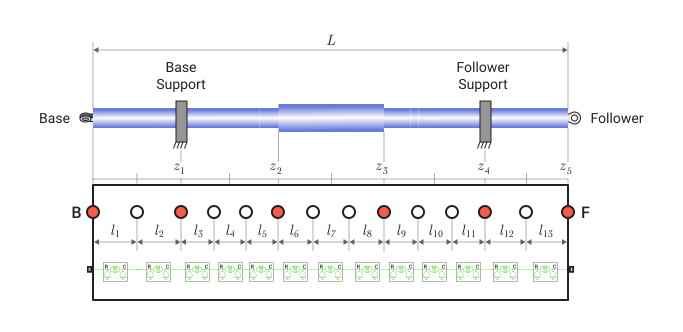
+
If If the number of unfixed nodes is large enough to exceed the number of fixed nodes, the block distributes more than one unfixed node among each set of neighboring fixed nodes.
size and material properties
The parameterization of the torsion model can be set using either stiffness and the polar moment of inertia , or the dimensions and properties of the shaft material.
The stiffness and inertia of each element are calculated based on the shaft dimensions and material properties as follows:
where
-
— the polar moment of inertia of the shaft at the location of the elastic element;
-
— the outer diameter of the shaft at the location of the elastic element;
-
— the inner diameter of the shaft at the location of the elastic element; for a solid shaft ; for the annular shaft ;
-
— the length of the elastic element;
-
— the mass of the shaft at the location of the elastic element;
-
— the moment of inertia of the shaft at the location of the elastic element;
-
— shaft material density;
-
— the shear modulus of the shaft material;
-
— torsional stiffness of the elastic element.
internal damping in the material
For any torsion parameterization, the internal damping in the material is determined by the damping coefficient for a model with a single elastic element with equivalent torsional stiffness and inertia. The damping coefficient in this case is , where the natural frequency of undamped oscillations is . The damping moment applied to a single elastic element of a concentrated mass model is equivalent to the product of the damping coefficient and the relative rotational velocity of this elastic element.
Improving the speed or accuracy of the simulation
The balance between simulation accuracy and performance depends on — the number of elastic elements used by the block to represent the shaft. Modeling accuracy is a measure of the correspondence of modeling results to mathematical and empirical models. As a rule, with increasing the accuracy and reliability of modeling increases. However, the computational cost of modeling is also correlated with , and as computing costs increase, performance decreases. And vice versa, with decreasing The simulation speed increases, but the accuracy decreases.
To improve the accuracy of concentrated mass modeling for the torsion model
increase the minimum number of elastic elements, . The torsion model with one elastic element has a natural torsion frequency close to the first natural frequency of the model with a continuous parameter distribution. For more accuracy, you can choose 2, 4, 8 or more elastic elements. For example, the four lowest natural torsion frequencies are represented with precision 0.1, 1.9, 1.6 and 5.3 percent , respectively, in the model with 16 elastic elements.
Assumptions and limitations
-
The model with distributed parameters of a continuous torsion shaft is approximated by a finite number of concentrated masses. .
-
Shaft rotation and torsional flexibility cause the shaft to bend, but bending does not affect shaft rotation and torsional flexibility.
-
The outer diameter of the shaft is small compared to the length of the shaft.
-
The shaft supports are fixed.
-
The gyroscopic effects of the shaft are not taken into account.
-
If the shaft simulates only torsion and uses parameterization values
By stiffness and inertiaorBy segment stiffness and inertiaThe block uses only two supports, one each at the ends of B and F.
Parameters
Shaft
#
Segment inner diameters [B,...,F] —
the inner diameter of each shaft segment
m | um | mm | cm | km | in | ft | yd | mi | nmi
Details
The internal diameters of the shaft segments. The number of elements in the vector must match the number of elements specified for the parameter. Segment length [B,…,F]. The order of the elements in the vector corresponds to the order of the segments relative to the leading end of the shaft B. Each value must be less than the corresponding value specified for the parameter. Segment outer diameters [B,…,F]. If the shaft segment is solid, specify 0 for the corresponding element of the vector. At least one element in the vector must be positive.
Dependencies
To use this parameter, set for the parameter Parameterization meaning By material and segment geometry, and for the parameter Shaft geometry meaning Annular.
| Units |
|
| Default value |
|
| Program usage name |
|
| Evaluatable |
Yes |
#
Segment torsional inertia [B,...,F] —
polar moment of inertia for each shaft segment
kg*m^2 | g*m^2 | kg*cm^2 | g*cm^2 | lbm*in^2 | lbm*ft^2 | slug*in^2 | slug*ft^2
Details
The ability of each shaft segment to withstand acceleration during torsion. The number of elements in the vector must match the number of elements specified for the parameter. Segment length [B,…,F]. The order of the elements in the vector corresponds to the order of the segments relative to the leading end of the shaft B.
Dependencies
To use this parameter, set for the parameter Parameterization meaning By segment stiffness and inertia.
| Units |
|
| Default value |
|
| Program usage name |
|
| Evaluatable |
Yes |
#
Material density —
material density
kg/m^3 | g/m^3 | g/cm^3 | g/mm^3 | lbm/ft^3 | lbm/gal | lbm/in^3
Details
The density of the shaft material.
Dependencies
To use this parameter, set for the parameter Parameterization meaning By material and geometry or By material and segment geometry.
| Units |
|
| Default value |
|
| Program usage name |
|
| Evaluatable |
Yes |
# Model torsional flexibility — elastic torsion model
Details
Whether to simulate torsional flexibility.
| Default value |
|
| Program usage name |
|
| Evaluatable |
No |
#
Shaft outer diameter —
outer diameter of the shaft
m | um | mm | cm | km | in | ft | yd | mi | nmi
Details
The outer diameter of the shaft.
Dependencies
To use this parameter, set for the parameter Parameterization meaning By material and geometry.
| Units |
|
| Default value |
|
| Program usage name |
|
| Evaluatable |
Yes |
# Minimum number of flexible elements — minimum number of flexible elements
Details
Minimum number of flexible elements for an approximation.
It is possible that flexible elements have different lengths or a simulated number of flexible elements. more . For more information, see Node placement algorithm.
More flexible elements improves the accuracy of the simulation, but reduces the simulation performance. A model with one flexible element ( ) has a natural torsion frequency close to the first natural frequency of the model with a continuous parameter distribution.
If model accuracy is more important than performance, choose 2, 4, 8 or more flexible elements. For example, the four lowest natural torsion frequencies are represented with precision 0.1, 1.9, 1.6 and 5.3 percent , respectively, in the model with 16 flexible elements.
For more information, see Improving the speed or accuracy of the simulation.
Dependencies
To use this option, check the box next to the option Model torsional flexibility.
| Default value |
|
| Program usage name |
|
| Evaluatable |
Yes |
#
Torsional inertia —
polar moment of inertia
kg*m^2 | g*m^2 | kg*cm^2 | g*cm^2 | lbm*in^2 | lbm*ft^2 | slug*in^2 | slug*ft^2
Details
The ability of the shaft to withstand acceleration during torsion.
Dependencies
To use this parameter, set for the parameter Parameterization meaning By stiffness and inertia.
| Units |
|
| Default value |
|
| Program usage name |
|
| Evaluatable |
Yes |
#
Shaft geometry —
geometry of the cross section
Solid | Annular
Details
The geometry of the cross-section along the length of the shaft. If the shaft or its segments are hollow, select the value Annular. Otherwise, select the value Solid.
Dependencies
To use this parameter, set for the parameter Parameterization meaning By material and geometry or By material and segment geometry.
| Values |
|
| Default value |
|
| Program usage name |
|
| Evaluatable |
No |
#
Shaft length —
shaft length
m | um | mm | cm | km | in | ft | yd | mi | nmi
Details
Shaft length.
Dependencies
To use this parameter,
set for the parameter Parameterization meaning By material and geometry.
| Units |
|
| Default value |
|
| Program usage name |
|
| Evaluatable |
Yes |
#
Shaft inner diameter —
inner diameter of the shaft
m | um | mm | cm | km | in | ft | yd | mi | nmi
Details
The inner diameter of the annular shaft. The value must be less than the value specified for the parameter. Shaft outer diameter.
Dependencies
To use this parameter, set for the parameter Parameterization meaning By material and geometry, and for the parameter Shaft geometry meaning Annular.
| Units |
|
| Default value |
|
| Program usage name |
|
| Evaluatable |
Yes |
#
Segment torsional stiffness [B,...,F] —
stiffness of the material for each shaft segment
N*m/rad | mN*m/rad | kN*m/rad | kgf*m/rad | lbf*ft/rad | N*m/deg | mN*m/deg | kN*m/deg | kgf*m/deg | lbf*ft/deg | W*s/rad | HP_DIN/rpm | HP_DIN*s/rad
Details
The torque per radians of rotation for each shaft segment. The number of elements in the vector must match the number of elements specified for the parameter. Segment length [B,…,F]. The order of the elements in the vector corresponds to the order of the segments relative to the leading end of the shaft B.
Dependencies
To use this parameter, set for the parameter Parameterization meaning By segment stiffness and inertia.
| Units |
|
| Default value |
|
| Program usage name |
|
| Evaluatable |
Yes |
#
Segment outer diameters [B,...,F] —
the outer diameter of each shaft segment
m | um | mm | cm | km | in | ft | yd | mi | nmi
Details
The outer diameter of each shaft segment. The number of elements in the vector must match the number of elements specified for the parameter. Segment length [B,…,F]. The order of the elements in the vector corresponds to the order of the segments relative to the leading end of the shaft B.
Dependencies
To use this parameter, set for the parameter Parameterization meaning By material and segment geometry.
| Units |
|
| Default value |
|
| Program usage name |
|
| Evaluatable |
Yes |
#
Shear modulus —
the shear modulus
Pa | uPa | hPa | kPa | MPa | GPa | kgf/m^2 | kgf/cm^2 | kgf/mm^2 | mbar | bar | kbar | atm | ksi | psi | mmHg | inHg
Details
The shear modulus for the shaft material.
Dependencies
To use this parameter, set for the parameter Parameterization meaning By material and geometry or By material and segment geometry.
| Units |
|
| Default value |
|
| Program usage name |
|
| Evaluatable |
Yes |
#
Segment length [B,...,F] —
length of each shaft segment
m | um | mm | cm | km | in | ft | yd | mi | nmi
Details
The length of each shaft segment, into which it is divided by length to simulate an axially inhomogeneous shaft. The number of elements in the vector is equal to the number of segments used to model an inhomogeneous shaft. The order of the elements in the vector corresponds to the order of the segments relative to the leading end of the shaft B.
Dependencies
To use this parameter,
set for the parameter Parameterization meaning By material and segment geometry.
| Units |
|
| Default value |
|
| Program usage name |
|
| Evaluatable |
Yes |
#
Torsional stiffness —
stiffness of the material
N*m/rad | mN*m/rad | kN*m/rad | kgf*m/rad | lbf*ft/rad | N*m/deg | mN*m/deg | kN*m/deg | kgf*m/deg | lbf*ft/deg | W*s/rad | HP_DIN/rpm | HP_DIN*s/rad
Details
Torque per radians of shaft torsion.
Dependencies
To use this option, check the box next to the option Model torsional flexibility and set for the parameter Parameterization meaning By stiffness and inertia.
| Units |
|
| Default value |
|
| Program usage name |
|
| Evaluatable |
Yes |
#
Parameterization —
parameterization method
By stiffness and inertia | By material and geometry | By segment stiffness and inertia | By material and segment geometry
Details
The parameterization method. You can model a homogeneous shaft or a shaft that is not uniform in the axial direction using any of the following parameters:
-
torsional stiffness;
-
torsion inertia;
-
density;
-
the shear modulus;
-
Outer diameter;
-
the inner diameter.
Select one of the following options for parameterizing the homogeneous shaft:
-
By stiffness and inertia— specify the torsional stiffness and inertia. -
By material and geometry— specify the length and geometry of the axial section of the shaft in terms of internal and external diameters. Specify the density and shear modulus for the shaft material.
For an axially inhomogeneous shaft model, the following parameters can be used:
-
By segment stiffness and inertia— for each shaft segment, specify the torsional stiffness, torsional inertia, and density per unit length. -
By material and segment geometry— for each shaft segment, specify the length and geometry of the axial section, including the inner and outer diameters. Specify the density and shear modulus for the shaft material.
| Values |
|
| Default value |
|
| Program usage name |
|
| Evaluatable |
No |
Torsion
# Damping ratio from internal losses — material damping coefficient
Details
The damping coefficient of the material.
Dependencies
To use this option, check the box next to the option Model torsional flexibility.
| Default value |
|
| Program usage name |
|
| Evaluatable |
Yes |
#
Viscous friction coefficients at each support [B1,...,F1] —
coefficients of viscous friction
N*m*s/rad | mN*m*s/rad | kN*m*s/rad | kgf*m*s/rad | lbf*ft*s/rad
Details
Coefficients of viscous friction on each support. The number of elements in the vector must match the number specified for the parameter. Number of supports. The order of the elements must correspond to the sequential arrangement of each support of the leading end of the shaft B.
Dependencies
To use this parameter,
set for the parameter Parameterization meaning By material and geometry or By material and segment geometry.
| Units |
|
| Default value |
|
| Program usage name |
|
| Evaluatable |
Yes |
#
Initial shaft torsional deflection —
initial deflection of the shaft during torsion
rad | deg | rev | mrad | arcsec | arcmin | gon
Details
The angular deviation of the shaft at the beginning of the simulation.
A positive initial deviation leads to a positive rotation of the driving end of the shaft B relative to the driven end of the shaft F.
Dependencies
To use this option, check the box next to the option Model torsional flexibility.
| Units |
|
| Default value |
|
| Program usage name |
|
| Evaluatable |
Yes |
#
Viscous friction coefficients at base (B) and follower (F) —
coefficients of viscous friction
N*m*s/rad | mN*m*s/rad | kN*m*s/rad | kgf*m*s/rad | lbf*ft*s/rad
Details
Coefficients of viscous friction at the driving B and driven F ends of the shaft. The vector must contain two elements.
Dependencies
To use this parameter,
set for the parameter Parameterization meaning By stiffness and inertia or By segment stiffness and inertia.
| Units |
|
| Default value |
|
| Program usage name |
|
| Evaluatable |
Yes |
#
Initial shaft rotational velocity —
initial angular velocity
rad/s | deg/s | rad/min | deg/min | rpm | rps
Details
The angular velocity of the shaft at the beginning of the simulation.
Dependencies
To use this option, check the box next to the option Model torsional flexibility.
| Units |
|
| Default value |
|
| Program usage name |
|
| Evaluatable |
Yes |
Supports
#
Number of supports —
number of supports
2 | 3 | 4
Details
The number of shaft supports.
Dependencies
To use this parameter,
set for the parameter Parameterization meaning By material and geometry or By material and segment geometry.
| Values |
|
| Default value |
|
| Program usage name |
|
| Evaluatable |
No |
#
Support locations relative to base (B) —
location of the supports
m | um | mm | cm | km | in | ft | yd | mi | nmi
Details
The position of the supports relative to the leading end of the shaft B. The number of elements must match the number specified for the parameter. Number of supports. The order of the elements corresponds to the sequential arrangement of each support relative to the leading end of the shaft. The maximum value should not exceed the length of the shaft. For a segmented shaft model, the shaft length is equal to the sum of the lengths of the individual segments.
Dependencies
To use this parameter,
set for the parameter Parameterization meaning By material and geometry or By material and segment geometry.
| Units |
|
| Default value |
|
| Program usage name |
|
| Evaluatable |
Yes |
Literature
-
Bathe, K. J. Finite Element Procedures. Prentice Hall, 1996.
-
Kane and Torby, «The Extended Modal Reduction Method Applied to Rotor Dynamic Problems», Journal of Vibration and Acoustics 113, no. 1 (January 1, 1991): 79–84. https://doi.org/10.1115/1.2930159.
-
Muszynska, A. Rotordynamics. Taylor & Francis, 2005
-
Rao, S.S. Vibration of Continuous Systems. Hoboken, NJ: John Wiley & Sons, 2007.