Rail Contact
The model of wheel-rail contact under variable vertical load and coupling.
blockType: Engee1DMechanical.Vehicles.Rail.WheelContact
|
Path in the library: |
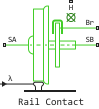
Description
Block Rail Contact generates a longitudinal force in the contact area of the wheel with the rail and rolling resistance.
When the train is moving, the force is calculated using a formula that depends on the coefficient of longitudinal sliding, which can be calculated using classical algebraic formulas.
Use this block to calculate the longitudinal interaction of the wheel and rail, taking into account rolling resistance when modeling one-dimensional vehicle movement.
The connection of the longitudinal and transverse couplings is not taken into account. Also note that the model does not take into account the mass transfer and the profile of the road.
The coefficient of longitudinal sliding
The longitudinal slip coefficient is calculated under the assumption of a stationary mode, which is valid only at high speed (more than 20 km/h). To calculate it, an algebraic equation is used, which has a singularity (diverges) at zero velocity. To avoid this divergence, the expression for longitudinal slippage is modified when the velocity drops below a threshold value. , set by the parameter Velocity threshold to define static damping.
When using classical formulas, the value of the longitudinal slip is under the assumption of a stationary regime, it is defined as follows:
where
-
— the longitudinal speed of the wheel on the port H;
-
— the rolling radius of the wheel, the value of the parameter Mean radius of wheel;
-
— angular velocity of the wheel;
-
— the update rate of the contact zone, determined to check the ratio :
if ,
if ,
if .
Longitudinal force
The longitudinal force is modeled using the assumption that the contact of the wheel with the rail is equivalent to the contact of two cylinders with perpendicular axes. Therefore, it is necessary to specify several characteristics of this contact.:
-
The average rolling radius of the wheel, the value of the parameter Mean radius of wheel;
-
Bending radius of the rail, parameter value Rail bending radius;
-
Determination of the wheel material (Young’s modulus, Poisson’s ratio), the value of the parameters Wheel Poisson’s ratio and Wheel Young’s modulus;
-
Determination of the rail material (Young’s modulus, Poisson’s ratio), the value of the parameters Rail Poisson’s ratio and Rail Young’s modulus;
-
Coupling characteristics, parameter value Adhesion characteristics.
Coupling is determined using a set of parameters described in [1]. This description is valid for small and large values of longitudinal slip. These parameters must be determined by measurements. For Adhesion characteristics you can set one of the values:
-
Typical dry condtion— general parameters for the dry contact of the wheel with the rail; -
Typical wet condtion— general parameters for wet wheel-rail contact; -
User defined— The user selects the value of each parameter.
The resulting formula of the longitudinal force:
where
-
— vertical load;
-
— reduction coefficient in the coupling area;
-
— reduction coefficient in the sliding zone;
-
— coefficient of friction;
-
— the gradient of the tangential stress in the longitudinal direction.
Coefficient of friction defined as:
where
-
— maximum coefficient of friction at zero sliding speed;
-
— the ratio of the coefficients of friction , where — coefficient of friction at infinite sliding speed;
-
— coefficient of exponential reduction of friction;
-
— the sliding speed in the longitudinal direction.
Tangential stress gradient in the longitudinal direction defined as:
where
-
— the shear modulus;
-
— semi-axes of the contact ellipse;
-
— coefficient from Kalker’s linear theory;
-
— sliding in the longitudinal direction (between
-1and1).
To approximate typical dry and wet conditions, the parameter values are shown in the table:
| Parameter | Typical dry conditions | Typical wet conditions |
|---|---|---|
|
|
|
|
|
|
|
|
|
|
|
|
|
|
|
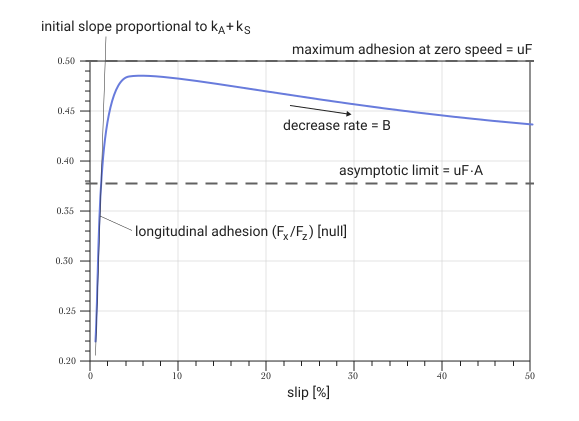
The figure shows a typical graph of the dependence of longitudinal adhesion on the coefficient of longitudinal slip. It also demonstrates the various connections between the shape of the curve and the coefficients.
Rolling resistance
Rolling resistance ( ) is calculated using a simple rolling resistance coefficient:
where
-
— coefficient of rolling resistance, the value of the parameter Rolling resistance coefficient;
-
— vertical load;
-
— the average rolling radius of the wheel, the value of the parameter Mean radius of wheel.
Braking torque
Applied braking torque and the moment of rolling resistance They are calculated using the approach described in [2]. The parameters need to be adjusted to avoid non-physical fluctuations and speed up the calculation time.:
-
equivalent viscous friction during coupling Equivalent viscous friction during stiction (brake) can be adjusted to avoid non-physical fluctuations.;
-
offset threshold Stick displacement threshold (brake) It can be adjusted to reflect the braking dynamics and speed up the calculation time.
Starting from a position where there is no moment of friction, when the angle of rotation of one surface relative to another changes, a moment of static friction arises. It consists of two components:
-
the moment of force, which varies linearly with the angle of rotation until the moment of static friction is reached. This happens when the rotation angle reaches a threshold value.
-
a component of viscous friction that is used to prevent non-physical vibrations.
When the angle of rotation of one surface relative to another exceeds a threshold value, the solids rotate (slide), and the moment of friction force is equal to the moment of dynamic friction force.
static friction
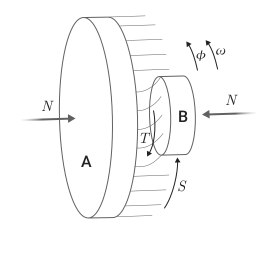
Contact stiffness It is taken into account when a rigid body experiences static friction. The adhesion stiffness is determined by the threshold value of the rotation angle :
where
— maximum moment of static friction force;
— the threshold value of the rotation angle, the value of the parameter Stick displacement threshold (brake).
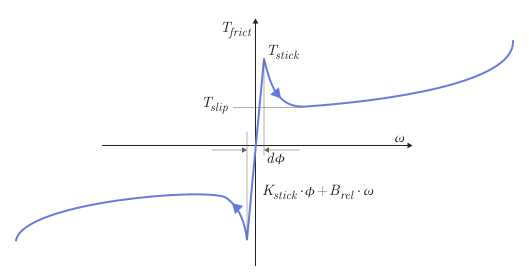
At low rotation angles (below the threshold angle value ) the moment of friction force It is a function of the rotation angle. The moment of the frictional force required to maintain zero acceleration and, consequently, to glue solids is equal to:
where
-
— attenuation coefficient adjusted to prevent vibrations when solids stick together;
-
— the speed of the wheel.
slide
When the angle is exceeds the angle threshold value , the bodies slip, and the moment of the friction force becomes equal to the moment of the dynamic friction force:
Wheel dynamics
The wheel speed is calculated by the equation of rotational motion dynamics:
where
-
— shaft torque at port SA;
-
— braking torque on the port BR
-
— braking torque;
-
— moment of rolling resistance;
-
— the average rolling radius of the wheel, the value of the parameter Mean radius of wheel.
-
— longitudinal force.
Ports
Conserving
#
SA
—
shaft
rotational mechanics
Details
A mechanical rotary port connected to the wheel shaft.
| Program usage name |
|
#
SB
—
shaft
rotational mechanics
Details
A mechanical rotary port connected to the wheel shaft.
| Program usage name |
|
#
H
—
hub
translational mechanics
Details
Mechanical translational port connected to the wheel hub.
| Program usage name |
|
#
Br
—
the brake
rotational mechanics
Details
A mechanical rotary port connected to the wheel brake.
| Program usage name |
|
Input
#
N
—
normal force, N
scalar
Details
The input port associated with the normal force acting on the wheel is in N. The minimum value of the normal force is set in the parameter Engagement threshold force.
Dependencies
To use this port, select the Controlled vertical load checkbox.
| Data types |
|
| Complex numbers support |
I don’t |
#
λ
—
scale factor for the coefficient of friction
scalar
Details
The scale factor for the coefficient of friction. The minimum value of the scaling factor is set in the parameter Minimum scale factor for coefficient of friction.
| Data types |
|
| Complex numbers support |
I don’t |
Parameters
Parameters
# Controlled vertical load — The method of setting the normal force
Details
Select this option to set the normal force acting on the wheel as a scalar value per port N. In this case, the value of the normal force will be limited by the threshold value. Engagement threshold force.
Uncheck this box to set the average value of the normal force in the parameter Mean vertical load on the wheel
| Default value |
|
| Program usage name |
|
| Evaluatable |
No |
# Friction coefficient at zero slip velocity — maximum coefficient of friction at zero sliding speed
Details
Maximum coefficient of friction at zero sliding speed .
Dependencies
To use this parameter, set for the parameter Adhesion characteristics meaning User defined.
| Default value |
|
| Program usage name |
|
| Evaluatable |
Yes |
# Minimum scale factor for coefficient of friction — minimum scale factor for the coefficient of friction
Details
The minimum value of the scale factor for the coefficient of friction on the port is λ.
| Default value |
|
| Program usage name |
|
| Evaluatable |
Yes |
#
Engagement threshold force —
threshold coupling force
N | nN | uN | mN | kN | MN | GN | dyn | lbf | kgf
Details
The threshold force at which the unit applies a normal force to the wheel. If this value is too low, the wheel quickly gains traction and loses traction with the rail. If this value is too high, then the block creates unrealistically low static and dynamic friction forces. The parameter must be greater than zero.
Dependencies
To use this option, select the Controlled vertical load checkbox.
| Units |
|
| Default value |
|
| Program usage name |
|
| Evaluatable |
Yes |
#
Adhesion characteristics —
coupling characteristics
Typical dry condtion | Typical wet condtion | User defined
Details
The coupling characteristics can be set using one of the values:
-
Typical dry condtion— general parameters for the dry contact of the wheel with the rail; -
Typical wet condtion— general parameters for wet wheel-rail contact; -
User defined— The user selects the value of each parameter.
| Values |
|
| Default value |
|
| Program usage name |
|
| Evaluatable |
No |
#
Mean vertical load on the wheel —
the average value of the normal force acting on the wheel
N | nN | uN | mN | kN | MN | GN | dyn | lbf | kgf
Details
The average value of the normal force acting on the wheel.
Dependencies
To use this option, uncheck the Controlled vertical load checkbox.
| Units |
|
| Default value |
|
| Program usage name |
|
| Evaluatable |
Yes |
Rail
# Rail Poisson's ratio — Poisson’s ratio of rail material
Details
Poisson’s ratio of the rail material.
| Default value |
|
| Program usage name |
|
| Evaluatable |
Yes |
#
Rail bending radius —
bending radius of the rail
m | um | mm | cm | km | in | ft | yd | mi | nmi
Details
The bending radius of the rail.
| Units |
|
| Default value |
|
| Program usage name |
|
| Evaluatable |
Yes |
#
Rail Young's modulus —
Young’s module of the rail material
Pa | uPa | hPa | kPa | MPa | GPa | kgf/m^2 | kgf/cm^2 | kgf/mm^2 | mbar | bar | kbar | atm | ksi | psi | mmHg | inHg | N/m^2
Details
The Young’s module of the rail material.
| Units |
|
| Default value |
|
| Program usage name |
|
| Evaluatable |
Yes |
Longitudinal slip
#
Velocity threshold to define static damping —
minimum speed threshold value
m/s | mm/s | cm/s | km/s | m/hr | km/hr | in/s | ft/s | mi/s | ft/min | mi/hr | kn
Details
The minimum speed threshold value.
| Units |
|
| Default value |
|
| Program usage name |
|
| Evaluatable |
Yes |
Wheel
#
Wheel Young's modulus —
Young’s wheel material module
Pa | uPa | hPa | kPa | MPa | GPa | kgf/m^2 | kgf/cm^2 | kgf/mm^2 | mbar | bar | kbar | atm | ksi | psi | mmHg | inHg | N/m^2
Details
The Young’s module of the wheel material.
| Units |
|
| Default value |
|
| Program usage name |
|
| Evaluatable |
Yes |
#
Mean radius of wheel —
average wheel radius
m | um | mm | cm | km | in | ft | yd | mi | nmi
Details
The average radius of the wheel.
| Units |
|
| Default value |
|
| Program usage name |
|
| Evaluatable |
Yes |
#
Wheel inertia —
inertia of the wheel
kg*m^2 | g*m^2 | kg*cm^2 | g*cm^2 | lbm*in^2 | lbm*ft^2 | slug*in^2 | slug*ft^2
Details
The inertia of the wheel.
| Units |
|
| Default value |
|
| Program usage name |
|
| Evaluatable |
Yes |
# Wheel Poisson's ratio — Poisson’s ratio of wheel material
Details
The Poisson’s ratio of the wheel material.
| Default value |
|
| Program usage name |
|
| Evaluatable |
Yes |
Resistive and braking torque
#
Equivalent viscous friction during stiction (brake) —
equivalent viscous friction during coupling
N*m*s/rad | mN*m*s/rad | kN*m*s/rad | kgf*m*s/rad | lbf*ft*s/rad
Details
Equivalent viscous friction during coupling.
| Units |
|
| Default value |
|
| Program usage name |
|
| Evaluatable |
Yes |
# Rolling resistance coefficient — coefficient of rolling resistance
Details
Coefficient of rolling resistance.
| Default value |
|
| Program usage name |
|
| Evaluatable |
Yes |
#
Stick displacement threshold (brake) —
offset threshold
rad | deg | rev | mrad | arcsec | arcmin | gon
Details
The offset threshold value for adjusting the braking dynamics.
| Units |
|
| Default value |
|
| Program usage name |
|
| Evaluatable |
Yes |
Wheel-rail adhesion
# Ratio of friction coefficients uinf/uF — ratio of friction coefficients
Details
Ratio of friction coefficients , where is the coefficient of friction at an infinite sliding speed, and — maximum coefficient of friction at zero sliding speed.
Dependencies
To use this parameter, set for the parameter Adhesion characteristics meaning User defined.
| Default value |
|
| Program usage name |
|
| Evaluatable |
Yes |
# Reduction factor in the area of adhesion — coefficient of reduction in the coupling area
Details
Coefficient of reduction in the coupling area .
Dependencies
To use this parameter, set for the parameter Adhesion characteristics meaning User defined.
| Default value |
|
| Program usage name |
|
| Evaluatable |
Yes |
# Reduction factor in the area of slip — reduction coefficient in the sliding zone
Details
Reduction coefficient in the sliding zone .
Dependencies
To use this parameter, set for the parameter Adhesion characteristics meaning User defined.
| Default value |
|
| Program usage name |
|
| Evaluatable |
Yes |
#
Coefficient of exponential friction decrease —
coefficient of exponential reduction of friction
s/m | s/ft
Details
Coefficient of exponential reduction of friction .
Dependencies
To use this parameter, set for the parameter Adhesion characteristics meaning User defined.
| Units |
|
| Default value |
|
| Program usage name |
|
| Evaluatable |
Yes |
Initial Conditions
#
Initial wheel rotary velocity —
initial rotation speed of the wheel
rad/s | deg/s | rad/min | deg/min | rpm | rps
Details
The initial rotation speed of the wheel.
| Units |
|
| Default value |
|
| Program usage name |
|
| Evaluatable |
Yes |