Flow Resistance (2P)
Hydraulic resistance in a two-phase fluid network.
blockType: AcausalFoundation.TwoPhaseFluid.Elements.FlowResistance
|
Path in the library: |

Description
Block Flow Resistance (2P) simulates the total pressure drop in a two-phase liquid network. The pressure drop is proportional to the square of the mass flow and inversely proportional to the density of the two-phase liquid. The proportionality coefficient is determined based on the nominal operating mode specified in the unit parameters.
Use this unit when only the pressure drop depending on the mass flow rate is known about the component. Combine this unit with others to create a custom component that more accurately reflects the pressure drop it causes, such as a block-based heat exchanger. Constant Volume Chamber (2P).
Conservation of mass
It is assumed that the volume of liquid inside the hydraulic resistance is negligible. Then the mass expenses through the ports are equal
where and — mass expenses via ports A and B respectively.
Energy conservation
Energy can enter and exit the hydraulic resistance only through the ports of the two-phase fluid. There is no heat exchange between the walls and the environment, and the liquid does not perform any work. The amount of energy entering per unit of time through one port is equal to the amount of energy exiting through the other port per unit of time:
where and — energy flow through ports A and B respectively.
Conservation of momentum
External forces acting on the liquid include forces due to pressure on the ports and forces due to viscous friction on the walls. Gravity, like other volumetric forces, is not taken into account. Expression of friction forces in terms of the loss coefficient gives a semi-empirical expression:
where
-
— pressure drop from port A to port B, that is ;
-
— loss ratio;
-
— specific volume, the inverse of density That is , ;
-
— the area of the stream.
The differential pressure equation is implemented in two modifications. The first one takes into account the change in sign when the flow direction changes, then the equation is rewritten as follows:
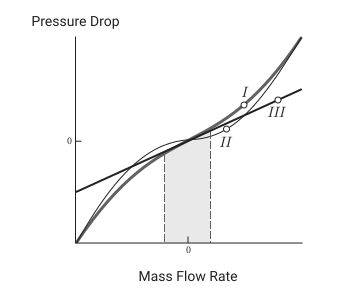
where the pressure drop is positive only if the mass flow rate is also positive. The second modification is designed to eliminate singularities caused by a change in the flow direction, which may pose a problem for numerical solvers during simulation. In this modification, linearization is performed in a small area with almost zero consumption.:
where — the threshold mass flow rate below which the pressure drop is linearized. The figure shows a modified pressure drop depending on the local mass flow (curve ):
-
Higher the pressure drop is approaching the value expressed in the original equation (curve ), and varies depending on . This dependence is approximated to that observed in turbulent flows.
-
Below the pressure drop approaches a straight line with a slope partially dependent on (the curve ), and varies depending on . This dependence is approximated to that observed in laminar flows.
For ease of modeling, the loss factor is it is not required as a block parameter. Instead, it is automatically calculated based on the nominal conditions specified in the block parameters.:
where is the asterisk ( ) indicates the value at the nominal operating mode. All these calculations are based on the assumption that the threshold mass flow rate significantly less than the nominal value . Replacing fractions in the expression for the pressure drop, it gives
or, equivalently:
where — the coefficient of proportionality between the pressure drop on the hydraulic resistance and the local mass flow rate, which is defined as
If we assume that the specific volume — and, consequently, the density — is unchanged, then its nominal and actual values should always be equal. This is true if the nominal value is specified in the block parameter as 0 — a special value used to indicate to the block that the specific volume is constant. Then the ratio of these two values is 1, and the product it boils down to the expression
Ports
Conserving
#
B
—
two-phase liquid inlet or outlet
two-phase liquid
Details
The two-phase liquid port corresponds to the inlet or outlet of the hydraulic resistance.
| Program usage name |
|
#
A
—
two-phase liquid inlet or outlet
two-phase liquid
Details
The two-phase liquid port corresponds to the inlet or outlet of the hydraulic resistance.
| Program usage name |
|
Parameters
Parameters
#
Nominal specific volume —
specific volume at a known operating mode
m^3/kg | cm^3/g | gal/lbm
Details
The specific volume inside the hydraulic resistance at a known operating mode. The unit uses the nominal parameters to calculate the proportionality coefficient between the pressure drop and the mass flow rate. Set this parameter to zero to ignore the dependence of the pressure drop on the specific volume of the liquid.
| Units |
|
| Default value |
|
| Program usage name |
|
| Evaluatable |
Yes |
#
Cross-sectional area at ports A and B —
the cross-sectional area is normal to the flow path at the ports
m^2 | um^2 | mm^2 | cm^2 | km^2 | in^2 | ft^2 | yd^2 | mi^2 | ha | ac
Details
The cross-sectional area is normal to the flow path at ports A and B. It is assumed that this area is the same for the two ports.
| Units |
|
| Default value |
|
| Program usage name |
|
| Evaluatable |
Yes |
#
Nominal pressure drop —
pressure drop at a known operating mode
Pa | uPa | hPa | kPa | MPa | GPa | kgf/m^2 | kgf/cm^2 | kgf/mm^2 | mbar | bar | kbar | atm | ksi | psi | mmHg | inHg
Details
The pressure drop from the inlet to the outlet at a known operating mode. The unit uses nominal parameters to calculate the proportionality coefficient between the pressure drop and the mass flow rate.
| Units |
|
| Default value |
|
| Program usage name |
|
| Evaluatable |
Yes |
# Fraction of nominal mass flow rate for laminar flow — ratio of threshold mass flow to nominal mass flow
Details
The ratio of the threshold mass flow to the nominal mass flow. The unit uses this parameter to calculate the threshold mass flow rate and, ultimately, to set linearization limits for differential pressure.
| Default value |
|
| Program usage name |
|
| Evaluatable |
Yes |
#
Nominal mass flow rate —
mass flow rate at a known operating mode
kg/s | kg/hr | kg/min | g/hr | g/min | g/s | t/hr | lbm/hr | lbm/min | lbm/s
Details
The mass flow rate from the input to the output at a known operating mode. The unit uses nominal parameters to calculate the proportionality coefficient between the pressure drop and the mass flow rate.
| Units |
|
| Default value |
|
| Program usage name |
|
| Evaluatable |
Yes |