Local Restriction (2P)
Local narrowing of the flow in a two-phase liquid network.
blockType: AcausalFoundation.TwoPhaseFluid.Elements.LocalRestriction
|
Local Restriction (2P) Path in the library: |
|
Variable Local Restriction (2P) Path in the library: |


Description
Block Local Restriction (2P) simulates a pressure drop due to a local decrease in the flow section, such as a valve or an opening, in a two-phase liquid network.
Ports A and B represent the input and output of the unit. The input signal on the AR port specifies the cross-sectional area. In addition, you can specify a fixed narrowing area as a block parameter.
The block icon changes depending on the parameter value. Restriction type.
The narrowing of the flow is considered an adiabatic system, that is, it does not exchange heat with the environment.
A local narrowing of the flow consists of a narrowing followed by a sudden expansion of the flow section.
Permanent throttle circuit
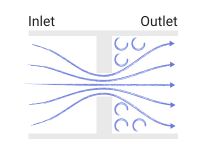
The liquid accelerates as it passes through the constriction, causing a pressure drop. It then separates from the wall during a sudden expansion, as a result of which the pressure is restored only partially due to loss of momentum. This pressure loss model corresponds to the option Control volume the Pressure loss model parameter. It provides higher accuracy, but is less reliable and efficient than the default setting. Bernoulli, which assumes a uniform density of the liquid between the inlet and outlet of the local constriction.
Use the option Bernoulli if:
-
The permanent throttle operates in a fully supercooled liquid mode. The liquid can be considered incompressible, and the assumption of uniform density is acceptable.
-
The permanent throttle is used as an expansion valve in the refrigeration cycle. The liquid at the inlet is a supercooled liquid coming out of the condenser, so the assumption of uniform density is acceptable.
-
The permanent throttle operates in the fully superheated steam mode, but the flow rate is low and subsonic, which is usually the case in East Kazakhstan region systems. In this case, the density also changes slightly, and the assumption of uniform density is acceptable.
For all other situations, you can also use the option Bernoulli in this case, the accuracy of calculations will decrease, but the speed and reliability of the simulation will increase.
Conservation of mass
The mass conservation equation has the form:
where and — mass expenses via ports A and B respectively.
Energy conservation
The energy conservation equation has the form:
where and — energy flow through ports A and B respectively.
Constant throttle variables
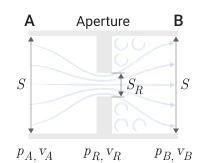
A constant throttle is considered adiabatic, so the change in specific total enthalpy is zero. In port A:
and in port B:
where
-
, and — specific internal energies in port A, in port B and at the diaphragm;
-
, and — pressure in port A, port B and on the diaphragm;
-
, and — specific volumes in port A, port B and on the diaphragm;
-
, and — ideal flow rates at port A, port B and at the diaphragm.
The block calculates the ideal flow rate in port A as
in port B as
and on the narrowing as
where
-
— theoretical mass flow rate through the constriction;
-
— cross-sectional area of ports A and B;
-
— the cross-sectional area of the diaphragm.
The block calculates the theoretical mass flow through the constriction as
where — the flow rate for a constant throttle.
Conservation of momentum using the Bernoulli equation
The mass flow rate from port A to port B is:
where
-
— the threshold pressure drop at which the flow begins to smoothly transition from laminar to turbulent;
-
— the specific volume of the inlet. Which port serves as an inlet and which as an outlet depends on the pressure drop through the constriction. If the pressure in port A is greater than in port B, then port A is the inlet; if the pressure is greater in port B, then port B is the inlet;
-
— pressure loss coefficient.
Pressure loss coefficient is the ratio of the pressure difference between the inlet and outlet to the pressure difference between the inlet and the constriction. This value takes into account the pressure recovery when the flow expands after constriction.:
Conservation of momentum when using the control volume method
The mass flow rate from port A to port B for a turbulent flow is:
where defined as
where is the subscript indicates the input port, and the subscript — output port. Which port serves as an inlet and which as an outlet depends on the pressure drop through the constriction. If the pressure at port A is greater than at port B, then port A is the inlet; if the pressure is greater at port B, then port B is the inlet.
The mass flow rate from port A to port B for laminar flow is:
where — the threshold pressure drop at which the flow begins to smoothly transition from laminar to turbulent:
where — parameter value Laminar flow pressure ratio. The flow is laminar if the pressure drop from port A to port B is less than the threshold value; otherwise, the flow is turbulent.
Pressure in the constriction area it also depends on the flow mode. When the flow is turbulent:
When the flow is laminar:
Ports
Input
#
AR
—
control signal of the cross-sectional area, m^2 ^
scalar
Details
The input port that controls the cross-sectional area of the local narrowing of the flow. If the value on the port is outside the minimum and maximum limits of the local narrowing of the flow, set by the parameters Minimum restriction area and Maximum restriction area, then it is equated to these values.
Dependencies
To use this port, set the parameter Restriction type value Variable.
| Data types |
|
| Complex numbers support |
I don’t |
Conserving
#
B
—
inlet or outlet
two-phase liquid
Details
The port of the two-phase liquid corresponds to the Input or output of the local narrowing of the flow. This unit has no internal orientation.
| Program usage name |
|
#
A
—
inlet or outlet
two-phase liquid
Details
The port of the two-phase liquid corresponds to the Input or output of the local narrowing of the flow. This unit has no internal orientation.
| Program usage name |
|
Parameters
Main
#
Minimum restriction area —
the lower boundary of the area of the passage section of the local narrowing of the flow
m^2 | um^2 | mm^2 | cm^2 | km^2 | in^2 | ft^2 | yd^2 | mi^2 | ha | ac
Details
The lower boundary of the area of the passage section of the local narrowing of the flow. This parameter can be used to represent the leakage area. The input signal AR less than this value is equated to the set area in order to prevent further reduction of the cross-sectional area.
Dependencies
To use this parameter, set for the parameter Restriction type meaning Variable.
| Units |
|
| Default value |
|
| Program usage name |
|
| Evaluatable |
Yes |
# Laminar flow pressure ratio — the pressure ratio at which the flow transitions between laminar and turbulent modes
Details
The ratio of outlet pressure to inlet pressure at which the flow transitions between laminar and turbulent flow modes. The prevailing flow regime determines the equations used in the simulation. If the flow is laminar, then the pressure drop through the constriction is linear with respect to the mass flow rate. If the flow is turbulent, then the pressure drop through the restriction is quadratic with respect to the mass flow rate.
| Default value |
|
| Program usage name |
|
| Evaluatable |
Yes |
#
Maximum restriction area —
the upper boundary of the area of the passage section of the local narrowing of the flow
m^2 | um^2 | mm^2 | cm^2 | km^2 | in^2 | ft^2 | yd^2 | mi^2 | ha | ac
Details
The upper boundary of the area of the passage section of the local narrowing of the flow. The input signal AR greater than this value is equated to the set area in order to prevent further increase in the cross-sectional area.
Dependencies
To use this parameter, set for the parameter Restriction type meaning Variable.
| Units |
|
| Default value |
|
| Program usage name |
|
| Evaluatable |
Yes |
#
Cross-sectional area at ports A and B —
the cross-sectional area is normal to the flow path at the ports
m^2 | um^2 | mm^2 | cm^2 | km^2 | in^2 | ft^2 | yd^2 | mi^2 | ha | ac
Details
The cross-sectional area is normal to the flow path at ports A and B. It is assumed that this area is the same for the two ports.
| Units |
|
| Default value |
|
| Program usage name |
|
| Evaluatable |
Yes |
#
Restriction type —
the possibility of changing the passage section
Fixed | Variable
Details
Select whether the flow section can change during the simulation.:
-
Variable— the input signal on the AR port determines the cross-sectional area, which may change during the simulation. Parameters Minimum restriction area and Maximum restriction area set the lower and upper boundaries of the cross-sectional area; -
Fixed— the cross-sectional area specified by the parameter value Restriction area, remains constant during simulation. At the same time, the AR port is hidden.
| Values |
|
| Default value |
|
| Program usage name |
|
| Evaluatable |
No |
#
Restriction area —
the area of the passage section normal to the flow path in the constriction
m^2 | um^2 | mm^2 | cm^2 | km^2 | in^2 | ft^2 | yd^2 | mi^2 | ha | ac
Details
The area of the passage section is normal to the flow path in the constriction.
Dependencies
To use this parameter, set for the parameter Restriction type meaning Fixed.
| Units |
|
| Default value |
|
| Program usage name |
|
| Evaluatable |
Yes |
# Discharge coefficient — the ratio of the actual mass flow to the theoretical mass flow due to local flow narrowing
Details
The flow coefficient is an empirical parameter commonly used to characterize the flow capacity of an opening. This parameter represents the ratio of the actual mass flow to the theoretical mass flow through the local constriction.
| Default value |
|
| Program usage name |
|
| Evaluatable |
Yes |
#
Pressure Loss Model —
the model of momentum conservation equations
Bernoulli | Control volume
Details
Momentum conservation equations used for calculation:
-
Bernoulli— the block uses the Bernoulli equation, which assumes a uniform density from the input to the output. This option is sometimes less accurate than the model.Control volumebut it is more reliable and provides faster simulation.; -
Control volume— the block uses the control volume method without assuming uniform density. It models the flow from the inlet to the constriction as a compression of the flow, and the flow from the constriction to the outlet as an expansion of the flow.
| Values |
|
| Default value |
|
| Program usage name |
|
| Evaluatable |
No |