Rotational Mechanical Converter (2P)
The interface between the networks of two-phase fluid and rotational mechanics.
blockType: AcausalFoundation.TwoPhaseFluid.Elements.RotationalMechanicalConverter
|
Path in the library: |
Description
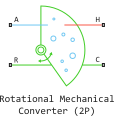
Block Rotational Mechanical Converter (2P) simulates the interface between a two-phase fluid network and a rotational motion mechanics network. The block converts the pressure of a two-phase liquid into a mechanical torque and vice versa.
This unit allows you to simulate a rotary actuator driven by a two-phase fluid. However, it does not take into account inertia, friction, or rigid stops, which are commonly used in rotary actuators. You can simulate these effects separately using blocks. Inertia, Rotational Friction and Rotational Hard Stop.
Port A is an opening through which liquid enters and exits the transducer. Ports C and R represent the housing and shaft of the converter, respectively. The H port is a wall through which the converter exchanges heat with the environment.
Direction of the torque
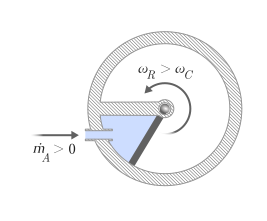
The direction of the torque depends on the mechanical orientation of the transducer. If for the parameter Mechanical orientation the value is set Pressure at A causes positive rotation of R relative to C, then the positive flow rate through the inlet tends to rotate the shaft in a positive direction relative to the transducer housing.
positive direction of rotation
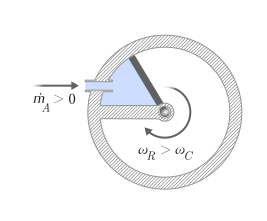
If for the parameter Mechanical orientation the value is set Pressure at A causes negative rotation of R relative to C, then the positive mass flow through the inlet tends to rotate the shaft in a negative direction relative to the converter housing.
The negative direction of rotation
Flow resistance and thermal resistance
The flow resistance between the A port and the internal space of the converter is assumed to be negligible. The pressure loss between them is approximately zero. Therefore, the pressure in port A is equal to the pressure in the converter:
where
-
— pressure in port A;
-
— pressure in the transducer.
Similarly, the thermal resistance between the H port and the interior of the converter is considered negligible. The temperature gradient between them is approximately zero. Therefore, the temperature in port H is equal to the temperature in the converter:
where
-
— port temperature H;
-
— temperature in the converter.
Liquid volume
The volume of liquid in the converter is the sum of the dead volume and the volume of the displaced liquid. Dead volume is the amount of liquid remaining in the converter at zero shaft rotation angle. This volume allows you to simulate the effects of dynamic compressibility and heat capacity, even when the shaft is in the zero position.
The volume of displaced liquid is the amount of liquid added to the converter as a result of shaft rotation. This volume increases as the angle of rotation of the shaft increases. The total volume in the converter, depending on the rotation of the shaft, is
where
-
— the total volume of liquid in the converter;
-
— dead volume of the converter;
-
— the volume of displaced liquid per unit rotation of the shaft;
-
— angle of rotation of the shaft;
-
— the coefficient of mechanical orientation. If for the parameter Mechanical orientation the value is set
Pressure at A causes positive rotation of R relative to CThen . IfPressure at A causes negative rotation of R relative to CThen .
The rotation of the shaft is zero when the volume of the liquid is equal to the dead volume. Then depending on the parameter value Mechanical orientation:
-
If
Pressure at A causes positive rotation of R relative to C, then the angle of rotation of the shaft increases when the volume of the liquid increases compared to the dead volume. -
If
Pressure at A causes negative rotation of R relative to C, then the angle of rotation of the shaft decreases when the volume of the liquid increases compared to the dead volume.
Torque balance
At equilibrium, the internal pressure in the transducer counteracts the external pressure of the environment and the torque acting on the shaft from the mechanical network. This torque is the reverse of the torque that is applied to the fluid network. Thus, the torque balance in the converter is as follows:
where
-
— ambient pressure outside the transducer;
-
— the amount of torque applied from the side of the fluid network to the shaft.
Energy conservation
The total energy in the converter can vary due to the energy flow through the inlet, the heat flow through the wall of the converter and the work performed by the mechanical network. The energy flow, defined by the energy conservation equation, is
where
-
— total energy of the liquid in the converter;
-
— energy flow to the converter via port A;
-
— the heat flow entering the converter through the H port.
If we assume that the kinetic energy of the liquid in the converter is negligible, then the total energy of the liquid decreases to
where
-
— the mass of the liquid in the converter;
-
— the specific internal energy of the liquid in the converter.
Conservation of mass
The mass of the liquid in the converter can change due to the flow through the inlet represented by port A. Thus, the mass flow rate, determined by the equation of conservation of mass, is
where — the mass flow rate of the liquid in the converter through port A.
A change in the mass of the liquid may be accompanied by a change in the volume of the liquid due to the rotation of the shaft. It may also be accompanied by a change in the density of the liquid due to changes in pressure or specific internal energy in the converter. Then the mass flow rate in the converter is
where
-
— partial derivative of density with respect to pressure at constant specific internal energy;
-
— partial derivative of density with respect to specific internal energy at constant pressure;
-
— the specific volume of liquid in the converter.
The partial derivatives of the density vary between regions using a cubic polynomial function. With a degree of dryness in the range 0–0.1 This function ensures a smooth change of derivatives between the regions of the supercooled liquid and the two-phase mixture. With a degree of dryness in the range 0.9–1 it provides a smooth change of derivatives between the regions of the two-phase mixture and superheated steam.
The smoothed partial derivatives of density introduce undesirable numerical errors into the initial equation of conservation of mass. To correct these errors, the block adds a correction term.
where
-
— correction member;
-
— The phase transition time constant is the characteristic duration of the phase transition event. This constant ensures that phase transitions do not occur instantaneously, effectively introducing a time delay whenever they occur.
The final form of the mass conservation equation:
The unit uses this equation to calculate the internal pressure in the transducer, taking into account the mass flow through the inlet.
Assumptions and limitations
-
The walls of the converter are rigid. They do not deform under pressure.
-
The flow resistance between the A port and the internal space of the converter is negligible. The pressure is the same in port A and in the internal space of the transducer.
-
The thermal resistance between the H port and the internal space of the converter is negligible. The temperature in the H port and in the internal space of the converter are the same.
-
The shaft is perfectly sealed. There are no liquid leaks between the shaft and the housing.
-
Mechanical effects such as rigid stops, inertia and friction are not taken into account.
Ports
Conserving
#
C
—
body
rotational mechanics
Details
Mechanical rotary port, corresponds to the converter body.
| Program usage name |
|
#
R
—
shaft
rotational mechanics
Details
Mechanical rotary port, corresponds to the converter shaft.
| Program usage name |
|
#
H
—
thermal port
warm
Details
The thermal port, which is the surface of the converter through which heat exchange takes place.
| Program usage name |
|
#
A
—
two-phase liquid inlet
two-phase liquid
Details
The two-phase liquid port corresponds to the input of the converter.
| Program usage name |
|
Parameters
Main
#
Environment pressure —
pressure outside the transducer
Pa | uPa | hPa | kPa | MPa | GPa | kgf/m^2 | kgf/cm^2 | kgf/mm^2 | mbar | bar | kbar | atm | ksi | psi | mmHg | inHg
Details
Absolute ambient pressure. The ambient pressure counteracts the internal pressure of the transducer and affects the motion of the transducer shaft.
Dependencies
To use this parameter, set for the parameter Environment pressure specification meaning Specified pressure.
| Units |
|
| Default value |
|
| Program usage name |
|
| Evaluatable |
Yes |
#
Mechanical orientation —
orientation of the converter
Pressure at A causes positive rotation of R relative to C | Pressure at A causes negative rotation of R relative to C
Details
Sets the orientation of the movement of the mechanical part in relation to the change in the volume of the liquid:
-
Pressure at A causes positive rotation of R relative to C— an increase in the volume of liquid leads to a positive rotation of port R relative to port C. -
Pressure at A causes negative rotation of R relative to C— an increase in the volume of liquid leads to a negative rotation of port R relative to port C.
| Values |
|
| Default value |
|
| Program usage name |
|
| Evaluatable |
No |
#
Initial interface rotation —
the initial rotation angle of the port R relative to the port C
rad | deg | rev | mrad | arcsec | arcmin | gon
Details
The initial rotation angle of port R relative to port C. Meaning 0 corresponds to the initial volume of the liquid equal to the value of the parameter Dead volume.
-
If Mechanical orientation it matters
Pressure at A causes positive rotation of R relative to C, the parameter value must be greater than or equal to0. -
If Mechanical orientation it matters
Pressure at A causes negative rotation of R relative to C, the parameter value must be less than or equal to0.
| Units |
|
| Default value |
|
| Program usage name |
|
| Evaluatable |
Yes |
#
Cross-sectional area at port A —
the area normal to the flow section at the inlet to the converter
m^2 | um^2 | mm^2 | cm^2 | km^2 | in^2 | ft^2 | yd^2 | mi^2 | ha | ac
Details
The cross-sectional area of the transducer inlet, indicated by port A. Pressure losses caused by a change in the cross-sectional area inside the transducer are ignored.
| Units |
|
| Default value |
|
| Program usage name |
|
| Evaluatable |
Yes |
#
Dead volume —
the volume of liquid at zero angle of rotation of the shaft
m^3 | um^3 | mm^3 | cm^3 | km^3 | ml | l | gal | igal | in^3 | ft^3 | yd^3 | mi^3
Details
The volume of liquid at the angle of rotation of the shaft, equal to 0. The dead volume allows the unit to take into account the accumulation of mass and energy in the converter even at zero angle of rotation of the shaft.
| Units |
|
| Default value |
|
| Program usage name |
|
| Evaluatable |
Yes |
#
Interface volume displacement —
volume of displaced liquid per unit rotation of the shaft
m^3/rad | mm^3/rad | cm^3/rad | km^3/rad | m^3/deg | cm^3/rev | m^3/rev | l/rad | l/rev | in^3/rad | ft^3/rad | gal/rad | igal/rad | in^3/deg | in^3/rev | gal/rev
Details
The volume of displaced liquid per unit rotation of the shaft.
| Units |
|
| Default value |
|
| Program usage name |
|
| Evaluatable |
Yes |
#
Environment pressure specification —
the method of setting the ambient pressure
Atmospheric pressure | Specified pressure
Details
Sets the method for setting the ambient pressure:
-
Atmospheric pressure— atmospheric pressure; -
Specified pressure— the value set by the parameter Environment pressure.
| Values |
|
| Default value |
|
| Program usage name |
|
| Evaluatable |
No |
Effects and Initial Conditions
# Initial vapor void fraction — volume fraction of steam at the beginning of the simulation
Details
The volume fraction of steam in the converter at the beginning of the simulation.
Dependencies
To use this parameter, set for the parameter Initial fluid energy specification meaning Vapor void fraction.
| Default value |
|
| Program usage name |
|
| Evaluatable |
Yes |
#
Initial pressure —
absolute pressure at the beginning of the simulation
Pa | uPa | hPa | kPa | MPa | GPa | kgf/m^2 | kgf/cm^2 | kgf/mm^2 | mbar | bar | kbar | atm | ksi | psi | mmHg | inHg
Details
The pressure of the liquid in the transducer at the beginning of the simulation, set relative to absolute zero.
| Units |
|
| Default value |
|
| Program usage name |
|
| Evaluatable |
Yes |
#
Initial specific enthalpy —
specific enthalpy at the beginning of the simulation
J/kg | kJ/kg | cal/kg | kcal/kg | mm^2/s^2 | cm^2/s^2 | m^2/s^2 | km^2/s^2 | km^2/hr^2 | in^2/s^2 | ft^2/s^2 | ft^2/min^2 | mi^2/s^2 | mi^2/hr^2 | Pa/(kg/m^3) | psi/(lbm/ft^3) | bar/(kg/m^3)
Details
The specific enthalpy of the liquid in the converter at the beginning of the simulation.
Dependencies
To use this parameter, set for the parameter Initial fluid energy specification meaning Specific enthalpy.
| Units |
|
| Default value |
|
| Program usage name |
|
| Evaluatable |
Yes |
#
Phase change time constant —
the characteristic duration of the phase transition event
s | ns | us | ms | min | hr | d
Details
The characteristic time to reach equilibrium during the phase transition in the converter. This constant introduces a time delay in the transition between phases. Increase this parameter to decrease the speed of the phase transition, or decrease it to increase the speed.
| Units |
|
| Default value |
|
| Program usage name |
|
| Evaluatable |
Yes |
#
Initial temperature —
absolute temperature at the beginning of the simulation
K | degC | degF | degR | deltaK | deltadegC | deltadegF | deltadegR
Details
The temperature of the liquid in the converter at the beginning of the simulation, set relative to absolute zero.
Dependencies
To use this parameter, set for the parameter Initial fluid energy specification meaning Temperature.
| Units |
|
| Default value |
|
| Program usage name |
|
| Evaluatable |
Yes |
#
Initial fluid energy specification —
a thermodynamic variable used to determine initial conditions
Temperature | Vapor quality | Vapor void fraction | Specific enthalpy | Specific internal energy
Details
A thermodynamic variable used to determine the initial conditions of a block.
Parameter Value Initial fluid energy specification limits the available initial states for a two-phase liquid. When the value is Initial fluid energy specification set as follows:
-
Temperature— specify the initial state, which is a supercooled liquid or superheated steam. It is not possible to specify a mixture of liquid and steam, since the temperature is constant in the region of the mixture of liquid and steam. -
Vapor quality— specify the initial state, which is a mixture of liquid and steam. You cannot specify a supercooled liquid or superheated steam, since the mass fraction is0and1accordingly, in the entire region. In addition, the unit limits the pressure to a value below the critical pressure. -
Vapor void fraction— specify the initial state, which is a mixture of liquid and steam. You cannot specify a supercooled liquid or superheated steam, since the mass fraction is0and1accordingly, in the entire region. In addition, the unit limits the pressure to a value below the critical pressure. -
Specific enthalpy— specify the specific enthalpy of the liquid. The block does not limit the initial state. -
Specific internal energy— specify the specific internal energy of the liquid. The block does not limit the initial state.
| Values |
|
| Default value |
|
| Program usage name |
|
| Evaluatable |
No |
# Initial vapor quality — mass fraction of steam at the beginning of the simulation
Details
The mass fraction of steam in the converter at the beginning of the simulation.
Dependencies
To use this parameter, set for the parameter Initial fluid energy specification meaning Vapor quality.
| Default value |
|
| Program usage name |
|
| Evaluatable |
Yes |
#
Initial specific internal energy —
specific internal energy at the beginning of the simulation
J/kg | kJ/kg | cal/kg | kcal/kg | mm^2/s^2 | cm^2/s^2 | m^2/s^2 | km^2/s^2 | km^2/hr^2 | in^2/s^2 | ft^2/s^2 | ft^2/min^2 | mi^2/s^2 | mi^2/hr^2 | Pa/(kg/m^3) | psi/(lbm/ft^3) | bar/(kg/m^3)
Details
The specific internal energy of the liquid in the converter at the beginning of the simulation.
Dependencies
To use this parameter, set for the parameter Initial fluid energy specification meaning Specific internal energy.
| Units |
|
| Default value |
|
| Program usage name |
|
| Evaluatable |
Yes |