P-controller AVR
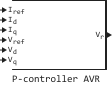
ARV-P excitation regulator.
blockType: SubSystem
|
Path in the library: |
Description
Block P-controller AVR It is an excitation regulator that implements the proportional voltage control law of the generator and provides current compounding of the stator. This type of regulator is usually used to control slow-acting excitation systems (electric and high-frequency).
Block P-controller AVR It can be used as an excitation regulator in a synchronous generator model with a control system, which is shown in the diagram.

Mathematical model P-controller AVR shown in the diagram.

On the presented diagram
-
— time delay constant of the voltage channel;
-
— current channel gain;
-
— voltage channel gain;
-
— output voltage of the automatic excitation regulator;
-
— voltage at the terminals of the generator;
-
— the value of the voltage setpoint;
-
— generator stator current;
-
— the setpoint of the generator stator current.
Ports
Entrance
# Iref is the input value of the generator stator current setpoint
+
scalar
Details
The input value of the generator stator current setpoint in relative units.
| Data types |
|
| Support for complex numbers |
None |
# Vref is the input value of the generator voltage setpoint
+
scalar
Details
The input value of the generator voltage setpoint in relative units.
| Data types |
|
| Support for complex numbers |
None |
# Id is the input value of the generator current along the d axis
+
scalar
Details
The input value of the generator current along the d axis in dq0 coordinates in relative units.
Dependencies
To use this port, check the box Enable d-q voltage and current ports.
| Data types |
|
| Support for complex numbers |
None |
# Iq is the input value of the generator current along the q axis
+
scalar
Details
The input value of the generator current along the q axis in dq0 coordinates in relative units.
Dependencies
To use this port, check the box Enable d-q voltage and current ports.
| Data types |
|
| Support for complex numbers |
None |
# I is the full input value of the generator current
+
scalar
Details
The full input value of the generator current.
Dependencies
To use this port, uncheck the box. Enable d-q voltage and current ports.
| Data types |
|
| Support for complex numbers |
None |
#
Vq is
the input voltage value of the generator along
the q + axis
scalar
Details
The input voltage value of the generator along the q axis in dq0 coordinates in relative units.
Dependencies
To use this port, check the box Enable d-q voltage and current ports.
| Data types |
|
| Support for complex numbers |
None |
# Vd is the input voltage value of the generator along the d axis
+
scalar
Details
The input voltage value of the generator along the d axis in dq0 coordinates in relative units.
Dependencies
To use this port, check the box Enable d-q voltage and current ports.
| Data types |
|
| Support for complex numbers |
None |
# V is the full input voltage of the generator
+
scalar
Details
The full input voltage value of the generator.
Dependencies
To use this port, uncheck the box. Enable d-q voltage and current ports.
| Data types |
|
| Support for complex numbers |
None |
Output
# Vr is the output voltage value of the automatic excitation regulator
+
scalar
Details
The output voltage value of the automatic excitation regulator, in relative units.
| Data types |
|
| Support for complex numbers |
None |
Parameters
Main
# Voltage regulator gain K0v — voltage channel gain
Details
The gain on the voltage channel.
| Default value |
|
| Program usage name |
|
| Evaluatable |
Yes |
# Сurrent regulator gain K0i — current channel gain
Details
The gain on the current channel.
| Default value |
|
| Program usage name |
|
| Evaluatable |
Yes |
# Voltage branch time constant T1, s — the time constant of the voltage channel delay
Details
The time constant of the voltage channel delay, in seconds.
| Default value |
|
| Program usage name |
|
| Evaluatable |
Yes |
# Voltage feedback limits [VFmax VFmin], pu — limits of the output value of the voltage channel
Details
The maximum and minimum output value of the voltage channel in relative units.
| Default value |
|
| Program usage name |
|
| Evaluatable |
Yes |
Voltage And Current Ports
# Enable d-q voltage and current ports — activation of input voltage and current ports of the generator along the d and q axes
Details
If this option is checked, the unit uses the input ports Vd, Vq, Id, Iq. If the checkbox is unchecked, instead of the d- and q-components, the unit uses the ports V and I to transmit the full voltage and current values.
The check box is checked By default.
| Default value |
|
| Program usage name |
|
| Evaluatable |
Yes |
Initial Values
# Initial condition of the regulator voltage, pu — the initial value of the voltage regulator
Details
The initial value of the voltage regulator , in relative units. The initial value is set for the voltage channel and the current channel value is added to it during the simulation.
| Default value |
|
| Program usage name |
|
| Evaluatable |
Yes |