Positive-Sequence (PLL-Driven)
Calculates the component of the direct sequence of a three-phase signal at the fundamental frequency.
blockType: SubSystem
|
Path in the library: |
Description
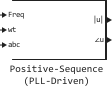
Block Positive-Sequence (PLL-Driven) calculates the component (amplitude and phase) of the direct sequence of the input three-phase signal abc during one cycle of the fundamental frequency specified by the input signal Freq. The angle of the reference frame required for calculations is set by the input signal wt.
A component of the direct sequence of a three-phase signal (voltage or current ) is calculated as follows:
Where
-
— three voltage vectors at the main frequency;
-
— complex operator.
First, Fourier analysis is applied to the three input signals using a sliding window usage covering one cycle of the fundamental frequency (input Freq). The unit calculates the values of the voltage vectors at the fundamental frequency. Then the transformation is applied to obtain a direct sequence.
Since the unit uses a moving average window to perform Fourier analysis, it is necessary to complete one simulation cycle before the output values correspond to the correct amplitude and phase values. For example, the reaction of the block to an abrupt change in the vector It is a single-stroke linearly varying signal. During the first simulation cycle, the output values are kept constant and correspond to the values set by the initial input parameters.
Ports
Input
#
Freq
—
main frequency, Hz
scalar
Details
The fundamental frequency (Hz) required for calculations.
| Data types |
|
| Complex numbers support |
I don’t |
#
wt
—
the angle of the coordinate system, rad
scalar
Details
The angle of the coordinate system (rad) required for calculations.
| Data types |
|
| Complex numbers support |
I don’t |
#
abc
—
input three-phase signal
vector
Details
Input vector signal of three of sinusoidal signals. The input signals can be voltage or current signals.
| Data types |
|
| Complex numbers support |
I don’t |
Output
#
|u|
—
amplitude of the component of the direct sequence
scalar
Details
The amplitude of the component of the direct sequence is in the same units as the input signal.
| Data types |
|
| Complex numbers support |
I don’t |
#
∠u
—
the phase of the component of the direct sequence
scalar
Details
The phase of the component of the direct sequence in degrees relative to the coordinate system wt.
| Data types |
|
| Complex numbers support |
I don’t |
Parameters
Parameters
# Initial frequency, Hz: — initial frequency, Hz
Details
The frequency of the first simulation cycle in Hz.
| Default value |
|
| Program usage name |
|
| Evaluatable |
Yes |
# Minimum frequency, Hz: — minimum frequency, Hz
Details
The minimum frequency value determines the block buffer size. Variable Time Delay, used inside the block to calculate the average value.
| Default value |
|
| Program usage name |
|
| Evaluatable |
Yes |
# Initial input (positive component) [ Mag, Phase-relative-to-PLL (deg) ]: — initial input values of amplitude and phase (for direct sequence)
Details
The initial values of the amplitude and phase of the output signal.
The phase is set in degrees.
| Default value |
|
| Program usage name |
|
| Evaluatable |
Yes |
# Sample time: — sampling period
Details
The sampling period of the block in seconds. Set the value 0 to implement a continuous block.
| Default value |
|
| Program usage name |
|
| Evaluatable |
Yes |