Fault (Three-Phase)
Short circuit: single-, two-, or three-phase, as well as ground fault.
blockType: AcausalElectricPowerSystems.Utilities.ThreePhaseFault
|
Path in the library: |
Description
Block Fault (Three-Phase) simulates any combination of one-, two-, or three-phase short circuit and ground fault.
The unit can cause a short circuit (short circuit) both in time and in event. The unit can trigger one or both types of short circuits sequentially, at the same time, or over an overlapping period of time.
For a time-based short circuit, specify the short circuit activation time using the parameter Fault start time. The short circuit becomes inactive after the specified short circuit duration has expired.
For an event-based short circuit, specify the short circuit activation threshold using the Threshold block parameter. The external control signal F controls the short circuit.
The block can simulate the following combinations:
-
Single-phase short circuit to ground ( - , - or - );
-
Two-phase short circuit ( - , - or - );
-
Two-phase short circuit to ground ( - - , - - or - - );
-
Three-phase short circuit ( - - );
-
Three-phase short circuit to ground ( - - - ).
The figure below shows the equivalent electrical circuit of the unit.
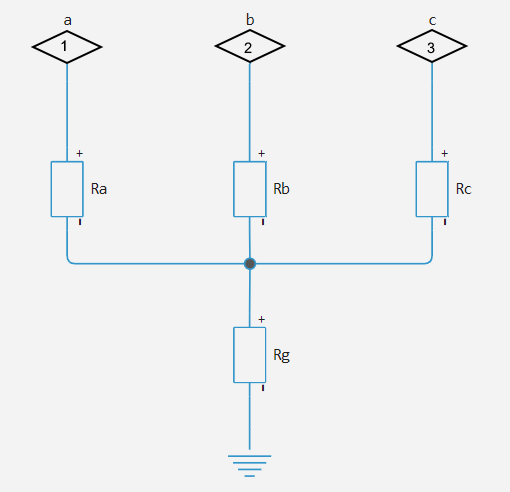
To determine the resistance in an equivalent circuit, use the corresponding equations from the table below.
| Short circuit mode | Value | Value | Value | Value | |
|---|---|---|---|---|---|
No / inactive |
|
|
|
Infinity/Open circuit |
|
Single-phase (to ground) |
- |
|
|
|
|
- |
|
|
|
|
|
- |
|
|
|
|
|
Two-phase |
- |
|
|
|
Infinity/Open circuit |
- |
|
|
|
Infinity/Open circuit |
|
- |
|
|
|
Infinity/Open circuit |
|
Two-phase to ground |
- - |
|
|
|
|
- - |
|
|
|
|
|
- - |
|
|
|
|
|
Three-phase |
- - |
|
|
|
Infinity/Open circuit |
Three-phase to ground |
- - - |
|
|
|
|
In the table:
|
|||||
Ports
Conserving
#
~
—
three-phase port
electricity
Details
Three-phase electrical port for connecting the unit to the circuit.
| Program usage name |
|
Output
#
X
—
short circuit status
scalar
Details
Signal output port for short circuit status message:
-
1— short circuit; -
0— no changes.
Dependencies
To use this port, check the box State port.
| Data types |
|
| Complex numbers support |
No |
Input
#
F
—
external short circuit call
scalar
Details
An external signal to call the short circuit.
Dependencies
To use this port, check the box Enable external fault trigger.
| Data types |
|
| Complex numbers support |
No |
Parameters
Main
# Enable zero crossing — choosing a replacement scheme
Details
This parameter defines the way to turn off the current: instantly (if the checkbox is unchecked) or when passing through zero (if the checkbox is checked).
Select this option to use a replacement circuit in the form of three single-phase switches. Circuit Breaker which can be individually switched on and off to program phase-to-phase circuits, ground circuits, or a combination of phase-to-phase and ground circuits. The process of extinguishing the arc of the block Fault (Three-Phase) the same as for the block Circuit Breaker.
Below is a diagram that illustrates how the block works when the checkbox is Enable zero crossing installed. This circuit is not an equivalent block circuit.
-1-2.png)
| Default value |
|
| Program usage name |
|
| Evaluatable |
No |
#
Failure mode —
type of short circuit
None | Single-phase to ground (a-g) | Single-phase to ground (b-g) | Single-phase to ground (c-g) | Two-phase (a-b) | Two-phase (b-c) | Two-phase (c-a) | Two-phase to ground (a-b-g) | Two-phase to ground (b-c-g) | Two-phase to ground (c-a-g) | Three-phase (a-b-c) | Three-phase to ground (a-b-c-g)
Details
The type of short circuit for modeling. The following options are available:
-
None— KZ is missing; -
Single-phase to ground (a-g); -
Single-phase to ground (b-g); -
Single-phase to ground (c-g); -
Two-phase (a-b); -
Two-phase (b-c); -
Two-phase (c-a); -
Two-phase to ground (a-b-g); -
Two-phase to ground (b-c-g); -
Two-phase to ground (c-a-g); -
Three-phase (a-b-c); -
Three-phase to ground (a-b-c-g).
| Values |
|
| Default value |
|
| Program usage name |
|
| Evaluatable |
No |
#
Faulted phase-neutral resistance —
phase-neutral circuit resistance at short circuit
Ohm | mOhm | kOhm | MOhm | GOhm
Details
The resistance between the phase and the neutral point when the short circuit is active.
Dependencies
To use this parameter, set for the parameter Failure mode one of the values is:
-
Single-phase to ground (a-g); -
Single-phase to ground (b-g); -
Single-phase to ground (c-g); -
Two-phase (a-b); -
Two-phase (b-c); -
Two-phase (c-a); -
Two-phase to ground (a-b-g); -
Two-phase to ground (b-c-g); -
Two-phase to ground (c-a-g); -
Three-phase (a-b-c); -
Three-phase to ground (a-b-c-g).
| Units |
|
| Default value |
|
| Program usage name |
|
| Evaluatable |
Yes |
#
Faulted neutral-ground resistance —
resistance of the neutral-ground circuit at short circuit
Ohm | mOhm | kOhm | MOhm | GOhm
Details
Resistance between the neutral point and the ground when the short circuit is active.
Dependencies
To use this parameter, set for the parameter Failure mode one of the values is:
-
Single-phase to ground (a-g); -
Single-phase to ground (b-g); -
Single-phase to ground (c-g); -
Two-phase to ground (a-b-g); -
Two-phase to ground (b-c-g); -
Two-phase to ground (c-a-g); -
Three-phase to ground (a-b-c-g).
| Units |
|
| Default value |
|
| Program usage name |
|
| Evaluatable |
Yes |
# State port — enable the short circuit status port
Details
Select this option to use the short circuit status port X.
| Default value |
|
| Program usage name |
|
| Evaluatable |
No |
External Trigger
# Enable external fault trigger — short circuit start by external signal
Details
Select this checkbox to enable the start of the short circuit on an external signal F.
| Default value |
|
| Program usage name |
|
| Evaluatable |
No |
# Fault threshold — the threshold value that causes a short circuit
Details
A short circuit occurs when an external signal crosses the threshold value in the direction specified in the short circuit condition (External fault trigger).
Dependencies
To use this option, check the box Enable external fault trigger.
| Default value |
|
| Program usage name |
|
| Evaluatable |
Yes |
#
External fault trigger —
the condition for the short circuit
Faulted if F ≥ Fault threshold | Faulted if F ≤ Fault threshold
Details
Select the condition that causes a short circuit:
-
Faulted if F ≥ Fault threshold— Short circuit occurs when the value of the external signal becomes greater than or equal to the value of the parameter Fault threshold; -
Faulted if F ≤ Fault threshold— Short circuit occurs when the value of the external signal becomes less than or equal to the value of the parameter Fault threshold.
Dependencies
To use this option, check the box Enable external fault trigger.
| Values |
|
| Default value |
|
| Program usage name |
|
| Evaluatable |
No |
# Fault resets when fault trigger reverts — short circuit termination when the trigger signal is restored
Details
Select this checkbox to terminate the short circuit at the moment when the value of the external signal F ceases to satisfy the condition External fault trigger.
Dependencies
To use this option, check the box Enable external fault trigger.
| Default value |
|
| Program usage name |
|
| Evaluatable |
No |
Temporal Trigger
# Enable temporal fault trigger — time limit start-up
Details
Select this option to enable the time limit start.
| Default value |
|
| Program usage name |
|
| Evaluatable |
No |
#
Fault start time —
short circuit start time
s | ns | us | ms | min | hr | d
Details
The simulation time at which the block switches to the short circuit state.
_ Dependencies_
To use this option, check the box Enable temporal fault trigger.
| Units |
|
| Default value |
|
| Program usage name |
|
| Evaluatable |
Yes |
#
Fault duration —
duration of short circuit
s | ns | us | ms | min | hr | d
Details
The time of the simulation duration is short. The unit exits the short circuit state after the set time has elapsed.
Dependencies
To use this option, check the box Enable temporal fault trigger.
| Units |
|
| Default value |
|
| Program usage name |
|
| Evaluatable |
Yes |
Parasitics
#
Unfaulted phase-neutral conductance —
the conductivity between the intact phase and the neutral point
S | nS | uS | mS | 1/Ohm
Details
The conductivity between the intact phase and the neutral point.
| Units |
|
| Default value |
|
| Program usage name |
|
| Evaluatable |
Yes |