Wheel and Axle
Wheel and axle.
blockType: AcausalFoundation.Mechanical.Mechanisms.WheelAndAxle
|
Path in the library: |

Description
Block Wheel and Axle It is a wheel and axle mechanism shown in the following diagram.
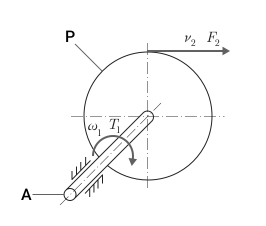
The wheel and the axle are coaxial, and it is assumed that the axle is rigidly connected to the frame, which makes this mechanism an ideal converter of mechanical rotational motion into mechanical translational motion. The mechanism has two connections: a mechanical rotary port A corresponding to the axis, and a mechanical translational port P corresponding to a point on the wheel rim. The mechanism is described by the following equations:
where
-
— the torque on the axis;
-
— force on the wheel rim;
-
— angular velocity of the wheel;
-
— linear speed on the wheel rim;
-
— wheel radius;
-
— orientation of the mechanism. The value is
+1if the rotation of the axis in a globally defined positive direction is transformed into translational motion in the positive direction, and−1if a positive rotation leads to a translational motion in a negative direction.
Use this unit when modeling rack and pinion gears, steering wheels, hoists, winches, etc.
The positive directions of the block are from A to the reference point and from the reference point to P.
Variables
Use the parameter group Initial Targets to set the priority and initial target values for the block parameter variables before modeling. For more information, see Configuring physical blocks using target values.
Ports
Conserving
#
A
—
axis
rotational mechanics
Details
Mechanical rotary port, corresponds to the axis.
| Program usage name |
|
#
P
—
periphery of the wheel
translational mechanics
Details
Mechanical translational port, corresponds to a point on the rim of the wheel.
| Program usage name |
|
Parameters
Parameters
#
Wheel radius —
wheel radius
m | um | mm | cm | km | in | ft | yd | mi | nmi
Details
The radius of the wheel.
| Units |
|
| Default value |
|
| Program usage name |
|
| Evaluatable |
Yes |
#
Mechanism orientation —
the relationship between the rotation of the axis and the direction of translational motion
Drives in positive direction | Drives in negative direction
Details
Meaning Drives in positive direction This means that the rotation of the axis in the globally assigned positive direction is converted into translational motion in the positive direction. Meaning Drives in negative direction This means that the rotation of the axis in the globally assigned positive direction is converted into translational motion in the negative direction.
| Values |
|
| Default value |
|
| Program usage name |
|
| Evaluatable |
No |