Random Integer Generator
Generates integers randomly distributed in the specified range.
blockType: RandomIntegerGenerator
|
Path in the library: |
Description
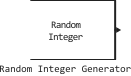
Block Random Integer Generator generates uniformly distributed random integers in the range , where set by the parameter Set size. Use this block to generate random binary or integer data.
Ports
Output
#
OUT_1
—
random integers
scalar | vector | the matrix
Details
Random integer output returned as a scalar, vector, or matrix. This port does not have a name in the block. The data type is set using the parameter Output data type.
The number of lines in the output is equal to the parameter value Samples per frame and it corresponds to the number of samples in one frame. The number of columns in the output is equal to the number of elements in the parameter Set size and it corresponds to the number of channels.
| Data types |
|
| Complex numbers support |
No |
Parameters
Parameters
#
Set size —
set the size
Real number
Details
Size , specified as a positive integer or a vector string of positive integers. The block generates integers in the range . The number of items in Set size corresponds to the number of independent channels output from the block.
-
If Set size if is a scalar, then all output random variables are independent and equally distributed.
-
If Set size if is a vector, then the length of the vector determines the number of output channels. Channels can have different output ranges.
| Default value |
|
| Program usage name |
|
| Tunable |
No |
| Evaluatable |
Yes |
#
Source of initial seed —
source of the initial value
Parameter
Details
The source of the initial value for the random number generator in the form:
-
Parameter— the block sets the initial number of the random number generator in Initial seed.
| Values |
|
| Default value |
|
| Program usage name |
|
| Tunable |
No |
| Evaluatable |
No |
#
Initial seed —
initial value
Real number
Details
The initial value for the random number generator in the form of a non-negative integer. If the parameter Initial seed is a constant, the resulting sequence is repeatable.
Dependencies
To use this parameter, set for the parameter Source of initial seed meaning Parameter.
| Default value |
|
| Program usage name |
|
| Tunable |
No |
| Evaluatable |
Yes |
#
Sample time —
sampling period
SampleTime (real number / vector of two real numbers)
Details
The sampling period, set as a positive number. To inherit the sampling period, set this parameter to −1.
| Default value |
|
| Program usage name |
|
| Tunable |
No |
| Evaluatable |
Yes |
#
Samples per frame —
counts per output frame
Real number
Details
Samples per frame as a positive integer indicating the number of samples per frame in one output channel.
| Default value |
|
| Program usage name |
|
| Tunable |
No |
| Evaluatable |
Yes |
#
Output data type —
type of output data
Int8 | UInt8 | Int16 | UInt16 | Int32 | UInt32 | Int64 | UInt64 | Int128 | UInt128 | Bool
Details
The type of output data.
If this parameter is set to Bool, you must set for the parameter Set size meaning 2.
| Values |
|
| Default value |
|
| Program usage name |
|
| Tunable |
No |
| Evaluatable |
No |
Additional Info
Choosing the time
The time between output updates is equal to the product of the parameter values Samples per frame and Sample time. For example, if Sample time and Samples per frame equal 1 the block outputs counts every second. If you increase Samples per frame before 10, then the block outputs a vector 10×1 each 10 seconds. This ensures that the equivalent output speed is independent of the parameter. Samples per frame.