Marine Propeller
A propeller that converts rotation into a stop motion in a marine environment.
blockType: Engee1DMechanical.Turbomachinery.MarinePropeller
|
Path in the library: |
Description
Block Marine Propeller It is a propeller that converts rotational mechanical motion into thrust for modeling marine vessels. The propeller can be configured with fixed or steerable blades. The propeller can be parameterized using constants, polynomials, or tabular data to characterize thrust and torque coefficients. You can provide tabular data on the speed of the associated flow or tabular data on the angle of entry to parameterize all four working quadrants. Screws that allow a negative pitch of the screw or work in the opposite direction may include curves of the thrust and torque coefficients characteristic of the backward direction, which can also be specified in the block.
The block can also take into account the influence of the tailwind from the hull. If you set a constant coefficient of the associated flow or activate the scalar signal port, the unit will automatically calculate the effect of the associated flow.
A scalar signal can be used to control the pitch of the screw.
The following terminology is useful for understanding the operation of the block:
-
The associated flow coefficient is the difference between the speed of the vessel and the speed of the incoming flow, expressed as a ratio to the speed of the vessel.
-
The velocity of the incoming flow is the velocity of the flow through the propeller, .
-
The relative tread of the screw is the ratio of the flow velocity through the propeller to the angular velocity of its rotation. The block uses this value to determine and when setting for the parameter Parameterization values
Polynomial fitorTabulated data for advance ratio. -
The angle of the tread is the angular position of the operational modes of the propeller on the four—quadrant graph. The block uses this value to determine and when setting for the parameter Parameterization values
Tabulated data for advance ratio. -
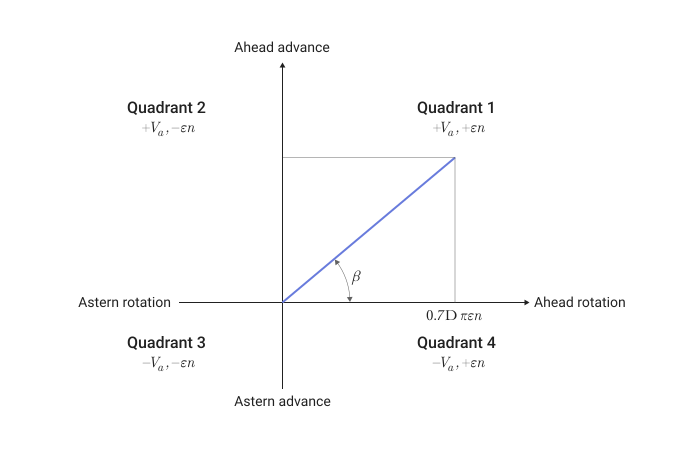
Quadrant is the relative two—dimensional position of the operational mode of the propeller, where the vertical axis is — , and the horizontal — .
-
The screw step is the ideal distance of forward movement of the propeller in one revolution.
-
_ Free water mode_ is a state where there is no influence from the ship’s hull.
The following values are used in the block equations:
-
— propeller stop;
-
— the torque of the propeller;
-
— the density of the liquid; the density of the liquid can be set using the parameter Fluid density or the port r;
-
— screw pitch;
-
— parameter value Propeller diameter;
-
— the angular velocity of the propeller, set via port w;
-
— the angular velocity of the propeller in revolutions per second, which determines the dimensionless representation of the torque and thrust; the expression is specified in the block ;
-
— parameter value Rotational speed threshold;
-
— the thrust coefficient relative to the speed of rotation of the propeller;
-
— the coefficient of torque relative to the speed of rotation of the propeller;
-
— vector or two-dimensional matrix of polynomial coefficients for calculating the thrust coefficient;
-
— vector or two-dimensional matrix of polynomial coefficients for calculating the torque coefficient;
-
— the coefficient of thrust in relation to the relative velocity of the incoming flow;
-
— the coefficient of torque in relation to the relative velocity of the incoming flow;
-
— parameter value Saturation threshold for nondimensional coefficients;
-
— relative tread of the screw;
-
— the incoming flow velocity set through the Va port;
-
— the relative velocity of the incoming flow at a distance of 70% of the blade radius;
-
— efficiency (efficiency);
-
— the thrust coefficient based on the relative velocity of the incoming flow at a distance of 70% of the blade radius;
-
— vector or two-dimensional matrix of support coefficients of the stop;
-
— the torque coefficient based on the relative velocity of the incoming flow at a distance of 70% of the blade radius;
-
— vector or two-dimensional matrix of reference torque coefficients;
-
— the angle of the step;
-
— the vector of the supporting angles of the step.
Parameterizations
The characteristics of the propeller depend on the thrust and torque coefficients. Parameter Parameterization provides various options for managing these coefficients. The output power of a propeller depends on the quadrant in which it operates. The block defines four quadrants as follows:
-
The first quadrant: ;
-
The second quadrant: ;
-
The third quadrant: ;
-
The fourth quadrant: .
The figure shows a visual representation of the quadrants.
If for the parameter Parameterization the value is set Constant coefficients, this allows you to directly set the thrust and torque coefficients. Otherwise, the block calculates these coefficients depending on the parameter value. Parameterization.
The relative tread of the screw
If for the parameter Parameterization the value is set Polynomial fit or Tabulated data for advance ratio, the block uses the relative tread of the screw . The unit uses a numerically smoothed version of the basic thrust and torque equations, so that
The block defines the relative tread of the screw as
where is the threshold value of the angular velocity linearizes the rotation speed of the propeller for smoothing, — parameter value Propeller direction.
If for the parameter Parameterization the value is set:
-
Polynomial fit— values and they change over time in accordance with the values set for the parameters of the coefficients of the polynomial. The block sets the value in the range of0up to the first positive root of the polynomial and limits the values and so that they are always positive. The unit calculates the thrust and torque coefficients as follows:
where and these are the coefficients of the polynomial.
-
Tabulated data for advance ratio— you need to specify tabular values for and for the set values or and depending on the flag state Controlled blade pitch.
The efficiency of a propeller is based on a fundamental ratio
If the check box Efficiency sensor is also set for the parameter Parameterization the value is set Constant coefficients, the block calculates the smoothed efficiency as follows:
If the check box Efficiency sensor is also set for the parameter Parameterization the value is set Polynomial fit or Tabulated data for advance ratio, the block calculates the smoothed efficiency as follows:
The head of the act
If for the parameter Parameterization the value is set Tabulated data for advance angle The block uses the coefficients of thrust and torque, taking into account the relative angle of the tread. The block determines the angle of the step as follows:
where — cyclically variable value. The block defines the thrust and torque coefficients for the relative velocity of the incoming flow as
where — the relative velocity of the incoming flow on the blade profile at a distance of 70% of the blade radius, such that
Rearranging the coefficient equations yields the block equations for thrust and torque as a function of the relative velocity of the incoming flow:
If the check box Controlled blade pitch:
-
Removed, the unit calculates the thrust and torque coefficients as follows:
-
When installed, the unit calculates the thrust and torque coefficients as follows:
The efficiency of a propeller is based on a fundamental ratio
If the check box is Efficiency sensor installed, the unit calculates the smoothed efficiency as follows:
interaction with the environment
If for the parameter Translational connections the value is set Conserving, the block uses a constant coefficient of associated flow to relate the speed of the vessel to the speed of the incoming flow. The vessel’s thrust and speed are set via ports R2 and C2. The block calculates the speed of the associated flow as follows:
where
-
— the speed of the vessel, which can be set relative to the reference through ports R2 and C2, given that ;
-
— parameter value Wake fraction.
If for the parameter Translational connections the value is set Signals, the Va port can be used to provide a signal of the incoming flow velocity in the form of a scalar signal. The unit outputs the screw stop signal in the form of a scalar scalar through the Th port.
_ Adjustable screw pitch_
When the checkbox is selected Controlled blade pitch The propeller can be parameterized in a range of blade mounting angles and diameter., . Meaning it must be specified as a vector in the parameter Pitch-diameter ratio vector, P/D where each element corresponds to a row in the matrices and .
Inertia
Optionally, the inertia of the translational and rotational motion of the propeller can be turned on. To simulate inertia, set the parameters Rotational connections or Translational connections meaning Conserving, and then check the box Model inertia. When the checkbox is selected Model inertia and setting for the parameter Rotational connections values Conserving set the initial rotation speed or shaft torque in the parameter group Initial targets or set an algebraically related variable with a high priority to initialize the inertia of rotation. When the checkbox is selected Model inertia and setting for the parameter Translational connections values Conserving set the initial forward velocity or thrust in the parameter group Initial targets or set an algebraically related variable with a high priority to initialize translational inertia.
|
For non-directional ports with a domain For non-directional ports with a domain |
Assumptions and limitations
-
The block considers the velocity of the liquid and the speed of rotation of the screw as quasi-stationary in time. The liquid flows evenly around the screw.
-
If for the parameter Parameterization the value is set
Polynomial fitThe block assumes that the coefficients of the torque and the screw stop are symmetrical to the first quadrant. -
If for the parameter Parameterization the value is set
Tabulated data for advance ratioThe block assumes that the torque and thrust coefficients are the same in the first and third quadrants, as well as in the second and fourth quadrants. -
If for the parameter Parameterization the value is set
Tabulated data for advance angle, the block removes a sign from . To obtain negative values of thrust and torque, the signs in the values must be taken into account. and .
Variables
Use the parameter group Initial targets to set the priority and initial target values for the block parameter variables before modeling. For more information, see Configuring physical blocks using target values.
Ports
Conserving
#
C2
—
reference flow
translational mechanics
Details
A non-directional port associated with the movement of the current against which the screw rotates.
Dependencies
To use this port, set the parameter Translational connections meaning Conserving.
| Program usage name |
|
#
R1
—
propeller shaft
rotational mechanics
Details
A non-directional port connected to the propeller shaft.
Dependencies
To use this port, set the parameter Rotational connections meaning Conserving.
| Program usage name |
|
#
R2
—
vessel speed and thrust
translational mechanics
Details
A non-directional port related to the ship’s speed and thrust.
Dependencies
To use this port, set the parameter Translational connections meaning Conserving.
| Program usage name |
|
Input
#
w
—
screw rotation speed, rad/s
scalar
Details
The input port of the scalar signal is associated with the rotation speed of the screw, measured in rad/s.
Dependencies
To use this port, set the parameter Rotational connections meaning Signals.
| Data types |
|
| Complex numbers support |
No |
#
PR
—
the ratio of the pitch of the screw to the diameter, dimensionless
scalar
Details
The input port of the scalar signal associated with the pitch of the screw for a given diameter.
Dependencies
To use this port, check the box Controlled blade pitch.
| Data types |
|
| Complex numbers support |
No |
#
ρ
—
variable density, kg/m3
scalar
Details
The input port of the scalar signal is associated with the density of the liquid, measured in kg/m 3.
Dependencies
To use this port, check the box Variable fluid density.
| Data types |
|
| Complex numbers support |
No |
#
Va
—
incoming flow velocity, m/s
scalar
Details
The input port of the scalar signal is associated with the flow velocity passing through the screw, measured in m/s.
Dependencies
To use this port, set the parameter Translational connections meaning Signals.
| Data types |
|
| Complex numbers support |
No |
Output
#
Th
—
screw stop, N
scalar
Details
The output port of the scalar signal connected to the stop created by the screw, measured in Newtons.
Dependencies
To use this port, set the parameter Translational connections meaning Signals.
| Data types |
|
| Complex numbers support |
No |
#
Q
—
the moment of resistance of the propeller blades, NM
scalar
Details
The output port of the scalar signal is connected to the resistance of the propeller blades, measured in Nm.
Dependencies
To use this port, set the parameter Rotational connections meaning Signals.
| Data types |
|
| Complex numbers support |
No |
#
E
—
efficiency, dimensionless
scalar
Details
The output port of the scalar signal is associated with the efficiency of the screw. The efficiency signal is a function of the absolute value of the relative thrust of the screw.
Dependencies
To use this port, check the box Efficiency sensor.
| Data types |
|
| Complex numbers support |
No |
Parameters
Environment and Dynamics
#
Rotational connections —
rotational motion simulation option
Signals | Conserving
Details
A parameter that allows you to simulate the speed of rotation of a propeller and the torque of resistance as input and output scalar signals, respectively, or as rotational connections. This parameter determines the color of the shaft on the block icon, which indicates the domain of the scalar signal.
| Values |
|
| Default value |
|
| Program usage name |
|
| Evaluatable |
No |
# Model inertia — inertia modeling option
Details
Setting this flag allows you to simulate inertia caused by the movement of the rotor. The unit applies rotational inertia at port R1 and translational inertia at port R2.
Dependencies
To use this parameter, set for the parameter Rotational connections or Translational connections meaning Conserving.
| Default value |
|
| Program usage name |
|
| Evaluatable |
No |
#
Translational connections —
translational motion modeling option
Signals | Conserving
Details
A parameter that allows you to simulate the velocity of the incoming flow and the thrust of the propeller as input and output scalar signals, respectively, or as translational connections. This parameter determines the color of the blades on the block icon, which indicates the domain of the scalar signal. When selecting a value Conserving The constant coefficient of the associated flow reduces the speed of the incoming flow relative to the speed of the vessel.
| Values |
|
| Default value |
|
| Program usage name |
|
| Evaluatable |
No |
#
Fluid density —
constant value of liquid density
kg/m^3 | g/m^3 | g/cm^3 | g/mm^3 | lbm/ft^3 | lbm/gal | lbm/in^3
Details
The constant value of the liquid density.
Dependencies
To use this option, uncheck the box. Variable fluid density.
| Units |
|
| Default value |
|
| Program usage name |
|
| Evaluatable |
Yes |
#
Propeller mass —
screw weight
kg | mg | g | t | lbm | oz | slug
Details
The mass of the propeller assembly. The unit applies the inertia of translational motion in port R2.
Dependencies
To use this parameter, set for the parameter Translational connections meaning Conserving and check the box Model inertia.
| Units |
|
| Default value |
|
| Program usage name |
|
| Evaluatable |
Yes |
#
Propeller inertia —
inertia of the screw
kg*m^2 | g*m^2 | kg*cm^2 | g*cm^2 | lbm*in^2 | lbm*ft^2 | slug*in^2 | slug*ft^2
Details
Inertia of the propeller assembly. The unit applies rotational inertia at port R1.
Dependencies
To use this parameter, set for the parameter Rotational connections meaning Conserving and check the box Model inertia.
| Units |
|
| Default value |
|
| Program usage name |
|
| Evaluatable |
Yes |
# Wake fraction — the percentage ratio of the ship’s speed to the speed of the associated flow
Details
Reducing the speed of the vessel relative to the speed of the incoming current. For free water, use the value 0.
Dependencies
To use this parameter, set for the parameter Translational connections meaning Conserving.
| Default value |
|
| Program usage name |
|
| Evaluatable |
Yes |
# Variable fluid density — choosing the density of the liquid
Details
If the check box is unchecked, the density of the liquid is considered constant. If the check box is selected, the density of the liquid is considered variable.
| Default value |
|
| Program usage name |
|
| Evaluatable |
No |
Advanced
#
Check if operating beyond normal propeller operation —
tolerance of working boundaries
None | Error
Details
This parameter allows you to display an error when the screw exceeds the operating parameters. The unit checks whether the screw is working in the first quadrant. If the values are or If they are not positive, the screw generates the thrust and torque coefficients with the corresponding signs and outputs an error if this parameter is adjusted accordingly. When the parameter value is increased Rotational speed threshold the trigger becomes less sensitive.
If for the parameter Parameterization the value is set Polynomial fit, the block outputs an error when the screw exceeds the first positive root of the parameter value .
The block approximates hydrodynamics using symmetric or asymmetric behavior relative to the first quadrant.
Dependencies
To use this parameter, set for the parameter Parameterization meaning Polynomial fit or Tabulated data for advance ratio.
| Values |
|
| Default value |
|
| Program usage name |
|
| Evaluatable |
No |
#
Rotational speed threshold —
the smoothing point of the rotation speed
Hz | kHz | MHz | GHz
Details
Saturation threshold value , after exceeding which the block applies smoothing to the saturation point.
| Units |
|
| Default value |
|
| Program usage name |
|
| Evaluatable |
Yes |
# Efficiency sensor — the option of displaying information about efficiency
Details
By checking this box, you can activate the E port, which outputs a positive efficiency signal.
| Default value |
|
| Program usage name |
|
| Evaluatable |
No |
# Saturation threshold for nondimensional coefficients — smoothing point for dimensionless coefficients
Details
Saturation threshold value in which the block applies smoothing to the dimensionless coefficients.
| Default value |
|
| Program usage name |
|
| Evaluatable |
Yes |
Propeller
# Resistive torque coefficient table, kQ(P/D, J) — tabular values of the torque coefficient for the specified ratio of the pitch of the screw to the diameter and the relative tread of the screw
Details
Tabular values of the torque coefficients depending on the ratio of the pitch of the screw to the diameter and the relative tread of the screw. The columns correspond to the parameter elements Advance ratio vector, J, and the strings correspond to the elements of the parameter Pitch-diameter ratio vector, P/D.
_ Dependencies_
To use this parameter, set for the parameter Parameterization meaning Tabulated data for advance ratio and check the box Controlled blade pitch.
| Default value |
|
| Program usage name |
|
| Evaluatable |
Yes |
# Table of kT polynomial coefficients (P/D, pN...p0) — polynomial coefficients for calculating the thrust coefficient in the case of adjustable pitch screws
Details
A table of vectors of polynomial coefficients for calculating the thrust coefficient for given values .
Dependencies
To use this parameter, set for the parameter Parameterization meaning Tabulated data for advance ratio and check the box Controlled blade pitch.
| Default value |
|
| Program usage name |
|
| Evaluatable |
Yes |
#
Extrapolation method —
a method for processing input values that fall outside the range of the inflection point dataset
Linear | Nearest | Error
Details
A method used to extrapolate inflection points in an interpolation table. This method determines the output value when the input value is outside the range specified in the argument list.
-
Linear— select this value to obtain a curve with continuous first-order derivatives in the extrapolation region and on the boundary with the interpolation region. -
Nearest— Select this value to build an extrapolation that does not go beyond the highest data point and does not fall below the lowest data point. -
Error— select this value to avoid extrapolation if you want your data to be within the range of the table. If the input signal is outside the range of the table, the simulation stops and outputs an error.
Dependencies
To use this parameter, set for the parameter Parameterization meaning Tabulated data for advance ratio or Tabulated data for advance angle.
| Values |
|
| Default value |
|
| Program usage name |
|
| Evaluatable |
No |
# Controlled blade pitch — constant or adjustable screw pitch
Details
The type of blade being modeled. Uncheck the box for the blade with constant pitch or check the box for the blade with adjustable pitch, which is set using the PR port.
Dependencies
To use this parameter, set for the parameter Parameterization meaning Polynomial fit, Tabulated data for advance ratio or Tabulated data for advance angle.
| Default value |
|
| Program usage name |
|
| Evaluatable |
No |
# Table of kQ polynomial coefficients (P/D, pN...p0) — polynomial coefficients for calculating the torque coefficient in the case of adjustable pitch screws
Details
A table of vectors of polynomial coefficients for calculating the torque coefficient for given values .
Dependencies
To use this parameter, set for the parameter Parameterization meaning Tabulated data for advance ratio and check the box Controlled blade pitch.
| Default value |
|
| Program usage name |
|
| Evaluatable |
Yes |
# Thrust coefficient vector, kT(J) — tabular values of the thrust coefficient for a given relative thrust of the screw
Details
Tabular values of the thrust coefficient depending on the relative thrust of the screw.
Dependencies
To use this parameter, set for the parameter Parameterization meaning Tabulated data for advance ratio and uncheck the box Controlled blade pitch.
| Default value |
|
| Program usage name |
|
| Evaluatable |
Yes |
#
Interpolation method —
the method of interpolation between the values of inflection points
Linear | Smooth
Details
The method used to interpolate inflection points in an interpolation table.
-
Linear— select this value for the lowest computational cost. -
Smooth— select this value to obtain a continuous curve with continuous first-order derivatives.
Dependencies
To use this parameter, set for the parameter Parameterization meaning Tabulated data for advance ratio or Tabulated data for advance angle.
| Values |
|
| Default value |
|
| Program usage name |
|
| Evaluatable |
No |
# Thrust coefficient table, kT(P/D, J) — tabular values of the thrust coefficient for the specified ratio of the pitch of the screw to the diameter and the relative tread of the screw
Details
Tabular values of the stop coefficients depending on the ratio of the pitch of the screw to the diameter and the relative tread of the screw. The columns correspond to the parameter elements Advance ratio vector, J, and the strings correspond to the elements of the parameter Pitch-diameter ratio vector, P/D.
_ Dependencies_
To use this parameter, set for the parameter Parameterization meaning Tabulated data for advance ratio and check the box Controlled blade pitch.
| Default value |
|
| Program usage name |
|
| Evaluatable |
Yes |
# kT polynomial coefficients (pN...p0) — polynomial coefficients for calculating the thrust coefficient
Details
A vector of dimensionless polynomial coefficients for calculating the thrust coefficient. Specify the elements in descending order. The block uses these coefficients to create an interpolation table.
Dependencies
To use this parameter, set for the parameter Parameterization meaning Polynomial fit and uncheck the box Controlled blade pitch.
| Default value |
|
| Program usage name |
|
| Evaluatable |
Yes |
# kQ polynomial coefficients (pN...p0) — polynomial coefficients for calculating the torque coefficient
Details
A vector of dimensionless polynomial coefficients for calculating the torque coefficient. Specify the elements in descending order. The block uses these coefficients to create an interpolation table.
Dependencies
To use this parameter, set for the parameter Parameterization meaning Polynomial fit and uncheck the box Controlled blade pitch.
| Default value |
|
| Program usage name |
|
| Evaluatable |
Yes |
# Torque coefficient vector, Cq(β) — tabular torque coefficients for a given tread angle
Details
Tabular torque coefficients depending on the angle of tread. This coefficient depends on the relative velocity of the incoming flow at a distance of 70% of the blade radius. The elements of this vector are correlated one-to-one with the elements of the vector in the parameter Advance angle vector, β.
Dependencies
To use this parameter, set for the parameter Parameterization meaning Tabulated data for advance angle and uncheck the box Controlled blade pitch.
| Default value |
|
| Program usage name |
|
| Evaluatable |
Yes |
# Thrust coefficient vector, Ct(β) — tabular stop coefficients for a given angle of tread
Details
Tabular coefficients of the stop depending on the angle of the step. This coefficient depends on the relative velocity of the incoming flow at a distance of 70% of the blade radius. The elements of this vector are correlated one-to-one with the elements of the vector in the parameter Advance angle vector, β.
Dependencies
To use this parameter, set for the parameter Parameterization meaning Tabulated data for advance angle and uncheck the box Controlled blade pitch.
| Default value |
|
| Program usage name |
|
| Evaluatable |
Yes |
# Resistive torque coefficient vector, kQ(J) — tabular values of the torque coefficient for a given relative thrust of the screw
Details
Tabular values of the torque coefficient depending on the relative thrust of the screw.
Dependencies
To use this parameter, set for the parameter Parameterization meaning Tabulated data for advance ratio and uncheck the box Controlled blade pitch.
| Default value |
|
| Program usage name |
|
| Evaluatable |
Yes |
# Advance ratio vector, J — range of relative steps for tabular thrust and torque coefficients
Details
Tabular values of relative steps. Each element has a corresponding element in the parameters Thrust coefficient vector, kT(J) and Resistive torque coefficient vector, kQ(J) or a column in the parameters Thrust coefficient table, kT(P/D, J) and Resistive torque coefficient table, kQ(P/D, J).
Dependencies
To use this parameter, set for the parameter Parameterization meaning Tabulated data for advance ratio.
| Default value |
|
| Program usage name |
|
| Evaluatable |
Yes |
# Таблица коэффициента упора, Ct(P/D, β) — tabular stop coefficients for the specified ratio of screw pitch to diameter and tread angle
Details
Tabular stop coefficients depending on the ratio of the pitch of the screw to the diameter and the angle of the tread.
Dependencies
To use this parameter, set for the parameter Parameterization meaning Tabulated data for advance angle and check the box Controlled blade pitch.
| Default value |
|
| Program usage name |
|
| Evaluatable |
Yes |
# Pitch-diameter ratio vector, P/D — the values of the ratio of the pitch of the screw to the diameter for the thrust and torque coefficients
Details
The ratio of the pitch of the screw to its diameter. Each element corresponds to a string in the parameters Table of kT polynomial coefficients (P/D, pN…p0) and Table of kQ polynomial coefficients (P/D, pN…p0).
Dependencies
To use this parameter, set for the parameter Parameterization meaning Polynomial fit, Tabulated data for advance ratio or Tabulated data for advance angle and check the box Controlled blade pitch.
| Default value |
|
| Program usage name |
|
| Evaluatable |
Yes |
# Resistive torque coefficient, kQ — torque ratio
Details
The dimensionless coefficient of torque resistance when using constant coefficients.
Dependencies
To use this parameter, set for the parameter Parameterization meaning Constant coefficients.
| Default value |
|
| Program usage name |
|
| Evaluatable |
Yes |
#
Advance angle vector, β —
increasing gait angles
rad | deg | rev | mrad | arcsec | arcmin | gon
Details
Tabular values of gait angles. Use a monotonically increasing vector whose elements are in the range [0, 360] degrees. During the simulation, the angle of the screw can be in the range of [0, 360) degrees, where the block covers the angle from 0 before 360 degrees.
If for the parameter Extrapolation method the value is set Linear or Nearest:
-
If the first element is not equal
0, then the block extrapolates based on the first or two elements when less than the first element. -
If the last element is not equal to
360degrees, then the block extrapolates based on the last or two elements when more than the last element.
Dependencies
To use this parameter, set for the parameter Parameterization meaning Tabulated data for advance angle.
| Units |
|
| Default value |
|
| Program usage name |
|
| Evaluatable |
Yes |
#
Propeller diameter —
screw diameter
m | um | mm | cm | km | in | ft | yd | mi | nmi
Details
The diameter of the screw.
| Units |
|
| Default value |
|
| Program usage name |
|
| Evaluatable |
Yes |
#
Parameterization —
parameterization of the propeller
Constant coefficients | Polynomial fit | Tabulated data for advance ratio | Tabulated data for advance angle
Details
Parameterization of the propeller using constants, polynomials, tabular thrust and torque coefficients. Choose one of the following options:
-
Constant coefficients— the use of constant coefficients of thrust and torque depending on the relative speed of the screw. -
Polynomial fit— the use of polynomial coefficients to parameterize the relative speed of the screw. -
Tabulated data for advance ratio— using tabular data to parameterize the relative speed of the screw. -
Tabulated data for advance angle— the use of thrust and torque coefficients depending on the relative velocity of the incoming flow at a distance of 70% of the blade radius.
For more information, see Parameterizations.
| Values |
|
| Default value |
|
| Program usage name |
|
| Evaluatable |
No |
#
Propeller direction —
the direction of the positive stop
Positive rotational velocity generates positive thrust for positive thrust coefficients | Negative rotational velocity generates positive thrust for positive thrust coefficients
Details
Both negative and positive rotational speeds are a source of positive thrust at positive thrust coefficients.
| Values |
|
| Default value |
|
| Program usage name |
|
| Evaluatable |
No |
# Torque coefficient table, Cq(P/D, β) — tabular torque coefficients for the specified ratio of screw pitch to diameter and tread angle
Details
Tabular torque coefficients depending on the ratio of the pitch of the screw to the diameter and the angle of the tread.
Dependencies
To use this parameter, set for the parameter Parameterization meaning Tabulated data for advance angle and check the box Controlled blade pitch.
| Default value |
|
| Program usage name |
|
| Evaluatable |
Yes |
# Thrust coefficient, kT — thrust ratio
Details
A dimensionless constant stop coefficient when using constant coefficients.
Dependencies
To use this parameter, set for the parameter Parameterization meaning Constant coefficients.
| Default value |
|
| Program usage name |
|
| Evaluatable |
Yes |
Literature
-
Bernitsas, Michael M., D. Ray, P. Kinley. «Kt, Kq and Efficiency Curves for the Wageningen B-Series Propellers.» Report 237. Department of Naval Architecture and Marine Engineering. College of Engineering. University of Michigan, 1981.
-
Carlton, J. S. Marine Propellers and Propulsion. Second edition. Oxford: Elsevier, 2007.