Wind Turbine
A turbine that converts kinetic wind energy into rotational motion.
blockType: Engee1DMechanical.Turbomachinery.WindTurbine
|
Path in the library: |
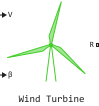
Description
Block Wind Turbine It is a wind turbine that converts wind motion into mechanical rotational energy. Wind turbines use wind energy to produce electricity. The development of wind turbines is aimed at improving the efficiency, reliability and economy of individual turbines, while the development of a wind farm involves the strategic placement of several turbines to optimize energy harvesting. This block can be used to model individual wind turbines and entire wind farms. It is possible to analyze turbine performance, energy generation, and interactions in a wind farm, as well as the impact of various geometries, configurations, control algorithms, and turbine placement plans on wind farm performance and energy generation.
The incoming wind speed and the angle of the blades are set as input data, and additionally, the thrust acting on the turbine can be output. The effects of thrust and inertia can be taken into account. Parameterize the unit using tabular power and thrust coefficients or lift and drag coefficients of the airfoil.
Parameterization by power and thrust coefficients
If for the parameter Parameterization the value is set Tabulated data for power and thrust coefficients, the block calculates the coefficients of wind energy utilization and thrust using tabular data in such a way that
where
-
— the reference angle of the blade installation;
-
— reference speed coefficient;
-
and — parameter values Power coefficient table, Cp(β,λ) and Thrust coefficient table, Ct(β,λ) accordingly;
-
— smoothed speed coefficient.
The block uses the following equation as the basis for determining the speed coefficient
where
-
— parameter value Turbine radius;
-
— the difference in angular velocities between the shaft and the housing;
-
— the speed of the air flow falling on the rotor. This value is a scalar of the input port V.
The block uses the following equation to describe a smoothed version of the velocity coefficient equation
where — parameter value Wind velocity threshold.
The unit uses the following equations as the basis for calculating power and thrust
where
-
— parameter value Air density;
-
— the area of the circle swept by the turbine blades.
To establish a relationship between the parameters of the unit and the nominal mechanical power of the wind turbine, it is necessary to determine the power of the wind turbine at peak power factor and nominal wind speed. The rated power corresponds to the unit parameters calculated by the formula
where
-
— the peak value of the wind energy utilization factor; this is the maximum value of the parameter Power coefficient table, Cp(β,λ);
-
— swept surface area of the rotor;
-
— nominal wind speed. Nominal wind speeds are usually from
10before15m/s. At this wind speed, the designs of wind turbine controllers can change their operating strategy to maintain their rated power.
The unit uses numerically smoothed equations for thrust, power, and torque such that
where — parameter value Rotational velocity threshold. When , the unit smoothly reduces the power to zero.
The block assumes that . The generated power is zero when the rotor rotation speed is zero and the non-zero value is it affects the starting torque. The starting moment is related to so that
Your model may be sensitive to this behavior of the starting torque if you are simulating rotor braking in high winds.
Parameterization by lift and drag coefficients of an aerodynamic profile
If for the parameter Parameterization the value is set Tabulated data for airfoil lift and drag coefficients, it is possible to parameterize the coefficients of lift and drag, as well as the geometry of the aerodynamic profile for a given blade element. The default values correspond to the reference wind turbine NREL 5-MW [3]. The unit treats the propeller as a solid disk. The law of conservation of momentum is applied to the air passing through the disk when the block calculates the induced velocity. . The unit uses the induced velocity to determine the magnitude and direction of the total flow velocity in a vector of radial points along the blade, which are then used to determine lift and drag based on interpolation tables of lift and drag coefficients. These values are specific to this parameterization.:
-
— thrust calculated according to the impulse theory;
-
— axial flow velocity created by the movement of the blades of the wind turbine;
-
— radial velocity at the location of the blade;
-
— axial velocity at the location of the blade;
-
— thrust calculated according to the theory of the blade element;
-
— the torque calculated according to the theory of the blade element;
-
— number of propeller blades;
-
— the dimensionless position of the comet, set by the first element of the parameter Nondimensional radial location vector, r;
-
— the rotation speed of the wind turbine;
-
— the radius of the wind turbine blade;
-
— element-wise coefficients of lifting force and drag , respectively;
-
— the angle of flow at a given point along the blade;
-
— axial induction coefficient;
-
— tangential coefficient of induction;
-
— smoothed speed coefficient in each element of the blade.
The block uses momentum theory to determine the smoothed thrust equation in such a way that
where the block uses the Glauert correction in the turbulent wake mode when So that
The smoothed axial induction coefficient is
The block interpolates values from the parameter Nondimensional radial location vector, r to find . The block then interpolates the lift and drag coefficients to find and based on tabular values of the angle of attack and coefficients of lift and drag. The unit uses the theory of the blade element to calculate thrust and torque in such a way that
where
The unit performs this integration for each discrete element of the blade. The block samples according to the value in the parameter Number of blade elements and calculates the tangential coefficient of induction in each element of the blade as
Ports
Conserving
#
R
—
turbine shaft
rotational mechanics
Details
A non-directional port connected to the shaft of a wind generator.
| Program usage name |
|
Input
#
β
—
blade installation angle, degrees
scalar
Details
The input port associated with the angle of installation of the turbine blades, measured in degrees.
| Data types |
|
| Complex numbers support |
I don’t |
#
V
—
incoming wind speed, m/s
scalar
Details
The input port associated with the speed of the incoming wind, measured in m/s.
| Data types |
|
| Complex numbers support |
I don’t |
Output
#
T
—
thrust, N
scalar
Details
The output port associated with the axial force that the wind applies to the turbine blades, measured in N.
Dependencies
To use this port, check the box Output thrust.
| Data types |
|
| Complex numbers support |
I don’t |
Parameters
Environment and Dynamics
# Output thrust — turbine engine thrust simulation option
Details
By checking this box, you can simulate the thrust forces acting on the turbine. Checking this box activates the T port.
| Default value |
|
| Program usage name |
|
| Evaluatable |
No |
# Model inertia — inertia modeling option
Details
Setting this flag allows you to simulate inertia caused by the movement of the rotor. The block applies inertia at the R port.
| Default value |
|
| Program usage name |
|
| Evaluatable |
No |
#
Rotor inertia —
inertia of the wind turbine rotor
kg*m^2 | g*m^2 | kg*cm^2 | g*cm^2 | lbm*in^2 | lbm*ft^2 | slug*in^2 | slug*ft^2
Details
Inertia of the wind turbine rotor.
Dependencies
To use this option, check the box Model inertia.
| Units |
|
| Default value |
|
| Program usage name |
|
| Evaluatable |
Yes |
#
Air density —
air density
kg/m^3 | g/m^3 | g/cm^3 | g/mm^3 | lbm/ft^3 | lbm/gal | lbm/in^3
Details
Constant air density.
| Units |
|
| Default value |
|
| Program usage name |
|
| Evaluatable |
Yes |
#
Initial rotor rotational velocity —
initial angular velocity of the rotor
rad/s | deg/s | rad/min | deg/min | rpm | rps
Details
The initial rotation speed in the port is R.
Dependencies
To use this option, check the box Model inertia.
| Units |
|
| Default value |
|
| Program usage name |
|
| Evaluatable |
Yes |
Advanced
#
Wind velocity threshold —
threshold value for smoothing wind speed
m/s | mm/s | cm/s | km/s | m/hr | km/hr | in/s | ft/s | mi/s | ft/min | mi/hr | kn
Details
The wind speed at which the block applies smoothing.
| Units |
|
| Default value |
|
| Program usage name |
|
| Evaluatable |
Yes |
#
Rotational velocity threshold —
threshold value for smoothing angular velocity
rad/s | deg/s | rad/min | deg/min | rpm | rps
Details
The rotation speed at which the block applies smoothing. This parameter smooths out the torque and power when the rotation speed approaches 0 or crosses it. As the value of this parameter increases, the block applies more smoothing over wider speed ranges.
| Units |
|
| Default value |
|
| Program usage name |
|
| Evaluatable |
Yes |
Wind Turbine
# Tip speed ratio vector, λ — reference speed coefficient
Details
Reference speed coefficient . — the ratio of the speed of the end of the blade to the speed of the incoming flow. The length of this vector determines the number of columns in the parameters Power coefficient table, Cp(β,λ) and Thrust coefficient table, Ct(β,λ). The block supports negative values . The values must be strictly monotonically increasing.
Dependencies
To use this parameter, set for the parameter Parameterization meaning Tabulated data for power and thrust coefficients.
| Default value |
|
| Program usage name |
|
| Evaluatable |
Yes |
#
Blade twist vector, θ_tw(r) —
turning the blade elements
rad | deg | rev | mrad | arcsec | arcmin | gon
Details
The corners turning the blade for a given radial position. The elements of this vector are correlated one-to-one with the elements of the vector in the parameter Nondimensional radial location vector, r.
Dependencies
To use this parameter, set for the parameter Parameterization meaning Tabulated data for airfoil lift and drag coefficients.
| Units |
|
| Default value |
|
| Program usage name |
|
| Evaluatable |
Yes |
# Power coefficient table, Cp(β,λ) — table of wind energy usage coefficients
Details
Wind energy utilization coefficients for a given installation angle and speed coefficient. Each row corresponds to an element of the vector in the parameter Pitch angle vector, β, and each column corresponds to an element of the vector in the parameter Tip speed ratio vector, λ. The block assumes that .
Dependencies
To use this parameter, set for the parameter Parameterization meaning Tabulated data for power and thrust coefficients.
| Default value |
|
| Program usage name |
|
| Evaluatable |
Yes |
# Number of blade elements — number of blade elements
Details
The number of blade elements per blade.
Dependencies
To use this parameter, set for the parameter Parameterization meaning Tabulated data for airfoil lift and drag coefficients.
| Default value |
|
| Program usage name |
|
| Evaluatable |
Yes |
# Airfoil lift coefficient table, Cl(α,r) — lifting force coefficients of the aerodynamic profile
Details
Coefficients of the lifting force of the profile for a given angle of attack and radial position along the blade. The rows of this matrix correspond one to one to the parameter Airfoil angle of attack vector, α. The columns of this matrix correspond one to one to the parameter Nondimensional radial location vector, r.
Dependencies
To use this parameter, set for the parameter Parameterization meaning Tabulated data for airfoil lift and drag coefficients.
| Default value |
|
| Program usage name |
|
| Evaluatable |
Yes |
#
Airfoil angle of attack vector, α —
Angle of attack
rad | deg | rev | mrad | arcsec | arcmin | gon
Details
Range of angles of attack. The elements of this vector are correlated one-to-one with the rows in the parameters Airfoil lift coefficient table, Cl(α,r) and Airfoil drag coefficient table, Cd(α,r).
Dependencies
To use this parameter, set for the parameter Parameterization meaning Tabulated data for airfoil lift and drag coefficients.
| Units |
|
| Default value |
|
| Program usage name |
|
| Evaluatable |
Yes |
# Number of blades — number of blades
Details
The number of blades of the wind turbine.
Dependencies
To use this parameter, set for the parameter Parameterization meaning Tabulated data for airfoil lift and drag coefficients.
| Default value |
|
| Program usage name |
|
| Evaluatable |
Yes |
# Airfoil drag coefficient table, Cd(α,r) — drag coefficients of the aerodynamic profile
Details
Drag coefficients of the airfoil for a given angle of attack and radial position along the blade. The rows of this matrix correspond one to one to the parameter Airfoil angle of attack vector, α. The columns of this matrix correspond one to one to the parameter Nondimensional radial location vector, r.
Dependencies
To use this parameter, set for the parameter Parameterization meaning Tabulated data for airfoil lift and drag coefficients.
| Default value |
|
| Program usage name |
|
| Evaluatable |
Yes |
# Nondimensional radial location vector, r — radial position
Details
The radial position for a given set of blade sizes. Meaning 1 equivalent to the radius of the blade. The first element of this vector defines — komel.
Dependencies
To use this parameter, set for the parameter Parameterization meaning Tabulated data for airfoil lift and drag coefficients.
| Default value |
|
| Program usage name |
|
| Evaluatable |
Yes |
# Thrust coefficient table, Ct(β,λ) — table of thrust coefficients
Details
Thrust coefficients for a given installation angle and speed coefficient. Each row corresponds to an element of the vector in the parameter Pitch angle vector, β, and each column corresponds to an element of the vector in the parameter Tip speed ratio vector, λ.
Dependencies
To use this parameter, set for the parameter Parameterization meaning Tabulated data for power and thrust coefficients and check the box Output thrust.
| Default value |
|
| Program usage name |
|
| Evaluatable |
Yes |
#
Turbine radius —
blade end radius
m | um | mm | cm | km | in | ft | yd | mi | nmi
Details
The distance from the center of the turbine hub to the ends of the blades.
| Units |
|
| Default value |
|
| Program usage name |
|
| Evaluatable |
Yes |
#
Pitch angle vector, β —
the reference angle of the blade installation
rad | deg | rev | mrad | arcsec | arcmin | gon
Details
The reference angle of the blade installation. The length of this vector determines the number of rows in the parameters Power coefficient table, Cp(β,λ) and Thrust coefficient table, Ct(β,λ).
Dependencies
To use this parameter, set for the parameter Parameterization meaning Tabulated data for power and thrust coefficients.
| Units |
|
| Default value |
|
| Program usage name |
|
| Evaluatable |
Yes |
#
Parameterization —
a variant of wind turbine parameterization
Tabulated data for power and thrust coefficients | Tabulated data for airfoil lift and drag coefficients
Details
The choice of the method of parameterization of the wind turbine: according to the coefficients of thrust and power, or according to the coefficients of lift and drag of the aerodynamic profile.
| Values |
|
| Default value |
|
| Program usage name |
|
| Evaluatable |
No |
# Normalized chord length vector, c(r)/R — length of the chord of the blade element
Details
The length of the chord, normalized to the radius, for a given radial position along the blade. The elements of this vector are correlated one-to-one with the elements of the vector in the parameter Nondimensional radial location vector, r and columns in the parameters Airfoil lift coefficient table, Cl(α,r) and Airfoil drag coefficient table, Cd(α,r).
Dependencies
To use this parameter, set for the parameter Parameterization meaning Tabulated data for airfoil lift and drag coefficients.
| Default value |
|
| Program usage name |
|
| Evaluatable |
Yes |
Literature
-
Buhl Jr., Marshall L. «New Empirical Relationship between Thrust Coefficient and Induction Factor for the Turbulent Windmill State». National Renewable Energy Lab (NREL), Golden, CO (United States), No. NREL/TP-500-36834 (2005).
-
Jain, Palash, Jayant Sirohi, and Christopher Cameron. «Design, Analysis, and Testing of a Passively Deployable Autorotative Decelerator». Journal of Aircraft 59, no. 1 (January 2022): 272–277. https://doi.org/10.2514/1.C036509.
-
Jonkman, Jason. «Definition of a 5-MW Reference Wind Turbine for Offshore System Development». National Renewable Energy Lab (NREL), Golden, CO (United States), No. NREL/TP-500-38060 (2009).
-
Manwell, J. F., J. G. McGowan, and A. L. Rogers. Wind Energy Explained: Theory, Design and Application. 1st ed. Wiley. 2009. https://doi.org/10.1002/9781119994367.