Piston
The piston mechanism of a piston internal combustion engine.
blockType: Engee1DMechanical.Engines.SinglePiston
|
Path in the library: |
Description
Block Piston It is a piston mechanism of a piston internal combustion engine. Block Piston It takes into account the instantaneous torque transmitted to the crankshaft of the engine, which allows you to simulate vibrations in the transmission that occur when the piston rotates. To simulate a multi-piston engine, use the block Piston Engine.
Port B is a translationally moving piston, and port F is a rotating crankshaft. The force acting on the piston is determined by the pressure in the cylinder and the cross-sectional area. The unit receives combustion pressure from an interpolation table parameterized depending on the angle of rotation of the crank and, if necessary, the angular velocity of the crank and the level of opening of the engine throttle.
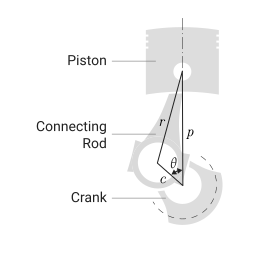
The torque of the crank depends on the force acting on the piston, the angle of rotation of the crank, as well as the length of the crank and connecting rod. In terms of these parameters, the ratio of the torque of the crankshaft to the force acting on the piston is expressed as follows:
Where
-
— the instantaneous force acting on the piston associated with the drive port B;
-
— instantaneous torque of the crank connected to the slave port F;
-
— crank length;
-
— instantaneous crank rotation angle;
-
— connecting rod length.
_ Dimensions of the piston_
The input port T allows you to set the engine throttle level as a fraction of 0 before 1. This fraction corresponds to a percentage of the total power. The unit uses the input port T whenever the pressure interpolation table in the unit parameter window is parameterized only by the angle of rotation of the crank.
Ports
Conserving
#
F
—
the slave port associated with the torque of the crank
rotational mechanics
Details
A non-directional port connecting to the crankshaft of the engine.
| Program usage name |
|
#
B
—
the leading port associated with the force acting on the piston
translational mechanics
Details
A non-directional port connecting to the engine block.
| Program usage name |
|
Output
#
FC
—
fuel consumption, kg/s
scalar
Details
The output port that returns fuel consumption data.
Dependencies
To use this port, set the parameter Fuel consumption model one of the following values:
-
Constant per revolution; -
Fuel consumption by speed and torque; -
Brake specific fuel consumption by speed and torque; -
Brake specific fuel consumption by speed and brake mean effective pressure.
| Data types |
|
| Complex numbers support |
I don’t |
Input
#
T
—
normalized engine throttle opening level, dimensionless
scalar
Details
The input port that determines the position of the engine throttle.
| Data types |
|
| Complex numbers support |
I don’t |
Parameters
Main
#
Offset angle —
the angular deviation between the middle of the engine cycle and the top dead center
rad | deg | rev | mrad | arcsec | arcmin | gon
Details
The point in the engine cycle when the piston reaches the top dead center. The engine’s operating cycle covers a range of angles from before degrees, where — parameter value Number of strokes per cycle.
| Units |
|
| Default value |
|
| Program usage name |
|
| Evaluatable |
Yes |
# Throttle vector — different throttle positions
Details
Different throttle positions corresponding to the pressure in the parameters Pressure matrix (gauge) or Pressure 3D matrix (gauge). The throttle position must remain in the range of [0, 1], where 0 means that the throttle valve is fully closed, and 1 — full throttle opening.
Each element of the parameter Throttle vector respond -the th column of the parameter Pressure matrix (gauge) or each parameter matrix Pressure 3D matrix (gauge).
Dependencies
To use this parameter, set for the parameter Pressure parameterization meaning By crank angle and throttle or By crank angle, throttle and crank velocity.
| Default value |
|
| Program usage name |
|
| Evaluatable |
Yes |
#
Crank angle vector —
different angles of rotation of the piston crank
rad | deg | rev | mrad | arcsec | arcmin | gon
Details
The angle of rotation of the piston crank, starting from the minimum angle or higher and ending with the maximum angle or lower. The minimum or maximum angle can be calculated by multiplying the number of cycles by −90 degrees or 90 degrees, respectively. At least two values must be specified.
Each element of the parameter Crank angle vector corresponds to the parameter element Pressure vector (gauge) or -th line of the parameter Pressure matrix (gauge) or each parameter matrix Pressure 3D matrix (gauge).
| Units |
|
| Default value |
|
| Program usage name |
|
| Evaluatable |
Yes |
#
Bearing viscous friction coefficient —
the ability of the main and connecting rod bearings to dissipate power
N*m*s/rad | mN*m*s/rad | kN*m*s/rad | kgf*m*s/rad | lbf*ft*s/rad
Details
The combined coefficient of viscous friction of the main and connecting rod bearings. The unit uses this parameter to calculate power losses due to viscous friction between the drive and driven shafts.
| Units |
|
| Default value |
|
| Program usage name |
|
| Evaluatable |
Yes |
#
Cylinder bore —
the inner diameter of the piston cylinder wall
m | um | mm | cm | km | in | ft | yd | mi | nmi
Details
The inner diameter of the piston cylinder wall. Block Piston uses this parameter to calculate the torque interpolation table. You must specify a value greater than zero.
| Units |
|
| Default value |
|
| Program usage name |
|
| Evaluatable |
Yes |
#
Pressure vector (gauge) —
parameterized pressure values depending on the angle of rotation of the crank
Pa | uPa | hPa | kPa | MPa | GPa | kgf/m^2 | kgf/cm^2 | kgf/mm^2 | mbar | bar | kbar | atm | ksi | psi | mmHg | inHg
Details
The vector of pressure values corresponding to the different positions of the crank rotation angle.
Dependencies
To use this parameter, set for the parameter Pressure parameterization meaning By crank angle.
| Units |
|
| Default value |
|
| Program usage name |
|
| Evaluatable |
Yes |
#
Pressure 3D matrix (gauge) —
parameterized pressure values depending on the angle of rotation of the crank, throttle position and crank rotation speed
Pa | uPa | hPa | kPa | MPa | GPa | kgf/m^2 | kgf/cm^2 | kgf/mm^2 | mbar | bar | kbar | atm | ksi | psi | mmHg | inHg
Details
A combined matrix of pressure values corresponding to different combinations of crank angle, throttle position, and crank rotation speed.
Parameter Elements Crank angle vector correspond to lines. Parameter Elements Throttle vector correspond to columns. Parameter Elements Crank velocity vector correspond to the matrices that you combine along the dimension .
By default , and .
Dependencies
To use this parameter, set for the parameter Pressure parameterization meaning By crank angle, throttle and crank velocity.
| Units |
|
| Default value |
|
| Program usage name |
|
| Evaluatable |
Yes |
#
Crank velocity vector —
different angular velocities
rad/s | deg/s | rad/min | deg/min | rpm | rps
Details
Different crank rotation speeds corresponding to the pressures in the parameter Pressure 3D matrix (gauge).
Each element of the parameter Crank velocity vector corresponds to one of the -parameter matrices Pressure 3D matrix (gauge).
Dependencies
To use this parameter, set for the parameter Pressure parameterization meaning By crank angle, throttle and crank velocity.
| Units |
|
| Default value |
|
| Program usage name |
|
| Evaluatable |
Yes |
#
Initial crank angle —
the initial position of the crank
rad | deg | rev | mrad | arcsec | arcmin | gon
Details
The angle of rotation of the crank at time zero relative to the position of the upper dead center.
| Units |
|
| Default value |
|
| Program usage name |
|
| Evaluatable |
Yes |
#
Pressure matrix (gauge) —
parameterized pressure values depending on the angle of rotation of the crank and the position of the throttle valve
Pa | uPa | hPa | kPa | MPa | GPa | kgf/m^2 | kgf/cm^2 | kgf/mm^2 | mbar | bar | kbar | atm | ksi | psi | mmHg | inHg
Details
A matrix of pressure values corresponding to different combinations of crank angle and throttle position.
Parameter Elements Crank angle vector correspond to parameter lines Pressure matrix (gauge). Parameter Elements Throttle vector correspond to parameter columns Pressure matrix (gauge).
Dependencies
To use this parameter, set for the parameter Pressure parameterization meaning By crank angle and throttle.
| Units |
|
| Default value |
|
| Program usage name |
|
| Evaluatable |
Yes |
# Number of strokes per cycle — the number of piston strokes required to complete one combustion cycle
Details
The number of piston strokes required for intake, compression, combustion, and exhaust of combustion products. Usually engines are two-stroke or four-stroke. You must use a multiple of two.
| Default value |
|
| Program usage name |
|
| Evaluatable |
Yes |
#
Piston rod length —
connecting rod length between piston and crankshaft
m | um | mm | cm | km | in | ft | yd | mi | nmi
Details
The distance from the center of the piston pin hole to the center of the crankshaft hole in the connecting rod of the piston. The unit uses this parameter to convert the pressure on the piston into torque. You must specify a value greater than zero.
| Units |
|
| Default value |
|
| Program usage name |
|
| Evaluatable |
Yes |
#
Pressure parameterization —
determination of the pressure applied to the piston
By crank angle | By crank angle and throttle | By crank angle, throttle and crank velocity
Details
A group of parameters that the block should use to parameterize pressure data.
| Values |
|
| Default value |
|
| Program usage name |
|
| Evaluatable |
No |
#
Piston stroke —
the length of the translational stroke of the piston
m | um | mm | cm | km | in | ft | yd | mi | nmi
Details
The distance from the fully retracted to the fully extended position of the piston. Block Piston uses this parameter to convert the pressure on the piston into torque values. You must specify a value greater than zero.
| Units |
|
| Default value |
|
| Program usage name |
|
| Evaluatable |
Yes |
Fuel Consumption
#
Fuel consumption per revolution —
fuel consumption per crank revolution
mg/rev | kg/rad
Details
The amount of fuel consumed per revolution of the crankshaft.
Dependencies
To use this parameter, set for the parameter Fuel consumption model meaning Constant per revolution.
| Units |
|
| Default value |
|
| Program usage name |
|
| Evaluatable |
Yes |
#
Brake specific fuel consumption table —
data on specific fuel consumption during braking
s^2/m^2 | s^2/ft^2 | g/(hr*kW)
Details
The matrix of indicators of specific fuel consumption during braking. Specific fuel consumption is the ratio of fuel consumption to power output. Number of rows must be equal to the number of elements in the parameter Speed vector. Number of columns must be equal to the number of elements in the parameter Torque vector.
When selecting a value Brake specific fuel consumption by speed and torque for the parameter Fuel consumption model This parameter is a matrix of indicators of specific fuel consumption during braking, which corresponds to the vectors of engine speed and torque.
When selecting a value Brake specific fuel consumption by speed and brake mean effective pressure for the parameter Fuel consumption model This parameter is a matrix of indicators of specific fuel consumption during braking, which corresponds to the vectors of engine speed and average effective pressure during braking. The number of rows must be equal to the number of elements in the parameter. Speed vector. The number of columns must be equal to the number of items in the parameter. Brake mean effective pressure vector.
Dependencies
To use this parameter, set for the parameter Fuel consumption model meaning Brake specific fuel consumption by speed and torque or Brake specific fuel consumption by speed and brake mean effective pressure.
| Units |
|
| Default value |
|
| Program usage name |
|
| Evaluatable |
Yes |
#
Fuel consumption table —
a matrix of fuel consumption indicators for specified combinations of speed and torque
kg/s | kg/hr | kg/min | g/hr | g/min | g/s | t/hr | lbm/hr | lbm/min | lbm/s
Details
A matrix of fuel consumption values corresponding to the engine speed and torque vectors. Number of rows must be equal to the number of elements in the parameter Speed vector. Number of columns must be equal to the number of elements in the parameter Torque vector.
Dependencies
To use this parameter, set for the parameter Fuel consumption model meaning Fuel consumption by speed and torque or Brake specific fuel consumption by speed and torque.
| Units |
|
| Default value |
|
| Program usage name |
|
| Evaluatable |
Yes |
#
Fuel consumption model —
parameterization of fuel consumption
No fuel consumption | Constant per revolution | Fuel consumption by speed and torque | Brake specific fuel consumption by speed and torque | Brake specific fuel consumption by speed and brake mean effective pressure
Details
The fuel consumption calculation model. The parameterization of the model is compatible with typical industrial data.
If for the parameter Fuel consumption model any value is selected except No fuel consumption, then the FC port and its associated parameters are activated. If the value is set to No fuel consumption, the unit will not calculate fuel consumption. Selecting this value increases the simulation speed.
| Values |
|
| Default value |
|
| Program usage name |
|
| Evaluatable |
No |
#
Speed vector —
angular velocity of the crankshaft
rad/s | deg/s | rad/min | deg/min | rpm | rps
Details
The vector of engine speeds used in the parameterization of the interpolation table. The length of the vector must match the length of the parameter. Torque vector.
Dependencies
To use this parameter, set for the parameter Fuel consumption model one of the following values:
-
Fuel consumption by speed and torque; -
Brake specific fuel consumption by speed and torque; -
Brake specific fuel consumption by speed and brake mean effective pressure.
| Units |
|
| Default value |
|
| Program usage name |
|
| Evaluatable |
Yes |
#
Brake mean effective pressure vector —
the average pressure in the cylinder required to create a given torque
Pa | uPa | hPa | kPa | MPa | GPa | kgf/m^2 | kgf/cm^2 | kgf/mm^2 | mbar | bar | kbar | atm | ksi | psi | mmHg | inHg
Details
The vector of values of the average effective braking pressure. The values of the average effective braking pressure satisfy the expression
where
-
— output torque;
-
— number of cycles per revolution;
-
— the working volume of the cylinder.
Dependencies
To use this parameter, set for the parameter Fuel consumption model meaning Fuel consumption by speed and torque or Brake specific fuel consumption by speed and brake mean effective pressure.
| Units |
|
| Default value |
|
| Program usage name |
|
| Evaluatable |
Yes |
#
Interpolation method —
the dependence of the rotation speed and torque on the values in a given range
Linear | Smooth
Details
An interpolation method for calculating fuel consumption at intermediate values of rotational speed and torque. Fuel consumption remains constant outside the range indicated in the interpolation table.
Dependencies
To use this parameter, set for the parameter Fuel consumption model one of the following values:
-
Fuel consumption by speed and torque; -
Brake specific fuel consumption by speed and torque; -
Brake specific fuel consumption by speed and brake mean effective pressure.
| Values |
|
| Default value |
|
| Program usage name |
|
| Evaluatable |
No |
#
Torque vector —
the torque applied to the set speed
N*m | uN*m | mN*m | kN*m | MN*m | GN*m | kgf*m | lbf*in | lbf*ft
Details
The vector of motor torques used in parameterization of the interpolation table. The length of the vector must match the length of the parameter. Speed vector.
Dependencies
To use this parameter, set for the parameter Fuel consumption model meaning Fuel consumption by speed and torque or Brake specific fuel consumption by speed and torque.
| Units |
|
| Default value |
|
| Program usage name |
|
| Evaluatable |
Yes |