Poppet with No Seat (IL)
Conical disc valve without seat.
blockType: EngeeFluids.IsothermalLiquid.DesignComponents.Poppets.NoSeat
|
Poppet with No Seat (IL) Path in the library: |
|
Poppet with No Seat with Moving Body (IL) Path in the library: |


Description
Block Poppet with No Seat (IL) It is a one-dimensional movement of a conical poppet valve in a cylindrical opening, without a seat.
The resulting force acting on the valve is due to the pressure force and external forces. This force can be adjusted using hydrodynamic force. It is assumed that the angle of inclination of the jet acting on the valve plate is constant (half the angle of the conical valve).
The movement and speed of the rod are transmitted to the RB port.
If the check box is selected Moving body, then the block is implemented Poppet with No Seat with Moving Body (IL) and the body movement is simulated. In this case, the displacement and velocity of the case are transmitted to the CA port.
There are no restrictions on the displacement value in the block, but restrictions can be provided by an attached block using end stops (Translational Hard Stop).
The area of the open opening is a variable related to the movement of the valve plate and the movement of the body, if modeled.
The figure shows a diagram of a conical disc valve without a seat and its main parameters.
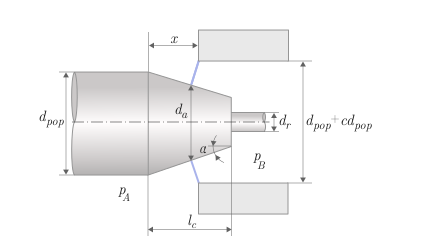
The figure shows:
-
— the diameter of the cylindrical part of the spool, the value of the parameter Poppet diameter;
-
— active diameter of the conical plate;
-
— the diameter of the rod, the value of the parameter Rod diameter (port B);
-
— half of the angle of the conical plate, parameter value Poppet half angle;
-
— the length of the conical plate, the value of the parameter Cone length;
-
— the gap in the diameter of the conical plate, the value of the parameter Clearance on the poppet diameter;
-
— valve lift.
The diameter values should be determined as follows:
The length of the conical plate It should be determined so that the smaller diameter of the cone is larger than the diameter of the stem.:
Half of the angle of the plate cone It is set in the range [0; 90] degrees.
The negative lift flow rate is the leakage flow through the annular flow channel between the plate and its body, determined by the gap in the diameter of the plate .
Please note that with a diametrical gap microns of leakage are considered overestimated.
The equations
If the check box is Moving body removed and the body movement is not simulated, the valve lift is defined as
where
-
— the rise corresponding to the zero offset, the value of the parameter Lift corresponding to zero displacement;
-
— moving the stem in the RA port.
If the check box is Moving body If the valve body is installed and the movement is simulated, then the valve lift is defined as
where — moving the case in port CA.
The diameter of the cylindrical hole is calculated as
The active area of the flow is determined by the curved surface of the truncated cone, as shown in the figure above. It is assumed that this surface divides the area occupied by the liquid into two areas with different pressures.: and . This assumption is justified if the rise small compared to the diameter of the hole . If the rise is large, then it is obvious that at some point the smallest limitation will be the area of the neck.:
The cross-sectional area of the flow never exceeds the area of the neck.
The cross-sectional area of the flow corresponding to the rise , calculated depending on the overlap:
-
For the positive overlap position ( ) the flow is considered a leakage flow, it is assumed that it remains laminar. The flow cross-sectional area is calculated as
Hydraulic diameter calculated as
The active diameter used to calculate the force is determined by the formula
The leakage rate between the poppet valve and the housing is determined by the standard leakage flow equation, discussed in detail in [1]. It can be expressed as follows:
where
-
— pressure difference between ports;
-
— the gap along the radius of the plate ( );
-
— the absolute viscosity of the liquid at an average pressure;
-
— correction term, which ensures continuity of the flow.
-
-
For the negative overlap position ( ) the flow is calculated as the flow through the hole. The flow cross-sectional area is calculated as
Hydraulic diameter calculated as
The active diameter used to calculate the force is determined by the formula
In these formulas — a modified lift that allows you to apply formulas that are valid for a conical poppet valve with a sharp seat edge. It is calculated using the formula
The volume flow through the negative overlap hole is calculated as
where
-
— the average density of the liquid. The average density is calculated at an average pressure ;
-
— expense ratio.
-
The flow rate is calculated as
where
-
— maximum flow rate, parameter value Maximum flow coefficient;
-
— critical flow coefficient, parameter value Critical flow number.
-
— the flow coefficient, calculated as
where — kinematic viscosity.
The average fluid velocity is
If the check box is Moving body removed, the volumes of liquid that are discharged to ports A and B are calculated as
where
-
and — parameter values Volume at port A corresponding to zero lift and Volume at port B corresponding to zero lift accordingly;
-
— the volume of liquid in which the pressure is equal to the pressure , additional to the volume when the valve is closed.
If the check box is Moving body installed, then
If the check box is Moving body if withdrawn, the volume costs in ports B and A are calculated as
where
-
— derivative of the additional volume ;
-
— liquid density at port pressure B, ;
-
— liquid density at port pressure A, ;
-
— the speed of the rod in the port RA.
If the check box Moving body installed, then
where — the speed of the case in the port CA.
The hydrodynamic force is determined by estimating the change in momentum. This force tends to close the valve. For a steady-state fluid flow, the hydrodynamic force is
where — the angle of inclination of the jet, equal to half the angle of the valve cone.
Dependence of the hydrodynamic force from the rise It is defined as follows:
The power in port RA is calculated as
where — the power that enters the RB port.
If the check box is selected Moving body, and the hull movement is modeled, then the force at port CA is calculated as
where — the power that enters the CB port.
Ports
Conserving
#
RB
—
stock
translational mechanics
Details
Mechanical translational port corresponding to the rod.
| Program usage name |
|
#
CA
—
housing
translational mechanics
Details
Mechanical translational port corresponding to the body.
Dependencies
To use this port, check the box Moving body.
| Program usage name |
|
#
B
—
Isothermal liquid port
Isothermal liquid
Details
The isothermal liquid port corresponding to the inlet or outlet.
| Program usage name |
|
#
RA
—
stock
translational mechanics
Details
Mechanical translational port corresponding to the rod.
| Program usage name |
|
#
CB
—
housing
translational mechanics
Details
Mechanical translational port corresponding to the body.
Dependencies
To use this port, check the box Moving body.
| Program usage name |
|
#
A
—
Isothermal liquid port
Isothermal liquid
Details
The isothermal liquid port corresponding to the inlet or outlet.
| Program usage name |
|
Parameters
Parameters
# Moving body — movable housing
Details
Select this option if you are modeling a movable enclosure.
If the flag is unchecked, it is assumed that the body is stationary.
| Default value |
|
| Program usage name |
|
| Evaluatable |
No |
#
Rod diameter (port B) —
stem diameter
m | um | mm | cm | km | in | ft | yd | mi | nmi
Details
Stem diameter .
| Units |
|
| Default value |
|
| Program usage name |
|
| Evaluatable |
Yes |
#
Lift corresponding to zero displacement —
the rise corresponding to the zero offset
m | um | mm | cm | km | in | ft | yd | mi | nmi
Details
The rise corresponding to the zero offset.
| Units |
|
| Default value |
|
| Program usage name |
|
| Evaluatable |
Yes |
#
Opening orientation —
the direction of movement of the spool corresponding to the opening of the hole
Positive relative rod displacement opens orifice | Negative relative rod displacement opens orifice
Details
The direction of movement of the element corresponding to the opening of the hole.
-
Positive orientation
Positive relative rod displacement opens orificeit means that the positive movement of the spool opens the hole. -
The negative direction
Negative relative rod displacement opens orificethis means that the negative movement of the spool opens the hole.
| Values |
|
| Default value |
|
| Program usage name |
|
| Evaluatable |
No |
#
Volume at port A corresponding to zero lift —
the volume in port A corresponding to zero lift
m^3 | um^3 | mm^3 | cm^3 | km^3 | ml | l | gal | igal | in^3 | ft^3 | yd^3 | mi^3
Details
The volume in port A corresponding to zero lift.
| Units |
|
| Default value |
|
| Program usage name |
|
| Evaluatable |
Yes |
#
Poppet diameter —
diameter of the cylindrical part of the spool
m | um | mm | cm | km | in | ft | yd | mi | nmi
Details
Diameter of the cylindrical part of the spool .
| Units |
|
| Default value |
|
| Program usage name |
|
| Evaluatable |
Yes |
#
Cone length —
length of the conical plate
m | um | mm | cm | km | in | ft | yd | mi | nmi
Details
Length of the conical plate .
| Units |
|
| Default value |
|
| Program usage name |
|
| Evaluatable |
Yes |
#
Poppet half angle —
half of the corner of a conical plate
rad | deg | rev | mrad | arcsec | arcmin | gon
Details
Half of the corner of a conical plate .
| Units |
|
| Default value |
|
| Program usage name |
|
| Evaluatable |
Yes |
#
Volume at port B corresponding to zero lift —
the volume in port B corresponding to zero lift
m^3 | um^3 | mm^3 | cm^3 | km^3 | ml | l | gal | igal | in^3 | ft^3 | yd^3 | mi^3
Details
The volume in port B corresponding to zero lift.
| Units |
|
| Default value |
|
| Program usage name |
|
| Evaluatable |
Yes |
#
Clearance on the poppet diameter —
the diameter gap of the conical plate
m | um | mm | cm | km | in | ft | yd | mi | nmi
Details
The diameter gap of the conical plate .
| Units |
|
| Default value |
|
| Program usage name |
|
| Evaluatable |
Yes |
Initial Conditions
#
Initial rod displacement —
initial displacement of the rod
m | um | mm | cm | km | in | ft | yd | mi | nmi
Details
The initial displacement of the rod.
| Units |
|
| Default value |
|
| Program usage name |
|
| Evaluatable |
Yes |
#
Initial case displacement —
initial displacement of the body
m | um | mm | cm | km | in | ft | yd | mi | nmi
Details
The initial displacement of the body.
Dependencies
To use this option, check the box Moving body.
| Units |
|
| Default value |
|
| Program usage name |
|
| Evaluatable |
Yes |
Flow Coefficient Law
# Critical flow number — critical flow coefficient
Details
The critical flow coefficient affects the flow rate/pressure drop characteristics in the orifice. For most applications, this value can be left at the default.
| Default value |
|
| Program usage name |
|
| Evaluatable |
Yes |
# Maximum flow coefficient — maximum flow rate
Details
The maximum flow rate affects the flow rate/pressure drop characteristics in the orifice. For most applications, this value can be left at the default.
| Default value |
|
| Program usage name |
|
| Evaluatable |
Yes |
Jet Force Evaluation
# Jet force coefficient — coefficient of hydrodynamic force
Details
The coefficient of hydrodynamic force, which is at the value 0 (by default) disables the hydrodynamic force, and when set to 1 turns it on. If there is experimental data for this coefficient, then you can adjust the model to fit this data.
| Default value |
|
| Program usage name |
|
| Evaluatable |
Yes |