movmedian
The moving median.
| Library |
|
Syntax
Function call
-
M = movmedian(A,k)— returns local median values bykpoints where each median is calculated in a sliding window of lengthk, which moves through the neighboring elements of the arrayA. Ifkodd, the window is centered relative to the element in the current position. Ifkeven, the window is centered relative to the current and previous elements. The window size is automatically truncated at the endpoints when there are not enough elements to fill it. When the window is truncated, the median is taken only for the elements filling the window.Mhas the same size asA.
-
M = movmedian(___,dim)— defines the dimension of the matrixA, which is used to perform the operation for any of the previous syntax options. For example, ifA— the matrix, thenmovmedian(A,k,2)performs an operation on the columns of the matrixA, calculating the moving median bykelements for each row.
-
M = movmedian(___,Name,Value)— sets additional parameters of the moving median using one or more arguments like «name-value». For example, ifxis a vector of time values, thenmovmedian(A,k,"SamplePoints",x)calculates the moving median relative to the time values inx.
Arguments
Input arguments
# A — input data
+
vector | the matrix | multidimensional array
Details
Input data specified as a vector, matrix, or multidimensional array.
| Data types |
|
# k — window length
+
scalar
Details
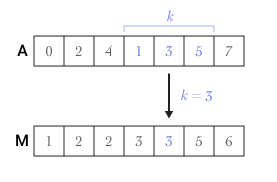
The length of the window, set as a scalar. If k — a positive integer, the centered median includes the element in the current position and its neighbors.
For example, movmedian(A,3) calculates an array of values of the local three-point median.
# [kb kf] is the length of the directional window
+
A two-element vector is a string
Details
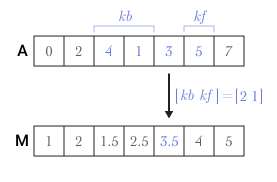
The length of the directional window, set as a string vector containing two elements. If kb and kf — positive integers, the calculation is performed by kb + kf + 1 the elements. The calculation includes an element in the current position, kb elements up to the current position and kf items after the current position.
For example, movmedian(A,[2 1]) calculates an array of values of the local four-point median.
# dim — the dimension along which the operation is performed
+
a positive integer scalar
Details
The dimension along which the operation is performed is specified as a positive integer scalar. If no dimension is specified, the first dimension of the array is used by default, the size of which is not equal to 1.
Argument dim specifies the dimension along which the function is executed movmedian, that is, the direction in which the specified window is moving.
Consider the input matrix A size m on n:
-
movmedian(A,k,1)calculates the moving median bykelements for each columnAand returns a matrix of sizemonn.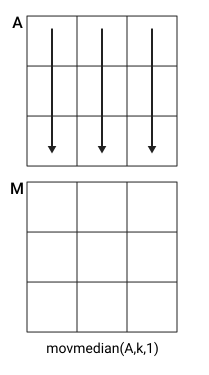
-
movmedian(A,k,2)calculates the moving median bykelements for each row of the matrixAand returns a matrix of sizemonn.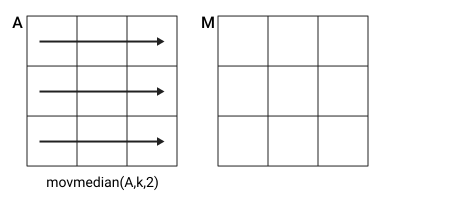
# nanflag — condition for missing value
+
"includemissing" (by default) | "includenan" | "omitmissing" | "omitnan"
Details
The condition for processing a missing value, set by one of the following values:
-
"includemissing"or"includenan"— enable valuesNaNinAwhen calculating each median. If any element is in the window —NaN, then the corresponding element inM—NaN. Values"includemissing"and"includenan"they behave the same way. -
"omitmissing"or"omitnan"— ignore all valuesNaNinAand calculate each median using fewer points. If all the elements are in the window —NaN, then the corresponding element inM—NaN. Values"omitmissing"and"omitnan"they behave the same way.
Input arguments «name-value»
Specify optional argument pairs in the format Name, Value, where Name — the name of the argument, and Value — the appropriate value. Type arguments «name-value» they should be placed after the other arguments, but the order of the pairs does not matter.
Use commas to separate the name and value, and Name put it in quotation marks.
Example: M = movmedian(A,k,"Endpoints","fill").
# Endpoints — a method for processing windows near endpoints
+
"shrink" (by default) | "discard" | "fill" | scalar
Details
The method of processing windows near endpoints, specified by one of the following options:
| Meaning | Description |
|---|---|
|
Reduce the window size near the endpoints of the input data to include only existing elements. |
|
Do not display any median values if the window does not completely overlap existing elements. |
|
Replace non-existent elements with |
|
Replace non-existent elements with the specified numeric or logical value. |
# SamplePoints — sampling points for calculating medians
+
vector
Details
Sample points for calculating medians, set as a vector. The sample points represent the location of the data in A. The sample points do not have to be evenly distributed. By default, the vector of sample points is [1 2 3 … ].
Sliding windows are defined relative to the sampling points, which should be sorted and contain unique elements. For example, if t is the time vector corresponding to the input data, then movmedian(rand(1,10),3,"SamplePoints",t) it has a window representing the time interval between t[i]-1.5 and t[i]+1.5.
If the sampling points are not evenly spaced and the parameter is set Endpoints, then its value should be "shrink".
Output arguments
# M — output data
+
vector | the matrix | multidimensional array
Details
The output data returned as a vector, matrix, or multidimensional array.
Examples
Centered moving median of the vector
Details
Calculate the three-point centered moving median of the row vector. If there are less than three elements in the window at the ends of the array, calculate the average value for the available elements.
import EngeeDSP.Functions: movmedian

A = [4 8 6 -1 -2 -3 -1 3 4 5]
M = movmedian(A,3)
1×10 Matrix{Float64}:
6.0 6.0 6.0 -1.0 -2.0 -2.0 -1.0 3.0 4.0 4.5The moving median of the vector
Details
Calculate the three-point moving median of the row vector. If there are less than three elements in the window at the endpoints, let’s take the average of the available elements.
import EngeeDSP.Functions: movmedian

A = [4 8 6 -1 -2 -3 -1 3 4 5]
M = movmedian(A, [2 1])
1×10 Matrix{Float64}:
6.0 6.0 5.0 2.5 -1.5 -1.5 -1.5 1.0 3.5 4.0The moving median of the matrix
Details
Calculate the three-point centered moving median for each row of the matrix. The window starts from the first line, slides horizontally to the end of the line, then moves to the second line, and so on. The dimension argument is two, which allows you to slide through the columns of the matrix A.
A = [4 8 6; -1 -2 -3; -1 3 4]3×3 Matrix{Int64}:
4 8 6
-1 -2 -3
-1 3 4import EngeeDSP.Functions: movmedian
M = movmedian(A,3,2)3×3 Matrix{Float64}:
6.0 6.0 7.0
-1.5 -2.0 -2.5
1.0 3.0 3.5Moving median without missing values
Details
Creating a vector string containing the values NaN.
A = [4 8 NaN -1 -2 -3 NaN 3 4 5];Calculate the three-point centered moving median of the vector, excluding the values NaN. For windows containing any value NaN, function movmedian calculates the value taking into account all the elements except NaN.
import EngeeDSP.Functions: movmedian

M = movmedian(A,3,"omitnan")
1×10 Matrix{Float64}:
6.0 6.0 3.5 -1.5 -2.0 -2.5 0.0 3.5 4.0 4.5Return only the medians of the full window
Details
Calculate the three-point centered moving median of the row vector, but discard all calculations using less than three points from the output data. In other words, we will return only the medians calculated for the full three-element window, discarding calculations at the endpoints.
import EngeeDSP.Functions: movmedian

A = [4 8 6 -1 -2 -3 -1 3 4 5];
M = movmedian(A,3,"Endpoints","discard")
1×8 Matrix{Float64}:
6.0 6.0 -1.0 -2.0 -2.0 -1.0 3.0 4.0