Transfer Fcn (with initial outputs)
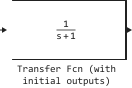
A model of a linear system in the form of a transfer function, taking into account the initial conditions.
blockType: SubSystem
|
Path in the library: |
Description
Block Transfer Fcn (with initial outputs) simulates a linear system using a transfer function of a variable in the form of Laplace images. The unit can simulate systems with one input and one output (SISO) or with one input and several outputs (SIMO).
The block icon displays the transfer function set by the parameters Numerator and Denominator. If the size of the block icon does not fit the entire expression, it is displayed .
Conditions for using the block
Block Transfer Fcn (with initial outputs) assumes that the following conditions are met:
-
The transfer function has the form:
where
-
and — input and output signals, respectively;
-
and — the number of coefficients in the numerator and denominator , respectively;
-
and — coefficients of the numerator and denominator in descending order of degree .
-
-
The order of the denominator must be greater than or equal to the order of the numerator.
-
For a system with multiple outputs, all transfer functions have the same denominator, and all numerators have the same order.
Simulation of a single-output system
For a single-output system, the input and output of the block are scalar signals in the time domain. To model this system:
-
Enter the vector of coefficients of the numerator of the transfer function in the field Numerator.
-
Enter the vector of coefficients of the denominator of the transfer function in the field Denominator.
Simulation of a system with multiple outputs
For a system with multiple outputs, the input of a block is a scalar, and the output is a vector, where each element is the output of the system. To model this system:
-
Enter the matrix in the field Numerator.
Each row of this matrix contains the coefficients of the numerator of the transfer function, which defines one of the outputs of the block.
-
Enter the vector of denominator coefficients common to all transfer functions of the system in the field Denominator.
Setting the initial conditions
The transfer function describes the relationship between input and output in the Laplace (frequency) domain. In particular, it is defined as the Laplace transform of the response (output signal) of a system with zero initial conditions to a pulsed input signal.
Operations such as multiplication and division of transfer functions depend on the zero initial state. For example, you can decompose one complex transfer function into a number of simpler ones and apply them sequentially to get a response equivalent to the response of the original transfer function. This rule is not fulfilled if one of these transfer functions has a non-zero initial state. In addition, the transfer function has infinitely many realizations in the time domain, most of which have no physical meaning.
Block Transfer Fcn (with initial outputs) implemented as a mask containing a block inside the mask State-Space. This allows you to set non-zero initial conditions through the parameters Initial output and Initial input. Thus, if it is necessary to take into account a non—zero initial state, it is not necessary to manually reduce the transfer function to a canonical form in the state space - it is enough to set the appropriate values of the initial conditions in the block parameters.
Parameters
Parameters
# Numerator — array of numerator coefficients
Details
Coefficients of the numerator of the transfer function.
-
For a single-output system, enter the vector of coefficients of the numerator of the transfer function.
-
For a system with multiple outputs, enter the matrix. Each row of this matrix contains the coefficients of the numerator of the transfer function, which determines one of the outputs of the block.
| Default value |
|
| Program usage name |
|
| Tunable |
No |
| Evaluatable |
Yes |
# Denominator — array of denominator coefficients
Details
Coefficients of the denominator of the transfer function.
-
For a single-output system, enter the vector of coefficients of the denominator of the transfer function.
-
For a system with multiple outputs, enter a vector containing the denominator coefficients common to all transfer functions of the system.
| Default value |
|
| Program usage name |
|
| Tunable |
No |
| Evaluatable |
Yes |
# Initial output — a scalar or an array of initial output values
Details
The initial output values of the transfer function.
| Default value |
|
| Program usage name |
|
| Tunable |
No |
| Evaluatable |
Yes |
# Initial input — a scalar or an array of initial input values
Details
The initial input values of the transfer function.
| Default value |
|
| Program usage name |
|
| Tunable |
No |
| Evaluatable |
Yes |