Half-Bridge Driver
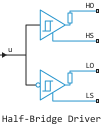
Behavioral model of the integrated circuit of a half-bridge driver.
blockType: AcausalElectricPowerSystems.Semiconductors.HalfBridgeDriver
|
Path in the library: |
Description
Block Half-Bridge Driver It is an abstract representation of an integrated circuit for controlling MOSFET and IGBT half bridges. This block simulates input hysteresis, signal propagation delay, and on/off dynamics. If the gate driver circuit is not explicitly modeled, always use this block or block Gate Driver to set the gate-source voltage on the MOSFET unit or the gate-emitter voltage on the IGBT unit. Do not connect the controlled voltage source directly to the gate of the semiconductor, as this eliminates the output impedance of the gate driver, which determines the switching dynamics.
You can simulate the electrical or scalar input ports of the signals by setting the parameter Input port one of the following values:
-
Signal— The output status of the driver is controlled by the input signal u. Use this simulation option if all the functions of your controller, including PWM generation, are defined by blocks. Engee. This simulation option is used by default.; -
Electrical— The driver output status is controlled by two electrical ports: PWM and REF. Use this option if your model has analog components, for example, Controlled PWM Voltage.
The first pair of electrical output ports, HO and HS, work similarly to ports G and S of the unit Gate Driver. Connect these ports to the MOSFET or IGBT of the upper level of the half-bridge. The second pair of ports, LO and LS, are connected to the MOSFET or IGBT of the lower half-bridge level. They work similarly, except that their logic is inverted relative to the top-level logic.
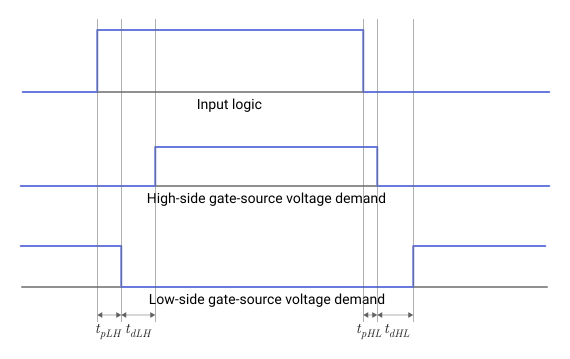
The diagram shows the time characteristics of the half-bridge driver, where
-
— delay in signal propagation over the lower level when the input control signal changes from
0on1; -
— the delay time at the upper level when the input control signal changes from
0on1; -
— delay in signal propagation over the upper level when the input control signal changes from
1on0; -
— the delay time at the lower level when changing the input control signal from
1on0.
Ports
Conserving
#
LO
—
output of the lower switch gate
electricity
Details
A non-directional port connected to the gate of the lower half-bridge switch. Connect this port to the gate of the MOSFET or IGBT unit.
| Program usage name |
|
#
REF
—
floating zero reference port
electricity
Details
A non-directional port associated with a floating zero reference signal.
Dependencies
To use this port, set the parameter Input port meaning Electrical.
| Program usage name |
|
#
LS
—
output of the source or emitter of the lower switch
electricity
Details
A non-directional port connected to the source or emitter of the lower half-bridge switch. Connect this port to the source of the MOSFET unit or the emitter of the IGBT unit.
| Program usage name |
|
#
HS
—
output of the source or emitter of the upper switchboard
electricity
Details
A non-directional port connected to the source or emitter of the upper half-bridge switch. Connect this port to the source of the MOSFET unit or the emitter of the IGBT unit.
| Program usage name |
|
#
PWM
—
pulse width modulation port
electricity
Details
The non-directional port to which the pulse width modulation signal is applied.
Dependencies
To use this port, set the parameter Input port meaning Electrical.
| Program usage name |
|
#
HO
—
upper switch gate output
electricity
Details
A non-directional port connected to the gate of the upper half-bridge switch. Connect this port to the gate of the MOSFET or IGBT unit.
| Program usage name |
|
Input
#
u
—
control signal, dimensionless
scalar
Details
An input signal specifying an input reference value.
Dependencies
To use this port, set the parameter Input port meaning Signal.
| Data types |
|
| Complex numbers support |
No |
Parameters
Input Logic
#
Logic 0 input value —
the value of the signal for the logic layer 0
Details
The value of the input signal corresponding to the logic level 0.
Dependencies
To use this parameter, set for the parameter Input port meaning Signal.
| Default value |
|
| Program usage name |
|
| Evaluatable |
Yes |
#
Input port —
option to specify the type of control port
Signal | Electrical
Details
Option to specify the control port:
-
Signal— The unit uses a directional input port to control the output status of the driver; -
Electrical— The unit uses two non-directional electrical ports to control the output status of the driver.
| Values |
|
| Default value |
|
| Program usage name |
|
| Evaluatable |
No |
#
Logic 1 input voltage —
the voltage value for the logic level 1
V | uV | mV | kV | MV
Details
The value of the input voltage corresponding to the logic level 1.
Dependencies
To use this parameter, set for the parameter Input port meaning Electrical.
| Units |
|
| Default value |
|
| Program usage name |
|
| Evaluatable |
Yes |
#
Logic 1 input value —
the value of the signal for the logic layer 1
Details
The value of the input signal corresponding to the logic level 1.
Dependencies
To use this parameter, set for the parameter Input port meaning Signal.
| Default value |
|
| Program usage name |
|
| Evaluatable |
Yes |
#
Logic 0 input voltage —
the voltage value for the logic level 0
V | uV | mV | kV | MV
Details
The value of the input voltage corresponding to the logic level 0.
Dependencies
To use this parameter, set for the parameter Input port meaning Electrical.
| Units |
|
| Default value |
|
| Program usage name |
|
| Evaluatable |
Yes |
Dynamics
#
Off-state gate drive resistance —
resistance to shutter control in the off state
Ohm | mOhm | kOhm | MOhm | GOhm
Details
The resistance of the gate control in the driver’s off state.
Dependencies
To use this parameter, set for the parameter Parameterization meaning Output impedance.
| Units |
|
| Default value |
|
| Program usage name |
|
| Evaluatable |
Yes |
#
Fall time —
driver down time
s | ns | us | ms | min | hr | d
Details
The time of the driver’s decline from 90% up to 10%.
Dependencies
To use this parameter, set for the parameter Parameterization meaning Rise and fall times.
| Units |
|
| Default value |
|
| Program usage name |
|
| Evaluatable |
Yes |
#
On-state gate drive resistance —
required gate control resistance when switched on
Ohm | mOhm | kOhm | MOhm | GOhm
Details
Required gate control resistance when the driver is switched on.
Dependencies
To use this parameter, set for the parameter Parameterization meaning Output impedance.
| Units |
|
| Default value |
|
| Program usage name |
|
| Evaluatable |
Yes |
#
Rise time —
driver rise time
s | ns | us | ms | min | hr | d
Details
Driver rise time from 10% up to 90%.
Dependencies
To use this parameter, set for the parameter Parameterization meaning Rise and fall times.
| Units |
|
| Default value |
|
| Program usage name |
|
| Evaluatable |
Yes |
#
Load capacitance for rise and fall times —
driver load capacity
F | pF | nF | uF | mF
Details
The load capacity of the driver.
Dependencies
To use this parameter, set for the parameter Parameterization meaning Rise and fall times.
| Units |
|
| Default value |
|
| Program usage name |
|
| Evaluatable |
Yes |
#
Parameterization —
choosing the driver parameterization
Output impedance | Rise and fall times
Details
Select the type of driver parameterization:
-
Output impedance— specify the gate driver resistances in the on and off states; -
Rise and fall times— specify the rise time, fall time and load capacity.
| Values |
|
| Default value |
|
| Program usage name |
|
| Evaluatable |
No |
Outputs
#
On-state gate-source voltage —
required output voltage when switched on
V | uV | mV | kV | MV
Details
The required output voltage when the driver is switched on.
| Units |
|
| Default value |
|
| Program usage name |
|
| Evaluatable |
Yes |
#
Off-state gate-source voltage —
required output voltage in the off state
V | uV | mV | kV | MV
Details
The required output voltage in the off state of the driver.
| Units |
|
| Default value |
|
| Program usage name |
|
| Evaluatable |
Yes |
Timing
#
Low-side propagation delay (logic 0->logic 1) —
on the time chart
s | ns | us | ms | min | hr | d
Details
Delay of signal propagation at the lower level when the input control signal changes from 0 on 1.
| Units |
|
| Default value |
|
| Program usage name |
|
| Evaluatable |
Yes |
#
High-side propagation delay (logic 1->logic 0) —
on the time chart
s | ns | us | ms | min | hr | d
Details
Delay of signal propagation along the upper level when the input control signal changes from 1 on 0.
| Units |
|
| Default value |
|
| Program usage name |
|
| Evaluatable |
Yes |
#
Low-side dead time (logic 1->logic 0) —
on the time chart
s | ns | us | ms | min | hr | d
Details
The delay time at the lower level when changing the input control signal from 1 on 0.
| Units |
|
| Default value |
|
| Program usage name |
|
| Evaluatable |
Yes |
#
High-side dead time (logic 0->logic 1) —
on the time chart
s | ns | us | ms | min | hr | d
Details
Upper-level delay time when the input control signal changes from 0 on 1.
| Units |
|
| Default value |
|
| Program usage name |
|
| Evaluatable |
Yes |