Half-Bridge (Ideal, Switching)
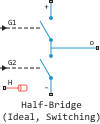
A half-bridge with perfect switches and a thermal port.
blockType: AcausalElectricPowerSystems.Semiconductors.HalfBridge
|
Path in the library: |
Description
Block Half-Bridge (Ideal, Switching) simulates a half-bridge with perfect switches and a thermal port. To select the ideal switching device, set the parameter Switching device meaning MOSFET, IGBT or GTO.
A built-in protective diode can be installed for each switching device. The built-in diode protects the semiconductor device by providing a reverse current transmission channel. An inductive load can cause a high reverse voltage surge when a semiconductor device suddenly cuts off the voltage supply to the load.
| The best option is to simulate the diodes inside the unit. Half-Bridge (Ideal, Switching). For external modeling of diodes, model them without taking into account capacity or charge. |
Switching losses
For information on how the block simulates power-on and power-off losses, see the description of the blocks. MOSFET (Ideal, Switching), IGBT (Ideal, Switching) or GTO, depending on the value you have selected for the Switching Device parameter. The main difference between how these blocks and the block model losses is Half-Bridge (Ideal, Switching), is that for the values of MOSFET and IGBT, block Half-Bridge (Ideal, Switching) does not use the Use last on-state current from previous cycle for turn-on loss or Use last off-state voltage from previous cycle for turn-off loss parameters. The reason for this difference is that the block Half-Bridge (Ideal, Switching) It does not simulate the capacitance of the diode or the inductance of the pins, as it is designed for fast simulation using perfect switching. Modeling both switching devices in one unit avoids the difficulties associated with measuring current in the on state and voltage in the off state during reverse diode recovery, so you do not need a physical model of the diode charge. The unit measures the forward current of the diode and the voltage in the off state at the time of giving the command to turn off the additional switching device.
By default, the unit applies switching losses only to the heat node, increasing the node’s temperature by the required amount. To get the necessary power due to losses when switching from the power supply, select the checkbox Apply switching losses to electrical supply.
Instantaneous application of switching losses to a power source is mathematically impossible, so the unit applies switching losses for a period equal to the value specified for the parameter. Averaging period for switching losses. Set this value to the pulse width modulation (PWM) period of the gate driver.
|
For all ideal switching devices, the heat losses in the recorded simulation data are represented as You can also access the total accumulated switching losses for each of the two switching devices from the corresponding variables. Variable When using a fixed-step solver, the minimum on or off pulse that supports recording switching losses is three time steps long. If the pulse is shorter than three steps, the unit does not register switching losses. If you are using tabular data to model switching or reverse recovery losses, make sure that the temperature, current, and voltage are within the range you specify. If you do not specify a realistic thermal model, for example, if the mass of the joint or the conductivity from the joint to the housing is too low, the temperature may exceed the range you specify, which will lead to extrapolation of losses by the unit to non-physical values. |
Thermal port
Use the thermal port to simulate the effect of the generated heat and the temperature of the device.
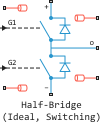
The thermal port H can also be divided into two separate thermal ports connected to the upper and lower switching devices by checking the box Separate thermal ports for upper and lower devices. If you separate the thermal ports for the upper and lower devices, you can also separate the thermal ports for the built-in diodes of each switching device by checking the box. Separate thermal ports for integral diodes. The upper and lower switching devices have the same thermal parameters.
This figure shows the block icon that is displayed when all thermal ports are opened.:
Dependencies of the main parameters
Visibility of parameters from the parameter group Main depends on the parameters Switching device and On-state behavior and losses.
| Parameters and values | |||||
|---|---|---|---|---|---|
Gate-control port |
|||||
Switching device |
|||||
|
|
|
|||
Threshold voltage, Vth |
Threshold voltage, Vth |
Gate trigger voltage, Vgt |
|||
Gate turn-off voltage, Vgt_off |
|||||
Holding current |
|||||
On-state behavior and losses |
On-state behavior and losses |
On-state behavior and losses |
|||
|
|
|
|
|
|
Drain-source on resistance, R_DS(on) |
On-state voltage, Vds(Tj,Ids) |
Forward voltage, Vf |
On-state voltage, Vce(Tj,Ice) |
Forward voltage, Vf |
On-state voltage, Vak(Tj,Iak) |
Temperature vector, Tj |
On-state resistance |
Temperature vector, Tj |
On-state resistance |
Temperature vector, Tj |
|
Drain-source current vector, Ids |
Collector-emitter current vector, Ice |
Anode-cathode current vector, Iak |
|||
Off-state conductance |
|||||
Limitations
-
If for the parameter Switching device the value is set
GTOThe block assumes that the current change in the load between PWM cycles is small. This assumption implies that the load inductance or switching frequency is large enough to smooth the current. -
If the check box is selected Apply switching losses to electrical supply, it is necessary to connect the power supply to the half bridge. For example, you need to uncheck the box Apply switching losses to electrical supply if your model has a switch that can disconnect one or both contacts of the power supply. There may also be problems with numerical initialization if the power supply is not initialized when it is switched on, for example, due to a smoothing capacitor that starts at zero charge.
Ports
Conserving
#
+
—
positive terminal
electricity
Details
A non-directional port connected to a positive terminal.
| Program usage name |
|
#
–
—
negative terminal
electricity
Details
A non-directional port connected to the negative terminal.
| Program usage name |
|
#
H1Diode
—
thermal port for the upper diode
warm
Details
A non-directional thermal port connected to the upper diode.
Dependencies
To use this port, check the boxes Separate thermal ports for upper and lower devices and Separate thermal ports for integral diodes.
| Program usage name |
|
#
H2Switch
—
thermal port for the lower switching device
warm
Details
A non-directional thermal port connected to the lower switching device.
Dependencies
To use this port, check the box Separate thermal ports for upper and lower devices.
| Program usage name |
|
#
G2
—
shutter output 2
electricity
Details
A non-directional port connected to the gate terminal for the second switching device.
Dependencies
To use this port, set the parameter Gate-control port meaning Electrical.
| Program usage name |
|
#
G1
—
shutter output 1
electricity
Details
A non-directional port connected to the gate terminal for the first switching device.
Dependencies
To use this port, set the parameter Gate-control port meaning Electrical.
| Program usage name |
|
#
H
—
thermal port
warm
Details
Non-directional heat port.
Dependencies
To use this port, uncheck the boxes Separate thermal ports for upper and lower devices and Separate thermal ports for integral diodes.
| Program usage name |
|
#
H2Diode
—
thermal port for the lower diode
warm
Details
A non-directional thermal port connected to the lower diode.
Dependencies
To use this port, check the boxes Separate thermal ports for upper and lower devices and Separate thermal ports for integral diodes.
| Program usage name |
|
#
i
—
the entrance node
electricity
Details
An undirected port connected to an input node.
To use this port, set the parameter Gate-control port meaning Electrical.
| Program usage name |
|
#
o
—
the output node
electricity
Details
An undirected port connected to an exit node.
| Program usage name |
|
#
H1Switch
—
thermal port for overhead switching device
warm
Details
A non-directional thermal port connected to an overhead switching device.
Dependencies
To use this port, check the box Separate thermal ports for upper and lower devices.
| Program usage name |
|
Input
#
G2
—
shutter output 2
scalar
Details
The input port connected to the gate terminal of the lower switching device.
If in the parameter group Integral Diode the flag is selected Integral protection diode, then this gate pin also controls the lower diode.
Dependencies
To use this port, set the parameter Gate-control port meaning Signal.
| Data types |
|
| Complex numbers support |
No |
#
G1
—
shutter output 1
scalar
Details
The input port connected to the gate terminal of the upper switching device.
If in the parameter group Integral Diode the flag is selected Integral protection diode, then this gate pin also controls the upper diode.
Dependencies
To use this port, set the parameter Gate-control port meaning Signal.
| Data types |
|
| Complex numbers support |
No |
Parameters
Thermal port
#
Diode thermal resistances, [R1, R2, ..., Rn] —
thermal resistances of the built-in diode
K/W
Details
Vector is a string of the values of the thermal resistance of the built-in protective diode, represented by the Kauer elements used in the thermal network.
If for the parameter Thermal network the value is set Cauer model parameterized with Foster coefficients, the default value is — [.03, .2].
Dependencies
To use this parameter,
-
in the parameter group Integral Diode check the box Integral protection diode;
-
in the parameter group Thermal port:
-
check the box Separate thermal ports for upper and lower devices;
-
check the box Separate thermal ports for integral diodes;
-
set for the parameter Thermal network meaning
Cauer model parameterized with Foster coefficients.
-
| Units |
|
| Default value |
|
| Program usage name |
|
| Evaluatable |
Yes |
#
Diode thermal time constants, [t1, t2, ..., tn] —
thermal time constants for the built-in diode
s | ns | us | ms | min | hr | d
Details
Vector is a string of the values of the thermal time constant for the built-in protective diode, where — the number of Kauer elements used in the heating network. The length of this vector must match the length of the parameter. Diode thermal resistances, [R1, R2, …, Rn]. With this parameterization, the heat capacities are calculated as , where , and — heat capacity, thermal time and thermal resistance for -the th element of the Kower (if for the parameter Thermal network the value is set Cauer model).
If for the parameter Thermal network the value is set Cauer model, the default value is — [.1, 1, 5].
Dependencies
To use this parameter,
-
in the parameter group Integral Diode check the box Integral protection diode;
-
in the parameter group Thermal port:
-
check the box Separate thermal ports for upper and lower devices;
-
check the box Separate thermal ports for integral diodes;
-
set for the parameter Thermal network meaning
Cauer model; -
set for the parameter Thermal mass parameterization meaning
By thermal time constants.
-
| Units |
|
| Default value |
|
| Program usage name |
|
| Evaluatable |
Yes |
#
Diode thermal time constants, [t1, t2, ..., tn] —
thermal time constants for the built-in diode
s | ns | us | ms | min | hr | d
Details
Vector is a string of the values of the thermal time constant for the built-in protective diode, where — the number of Kauer elements used in the heating network. The length of this vector must match the length of the parameter. Diode thermal resistances, [R1, R2, …, Rn]. With this parameterization, the heat capacities are calculated as , where , and — heat capacity, thermal time and thermal resistance for -th Foster element (if for the parameter Thermal network the value is set Cauer model parameterized with Foster coefficients).
If for the parameter Thermal network the value is set Cauer model parameterized with Foster coefficients, the default value is — [1, 10].
Dependencies
To use this parameter,
-
in the parameter group Integral Diode check the box Integral protection diode;
-
in the parameter group Thermal port:
-
check the box Separate thermal ports for upper and lower devices;
-
check the box Separate thermal ports for integral diodes;
-
set for the parameter Thermal network meaning
Cauer model parameterized with Foster coefficients; -
set for the parameter Thermal mass parameterization meaning
By thermal time constants.
-
| Units |
|
| Default value |
|
| Program usage name |
|
| Evaluatable |
Yes |
#
Diode thermal masses, [M1, M2, ..., Mn] —
heat capacity for the built-in diode
J/K | kJ/K
Details
Vector is a string of the values of the heat capacity for the built-in protective diode, where — the number of Kauer elements used in the heating network.
If for the parameter Thermal network the value is set Cauer model, the default value is — [3, 10, 25].
Dependencies
To use this parameter,
-
in the parameter group Integral Diode check the box Integral protection diode;
-
in the parameter group Thermal port:
-
check the box Separate thermal ports for upper and lower devices;
-
check the box Separate thermal ports for integral diodes;
-
set for the parameter Thermal network meaning
Cauer model; -
set for the parameter Thermal mass parameterization meaning
By thermal mass.
-
| Units |
|
| Default value |
|
| Program usage name |
|
| Evaluatable |
Yes |
#
Diode thermal resistances, [R1, R2, ..., Rn] —
thermal resistances of the built-in diode
K/W
Details
Vector is a string of the values of the thermal resistance of the built-in protective diode, represented by the Kauer elements used in the thermal network.
If for the parameter Thermal network the value is set Cauer model, the default value is — [.03, .1, .2].
Dependencies
To use this parameter,
-
in the parameter group Integral Diode check the box Integral protection diode;
-
in the parameter group Thermal port:
-
check the box Separate thermal ports for upper and lower devices;
-
check the box Separate thermal ports for integral diodes;
-
set for the parameter Thermal network meaning
Cauer model.
-
| Units |
|
| Default value |
|
| Program usage name |
|
| Evaluatable |
Yes |
#
Diode thermal masses, [M1, M2, ..., Mn] —
heat capacity for the built-in diode
J/K | kJ/K
Details
Vector is a string of the values of the heat capacity for the built-in protective diode, where — the number of Kauer elements used in the heating network.
If for the parameter Thermal network the value is set Cauer model parameterized with Foster coefficients, the default value is — [33, 50].
Dependencies
To use this parameter,
-
in the parameter group Integral Diode check the box Integral protection diode;
-
in the parameter group Thermal port:
-
check the box Separate thermal ports for upper and lower devices;
-
check the box Separate thermal ports for integral diodes;
-
set for the parameter Thermal network meaning
Cauer model parameterized with Foster coefficients; -
set for the parameter Thermal mass parameterization meaning
By thermal mass.
-
| Units |
|
| Default value |
|
| Program usage name |
|
| Evaluatable |
Yes |
#
Junction thermal mass —
transition heat capacity
J/K | kJ/K
Details
The heat capacity of the transition.
Dependencies
To use this parameter, set for the parameter Thermal network meaning External.
| Units |
|
| Default value |
|
| Program usage name |
|
| Evaluatable |
Yes |
#
Junction and case thermal masses, [M_J, M_C] —
the heat capacity of the transition and housing
J/K | kJ/K
Details
Vector string [M_J, M_C] two values of the heat capacity. The first value M_J — this is the heat capacity of the transition. The second value M_C — this is the heat capacity of the case.
Dependencies
To use this parameter, set for the parameter Thermal network meaning Specify juncion and case thermal parameters, and for the parameter Thermal mass parameterization meaning By thermal mass.
| Units |
|
| Default value |
|
| Program usage name |
|
| Evaluatable |
Yes |
#
Diode initial node temperatures, [T1, T2, ..., Tn] —
initial node temperatures for the built-in diode
K | degC | degF | degR | deltaK | deltadegC | deltadegF | deltadegR
Details
The vector is a string of absolute temperature values of each node, starting from the junction of the built-in protective diode.
Dependencies
To use this parameter,
-
in the parameter group Integral Diode check the box Integral protection diode;
-
in the parameter group Thermal port:
-
check the box Separate thermal ports for upper and lower devices;
-
check the box Separate thermal ports for integral diodes;
-
set for the parameter Thermal network meaning
Cauer model parameterized with Foster coefficients.
-
| Units |
|
| Default value |
|
| Program usage name |
|
| Evaluatable |
Yes |
#
Junction and case initial temperatures, [T_J, T_C] —
vector of initial temperatures
K | degC | degF | degR | deltaK | deltadegC | deltadegF | deltadegR
Details
Vector [T_J, T_C] of the two temperature values. The first value T_J — this is the initial temperature of the transition. The second value, T_C — this is the initial temperature of the case.
Dependencies
To use this parameter, set for the parameter Thermal network meaning Specify juncion and case thermal parameters.
| Units |
|
| Default value |
|
| Program usage name |
|
| Evaluatable |
Yes |
#
Thermal masses of diode junction and case, [M_J, M_C] —
the heat capacity of the junction and the housing of the built-in diode
J/K | kJ/K
Details
Vector string [M_J, M_C] two values of the heat capacity for the built-in protective diode. The first value M_J — this is the heat capacity of the transition. The second value M_C — this is the heat capacity of the case.
Dependencies
To use this parameter,
-
in the parameter group Integral Diode check the box Integral protection diode;
-
in the parameter group Thermal port:
-
check the box Separate thermal ports for upper and lower devices;
-
check the box Separate thermal ports for integral diodes;
-
set for the parameter Thermal network meaning
Specify juncion and case thermal parameters; -
set for the parameter Thermal mass parameterization meaning
By thermal mass.
-
| Units |
|
| Default value |
|
| Program usage name |
|
| Evaluatable |
Yes |
# Separate thermal ports for upper and lower devices — the ability to separate the thermal ports for the upper and lower devices
Details
The ability to separate the thermal ports for the upper and lower devices.
| Default value |
|
| Program usage name |
|
| Evaluatable |
No |
#
Thermal resistances, [R1, R2, ..., Rn] —
thermal resistances
K/W
Details
Vector is a string of the values of thermal resistance represented by the Kauer elements used in the heating network.
If for the parameter Thermal network the value is set Cauer model parameterized with Foster coefficients, the default value is — [.03, .2].
Dependencies
To use this parameter, set for the parameter Thermal network meaning Cauer model parameterized with Foster coefficients.
| Units |
|
| Default value |
|
| Program usage names |
|
| Evaluatable |
Yes |
#
Diode junction thermal mass —
the heat capacity of the built-in diode junction
J/K | kJ/K
Details
The heat capacity of the junction of the built-in diode.
Dependencies
To use this option, check the box Integral protection diode, and for the parameter Thermal network meaning External.
| Units |
|
| Default value |
|
| Program usage name |
|
| Evaluatable |
Yes |
#
Thermal masses, [M1, M2, ..., Mn] —
Heat capacity
J/K | kJ/K
Details
Vector is a string of values of heat capacities, where — the number of Kauer elements used in the heating network.
If for the parameter Thermal network the value is set Cauer model parameterized with Foster coefficients, the default value is — [33, 50].
Dependencies
To use this parameter, set for the parameter Thermal network meaning Cauer model parameterized with Foster coefficients, and for the parameter Thermal mass parameterization meaning By thermal mass.
| Units |
|
| Default value |
|
| Program usage names |
|
| Evaluatable |
Yes |
#
Thermal network —
options for modeling the thermal network
Specify junction and case thermal parameters | Cauer model | Cauer model parameterized with Foster coefficients | External
Details
Options for modeling the block’s thermal network.
| Values |
|
| Default value |
|
| Program usage name |
|
| Evaluatable |
No |
#
Thermal time constants of diode junction and case, [t_J, t_C] —
thermal transition time constants and enclosures for the built-in diode
s | ns | us | ms | min | hr | d
Details
Vector string [t_J, t_C] two values of the thermal time constant for the built-in protective diode. The first value t_J — this is the transition time constant. The second value t_C — this is the time constant of the corps.
Dependencies
To use this parameter,
-
in the parameter group Integral Diode check the box Integral protection diode;
-
in the parameter group Thermal port:
-
check the box Separate thermal ports for upper and lower devices;
-
check the box Separate thermal ports for integral diodes;
-
set for the parameter Thermal network meaning
Specify juncion and case thermal parameters; -
set for the parameter Thermal mass parameterization meaning
By thermal time constants.
-
| Units |
|
| Default value |
|
| Program usage name |
|
| Evaluatable |
Yes |
#
Diode junction-case and case-ambient (or case-heatsink) thermal resistances, [R_JC, R_CA] —
thermal resistances housing-junction and housing-environment (or housing-radiator) for the built-in diode
K/W
Details
Vector string [R_JC, R_CA] two values of thermal resistance, represented by two blocks Conductive Heat Transfer, for the built-in protective diode. The first value R_JC — this is the thermal resistance between the junction and the housing. The second value R_CA — this is the thermal resistance between the H port and the diode housing.
Dependencies
To use this parameter,
-
in the parameter group Integral Diode check the box Integral protection diode;
-
in the parameter group Thermal port:
-
check the box Separate thermal ports for upper and lower devices;
-
check the box Separate thermal ports for integral diodes;
-
set for the parameter Thermal network meaning
Specify juncion and case thermal parameters.
-
| Units |
|
| Default value |
|
| Program usage name |
|
| Evaluatable |
Yes |
#
Initial temperatures of diode thermal masses, [T1, T2, ..., Tn] —
initial temperatures of the diode heat capacities
K | degC | degF | degR | deltaK | deltadegC | deltadegF | deltadegR
Details
The vector is a string of temperature values for the built-in protective diode. This parameter corresponds to the temperature difference at each heat capacity in the model.
Dependencies
To use this parameter,
-
in the parameter group Integral Diode check the box Integral protection diode;
-
in the parameter group Thermal port:
-
check the box Separate thermal ports for upper and lower devices;
-
check the box Separate thermal ports for integral diodes;
-
set for the parameter Thermal network meaning
Cauer model.
-
| Units |
|
| Default value |
|
| Program usage name |
|
| Evaluatable |
Yes |
# Separate thermal ports for integral diodes — the ability to separate thermal ports for integrated diodes
Details
The ability to separate the thermal ports for the built-in diodes of the upper and lower devices.
Dependencies
To use this option, check the box Separate thermal ports for upper and lower devices and in the parameter group Integral Diode check the box Integral protection diode.
| Default value |
|
| Program usage name |
|
| Evaluatable |
No |
#
Initial node temperatures, [T1, T2, ..., Tn] —
initial node temperatures
K | degC | degF | degR | deltaK | deltadegC | deltadegF | deltadegR
Details
The vector is a string of absolute temperature values for each node, starting from the junction.
Dependencies
To use this parameter, set for the parameter Thermal network meaning Cauer model parameterized with Foster coefficients.
| Units |
|
| Default value |
|
| Program usage name |
|
| Evaluatable |
Yes |
#
Thermal time constants, [t1, t2, ..., tn] —
thermal time constants
s | ns | us | ms | min | hr | d
Details
Vector is a string of values of the thermal time constant, where — the number of Kauer elements used in the heating network. The length of this vector must match the length of the parameter. Thermal resistances, [R1, R2, …, Rn]. With this parameterization, the heat capacities are calculated as , where , and — heat capacity, thermal time and thermal resistance for -th Foster element (if for the parameter Thermal network the value is set Cauer model parameterized with Foster coefficients).
If for the parameter Thermal network the value is set Cauer model parameterized with Foster coefficients, the default value is — [1, 10].
Dependencies
To use this parameter, set for the parameter Thermal network meaning Cauer model parameterized with Foster coefficients, and for the parameter Thermal mass parameterization meaning By thermal time constants.
| Units |
|
| Default value |
|
| Program usage names |
|
| Evaluatable |
Yes |
#
Thermal mass parameterization —
possibility of parameterization of heat capacity
By thermal time constants | By thermal mass
Details
Options for parameterization of heat capacity:
-
By thermal time constants— parameterization of heat capacity through thermal time constants; -
By thermal mass— specifying the heat capacity values directly.
| Values |
|
| Default value |
|
| Program usage name |
|
| Evaluatable |
No |
#
Junction and case thermal time constants, [t_J, t_C] —
thermal constants of transition time and housing
s | ns | us | ms | min | hr | d
Details
Vector string [t_J, t_C] two values of the thermal time constant. The first value t_J — this is the transition time constant. The second value t_C — this is the time constant of the corps.
Dependencies
To use this parameter, set for the parameter Thermal network meaning Specify juncion and case thermal parameters, and for the parameter Thermal mass parameterization meaning By thermal time constants.
| Units |
|
| Default value |
|
| Program usage name |
|
| Evaluatable |
Yes |
#
Thermal masses initial temperatures, [T1, T2, ..., Tn] —
initial temperatures of heat capacities
K | degC | degF | degR | deltaK | deltadegC | deltadegF | deltadegR
Details
The vector is a string of temperature values corresponding to the temperature difference at each heat capacity in the model.
Dependencies
To use this parameter, set for the parameter Thermal network meaning Cauer model.
| Units |
|
| Default value |
|
| Program usage name |
|
| Evaluatable |
Yes |
#
Initial temperatures of diode junction and case, [T_J, T_C] —
initial temperatures of the diode junction and housing
K | degC | degF | degR | deltaK | deltadegC | deltadegF | deltadegR
Details
Vector string [T_J, T_C] two temperature values for the built-in protective diode. The first value T_J — this is the initial transition temperature. The second value T_C — this is the initial temperature of the case.
Dependencies
To use this parameter,
-
in the parameter group Integral Diode check the box Integral protection diode;
-
in the parameter group Thermal port:
-
check the box Separate thermal ports for upper and lower devices;
-
check the box Separate thermal ports for integral diodes;
-
set for the parameter Thermal network meaning
Specify juncion and case thermal parameters.
-
| Units |
|
| Default value |
|
| Program usage name |
|
| Evaluatable |
Yes |
#
Junction-case and case-ambient (or case-heatsink) thermal resistances, [R_JC, R_CA] —
thermal resistances housing-junction and housing-environment (or housing-radiator)
K/W
Details
Vector string [R_JC, R_CA] two values of thermal resistance, represented by two blocks Conductive Heat Transfer. The first value R_JC — this is the thermal resistance between the junction and the housing. The second value R_CA — this is the thermal resistance between the H port and the device body.
Dependencies
To use this parameter, set for the parameter Thermal network meaning Specify juncion and case thermal parameters.
| Units |
|
| Default value |
|
| Program usage name |
|
| Evaluatable |
Yes |
Integral Diode
#
Forward currents, If(Tj,Vf) —
direct currents
A | pA | nA | uA | mA | kA | MA
Details
Direct currents. This parameter must be a vector containing at least three non-negative elements in ascending order. The zero point is optional (If(Tj,Vf) = 0A).
Dependencies
To use this option, check the box Integral protection diode, for the parameter Diode model meaning Tabulated I-V curve and for the parameter Table type meaning Table in If(Tj,Vf) form.
| Units |
|
| Default value |
|
| Program usage name |
|
| Evaluatable |
Yes |
#
Forward voltages, Vf(Tj,If) —
direct voltages
V | uV | mV | kV | MV
Details
Direct voltages. This parameter must represent a vector containing at least three non-negative elements in ascending order. The zero point is optional (Vf(Tj,If) = 0V).
Dependencies
To use this option, check the box Integral protection diode, for the parameter Diode model meaning Tabulated I-V curve and for the parameter Table type meaning Table in Vf(Tj,If) form.
| Units |
|
| Default value |
|
| Program usage name |
|
| Evaluatable |
Yes |
#
Off conductance —
conductivity at shutdown
S | nS | uS | mS | 1/Ohm
Details
The conductivity of the diode is reversed.
Dependencies
To use this option, check the box Integral protection diode and
-
for the parameter Diode model meaning
Piecewise linear, or -
for the parameter Diode model meaning
Tabulated I-V curve, and for the parameter Reverse I-V characteristics type meaningSpecify off conductance.
| Units |
|
| Default value |
|
| Program usage name |
|
| Evaluatable |
Yes |
#
Reverse currents, Ir —
vector of reverse currents
A | pA | nA | uA | mA | kA | MA
Details
Vector of reverse currents. This parameter must be a vector containing at least three non-negative elements in ascending order. The zero point is optional (Ir = 0A).
Dependencies
To use this parameter, set
-
the flag Integral protection diode;
-
for the parameter Diode model meaning
Tabulated I-V curve; -
for the parameter Table type meaning
Table in Vf(Tj,If) form; -
for the parameter Reverse I-V characteristics type meaning
Tabulate.
| Units |
|
| Default value |
|
| Program usage name |
|
| Evaluatable |
Yes |
#
Reverse voltages, Vr —
vector of reverse stresses
V | uV | mV | kV | MV
Details
The vector of reverse stresses. This parameter must be a vector containing at least three non-negative elements in ascending order. The zero point is optional (Vr = 0V).
Dependencies
To use this parameter, set
-
the flag Integral protection diode;
-
for the parameter Diode model meaning
Tabulated I-V curve; -
for the parameter Table type meaning
Table in If(Tj,Vf) form; -
for the parameter Reverse I-V characteristics type meaning
Tabulate.
| Units |
|
| Default value |
|
| Program usage name |
|
| Evaluatable |
Yes |
#
Table type —
tabular function
Table in If(Tj,Vf) form | Table in Vf(Tj,If) form
Details
A table of current as a function of temperature and voltage, or voltage as a function of temperature and current.
Dependencies
To use this option, check the box Integral protection diode, and for the parameter Diode model meaning Tabulated I-V curve.
| Values |
|
| Default value |
|
| Program usage name |
|
| Evaluatable |
No |
#
Forward voltage —
forward voltage
V | uV | mV | kV | MV
Details
The minimum voltage required at the ports of the block + and − so that the gradient of the volt-ampere characteristic of the diode is equal to , where — parameter value On resistance.
Dependencies
To use this option, check the box Integral protection diode, and for the parameter Diode model meaning Piecewise linear.
| Units |
|
| Default value |
|
| Program usage name |
|
| Evaluatable |
Yes |
#
Reverse I-V characteristics type —
type of reverse volt-ampere characteristic
Specify off conductance | Tabulate
Details
The reverse volt-ampere characteristic (VAC) can be set using the conductivity of the diode in the off state, or by calculating the current depending on temperature and voltage, or voltage depending on temperature and current.
Dependencies
To use this option, check the box Integral protection diode, and for the parameter Diode model meaning Tabulated I-V curve.
| Values |
|
| Default value |
|
| Program usage name |
|
| Evaluatable |
No |
#
Forward voltages, Vf —
direct voltages
V | uV | mV | kV | MV
Details
The vector of direct stresses. This parameter must be a vector containing at least three non-negative elements in ascending order. The zero point is optional (Vf = 0V).
Dependencies
To use this option, check the box Integral protection diode, for the parameter Diode model meaning Tabulated I-V curve and for the parameter Table type meaning Table in If(Tj,Vf) form.
| Units |
|
| Default value |
|
| Program usage name |
|
| Evaluatable |
Yes |
#
Forward currents, If —
direct currents
A | pA | nA | uA | mA | kA | MA
Details
Vector of direct currents. This parameter must be a vector containing at least three non-negative elements in ascending order. The zero point is optional (If = 0A).
Dependencies
To use this option, check the box Integral protection diode, for the parameter Diode model meaning Tabulated I-V curve and for the parameter Table type meaning Table in Vf(Tj,If) form.
| Units |
|
| Default value |
|
| Program usage name |
|
| Evaluatable |
Yes |
#
Junction temperatures, Tj —
transition temperatures
K | degC | degF | degR | deltaK | deltadegC | deltadegF | deltadegR
Details
Vector of transition temperatures. This parameter must be a vector containing at least two elements.
Dependencies
To use this option, check the box Integral protection diode, and for the parameter Diode model meaning Tabulated I-V curve.
| Units |
|
| Default value |
|
| Program usage name |
|
| Evaluatable |
Yes |
#
Reverse voltages, Vr(Tj,Ir) —
vector of reverse stresses
V | uV | mV | kV | MV
Details
Reverse voltages. This parameter must be a vector containing at least three non-negative elements in ascending order. The zero point is optional (Vr(Tj,Ir) = 0V).
Dependencies
To use this parameter, set
-
the flag Integral protection diode;
-
for the parameter Diode model meaning
Tabulated I-V curve; -
for the parameter Table type meaning
Table in Vf(Tj,If) form; -
for the parameter Reverse I-V characteristics type meaning
Tabulate.
| Units |
|
| Default value |
|
| Program usage name |
|
| Evaluatable |
Yes |
# Integral protection diode — protective diode
Details
The ability to simulate the built-in protective diode of the unit.
| Default value |
|
| Program usage name |
|
| Evaluatable |
No |
#
Reverse currents, Ir(Tj,Vr) —
vector of reverse currents
A | pA | nA | uA | mA | kA | MA
Details
Reverse currents. This parameter must be a vector containing at least three non-negative elements in ascending order. The zero point is optional (Ir(Tj,Vr) = 0A).
Dependencies
To use this parameter, set
-
the flag Integral protection diode;
-
for the parameter Diode model meaning
Tabulated I-V curve; -
for the parameter Table type meaning
Table in If(Tj,Vf) form; -
for the parameter Reverse I-V characteristics type meaning
Tabulate.
| Units |
|
| Default value |
|
| Program usage name |
|
| Evaluatable |
Yes |
#
Diode model —
the diode model
Piecewise linear | Tabulated I-V curve
Details
-
Piecewise linear— simulation of a diode with a piecewise linear VAC, as described in the section A diode with a piecewise linear VAC. -
Tabulated I-V curve— simulation of a diode with tabulated values - with forward bias and fixed conductivity when switched off with reverse bias, as described in Diode with tabulated VAC.
Dependencies
To use this option, check the box Integral protection diode.
| Values |
|
| Default value |
|
| Program usage name |
|
| Evaluatable |
No |
#
On resistance —
resistance when switching on
Ohm | mOhm | kOhm | MOhm | GOhm
Details
The rate of voltage change depending on the current is higher than the value of the parameter Forward voltage.
Dependencies
To use this option, check the box Integral protection diode, and for the parameter Diode model meaning Piecewise linear.
| Units |
|
| Default value |
|
| Program usage name |
|
| Evaluatable |
Yes |
Losses
#
Diode reverse recovery loss, Erec(Tj,Ids) —
losses during reverse diode recovery
J | mJ | kJ | MJ | mW*hr | W*hr | kW*hr | MW*hr | eV | cal | kcal | Btu_IT
Details
The energy dissipated during reverse diode recovery as a function of temperature and the final drain-source current in the switched state.
Dependencies
To use this parameter,
-
set for the parameter Switching device meaning
MOSFET; -
set for the parameter On-state behavior and losses meaning
Tabulate; -
check the box Integral protection diode.
| Units |
|
| Default value |
|
| Program usage name |
|
| Evaluatable |
Yes |
#
Temperature vector for losses, Tj —
temperature for losses
K | degC | degF | degR | deltaK | deltadegC | deltadegF | deltadegR
Details
The temperature values at which losses are indicated.
Dependencies
To use this parameter, set for the parameter On-state behavior and losses meaning Tabulate.
| Units |
|
| Default value |
|
| Program usage names |
|
| Evaluatable |
Yes |
#
Switch-on loss —
switching losses
J | mJ | kJ | MJ | mW*hr | W*hr | kW*hr | MW*hr | eV | cal | kcal | Btu_IT
Details
The energy dissipated by a single power-on.
Dependencies
To use this parameter, set for the parameter On-state behavior and losses meaning Specify constant values.
| Units |
|
| Default value |
|
| Program usage names |
|
| Evaluatable |
Yes |
#
Switch-on loss, Eon(Tj,Iak) —
switching losses
J | mJ | kJ | MJ | mW*hr | W*hr | kW*hr | MW*hr | eV | cal | kcal | Btu_IT
Details
The energy dissipated during a single switch-on as a function of temperature and the final anode-cathode current in the switched-on state.
Dependencies
To use this parameter, set for the parameter Switching device meaning GTO, and for the parameter On-state behavior and losses meaning Tabulate.
| Units |
|
| Default value |
|
| Program usage name |
|
| Evaluatable |
Yes |
# Include switching loss tabulation with off-state Vds voltage — the ability to create a table of switching losses depending on the voltage of the Vds in the off state
Details
The ability to create a table of switching losses depending on the drain-source voltage in the off state.
Uncheck the box to create a table of power-on and power-off losses depending on the drain-source current when switched on. The block assumes that the losses depend linearly on the drain-source voltage in the off state.
Check the box to create a table of power-on and power-off losses depending on temperature, drain-source current in the on state, and drain-source voltage in the off state.
Dependencies
To use this parameter, set for the parameter Switching device meaning MOSFET, and for the parameter On-state behavior and losses meaning Tabulate.
| Default value |
|
| Program usage name |
|
| Evaluatable |
No |
#
On-state current for loss data —
Output current
A | pA | nA | uA | mA | kA | MA
Details
The output current at which power-on losses, power-off losses, and on-state voltage are indicated.
Dependencies
To use this parameter, set for the parameter On-state behavior and losses meaning Specify constant values.
| Units |
|
| Default value |
|
| Program usage names |
|
| Evaluatable |
Yes |
# Include switching loss tabulation with off-state voltage — the ability to create a table of switching losses depending on the voltage in the off state
Details
The ability to create a table of switching losses depending on the voltage in the off state.
Uncheck the box to create a table of power-on and power-off losses depending on the collector-emitter current in the switched state and temperature. The block assumes that the losses depend linearly on the voltage in the off state.
Check the box to create a table of power-on and power-off losses depending on temperature, collector-emitter current in the on state, and voltage in the off state.
Dependencies
To use this parameter, set for the parameter Switching device meaning IGBT, and for the parameter On-state behavior and losses meaning Tabulate.
| Default value |
|
| Program usage name |
|
| Evaluatable |
No |
#
Off-state voltage for loss data —
voltage in the off state
V | uV | mV | kV | MV
Details
The output voltage is switched off. The loss data determines the locking voltage at this value.
Dependencies
To use this option, select one of the following options:
-
set for the parameter Switching device meaning
MOSFET, for the parameter On-state behavior and losses meaningTabulateand uncheck the box Include switching loss tabulation with off-state Vds voltage; -
set for the parameter Switching device meaning
IGBT, for the parameter On-state behavior and losses meaningTabulateand uncheck the box Include switching loss tabulation with off-state voltage parameter; -
set for the parameter Switching device meaning
GTO; -
set for the parameter On-state behavior and losses meaning
Specify constant values.
| Units |
|
| Default value |
|
| Program usage name |
|
| Evaluatable |
Yes |
#
Diode reverse recovery loss, Erec(Tj,Ice) —
losses during reverse diode recovery
J | mJ | kJ | MJ | mW*hr | W*hr | kW*hr | MW*hr | eV | cal | kcal | Btu_IT
Details
The energy dissipated during the reverse recovery of the diode as a function of temperature and the final collector-emitter current in the switched state.
Dependencies
To use this parameter,
-
set for the parameter Switching device meaning
IGBT; -
set for the parameter On-state behavior and losses meaning
Tabulate; -
check the box Integral protection diode.
| Units |
|
| Default value |
|
| Program usage name |
|
| Evaluatable |
Yes |
# Apply switching losses to electrical supply — the possibility of applying losses when switching to a power source
Details
The possibility of applying losses when switching to a power source.
Uncheck the box to apply switching losses only to the heat node.
Select the checkbox to apply switching losses to the heating unit and to the power supply.
| Default value |
|
| Program usage name |
|
| Evaluatable |
No |
#
Collector-emitter current vector for losses, Ice —
collector-emitter current for losses
A | pA | nA | uA | mA | kA | MA
Details
Collector-emitter currents, at which losses are indicated. The sign of the collector-emitter current must match the sign of the corresponding collector-emitter voltage. If the collector-emitter voltage is zero, the corresponding collector-emitter current must also be zero.
Dependencies
To use this parameter, set for the parameter Switching device meaning IGBT, and for the parameter On-state behavior and losses meaning Tabulate.
| Units |
|
| Default value |
|
| Program usage name |
|
| Evaluatable |
Yes |
#
Switch-off loss —
shutdown losses
J | mJ | kJ | MJ | mW*hr | W*hr | kW*hr | MW*hr | eV | cal | kcal | Btu_IT
Details
The energy dissipated by a single shutdown.
Dependencies
To use this parameter, set for the parameter Switching device meaning MOSFET or IGBT, and for the parameter On-state behavior and losses meaning Specify constant values.
| Units |
|
| Default value |
|
| Program usage names |
|
| Evaluatable |
Yes |
#
Switch-off loss, Eoff(Tj,Ids,Vce) —
shutdown losses
J | mJ | kJ | MJ | mW*hr | W*hr | kW*hr | MW*hr | eV | cal | kcal | Btu_IT
Details
The energy dissipated during a single shutdown as a function of temperature, the final drain-source current in the on state, and the collector-emitter voltage in the off state.
Dependencies
To use this parameter,
-
set for the parameter Switching device meaning
IGBT; -
set for the parameter On-state behavior and losses meaning
Tabulate; -
check the box Include switching loss tabulation with off-state voltage.
| Units |
|
| Default value |
|
| Program usage name |
|
| Evaluatable |
Yes |
#
Off-state Vds voltage vector for switching losses —
off-state voltage vector for switching loss data
V | uV | mV | kV | MV
Details
Drain-source voltages in the off state, which indicate losses when switching on and off.
Dependencies
To use this parameter,
-
set for the parameter Switching device meaning
MOSFET; -
set for the parameter On-state behavior and losses meaning
Tabulate; -
check the box Include switching loss tabulation with off-state voltage.
| Units |
|
| Default value |
|
| Program usage name |
|
| Evaluatable |
Yes |
#
Switch-off loss, Eoff(Tj,Iak) —
shutdown losses
J | mJ | kJ | MJ | mW*hr | W*hr | kW*hr | MW*hr | eV | cal | kcal | Btu_IT
Details
The energy dissipated during a single shutdown as a function of temperature and the final anode-cathode current when switched on.
Dependencies
To use this parameter, set for the parameter Switching device meaning GTO, and for the parameter On-state behavior and losses meaning Tabulate.
| Units |
|
| Default value |
|
| Program usage name |
|
| Evaluatable |
Yes |
#
Natural commutation rectification loss —
natural losses of switching rectification
J | mJ | kJ | MJ | mW*hr | W*hr | kW*hr | MW*hr | eV | cal | kcal | Btu_IT
Details
Rectification losses that the unit applies when the device is turned off due to a current drop below the parameter value Holding current.
Dependencies
To use this parameter, set for the parameter Switching device meaning GTO.
| Units |
|
| Default value |
|
| Program usage name |
|
| Evaluatable |
Yes |
#
Averaging period for switching losses —
the period of averaging switching losses
s | ns | us | ms | min | hr | d
Details
The duration during which the unit applies losses when switching to the power supply.
Dependencies
To use this option, check the box Apply switching losses to electrical supply.
| Units |
|
| Default value |
|
| Program usage name |
|
| Evaluatable |
Yes |
#
Drain-source current vector for losses, Ids —
drain-source current for switching losses
A | pA | nA | uA | mA | kA | MA
Details
Drain-source currents, at which losses are indicated. The sign of the drain-source current must match the sign of the corresponding drain-source voltage. If the drain-source voltage is zero, the corresponding drain-source current must also be zero.
Dependencies
To use this parameter, set for the parameter Switching device meaning MOSFET, and for the parameter On-state behavior and losses meaning Tabulate.
| Units |
|
| Default value |
|
| Program usage name |
|
| Evaluatable |
Yes |
#
Switch-on loss, Eon(Tj,Ids) —
switching losses
J | mJ | kJ | MJ | mW*hr | W*hr | kW*hr | MW*hr | eV | cal | kcal | Btu_IT
Details
The energy dissipated during a single switch-on as a function of temperature and the final drain-source current in the switched-on state.
Dependencies
To use this parameter,
-
set for the parameter Switching device meaning
MOSFET; -
set for the parameter On-state behavior and losses meaning
Tabulate; -
uncheck the box Include switching loss tabulation with off-state Vds voltage.
| Units |
|
| Default value |
|
| Program usage name |
|
| Evaluatable |
Yes |
#
Anode-cathode current vector for losses, Iak —
anode-cathode current for losses
A | pA | nA | uA | mA | kA | MA
Details
Anode-cathode currents, at which losses are indicated. The sign of the anode-cathode current must match the sign of the corresponding anode-cathode voltage. If the anode-cathode voltage is zero, the corresponding anode-cathode current must also be zero.
Dependencies
To use this parameter, set for the parameter Switching device meaning GTO, and for the parameter On-state behavior and losses meaning Tabulate.
| Units |
|
| Default value |
|
| Program usage name |
|
| Evaluatable |
Yes |
#
Forced commutation switch-off loss —
losses due to forced disconnection of switching
J | mJ | kJ | MJ | mW*hr | W*hr | kW*hr | MW*hr | eV | cal | kcal | Btu_IT
Details
The energy dissipated when switching is forced off.
Dependencies
To use this parameter, set for the parameter Switching device meaning GTO, and for the parameter On-state behavior and losses meaning Specify constant values.
| Units |
|
| Default value |
|
| Program usage name |
|
| Evaluatable |
Yes |
#
Diode reverse recovery loss, Erec(Tj,Iak) —
losses during reverse diode recovery
J | mJ | kJ | MJ | mW*hr | W*hr | kW*hr | MW*hr | eV | cal | kcal | Btu_IT
Details
The energy dissipated during diode reverse reduction as a function of temperature and the final anode-cathode current in the switched state.
Dependencies
To use this parameter,
-
set for the parameter Switching device meaning
GTO; -
set for the parameter On-state behavior and losses meaning
Tabulate; -
check the box Integral protection diode.
| Units |
|
| Default value |
|
| Program usage name |
|
| Evaluatable |
Yes |
#
Switch-off loss, Eoff(Tj,Ice) —
shutdown losses
J | mJ | kJ | MJ | mW*hr | W*hr | kW*hr | MW*hr | eV | cal | kcal | Btu_IT
Details
The energy dissipated during a single shutdown as a function of temperature and the final collector-emitter current when switched on.
Dependencies
To use this parameter,
-
set for the parameter Switching device meaning
IGBT; -
set for the parameter On-state behavior and losses meaning
Tabulate; -
uncheck the box Include switching loss tabulation with off-state voltage.
| Units |
|
| Default value |
|
| Program usage name |
|
| Evaluatable |
Yes |
#
Diode reverse recovery loss —
losses during reverse diode recovery
J | mJ | kJ | MJ | mW*hr | W*hr | kW*hr | MW*hr | eV | cal | kcal | Btu_IT
Details
The energy dissipated during the reverse reduction of the diode.
Dependencies
To use this parameter, set for the parameter On-state behavior and losses meaning Specify constant values and check the box Integral protection diode.
| Units |
|
| Default value |
|
| Program usage names |
|
| Evaluatable |
Yes |
#
Switch-off loss, Eoff(Tj,Ids,Vds) —
loss on shutdown
J | mJ | kJ | MJ | mW*hr | W*hr | kW*hr | MW*hr | eV | cal | kcal | Btu_IT
Details
The energy dissipated during a single shutdown as a function of temperature, drain-source current in the on state, and drain-source voltage in the off state.
Dependencies
To use this parameter,
-
set for the parameter Switching device meaning
MOSFET; -
set for the parameter On-state behavior and losses meaning
Tabulate; -
check the box Include switching loss tabulation with off-state Vds voltage.
| Units |
|
| Default value |
|
| Program usage name |
|
| Evaluatable |
Yes |
#
Switch-on loss, Eon(Tj,Ids,Vds) —
switching losses
J | mJ | kJ | MJ | mW*hr | W*hr | kW*hr | MW*hr | eV | cal | kcal | Btu_IT
Details
The energy dissipated during a single power-on is a function of temperature, the drain-source current in the on state, and the drain-source voltage in the off state.
Dependencies
To use this parameter,
-
set for the parameter Switching device meaning
MOSFET; -
set for the parameter On-state behavior and losses meaning
Tabulate; -
check the box Include switching loss tabulation with off-state Vds voltage.
| Units |
|
| Default value |
|
| Program usage name |
|
| Evaluatable |
Yes |
#
Off-state voltage vector for switching losses, Vce —
off-state voltage vector for switching loss data
V | uV | mV | kV | MV
Details
Collector-emitter voltages in the off state, which indicate losses when switching on and off.
Dependencies
To use this parameter,
-
set for the parameter Switching device meaning
IGBT; -
set for the parameter On-state behavior and losses meaning
Tabulate; -
check the box Include switching loss tabulation with off-state voltage.
| Units |
|
| Default value |
|
| Program usage name |
|
| Evaluatable |
Yes |
#
Switch-on loss, Eon(Tj,Ice) —
switching losses
J | mJ | kJ | MJ | mW*hr | W*hr | kW*hr | MW*hr | eV | cal | kcal | Btu_IT
Details
The energy dissipated during a single switch-on as a function of temperature and the final collector-emitter current in the switched-on state.
Dependencies
To use this parameter,
-
set for the parameter Switching device meaning
IGBT; -
set for the parameter On-state behavior and losses meaning
Tabulate; -
uncheck the box Include switching loss tabulation with off-state voltage.
| Units |
|
| Default value |
|
| Program usage name |
|
| Evaluatable |
Yes |
#
Switch-off loss, Eoff(Tj,Ids) —
shutdown losses
J | mJ | kJ | MJ | mW*hr | W*hr | kW*hr | MW*hr | eV | cal | kcal | Btu_IT
Details
The energy dissipated during a single shutdown as a function of temperature and the final drain-source current when switched on.
Dependencies
To use this parameter,
-
set for the parameter Switching device meaning
MOSFET; -
set for the parameter On-state behavior and losses meaning
Tabulate; -
uncheck the box Include switching loss tabulation with off-state Vds voltage.
| Units |
|
| Default value |
|
| Program usage name |
|
| Evaluatable |
Yes |
#
Switch-on loss, Eon(Tj,Ids,Vce) —
switching losses
J | mJ | kJ | MJ | mW*hr | W*hr | kW*hr | MW*hr | eV | cal | kcal | Btu_IT
Details
The energy dissipated during a single power-on is a function of temperature, the final drain-source current in the on state, and the collector-emitter voltage in the off state.
Dependencies
To use this parameter,
-
set for the parameter Switching device meaning
IGBT; -
set for the parameter On-state behavior and losses meaning
Tabulate; -
check the box Include switching loss tabulation with off-state voltage.
| Units |
|
| Default value |
|
| Program usage name |
|
| Evaluatable |
Yes |
Main
#
Forward voltage, Vf —
forward voltage
V | uV | mV | kV | MV
Details
The minimum voltage required at the anode and cathode so that the voltage-ampere characteristic gradient of the diode is equal to , where — parameter value On-state resistance.
Dependencies
See the table in the Dependencies of the main parameters section.
| Units |
|
| Default value |
|
| Program usage names |
|
| Evaluatable |
Yes |
#
Anode-cathode current vector, Iak —
current vector anode-cathode
A | pA | nA | uA | mA | kA | MA
Details
Anode-cathode currents, at which the voltage is indicated in the switched state. The sign of the anode-cathode current must match the sign of the corresponding anode-cathode voltage. If the anode-cathode voltage is zero, the corresponding anode-cathode current must also be zero.
Dependencies
See the table in the Dependencies of the main parameters section.
| Units |
|
| Default value |
|
| Program usage name |
|
| Evaluatable |
Yes |
#
On-state behavior and losses —
switched-on behavior and losses
Specify constant values | Tabulate
Details
A method for parameterizing the on-state behavior and switching losses, specified by one of the following values:
-
Specify constant values— Use scalar values to determine the output current, power-on and power-off losses. The block assumes that the energy dissipated by switching on or off once depends linearly on the voltage in the off state and the current in the on state. The block also assumes that losses are independent of temperature. -
Tabulate— Use vectors to determine the output current and temperature. Use arrays to set losses when switching on and off.
Dependencies
See the table in the Dependencies of the main parameters section.
| Values |
|
| Default value |
|
| Program usage names |
|
| Evaluatable |
No |
#
Temperature vector, Tj —
temperature values
K | degC | degF | degR | deltaK | deltadegC | deltadegF | deltadegR
Details
The temperature values at which the switched-on voltage is indicated.
Dependencies
See the table in the Dependencies of the main parameters section.
| Units |
|
| Default value |
|
| Program usage names |
|
| Evaluatable |
Yes |
#
Gate trigger voltage, Vgt —
shutter release voltage
V | uV | mV | kV | MV
Details
The gate-cathode threshold voltage. The device turns on when the gate-cathode voltage exceeds this value.
_ Dependencies_
See the table in the Dependencies of the main parameters section.
| Units |
|
| Default value |
|
| Program usage name |
|
| Evaluatable |
Yes |
#
Drain-source on resistance, R_DS(on) —
drain-source resistance
Ohm | mOhm | kOhm | MOhm | GOhm
Details
Drain-source resistance when the device is switched on.
Dependencies
See the table in the Dependencies of the main parameters section.
| Units |
|
| Default value |
|
| Program usage name |
|
| Evaluatable |
Yes |
#
Gate-control port —
option to specify the type of shutter port
Signal | Electrical
Details
Option to specify the shutter control port:
-
Signal— The unit uses directional input ports G1 and G2 to control the shutter; -
Electrical— The unit uses non-directional electrical ports G1 and G2 to control the gate.
| Values |
|
| Default value |
|
| Program usage name |
|
| Evaluatable |
No |
#
Threshold voltage, Vth —
Threshold voltage
V | uV | mV | kV | MV
Details
The threshold voltage at which the device turns on. The default value depends on the parameter value Switching device.
Dependencies
See the table in the Dependencies of the main parameters section.
| Units |
|
| Default value |
|
| Program usage names |
|
| Evaluatable |
Yes |
#
On-state voltage, Vce(Tj,Ice) —
voltage in the switched state
V | uV | mV | kV | MV
Details
Voltage drop across the device when switched on. This parameter depends on the temperature and the final output current when switched on.
Dependencies
See the table in the Dependencies of the main parameters section.
| Units |
|
| Default value |
|
| Program usage name |
|
| Evaluatable |
Yes |
#
On-state resistance —
collector-emitter resistance in the switched state
Ohm | mOhm | kOhm | MOhm | GOhm
Details
Collector-emitter resistance when the device is switched on.
Dependencies
See the table in the Dependencies of the main parameters section.
| Units |
|
| Default value |
|
| Program usage names |
|
| Evaluatable |
Yes |
#
Gate turn-off voltage, Vgt_off —
shutter release voltage
V | uV | mV | kV | MV
Details
The gate-cathode threshold voltage. The device turns off when the gate-cathode voltage falls below this value.
Dependencies
See the table in the Dependencies of the main parameters section.
| Units |
|
| Default value |
|
| Program usage name |
|
| Evaluatable |
Yes |
#
Holding current —
current threshold value
A | pA | nA | uA | mA | kA | MA
Details
The current threshold value. The device remains switched on when the current exceeds this value, even if the gate-cathode voltage drops below the gate release voltage.
Dependencies
See the table in the Dependencies of the main parameters section.
| Units |
|
| Default value |
|
| Program usage name |
|
| Evaluatable |
Yes |
#
On-state voltage, Vds(Tj,Ids) —
voltage in the switched state
V | uV | mV | kV | MV
Details
Voltage drop across the device when switched on. This parameter depends on the temperature and the final output current when switched on.
Dependencies
See the table in the Dependencies of the main parameters section.
| Units |
|
| Default value |
|
| Program usage name |
|
| Evaluatable |
Yes |
#
Switching device —
switch type
MOSFET | IGBT | GTO
Details
The type of switching device for a half-bridge.
| Values |
|
| Default value |
|
| Program usage name |
|
| Evaluatable |
No |
#
On-state voltage, Vak(Tj,Iak) —
voltage in the switched state
V | uV | mV | kV | MV
Details
Voltage drop across the device when switched on. This parameter depends on the temperature and the final output current when switched on.
Dependencies
See the table in the Dependencies of the main parameters section.
| Units |
|
| Default value |
|
| Program usage name |
|
| Evaluatable |
Yes |
#
Off-state conductance —
collector-emitter conductivity in the off state
S | nS | uS | mS | 1/Ohm
Details
Conduction when the device is turned off. The value should be less than , where — parameter value On-state resistance.
Dependencies
See the table in the Dependencies of the main parameters section.
| Units |
|
| Default value |
|
| Program usage name |
|
| Evaluatable |
Yes |
#
Collector-emitter current vector, Ice —
collector-emitter current vector
A | pA | nA | uA | mA | kA | MA
Details
Collector-emitter currents, which indicate the voltage in the switched state. The sign of the collector-emitter current must match the sign of the corresponding collector-emitter voltage. If the collector-emitter voltage is zero, the corresponding collector-emitter current must also be zero.
_ Dependencies_
See the table in the Dependencies of the main parameters section.
| Units |
|
| Default value |
|
| Program usage name |
|
| Evaluatable |
Yes |
#
Drain-source current vector, Ids —
drain-source current vector
A | pA | nA | uA | mA | kA | MA
Details
Drain-source currents, which indicate the voltage in the switched-on state. The sign of the drain-source current must match the sign of the corresponding drain-source voltage. If the drain-source voltage is zero, the corresponding drain-source current must also be zero.
Dependencies
See the table in the Dependencies of the main parameters section.
| Units |
|
| Default value |
|
| Program usage name |
|
| Evaluatable |
Yes |